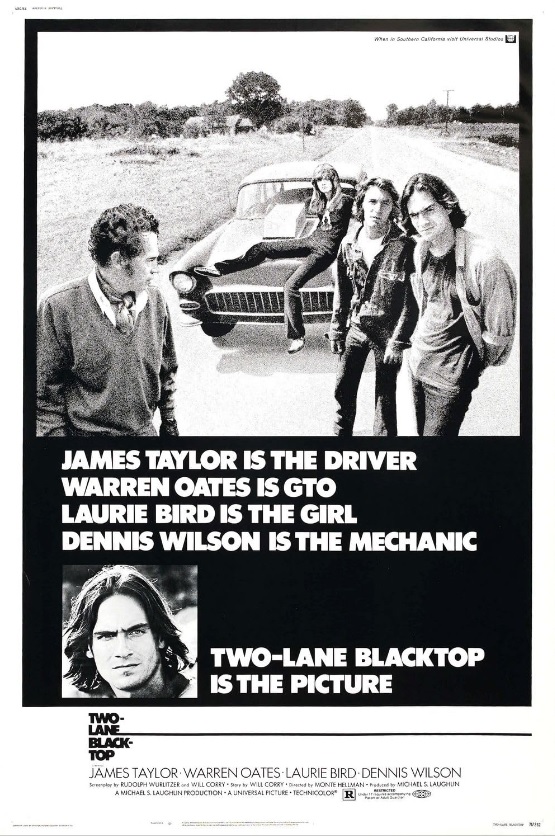
Two-Lane Blacktop

Director: Monte Hellman
Written by: Rudolph Wurlitzer, Will Corry
Cast: James Taylor, Dennis Wilson, Laurie Bird, Warren Oates

Year / Country: 1971, USA
Running Time: 98 mins.

After winning a late-night drag race, the driver (James Taylor) and his friend, the mechanic (Dennis Wilson), leave Los Angeles in their gray ’55 Chevrolet. They embark on an aimless road trip, stopping only for food, gas, and the occasional driving challenge. Along the way, they pick up a free-spirited hitchhiker (Laurie Bird) and continue their journey eastward. Their path repeatedly crosses with a 1970 Pontiac GTO, driven by a boastful older man (Warren Oates), leading to a high-stakes cross-country race to Washington, D.C. for ownership of their cars.

This is not a summary of the story, but it’s the whole story. The film unfolds as a meditation on existentialism, where racing becomes a metaphor for life itself. The characters drive not toward any clear destination but toward an uncertain fate, embodying the restless, aimless energy of drifters. Tellingly, none of the main characters even have names, emphasizing their roles as archetypes of the disillusioned wanderer.

Watching this film feels like stepping into a time capsule. Much like American Graffiti, it captures the spirit of a bygone era – an America of the early 1970s, defined by hippies, muscle cars, and rock ‘n’ roll. The minimalist storytelling is complemented by striking cinematography, making the open road a central character in its own right.

Two-Lane Blacktop is more than a movie; it’s a raw, unvarnished piece of Americana. A snapshot of a world long past, it stands as a beautiful, haunting testament to a fleeting time and place in American culture.

Rating:

Biography: Monte Hellman (1932, New York) studied drama at Stanford University and film at UCLA. He joined legendary producer Roger Corman and made his film debut with Beast From Haunted Cave, an enjoyable 50’s creature flick. Hellman teamed up with Jack Nicholson and together they made two low-budget flicks in the Philippines, one written by Nicholson. They continued the co-op and made two more films together, this time Westerns. Once again Nicholson wrote the screenplay for one of them (Ride in the Whirlwind). Hellman then made Two-Lane Blacktop, which did well with critics, but bad at the box-office. After making a couple more cult movies, Hellman mostly worked as second-unit director, editor and executive producer for acclaimed directors such as Samuel Fuller, Paul Verhoeven and Quentin Tarantino. His latest directing effort was a segment of the horror anthology Trapped Ashes.

Filmography: Beast from Haunted Cave (1959), Flight to Fury (1964), Back Door to Hell (1964), Ride in the Whirlwind (1965), The Shooting (1967), Two-Lane Blacktop (1971), Cockfighter (1974), Baretta (1975, TV), The Greatest (1977), China 9, Liberty 37 (1978), Inside the Coppola Personality (1981), Iguana (1988), Silent Night, Deadly Night III: Better Watch Out! (1989), Stanley’s Girlfriend (2006, short), Trapped Ashes (2006, segment ‘Stanley’s Girlfriend’)
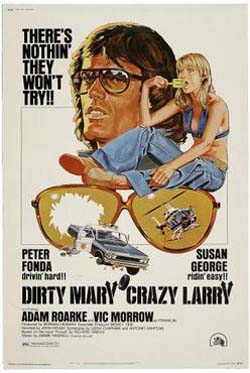
Dirty Mary, Crazy Larry

Director: John Hough
Written by: Leigh Chapman, Antonio Santean, Richard Unekis (novel ‘The Chase)
Cast: Peter Fonda, Susan George, Adam Roarke, Kenneth Tobey

Year / Country: 1974, USA
Running Time: 93 mins.

Peter Fonda’s Larry and his partner Deke (Adam Roarke) rob a supermarket manager for 150 large. On their getaway, they encounter the sluttish Mary who joins them on their high speed road trip in a blue Chevy. The law is on to them quickly leading to a number of spectacular chases. Off course the trio outsmarts the initially unmoved, but later fanatical police chief, played by Vic Morrow.

‘I’m gonna braid your tits’, the misogynist Larry tells Mary at one point during the movie. Not very politically correct but exploitation pur sang. Just check out the movie’s poster above: pure vintage 70’s cool. This film became a major drive-in cinema hit.

Dirty Mary, Crazy Larry is an excellent companion piece for Vanishing Point or Two-Lane Blacktop, philosophical, little story and big on car chases. That last element is especially well done. As soon as ‘the chase’ starts we get a 200 mph high-speed nitrous burnout. Very spectacular. The nihilistic tone doesn’t hurt the movie either.

The stupefying characters will be especially enjoyable for a stoned audience. Fonda plays a rougher (and crazier) version of his Easy Rider character Wyatt, and he pulls this off quite effectively. Mary’s part is harder to enjoy. We know she’s dirty, but why and what else is there to this girl?

The ending of Dirty Mary, Crazy Larry comes unexpectedly for those who are unfamiliar with this particular type of movie. It is shocking either way, and in a certain regard…beautiful. Especially as soon as the closing song ‘Time is Such a Funny Thing’ becomes audible.

Rating:

Biography: John Hough (1941, London) came into the picture with some low-budget horror flicks like Twins of Evil and The Legend of Hell House. He got his big break by securing himself a steady position as assistant director on the extremely popular TV-show The Avengers. Later he would try other stuff like sci-fi, fantasy, western, action and drama. He even directed a few Disney pictures. Late eighties he had a bump in the road, exemplified with the cruddy horror flick Howling IV: THe Original Nightmare. Hough’s last credit as a director to date was the gory Jack the Ripper tale Bad Karma.

Filmography (a selection): Wolfshead: The Legend of Robin Hood (1969), The Avengers (1968-69, TV episodes), Eyewitness (1970), Twins of Evil (1971), Treasure Island (1972), The Legend of Hell House (1973), Dirty Mary Crazy Larry (1974), Escape to Witch Mountain (1975), Return from Witch Mountain (1978), Brass Target (1978), The Watcher in the Woods (1980), Triumphs of a Man Called Horse (1982), Black Arrow (1985, TV), Biggles (1986), American Gothic (1987), Howling IV: The Original Nightmare (1988), A Ghost in Monte Carlo (1990, TV), Something to Believe In (1998), Bad Karma (2001)

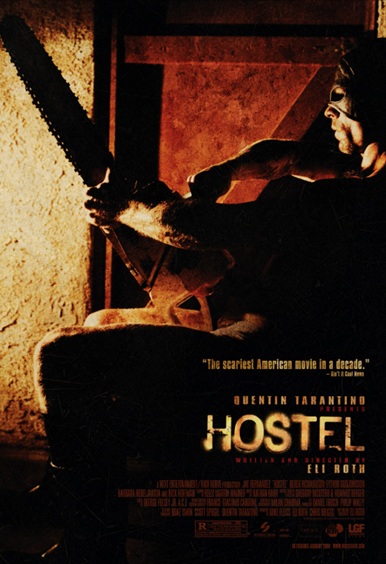
Hostel

Director: Eli Roth
Written by: Eli Roth
Cast: Jay Hernandez, Derek Richardson, Eythor Gudjonsson, Barbara Nedeljakova

Year / Country: 2005, USA
Running Time: 94 mins.

From executive producer Quentin Tarantino and director Eli Roth (Cabin Fever) comes Hostel, a relentless and visceral gore-fest that redefines the horror genre.

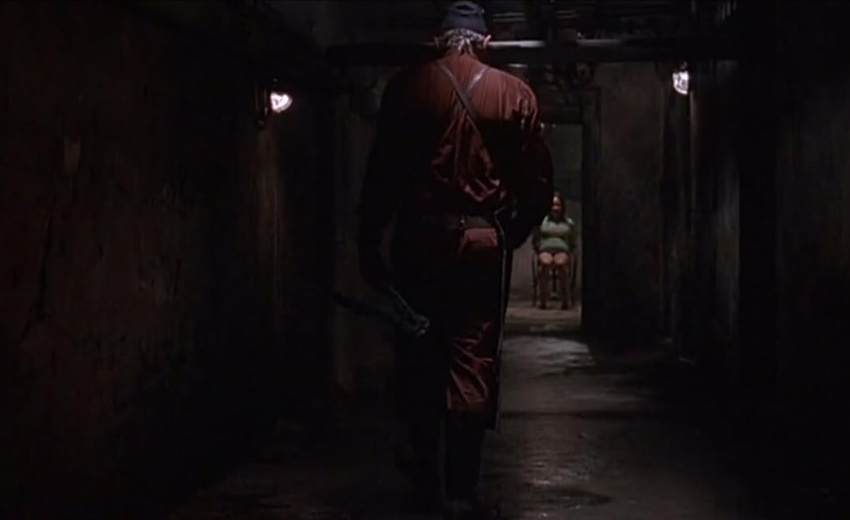
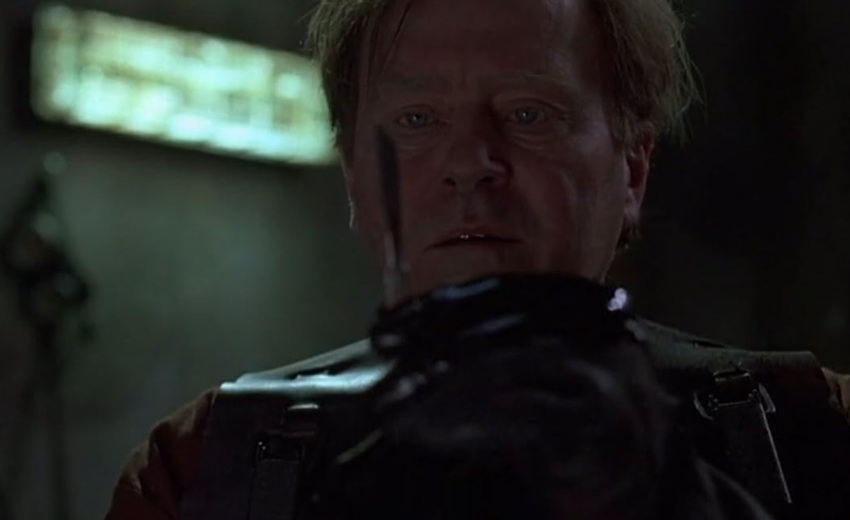
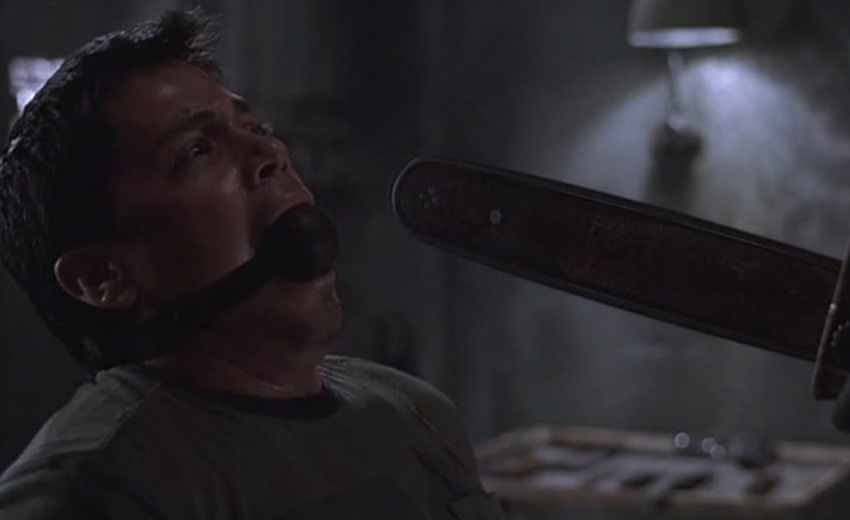
The film follows three reckless backpackers who, lured by the promise of a Slovakian hostel teeming with alluring women, stumble into a nightmare far darker than they could imagine. Instead of a paradise of hedonism, they find themselves trapped in a sadistic torture factory, where young travelers are systematically brutalized and slaughtered.

One by one, the trio is ensnared by their seductive yet treacherous holiday flings, drawn into a world of unimaginable horror. Hostel taps into the same vein of sadistic thrillers as James Wan’s Saw, but where Saw bogs itself down in a convoluted detective narrative, Hostel thrives by anchoring its terror in the protagonists’ harrowing first-person descent into madness. The slow, creeping revelation of their fate makes the experience all the more terrifying.

Roth masterfully manipulates his audience, balancing an entertaining – if occasionally implausible – setup (why would anyone impulsively jet off to Slovakia after a single photo of women?) with a descent into bleak, hopeless torment. The film escalates from a tense struggle for survival to a blood-soaked frenzy of revenge, delivering a rollercoaster of dread and catharsis.

Some people have complained about the lack of plot. But seriously: who cares? Horror movies haven’t been this fun in ages and it is the first film that actually scared the living hell out of me in quite a while. It’s a perfect storm of tension and grotesque brutality (and yes, it’s extremely gory). I’d even call it a brilliant piece of entertainment. Just a fair warning: this isn’t for the faint of heart.

Rating:

Biography: Eli Roth (1972, Boston) began shooting Super 8 movies at a young age. After studying at N.Y.U. he worked for many years in film and theatre doing every job available. His first feature Cabin Fever was made for only 1,5 million dollars and grossed a 100 million at the box office. Quentin Tarantino calls him ‘the future of horror movies’.

Filmography: Chowdaheads (1999, TV series), Cabin Fever (2002), The Rotten Fruit (2003, short), Hostel (2005), Hostel: Part II (2007)