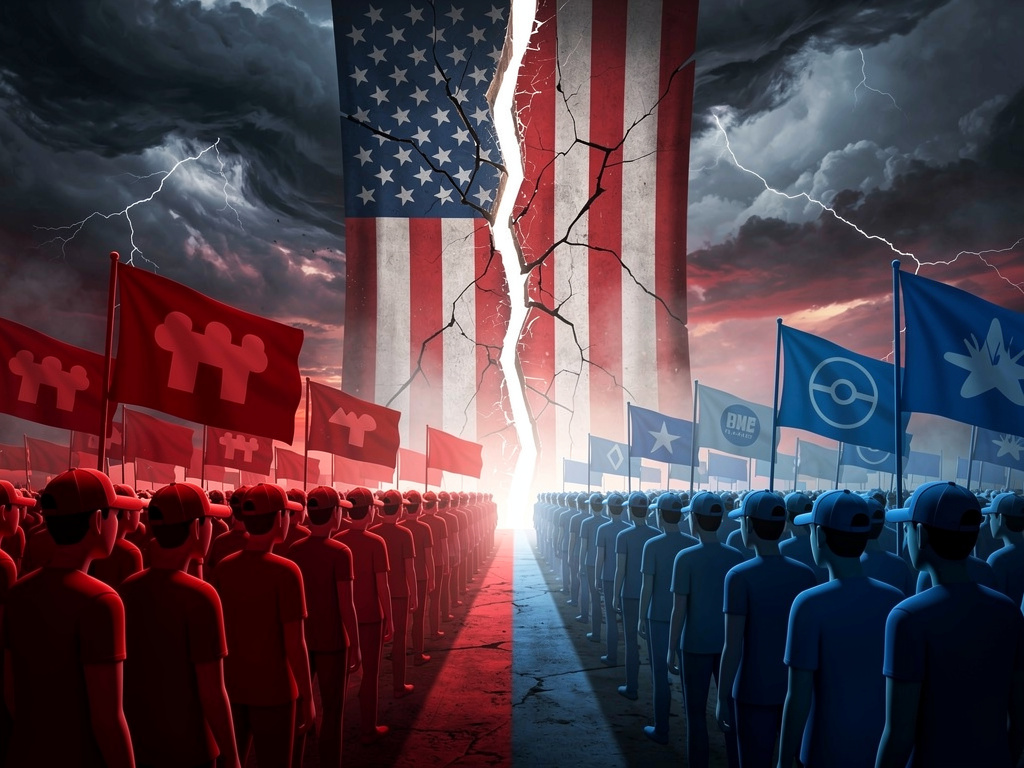
Is America’s Existential Crisis Unsolvable?

The Trump regime has been in power for 15 months now, and its actions are becoming increasingly damaging for the country and the world. The start of the Iran war by rogue states US and Israel, in which a girls’ school has already been bombed (170 children dead) and U.S.-Israeli airstrikes on oil depots caused ‘acid rain’ poisoning the population, is only the latest in a long list of scandalous crimes and human tragedies.

There is certainly a loud call for Trump to be impeached, but despite a lot of talk of a rupture in the MAGA movement, he still has full support of MAGA and the Republican Party. That is despite all the campaign promises he has broken and crimes he has committed, including his name being mentioned in the Epstein files a million times.

What does that tell us about the state of the country? In short: America is cooked. A recent post by a MAGA canal really drove it home for me:

The post refers to a recent scandal in which it became known that Secretary of War Crimes Bourbon Pete Hegseth went on a mad spending spree at the Pentagon blowing millions on lobster and steak.

The way this message is framed is that if you are opposed to over-spending at the Pentagon, you are against American troops getting decent food. Even worse, if you’re against American soldiers getting fed lobster and steak, you are obviously in favor of spending huge amounts of money on insurance premiums for illegals.

The debate over public spending on undocumented immigrants is completely unrelated to Pentagon spending, but the division in the USA paints everything in a toxic black and white picture. Trump has amplified these tensions through persistent misinformation, inflammatory rhetoric, and the promotion of unfounded conspiracy theories.

A recent poll indicates how deep this distrust in American society goes:
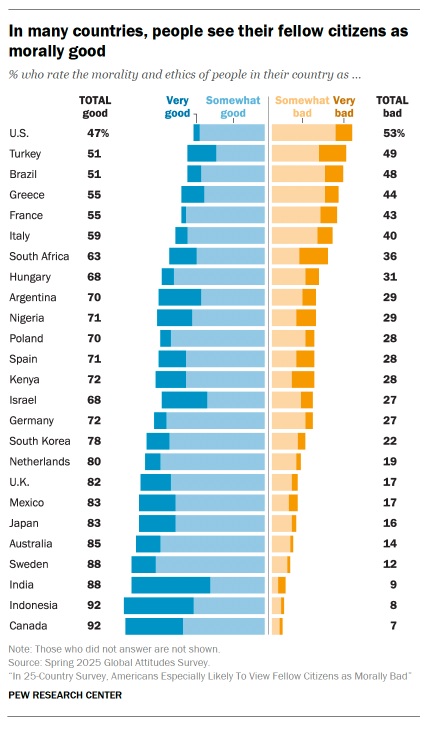

A whopping 53 percent of Americans see their fellow citizens as immoral, and this is obvious from how they are portraying each other in the media. MAGA is condemned for supporting an obviously criminal and completely immoral president who is destroying democracy, while democrats are seen as evil people who want to overflow the country with illegal criminals and rapists. This has become such a widespread belief among a large part of the country that it will be hard to get them back from this – even if Trump would be gone.

And that’s the heart of the problem: Americans are now living in entirely separate realities, each shaped by fundamentally different value systems. Democrats generally believe America should strive to be a force for good – flawed as it may be – working to improve lives and promote democracy around the world, even if the execution isn’t always perfect. In contrast, the ‘America First’ ideology pushes for a vision rooted in white, Christian, male dominance, where the U.S. operates as an unapologetic superpower, taking what it can with little or no regard for others. Under this worldview, immigrants are not just excluded but actively demonized, treated as threats to be expelled or erased.

How do you convince the MAGA crowd that Trump and his party are only in it for personal gain, and their actions are severely damaging to the country in the short and especially the long term?

The media are a big part of the problem. Mainstream channels have chosen for Trump (like FOX ‘News’) or a middle of the road approach, which really doesn’t work in this environment. A newspaper headline, like ‘Trump wants to acquire Greenland’ really doesn’t reflect what is really going on: ‘Dictator Trump wants to aggressively annex Greenland with military force’.

So the media is not doing its job, and even worse, many Trump supporters now own all major media, especially after the recent acquisition of Warner Bros Discovery by Trumper Larry Ellison.

And this is one of the reasons I am so pessimistic about America’s future prospects. The media is extremely important to turn the tide, but the legacy media are not doing their job and social media (owned by Trump’s billionaire cronies) that monetize conflict are making things much much worse.

But it is far from the only problem. These are other major issues that make a turnaround in the short term very unlikely:

● The Republican party are the only ones who could really stop Trump, but they are not doing it. The old party – yes, they were assholes, but at least they had some independent thinking going on that would definitely be opposed to much of what Trump is doing – is dead. Trump has destroyed it, and they are now in it for 100 percent. No matter how insane their leader is, they won’t stop him.

● The democrats – while they have some good people – are far from united and they are not speaking with one voice. Take the Iran war, where is their reunited condemnation of this illegal war?

● The corporate political donor system is still very much in place. That means that not the American people, but the big corporations decide which policies will be implemented. At the same time, the concentration of wealth and a non-level playing field for the middle and working classes are turning American democracy into an oligarchy.
● The current U.S. Supreme Court is widely seen as both a reflection and an amplifier of the country’s deep political polarization. The Court now has six conservative justices and three liberal justices. This ideological split is the most pronounced in decades, and the Court’s rulings increasingly break along these lines. In recent terms, the number of cases decided by a purely partisan vote has tripled, while unanimous decisions have declined sharply. The Court’s rulings on issues like abortion (Dobbs), campaign finance, voting rights, and executive power have not only reflected, but also deepened political divisions. The Court’s growing alignment with partisan politics has led many Americans to view it less as an impartial legal institution and more as a political actor. This shift is evident in public opinion polls, where favorable views of the Court are near historic lows, especially among Democrats and younger Americans

What America needs is a huge turnaround, a systematic change in government and how it functions. I currently see no evidence of this happening. The focus is now – understandably – on winning the Mid Terms by democrats and then winning the 2028 election in order to stop Trump. And it will certainly be a relief to see Trump removed. If they can, and this is a huge if.

However, the problems mentioned above will still be there. Which democratic leader will really solve this mess? Bernie Sanders was that leader, but the dems thought nominating him was too risky. A new leader of that calibre has not yet emerged.

We have been here before. When Biden won the election in 2020 we were relieved. But 74 million people still voted Trump in 2020 even after his disastrous first term. Just as worrying: about 89 million eligible Americans did not vote in 2024, while the country was under threat by a fascist takeover by MAGA. That means the trust in politics to solve problems has sunk to rock bottom in the US.

Optimists note that the U.S. has navigated previous existential threats – including the Revolutionary and Civil Wars – suggesting a capacity to overcome deep crises.

That may well be, but I currently see no way out of the polarization, so my current analysis is that the American crisis is terminal. We, as Europeans, have to steadily derisk from the USA and realign ourselves with reliable partners, such as Canada.

Let’s hope that in the long term, the crisis is an opportunity for the US to address long-standing flaws (such as economic inequality or political dysfunction) and create a ‘new Renaissance’ or a more inclusive society.

But for now, this is unfortunately the status of the country:

😅
This is the Significant Moment When Everything Went to Hell for America

America is turning into an autocracy very fast. Every week there are new lows – like last week the arrest of a judge and the week before that Trump (He/him) regime’s refusal to return Kilmar Abrego Garcia from an El Salvador prison camp – despite the supreme court ordering them to do so.

Of the 71 million Americans who voted him in office, some might be wondering; how did we get here? I’ll argue that one significant moment played a key role in creating this disaster.

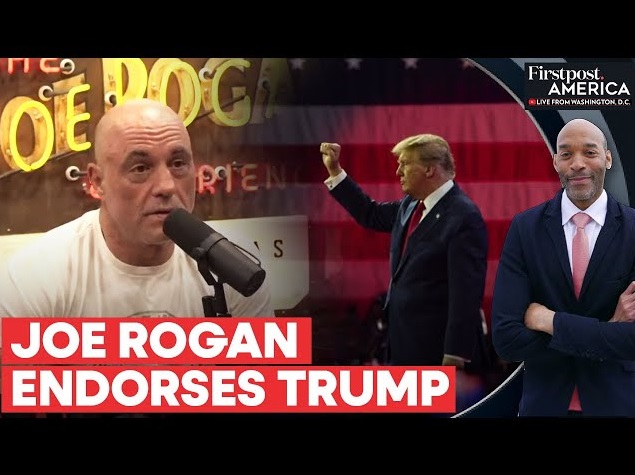
On the eve of the election day, on October 26, 2024, the extremely popular podcaster Joe Rogan interviewed Trump. I couldn’t bear to listen to his horse crap, but I recently watched one minute of the three hour interview on YouTube. In the fragment, Trump asked Rogan: “Come on, you’re not a Harris guy”.

And you see Rogan thinking: ‘shit, this guy is right. I am not a Harris guy’. Joe Rogan is manipulated at the spot. He lets himself be fooled by this con man. After that, he lets Trump get away with blatant lies about the 2020 election, which looks very bad for his interview ethos. I stopped viewing right after that.

What I took away from this short moment is that Trump – terrible person that he is – has at least one ‘quality’ that enabled him to become the 47th president of the USA: he knows just what to say to people to make them vote for him.

Of course this won’t work with everybody, but then again, he didn’t need everybody. He needed 71 million voters. He already had his loyal fan base secured, so he had to convince millions of others to vote for him. He and his campaign team put in all their efforts to convince right leaning people like Rogan to go for the Orange Turd. They were successful.

After the show, Rogan did something he had previously said he wouldn’t do: he endorsed Trump. With his immense reach amongst people for whom Rogan is their single source of news – tragic as this may be – he may have decided the fate of the United States.

How will he feel now, three months after Trump took office, and the country is sliding fastly into an authoritarian regime?

What we are watching right now might be the End of the American Empire.

The country is ruled by a mad king. Trump’s cabinet meetings are excruciatingly horrifying to watch. Every cabinet member that speaks, including Musk, first praises Trump for the absolutely brilliant leader that he is. And what an incredible honor it is to serve in his cabinet.

Then they proceed to tell absurd bullshit to cover up for their criminal actions. In the last cabinet meeting, Musk – in full Dr. Evil mode – bullshits about how he found 150 billion dollars in waste, fraud and abuse in the federal government. He says that ‘people are receiving social security that aren’t even born yet.’

This is just too much bullshit to handle.

Everybody knows how he is going to get this 150 billion. He will do it by slashing social security, medicaid, and other programmes for the poor – and recklessly fire tens of thousands of essential government employees. And Trump is gonna let him do it. The money saved will be given to billionaires like them as a tax cut.

Some still consider Trump a brilliant businessman, but he’s terrible in business – and that’s a fact. I mean, he bankrupted a casino once. Now, he’s going to bankrupt the country. He’s a fuck-up and a major fraudster.

The financial markets – who foolishly believed Trump would be good for business before – have now realised the terrible truth. Trump is so totally unstable and deranged that the risk for the world economy (countries, companies, currencies, and debt) is great. They finally realised, just like some voters did, that having a psychopathic gangster in charge of the largest economy in the world, might be bad for business.

It would have been exactly the same if they would have handed the reigns of the American government to Vladimir Putin or Kim Jung Un. That’s what the American’s did who voted this nut job into the White House.

Thank you, Joe Rogan.

Now maybe I am thinking too much of his endorsement. On the other hand, Trump thanked Rogan especially at his inauguration. Imagine that; that you would be responsible by having a cruel psycho elected who would then go on to create terrible suffering for millions of people. Who would send innocent people to an El Salvadorian prison camp to be tortured.

I have no idea how he feels about it, but this is a wound that he will have to live with. The same goes for all Americans, whether they voted for Trump or not. This is a national trauma and it will take decades to recover from it.

But first, they will have to remove Trump from office. Can it be done?

It will be very hard, that’s for sure. And even if they succeed, they will have a massive challenge waiting for them.

Let’s say they’ll have a revolution and remove Trump from office, will the two sides – the MAGA and the WOKE – reconcile and together restore the damage the Trump regime has caused? Will they think: ‘let’s go look at the root causes of this whole thing? Where did we go wrong? What laws are we going to introduce together to make sure something like this never happens again?’

The probability that this will happen is very small. Trump is a very severe symptom of a lethal disease: a mind virus that once it spreads through society – enhanced by anti-social media and AI – makes the country divided and ungovernable.

To stop this mind virus, we – the world – must regulate social media and AI. With AI becoming more powerful every day, we need to move fast to prevent every other democracy from sliding off the rails in the coming years and decades.

This will not be an easy feat – and America is in terrible shape. Still, the possibility also exists that the right leaders arise out of this sink hole and put the country on the right course again. A crisis can do that sometimes.

Right now, the crisis is not yet big enough. There are still many people, inside and outside of the USA, deluded by Trump and think it might not be so bad. But if enough people conclude: ‘this is not what we want’ and start fighting back in every way they can, it might bring about a new era of hopeful change.

Is this the end for the USA of merely the passage into a new prosperous era? Only time will tell.

Gaat de mensheid de komende eeuw overleven?

Antarctica’s Ross Sea. Original public domain image from Flickr

Een tijdje terug kwam ik in een social media bubbel terecht van de extinction crowd; mensen die denken dat we – de mensheid – het niet gaan redden vanwege allerlei tipping points op klimaatgebied die we gaan overschrijden en die zullen leiden tot een onomkeerbare cascade van rampzalige effecten met als gevolg: geen mensheid meer eind 21ste eeuw of begin 22ste eeuw.

Deze crowd baseert zich op harde wetenschap en hun argumenten zijn niet makkelijk te weerleggen. Bovendien begint het bewijs zich steeds duidelijk te manifesteren in de wereld van vandaag: bosbranden, hittegolven, overstromingen en stormen. Deze crowd zegt ook – terecht – dat de huidige generatie politieke leiders lang niet genoeg doet om de grootste rampen af te wenden.

Het is verleidelijk om in deze visie mee te gaan, maar ik zie toch nog hoop voor de mensheid. Er moet dan echt wel een heleboel gebeuren, maar ik geloof dat er manieren zijn om de politiek toch in beweging te krijgen. Politiek commentator Ian Bremmer schrijft in zijn laatste boek ‘The Power of Crisis’ dat crisissen dé manier zijn om voor een omwenteling te zorgen. En aan crisissen geen gebrek in deze tijd.

De impact van de coronacrisis in termen van doden, ziekte, schuld, economische vertraging, achteruitgang in mentale gezondheid en polarisatie in de samenleving zijn nog lang niet de wereld uit. Toch is dit verre van de laatste crisis geweest. De komende decennia zullen we geconfronteerd worden met tenminste drie crisissen die een veel grotere impact zullen hebben dan corona, stelt Bremmer.

Ten eerste is het vrijwel zeker dat er een nieuwe pandemie komt in de komende decennia. Dat is een direct gevolg van de toename van de wereldbevolking en het verdwijnen van natuur waardoor er steeds meer diersoorten met elkaar in aanraking komen. Qua dodelijkheid was corona zeker niet het ergst denkbare virus, dus dat kan de volgende keer een stuk slechter uitpakken. Of juist beter: als er een paar miljard mensen worden uitgeroeid hebben we meer tijd om te dealen met de tweede grote crisis die op ons afkomt: de klimaatcrisis.

klimaatverandering zal de levens van miljarden mensen op zijn kop zetten en vormt een ongekende bedreiging van de duurzaamheid van het leven op aarde. Dit is al niet meer tegen te houden. Delen van de aarde zullen onbewoonbaar worden en er zullen miljoenen vluchtelingen op de been komen de komende decennia.

Toch is volgens Bremmer klimaatverandering niet eens de ergste crisis die op ons afkomt. Volgens de geopolitieke expert is de grootste bedreiging voor onze collectieve toekomst de onverwachte impact van nieuwe technologieën die de manier waarop we leven, denken en met elkaar interacteren veranderen, en die onze toekomst zal bepalen. Kijk naar de polarisatie die momenteel veroorzaakt wordt door social media en je krijgt een idee van wat Bremmer bedoeld.

De technologie die nu in ontwikkeling is, zal nog veel grotere gevolgen hebben. Neem de ontwikkeling van kwantumcomputing. Het land dat dit als eerste ontwikkelt zal in staat zijn om nagenoeg alle encryptie van computer- en beveiligingssystemen wereldwijd te omzeilen. Alleen al de dreiging dat een land dit gaat ontwikkelen, kan aanleiding zijn voor het begin van de derde wereldoorlog…

Om met de gevolgen van deze drie existentiële bedreigingen om te gaan is internationale samenwerking onontbeerlijk. Met name de relatie tussen de VS en China is cruciaal en die relatie verslechtert momenteel in rap tempo. Dus hoe kan ik nog hoop hebben op een goede afloop? Ik denk dat de toekomst nog niet bepaald is en het verleden heeft aangetoond dat we in extreem moeilijke situaties een ommekeer kunnen maken. Ook nieuwe technologie is een wild card die ons verder kan helpen.

Er zijn geen garanties, maar ik denk dat we na de shit storm die we ongetwijfeld gaan krijgen de komende decennia tot een nieuwe hereniging komen en samen gaan werken aan de oplossingen die nodig zijn, want dit is ook in ieders eigen belang. Het is een gok, maar de extinction crowd gokt op een andere uitkomst, namelijk blijvende ‘inertia’ (traagheid). We gaan het hoe dan ook meemaken.

Hoe economische groei zijn waarde verloor

Wat is er mis met Nederland? Op het eerste gezicht niks. We zijn welvarend, hebben een goed onderwijssysteem en een goed zorgstelsel. Toch sluimert er al jaren iets onder de oppervlakte en komt dit steeds vaker naar boven. Denk aan de huizencrisis, de personeelstekorten in datzelfde onderwijs, de overbelaste ziekenhuizen en de toenemende armoede.

De opmars van populistische partijen is wat dat betreft een teken aan de wand met de overwinning van Forum voor Democratie bij de Provinciale Statenverkiezingen van 2019 als voorlopig dieptepunt. Een stem op een populistische partij is een stem tegen de gevestigde orde. Natuurlijk, een groep ontevreden zeikstralen heb je altijd. Maar als het er teveel worden, moet je je afvragen of er niet een reële, dieperliggende oorzaak voor hun onvrede is.

De auteurs van ‘Fantoomgroei’ – Sander Heijne en Hendrik Noten – komen wat mij betreft behoorlijk dicht in de buurt van een helder antwoord op die vraag. Zij hebben getracht uit te zoeken waarom werkend Nederland sinds 1982 nauwelijks meer profiteert van economische groei. Terwijl bedrijven en aandeelhouders hun kapitaal snel groter zien worden geldt dat nauwelijks meer voor de inkomensontwikkeling van gezinnen. Van gemaakte bedrijfswinsten gaat er nu een euro naar het bedrijf en een euro naar werknemers. Dividenden en bonussen voor topmannen zijn naar recordhoogtes gestegen. De CEO van een groot bedrijf verdient nu 80 keer zoveel als een gemiddelde werknemer. Dat zijn geen goede verhoudingen.

De ergste effecten van de scheefgroei zijn voelbaar in de middenklasse. Hoogopgeleiden doen het (voorlopig) nog aardig. Maar daarbij mag niet vergeten worden dat de overheid allerlei nivelleringsmethoden inzet, zoals hypotheekrenteaftrek en andere toeslagen. De meeste van ons zijn hier compleet van afhankelijk, maar een ideale verdeling van welvaart is het allerminst. Het is te kwetsbaar. Kijk maar naar de toeslagenaffaire. Een andere bron van welvaart voor een deel van de bevolking is de gigantische stijging in huizenprijzen. Maar dit is geen waardecreatie, want er zit geen enkele inspanning in. En gratis geld bestaat niet; iemand betaalt altijd de prijs. In het geval van de huizen zijn dat alle mensen die nergens meer terecht kunnen of zich enorm in de schulden moeten steken om nog een huis te kunnen bemachtigen. Te sterk oplopende huizenprijzen zijn geen goed nieuws voor de samenleving als geheel.

Er zijn verschillende oorzaken voor deze uit de hand lopende situatie en het wordt tijd dat politici die gaan inzien en actie gaan ondernemen. Een belangrijke oorzaak is de dalende belastingafdracht van bedrijven, die ondertussen wel volop profiteren van wat de overheid en werkend Nederland allemaal voor ze doet. (Dit terwijl de btw wel is gestegen en de lasten van werknemers dus gewoon oplopen). En dan wil Rutte ook nog eens de dividendbelasting afschaffen en de multinationals extra miljarden kado doen. Dit soort politieke keuzes is de plaag van de Westerse wereld die maakt dat de Franse econoom Piketty gelijk gaat krijgen: De ongelijkheid tussen mensen met kapitaal, en mensen die alleen inkomen uit arbeid halen, zal steeds verder toenemen.

Hieraan ten grondslag ligt de filosofie die sinds de jaren 80’ – het tijdperk Thatcher-Reagan – de Westerse wereld is gaan domineren: het neoliberalisme. De overheid dient zich te beperken tot zijn absolute kerntaken en het individu (lees de kapitaalbezitters) krijgt absolute economische vrijheid. Dit denken heeft geleid tot de illusie dat ‘de onzichtbare hand’, oftewel vrije markten, alle problemen gaan oplossen. En die vrije markten hebben ons platformbedrijven gegeven als Uber, die van hun werknemers onderbetaalde slaven van een app, hebben gemaakt, en zo hun markt zijn gaan domineren. Wat is er gebeurd met bedrijven als Philips die in Eindhoven een samenleving op zichzelf vormden met scholen, studiebeurzen, carrièrekansen, en vrijetijdsverenigingen voor hun werknemers? Het geld dat de Uber-chauffeurs voor het platform verdienen vloeit naar de stinkend rijke aandeelhouders in Silicon Valley, terwijl de chauffeurs nauwelijks kunnen rondkomen van hun arbeid.

Een andere ontwikkeling die hieruit voortvloeit is de financialisering van de economie. Bedrijven verdienen steeds vaker geld met geld. Een voorbeeld is Apple dat zo’n 200 miljard dollar in kas heeft. Sinds de dood van Steve Jobs is er geen grote innovatie meer gelanceerd, maar ondertussen verdient het bedrijf bakken met geld met financiële handel. Handel waar de samenleving geen moer mee opschiet.

Het neoliberale economische denken zit hem ook in thema’s als loonmatiging en begrotingsdiscipline. Deze aanpak heeft volgens de auteurs zijn intrede gedaan in 1982 toen onder Lubbers het ‘Wassenaar-akkoord’ gesloten werd. De vakbonden gingen hierin mee met loonmatiging, maar ze vergaten erbij te onderhandelen dat dit een tijdig iets moest zijn om uit de crisis te komen en geen permanente situatie. De rekening van de begrotingsdiscipline – die zowel in crisistijd als daarbuiten is gaan gelden – wordt betaald door de werknemers. De bedrijven ontspringen steeds de dans. Er waren tijden dat loonstijgingen van vijf procent normaal waren en belastingpercentages van 90 procent voor de vermogenden ook. Hier kunnen we ons niks meer bij voorstellen.

En dit is de kern van ‘Fantoomgroei’; de verhalen die we elkaar vertellen worden vanzelf werkelijkheid. En op dit moment is het verhaal dat lonen nooit teveel mogen stijgen. We moeten vooral bezuinigen en de tering naar de nering zetten. Ondertussen moeten de rijksten onder ons vooral geen strobreed in de weg gelegd worden. En daar komen domme voorstellen zoals het afschaffen van de dividendbelasting vandaan. Als die zo’n probleem was zouden bedrijven als Unilever toch nooit zo succesvol zijn geworden?

Nog los van de kloof tussen de kapitaaleigenaren en de rest, is er in de hedendaagse maatschappij ook een grote kloof ontstaan tussen hoogopgeleide werknemers en de middenklasse. Neem een bedrijf als Bol.com. Op het hoofdkantoor zit slechts een klein deel van het werknemersbestand. Dit zijn de inkopers, de managers, de marketeers en de developers. Zij verdienen goed geld en kunnen profiteren van de huizenbubbel. Het grootste deel van het personeel bestaat echter uit Oost-Europeanen die tegen het minimumloon in de distributiecentra onze orders aan het verzamelen zijn. Deze onderbetaalde krachten wonen samen in gedeelde vakantiehuizen waar ze grote bedragen voor neertellen. En de achteruitgang treft niet alleen buitenlandse werknemers. Steeds meer Nederlanders werken als ZZP’ers. Sommige verdienen goed, maar een groot deel (40 procent) verdient minder dan 16.000 bruto per jaar. Dit is de economie anno 2021.

We hebben een samenleving gecreëerd waarin werknemers – zelfs tweeverdieners – geen huis meer kunnen kopen. We zijn allemaal geprogrammeerd om te denken: ‘als de economie maar groeit’. Maar wat hebben we eraan als een loonsverhoging ondenkbaar is en zaken in de reële economie (zoals huizen, eten en energie) steeds duurder worden?

In plaats van ongrijpbare economische groei, heeft het onderwerp economie veel meer te maken met de vraag in wat voor samenleving we willen wonen. En dat is helaas niet de samenleving waar we nu in leven en al helemaal niet de samenleving waar we naar op weg zijn: een wereld gedomineerd door 10.000 miljardairs en de rest van de wereldbevolking overlevend als platformslaven.

Er zijn landen waar ze het anders zijn gaan doen. In 2019 heeft de Nieuw Zeelandse overheid het Bruto Binnenlands Product laten varen als belangrijkste indicator van de economie. Want als de economie groeit, maar mensen ongelukkiger en onsuccesvoller worden, wat heb je dan aan zo’n cijfer? Niks.

Dat er vele landen mogen volgen.