R.I.P. Big Pussy Bonpensiero

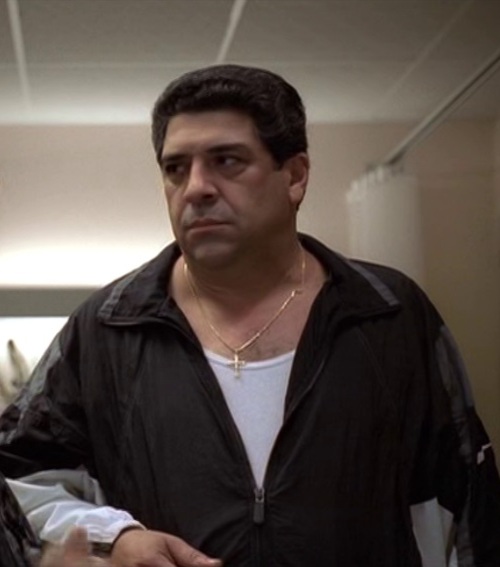
Vincent Pastore, the Italian-American actor from New York who played the legendary Salvatore ‘Big Pussy’ Bonpensiero in The Sopranos, has died. He was 80 years old.

Pastore was a former club owner in New Rochelle, New York. He became friends with Matt Dillon and Kevin Dillon – two of his regulars – who convinced him to try acting. He was in his forties when he got into the business. He died with nearly 200 film credits to his name (including Flodder in Amerika!).

In 1990, he had a small role in GoodFellas (credited as ‘Man with Coatrack’), one of the greatest gangster films ever made. That year marked the start of the decade of the mob movie, and Pastore appeared in many of them: State of Grace, New Jack City, Carlito’s Way, Sugar Hill, Gotti, The Last Don, A Brooklyn State of Mind, and Witness to the Mob.

In 1999, he was cast in The Sopranos as Big Pussy Bonpensiero, one of Tony Soprano’s crew members. His character’s name was based on a real gangster, apparently – something show creator David Chase had picked up somewhere. In fact, there were two Pussys in the mob: Big Pussy and Little Pussy. This became one of the big mob jokes in the pilot episode:

HESH: I hear Junior wants to whack Pussy Bonpensiero?
TONY: Pussy Malanga.
HESH: Oh, Little Pussy?
TONY: Yeah, Little Pussy. What, you think he’s gonna fuck with Big Pussy? My Pussy?

In the first season, Big Pussy became one of the leading characters. Then, in episode 11, Tony is told by a corrupt cop on his payroll that Pussy is a rat. A heartbroken Tony tells his soldier Paulie to go and check, and after a tense confrontation, Pussy flees.

Later that season, Tony suspects the cop was actually referring to Jimmy Altieri, another “fat fuck with black hair”, and Jimmy is killed on Tony’s orders. Pussy is exonerated, but he remains on the run, fearing his friends want to whack him.

When season one became a phenomenal success, fans wondered what happened to Pussy. David Chase realized he had to bring him back for season two. And so Pussy returns – only for us to quickly discover he’s working with the FBI to get Tony indicted. The way Tony eventually discovers this, and deals with it, leads to my favorite moment in The Sopranos in my favorite television episode of all time, from any show.

He would always remain famous for this role. I remember him coming on the ‘Talking Sopranos’ podcast, telling the story of how he took his grandchildren to the zoo and people recognized him: “Hey, it’s Pussy!”

So, 26 years after his fictional death in Funhouse, now Pussy has joined Tony (James Gandolfini) and Paulie (Tony Sirico) in Tony’s heaven crew.

Rest in peace, my friend.

Read some of Big Pussy’s best lines on The Sopranos here.

The Verdict: Wise Guy: David Chase and The Sopranos

As a devoted fan of The Sopranosmy all-time favorite show – I thought there wasn’t much left for me to discover. But HBO’s new two part documentary Wise Guy: David Chase and The Sopranos offers fresh insight, focusing primarily on the mastermind behind the series, David Chase (1945), especially in its first half. Chase is a compelling figure: intelligent, introspective, and a natural storyteller. Director Alex Gibney (Gonzo: The Life and Work of Dr. Hunter S. Thompson, Enron: The Smartest Guys in the Room) places Chase in a metaphorical psychiatrist’s chair, allowing him to speak candidly about his upbringing, his eccentric mother, dreams, death, and how these themes shaped The Sopranos. Chase recalls his time in college down south, which he disliked, though he was exposed to European cinema by directors like Godard, Bergman, and Fellini. “I saw , and I don’t think I understood it, but it blew my mind”, he reflects. This experience ignited his desire to become a filmmaker, leading him to study at Stanford’s film school. The documentary even shows part of his student film – a gangster story with an attempted Godard flair, which is amusing in its ambition. While Chase’s destiny wasn’t in film directing, he found his calling in television. He worked on successful shows like The Rockford Files and Northern Exposure, but his true breakthrough came when HBO greenlit The Sopranos in 1998. The series became a cultural phenomenon, and Chase infused it with deeply personal elements, including therapy sessions and his tumultuous relationship with his mother. Other talented writers like Robin Green and Terence Winter also contributed significantly to the show’s depth. In The Offer, a recent series about the making of The Godfather, we learn that Coppola saw the film as a commentary on capitalism. Similarly, The Sopranos carries an underlying critique of America’s decline. As Chase puts it, “Americans have gotten so materialistic and selfish that it made a mob boss sick.” That vision, combined with Chase’s storytelling genius, is part of what makes The Sopranos so enduringly powerful.

Wise Guy: David Chase and The Sopranos is now available on HBO Max

The verdict: to stream or not to stream? To stream (especially Part 1)

The Many Saints of Newark (2021, Review)

Directed by:
Alan Taylor

Written by:
David Chase
Lawrence Konner

Cast:
Alessandro Nivola (Dickie Moltisanti), Leslie Odom Jr. (Harold McBrayer), Jon Bernthal (Johnny Soprano), Vera Farmiga (Livia Soprano), Corey Stoll (Junior Soprano), Ray Liotta (‘Hollywood Dick’ Moltisanti), Michela De Rossi (Giuseppina Moltisanti), Michael Gandolfini (Teenage Tony Soprano), Billy Magnussen (Paulie Walnuts), John Magaro (Silvio Dante)

“My uncle Tony…” It is certainly great to hear Christopher’s voice again. He narrates the story in this long awaited Sopranos prequel from the grave. Chrissy forms the link between the spirit world – where the beloved show now resides – and the world of The Many Saints of Newark, which is now coming to life on cinema screens worldwide and on streaming service HBO Max.

This world, which is set in the 1960’s in New Jersey, is inhabited by many familiar characters in their younger years: Tony Soprano, ages 9 and 17, his parents Johnny Boy and Livia, his uncle Junior, Silvio Dante, Paulie Walnuts, Big Pussy Bonpensiero, and a couple of others. The main character is Christopher’s father Dickie Moltisanti (Alessandro Nivola), who was referred to as a legend in the series, but never seen. Logical, since he was already dead when the show started.

We meet Dickie at the Jersey station, where his father Hollywood Dick, played by Ray Liotta, brings home a new Italian wife from the home country. She is into the handsome and charming Dickie immediately, which complicates the already difficult relationship between him and his mobbed-up father. And soon it leads to a dramatic moment early in the film, which is also none of the highlights of the movie. Both Nivola and Liotta are terrific in their roles. For Liotta, a double role that is; he also plays Dick’s twin brother Sally who’s in jail for life for whacking a made member.

Dickie is a troubled man obviously. He resembles his future son Christopher in many ways: he’s a compulsive law breaker, has an explosive temper and is a murderer. He is also searching. Dickie has the deep desire to do something good, something special to elevate his existence out of the mundane. But he doesn’t know how. Dickie is involved in the numbers rackets in Jersey together with a bunch of black criminals. In the first part of the movie, the 1967 Newark riots take place in which the black riotters, who are structurally discriminated against, face off against the police. In the second part of the film, Dickie’s black business partners get ambitions of their own which leads to a violent conflict in the Jersey underworld.

Besides having his own activities, Moltisanti is also deeply involved with the DiMeo crime family in Jersey whose members love him. But as we know from the show, in this volatile milieu inhabited by envious sociopaths, danger is always lurking. It is this world that young Tony Soprano (Michael Gandolfini) is inevitably drawn to. Dickie becomes his mentor, but on advice of Sally, whom he goes to visit in jail, he turns his back on him. Although the film was marketed as the story of how Tony becomes a gangster, there is not one defining moment through which this happens. This is really at the early beginning of his transformation. Dickie is certainly an inspiration for him with all his influence, his money and his women. But above all, Tony is just talented, and the invitation for him to join the Family is there.

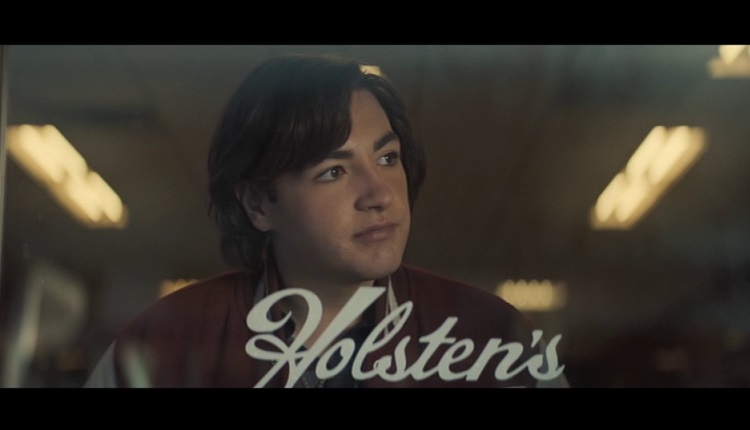
The casting of Michael Gandolfini – son of the deceased James Gandolfini who became a legend by portraying Tony Soprano – works wonderfully well. He is obviously a gifted actor like his father, but the way he resembles his dad as Tony is uncanny at times. Especially during the scene in which he and his friends hijack an icecream truck and start handing out free ice creams. Another standout performance is given by Vera Farmiga as Tony’s batshit crazy mother Livia. The dynamic between her and Gandolfini is great, and the scene between her and Tony’s school counselor is genuinely touching.

Other positive points of Many Saints are the terrific sixties soundtrack, the dark humour and the many clever references to the show that fans will love. A point of critique is that although it feels cinematic, which The Sopranos also did by the way, the screenplay is written more like a long television episode. Storywise, a few cogs are missing and the ending comes too suddenly.

David Chase has expressed interest in doing another period piece about young Tony Soprano together with Terence Winter, who wrote some of the best Sopranos-episodes. Winter responded positively, so there might be another return to this universe Chase has created. But if it doesn’t, that’s okay by me. The Many Saints is a very enjoyable return to the show that still ranks as one of the best ever. The Many Saints can now be added as a great cinematic companion piece.

The Sopranos – 100 Greatest Moments: 40-31

40. Seven Souls

Episode: Members Only (SE6, EP1)
Characters: Agent Harris, Agent Goddard, Vito, Janice, Domenica, Bobby, Gene & Deane Pontecorvo, Finn, Meadow, Raymond Curto, A.J., Adriana, Carmela, Tony and Junior

“The ancient Egyptians postulated Seven Souls. Top soul, and the first to leave at the moment of death, is Ren, the Secret Name.” The sixth season kicks off in a brilliant way. Nearly a year has passed since the final episode and we get a snapshot of the characters’ lives at this point. During the sequence, a two-minute narration by William S. Burroughs is heard from the album ‘Seven Souls’ by ‘Material’. It’s the perfect mood setter for the beginning of the end.

39. The Strong Silent Type

Episode: Pilot (SE1, EP1)
Characters: Tony and Dr. Melfi

In one of the first therapy sessions Tony has with Dr. Melfi, the subject of depression comes up for the very first time. Tony obviously has feelings of depression, but he has another problem. In his culture, this therapy shit doesn’t go down. “Whatever happened to Gary Cooper, the strong silent type?”, Tony asks Melfi. “That was an American! He wasn’t in touch with his feelings; he just did what he had to do.”
But Tony doesn’t have much of a choice. Since the ducks left, he does feel depressed. A combination of therapy and Prozac will now have to help him be a happier gangster. “The ducks that preceded your passing out”, Melfi tries. “Let’s talk about them”. Tony walks away. Yet this is definitely the moment when a new door – the door of psychiatry – is opened for Tony.

38. Confession

Episode: College (SE1, EP5)
Characters: Carmela and Father Phil Intintola

The episode ‘College’ teaches us a lot about the main characters. While Tony is killing rats in Maine, Carmela has therapy of her own. She confesses to Father Phil that she has allowed evil in her house. She is not at peace with herself. How can she be when she is living with a monster? In this early stage of The Sopranos it is still a possibility that Carmela would take action and leave Tony, the only right thing she can do. But the church is giving her an alibi not to. Divorce is deemed wrong, so she chooses the easy life of sin. This dilemma makes Carmela’s struggle all the more interesting.

37. The Sign
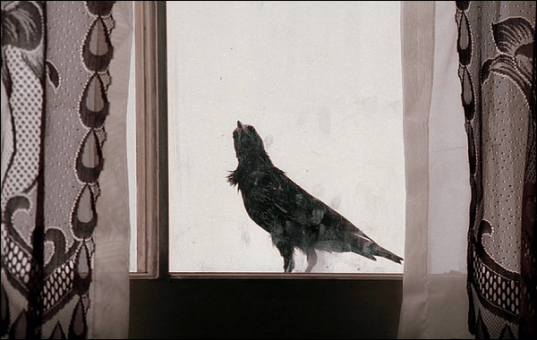
Episode: Fortunate Son (SE3, EP3)
Characters: Tony, Paulie, Silvio, Christopher, Bobby, Furio, Patsy Parisi, Raymond Curto and Eugene Pontecorvo

Christopher was warned before when he briefly visited hell; stay out of the Mafia. He chose to stick with Tony anyway leading to this moment. At his making ceremony he sees a raven sitting on the windowpane outside. This is definitely a bad omen. When you see the picture of St. Peter burn in his hand you know for sure; this is gonna end badly. Great use of symbolism! Another interesting aspect of this scene is that Eugene Pontecorvo is getting made as well and Tony says; “once you enter this family, there’s no getting out.” This will come back in Season 6 when Eugene finds out the hard way Tony wasn’t joking.

36. The Dream is Gone
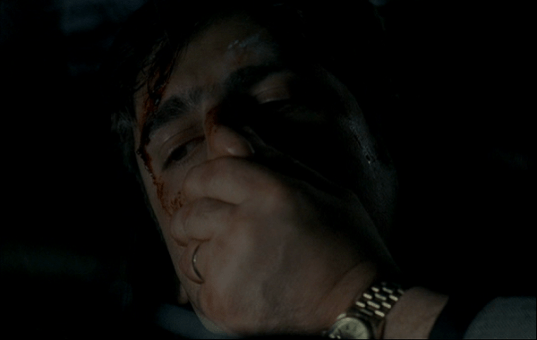
Episode: Kennedy and Heidi (SE6, EP18)
Characters: Christopher, Tony, Kennedy and Heidi

David Chase likes to mess with his audience’s expectations. He kills off Christopher, probably the second most important character of the series, in an entirely unexpected moment. Everybody knew that sooner or later he would have to go, but surely this would happen at the end of a long dramatic episode and in a very dramatic way. Now, he goes in the beginning of an episode and in a very silent way. Still, it is a pretty harrowing scene. Chance provides Tony with the opportunity to rid himself of a ‘weakling’ who had become a liability, and – predatory as he is – he takes it. The dream really is gone now. What did you expect? Christopher was listening to the soundtrack of ‘The Departed’.

35. The Involuntary Cliff Dive

Episode: Pax Soprana (SE1, EP6)
Characters: Mikey Palmice, Joseph ‘Joey Eggs’ Marino and Rusty Irish

This is a brutal moment in the series to once again remind the audience that they are watching sociopaths at work. Junior has just been made Caesar, and he is immediately (mis)using his power. In this scene, Junior’s soldiers kill dope peddler Rusty Irish, because he sold designed drugs to Junior’s tailor’s grandson, who consequently killed himself by jumping off Patterson Falls. The killers are visibly having a blast when they throw the terrified dealer off the bridge.

34. Cultural Warfare

Episode: Whitecaps (SE4, EP13)
Characters: Alan Sapinsly an Trish Reinhold-Sapinsly

In ‘Whitecaps’, Tony bought a house called Whitecaps, but changed his mind due to his marital problems. The owner won’t pay him back his deposit, so what does he do? He sends two underlings to the guy’s house in his boat with the biggest speakers ever and they start playing Dean Martin all night. David Chase described this method of intimidation ‘cultural warfare’, because Martin is Italian. It is also the final scene of the fourth season. The overall message; Tony is still powerful, but his private life is all messed-up.

33. Being Boss? Don’t Think So

Episode: Stage 5 (SE6, EP14)
Characters: Tony and Little Carmine

This is a crucial scene in the final season. Tony is trying to persuade Little Carmine to take the top spot, because he hates the current New York boss Doc Santoro. But Carmine, who was always mocked for his lack of brains, is the only one of these characters who made the right choice in life. He turns down Tony’s offer, because he is enjoying life with his wife and kids. This contrasts beautifully with Johnny Sack, who is in prison and can’t even touch his family members. Or with Tony, who is always stressed out like hell. Little Carmine really is smelling the roses.

32. The Real Soprano
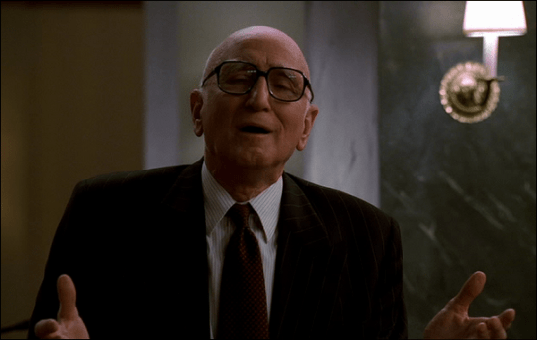
Episode: Army of One (SE3, EP13)
Characters: Tony, Carmela, Meadow, A.J., Junior, Silvio, Gabriella Dante, Bobby, Johnny, Ginny Sacrimoni, Christopher, Adriana, Patsy, Furio, Artie, Charmaine Bucco and Janice

Shitfaced or not, who ever knew Junior could sing like that? With the beautiful ‘Ungrateful Heart’, he provides a very fitting closing to the excellent third season. Look out for that moment where the drunken Meadow crosses the street, it seems visually related to the parallel parking scene in the final episode.

31. Square One
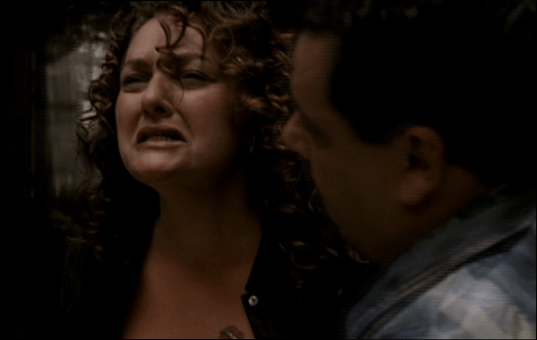
Episode: Cold Cuts (SE5, EP10)
Characters: Tony, Bobby, Janice, Sophia and Bobby Jr.

This is a real low for Tony. Janice has, for the first time in the series, done something brave to improve herself. She went to anger management class and is now successfully dealing with minor irritations. Tony can’t stand the new and improved Janice, so he starts to provoke her in the cruellest way he can find. “What’s French-Canadian for ‘I grew up without a mother?’ Sacrebleu! Where is mi mama?” Janice explodes and threatens Tony with a fork. He leaves satisfied. The Kinks ‘I’m not like Everybody Else’ plays over the end credits.