Dungeon Classics #45: Eastern Promises

FilmDungeon’s Chief Editor JK sorts through the Dungeon’s DVD-collection to look for old cult favorites….

Eastern Promises (2007, UK, Canada, USA)

Director: David Cronenberg
Cast: Viggo Mortensen, Naomi Watts, Armin Mueller-Stahl
Running Time: 100 mins.

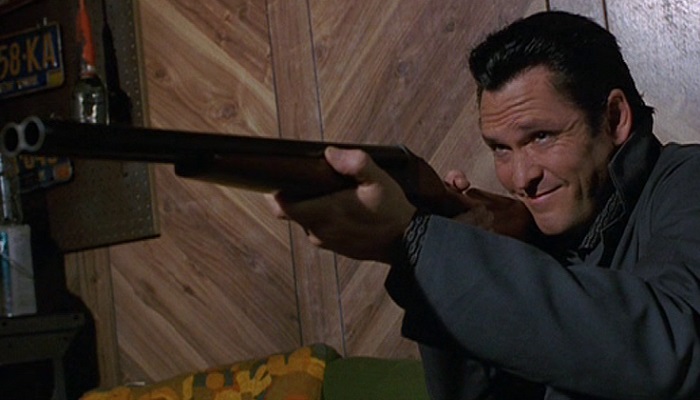
The master of body horror David Cronenberg made an outing in the gangster genre with A History of Violence, one of the surprise hits of 2005. I guess he liked it, because he soon followed it up with another gangster movie called Eastern Promises, once again starring Viggo Mortensen. A young Russian girl dies in childbirth, leaving a diary found by nurse Anna (Naomi Watts), who wants to return the baby to its family. Unable to read Russian, Anna seeks help and meets Semyon, a restaurant owner and leader of the brutal Russian mob Vory v Zakone. His enforcers – Kirill (Vincent Cassel), a violent, closeted homosexual, and Nikolai (Viggo Mortensen), a cunning newcomer – compete for Semyon’s approval. The diary reveals the girl was one of Semyon’s prostitutes, her life story unfolding in voice-over as the film’s central thread. The casting of non-Russians in the leading roles turns out very well. Mortensen speaks Russian like a pro. The details of the reality the filmmakers created are also spot-on: the underworld body tattoos that tell a person’s life story, the folk music, the accents, it is all very well executed. A few scenes stand out: Nikolai’s initiation ritual and a brutal fight in a bathhouse most notably. The characters are also beautifully realised, especially Cassel’s Kirill. You can feel the tension rise as his father swaps Nikolai for Kirill like he swaps a Ukrainian girl for a case of cheap booze. It is only a shame that ultimately too little is done with these characters. After we learn a big secret, the movie pretty much ends abruptly. Still works on many levels, and the cast and crew’s craftsmanship make it definitely worth viewing.


Dungeon Classics #44: A History of Violence

FilmDungeon’s Chief Editor JK sorts through the Dungeon’s DVD-collection to look for old cult favorites….

A History of Violence (2005, USA, Germany)

Director: David Cronenberg
Cast: Viggo Mortensen, Maria Bello, Ed Harris
Running Time: 96 mins.

David Cronenberg, the master of body horror, has long been fascinated by duality and fractured identities – most brilliantly explored in Dead Ringers (1988). In A History of Violence, adapted from a graphic novel, family man Tom Stall (Viggo Mortensen) reassures his young daughter that monsters don’t exist. Yet, as fate would have it, two real monsters arrive in their quiet town of Millbrook, Indiana, intent on another murderous spree. Tom stops them, but the media frenzy that follows draws the attention of gangsters who expose his dark past as a Philadelphia mob enforcer. Meanwhile, Tom’s sharp-witted son outsmarts an alpha male schoolyard bully, sparking a reflection on humanity’s violent, primal nature – our constant lust for power and sex. This realization weighs heavily on the son, who soon finds himself drawn into the violent legacy of the man his father once was. The ‘history’ in the title is richly layered: Tom’s hidden past, the family’s shared burden, and, quite literally, a story steeped in bloodshed. The film boasts a stellar cast, with William Hurt delivering a standout performance as Tom’s weirdo brother, Richie. It’s a history worth uncovering.

Double Bill #18: Fargo & A Simple Plan

Few films share as much in common as Fargo and A Simple Plan. Both unfold in the snowy, desolate landscapes of Minnesota, steeped in an atmosphere that feels as bleak as it is gripping. Thematically, they explore the destructive power of greed – how a single, flawed decision can spiral into violence, ruin lives, and reveal the darkness lurking within ordinary people. The connection between the films extends beyond their themes. The Coen Brothers, directors of Fargo, and Sam Raimi, who helmed A Simple Plan, are longtime collaborators and friends. Both films are superb, but Fargo stands as a true masterpiece. Its razor-sharp original screenplay and unforgettable characters set it apart. The story centers on Jerry Lundegaard (William H. Macy), a pathetic and desperate car salesman who arranges the kidnapping of his own wife, hoping to extort ransom money from his wealthy father-in-law. When the sociopathic criminals he hires (Steve Buscemi and Peter Stormare) murder a state trooper and two witnesses, they draw the attention of the sharp, heavily pregnant Brainerd police chief Marge Gunderson – an Oscar-winning role from Frances McDormand. Nothing in Jerry’s plan goes right, and the consequences of his evil scheme are as brutal as they are inevitable. A Simple Plan follows a similarly grim trajectory. When three men stumble upon a crashed plane in the woods – containing a dead pilot and over four million dollars in cash – the seemingly level-headed Hank (Bill Paxton) agrees with his dim-witted brother Jacob (Billy Bob Thornton) and Jacob’s redneck friend Lou (Brent Briscoe) to hide the money until they can safely claim it. What starts as a simple scheme quickly unravels, forcing Hank into a series of horrific acts to protect their secret. Together, these films serve as chilling cautionary tales, illustrating how the pursuit of easy money can corrupt ordinary lives and destroy families.

The Roaring Twenties (1939)


‘America’s Most Colorful Era!’

Directed by:
Raoul Walsh

Written by:
Jerry Wald (screenplay)
Richard Macaulay (screenplay)
Robert Rossen (screenplay)
Mark Hellinger (story)

Cast:
James Cagney (Eddie Bartlett), Priscilla Lane (Jean Sherman), Humphrey Bogart (George Hally), Gladys George (Panama Smith), Jeffrey Lynn (Lloyd Hart), Frank McHugh (Danny Green), Paul Kelly (Nick Brown), Elizabeth Risdon (Mrs. Sherman), Ed Keane (Henderson), Joe Sawyer (The Sergeant)

The Roaring Twenties opens in the immediate aftermath of World War I, as soldiers James Cagney and Humphrey Bogart return home in 1919. They find a nation grappling with economic hardship and rising living costs just as Prohibition is ratified, turning alcohol into both a forbidden fruit and a lucrative business opportunity.

The film follows Eddie Bartlett (Cagney), a former doughboy who seizes the moment and rises to power in the bootlegging underworld. Along the way, he reconnects with Jean Sherman, a woman he corresponded with during the war, securing her a singing job at a nightclub. His path eventually crosses again with his old comrade George Hally (Bogart), now a rival booze importer. Their partnership sours, and tensions escalate when they double-cross fellow bootlegger Nick Brown.

The movie by Raould Walch, who would ten years later make the best gangster film yet at that point – White Heat – is a trendsetter in more than one way. Walsh crafts The Roaring Twenties with a dynamic, almost documentary-like style. Crisp black-and-white cinematography is punctuated by newsreel-style interludes, lending the film an energetic, GoodFellas-esque rhythm. The story of the ‘working gangster’ feels like a clear influence on Scorsese, blending ambition, a jetset lifestyle, and eventually an ugly downfall.

Cagney delivers another magnetic performance as Eddie Bartlett, a character who begins as a mild-mannered entrepreneur, but grows increasingly volatile as his world unravels. What sets The Roaring Twenties apart is its focus on redemption: Eddie’s final act is a selfless one, driven by love rather than greed. It is a rare moral twist for the genre.

Like most gangster tales, it ends with a memorable line, this time spoken by a dame: “He used to be a big shot.”

Rating:

Quote:
EDDIE BARTLETT: “I just ran into a streak of bad luck, that’s all. I’ll be there on top again. I just got to figure out a new angle.”

Trivia:
Gladys George replaced Ann Sheridan (the female star of Cagney’s previous gangster film Angels with Dirty Faces) who had replaced Lee Patrick who had replaced Glenda Farrell for the character of Panama Smith.