The Driver

Director: Walter Hill
Written by: Walter Hill
Cast: Ryan O’Neal, Bruce Dern, Isabelle Adjani, Ronee Blakley

Year / Country: 1978, USA / UK
Running Time: 88 mins.

Ryan O’Neal stars as the Driver, a character defined by his cool, controlled demeanor. In the film’s opening, he steals a car to use as a getaway vehicle for a casino heist, instantly establishing his profession. We quickly understand that he takes his job very seriously. So seriously, in fact, that it’s not about the money for him, but about maintaining his professional integrity.

The Driver is smooth, fearless, and intensely focused. His obsessive commitment to professionalism drives the narrative of the film, reminiscent of Le Samouraï, where a similar code of conduct defines the protagonist. The film has an existential quality, with each character simply doing what they do best, without personal attachments or backstories. They aren’t even given names, only titles like ‘The Driver’, ‘The Detective’, and The Connection’.

Bruce Dern delivers an outstanding performance as the relentless cop determined to catch the Driver. His character devises a trap, using minor criminals in a staged bank robbery as bait. What follows is a tense game of cat and mouse. In the first half of the film, director Walter Hill expertly builds momentum through tight pacing and memorable sequences, most notably a standout scene in an underground parking garage where the Driver showcases his remarkable driving skills.

Unfortunately, much of the tension dissipates in the second half, as the film loses some of the momentum it carefully built. However, the final moments provide a satisfying conclusion. The Driver is a solid film and a cult classic in its own right, with Hill already demonstrating his potential as a filmmaker. The casting is spot-on, and while it doesn’t quite reach greatness, it remains a must-see if only for the three impeccably realistic chase sequences.

Rating:

Biography: Walter Hill (1942, California) has been an active member of the Hollywood community since 1967 when he became a 2nd assistant director. Ever since, he has produced, written and directed a significant number of movies. He once said in an interview that he considers all the films that he directed as westerns. If you look closely, you can see western touches, such as revolvers, Winchester rifles and cowboy hats in all of his work. Hill frequently works with character actors James Remar, David Patrick Kelly, Brion James and Ed O’Ross.

Filmography (a selection): Hard Times (1975), The Driver (1978), The Warriors (1979), The Long Riders (1980), Southern Comfort (1981), 48 Hrs. (1982), Streets of Fire (1984), Brewster’s Millions (1985), Crossroads (1986), Extreme Prejudice (1987), Red Heat (1988), Johnny Handsome (1989), Another 48 Hrs. (1990), Tales from the Crypt (1989-91, TV-episodes), Trespass (1992), Geronimo: An American Legend (1993), Wild Bill (1995), Last Man Standing (1995), Deadwood (2004, TV-episode), Broken Trail (2006, TV), Dead for a Dollar (2022)
Two-Lane Blacktop

Director: Monte Hellman
Written by: Rudolph Wurlitzer, Will Corry
Cast: James Taylor, Dennis Wilson, Laurie Bird, Warren Oates

Year / Country: 1971, USA
Running Time: 98 mins.

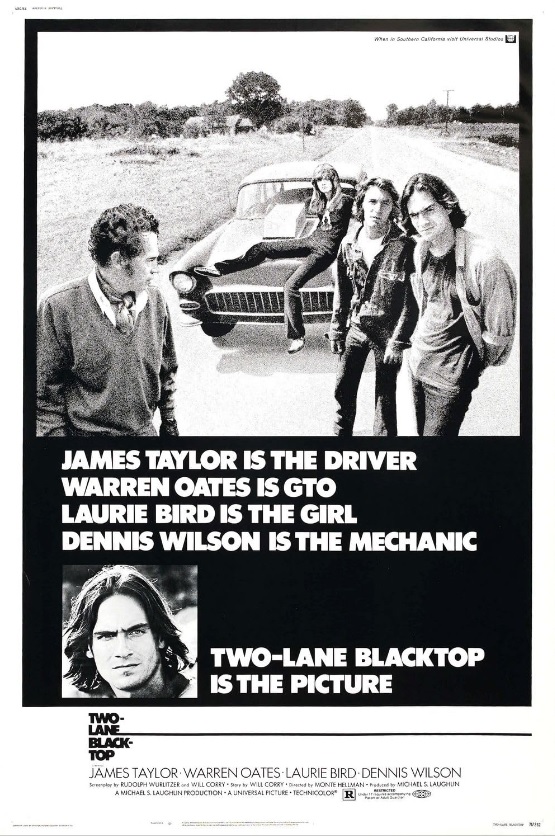
After winning a late-night drag race, the driver (James Taylor) and his friend, the mechanic (Dennis Wilson), leave Los Angeles in their gray ’55 Chevrolet. They embark on an aimless road trip, stopping only for food, gas, and the occasional driving challenge. Along the way, they pick up a free-spirited hitchhiker (Laurie Bird) and continue their journey eastward. Their path repeatedly crosses with a 1970 Pontiac GTO, driven by a boastful older man (Warren Oates), leading to a high-stakes cross-country race to Washington, D.C. for ownership of their cars.

This is not a summary of the story, but it’s the whole story. The film unfolds as a meditation on existentialism, where racing becomes a metaphor for life itself. The characters drive not toward any clear destination but toward an uncertain fate, embodying the restless, aimless energy of drifters. Tellingly, none of the main characters even have names, emphasizing their roles as archetypes of the disillusioned wanderer.

Watching this film feels like stepping into a time capsule. Much like American Graffiti, it captures the spirit of a bygone era – an America of the early 1970s, defined by hippies, muscle cars, and rock ‘n’ roll. The minimalist storytelling is complemented by striking cinematography, making the open road a central character in its own right.

Two-Lane Blacktop is more than a movie; it’s a raw, unvarnished piece of Americana. A snapshot of a world long past, it stands as a beautiful, haunting testament to a fleeting time and place in American culture.

Rating:

Biography: Monte Hellman (1932, New York) studied drama at Stanford University and film at UCLA. He joined legendary producer Roger Corman and made his film debut with Beast From Haunted Cave, an enjoyable 50’s creature flick. Hellman teamed up with Jack Nicholson and together they made two low-budget flicks in the Philippines, one written by Nicholson. They continued the co-op and made two more films together, this time Westerns. Once again Nicholson wrote the screenplay for one of them (Ride in the Whirlwind). Hellman then made Two-Lane Blacktop, which did well with critics, but bad at the box-office. After making a couple more cult movies, Hellman mostly worked as second-unit director, editor and executive producer for acclaimed directors such as Samuel Fuller, Paul Verhoeven and Quentin Tarantino. His latest directing effort was a segment of the horror anthology Trapped Ashes.

Filmography: Beast from Haunted Cave (1959), Flight to Fury (1964), Back Door to Hell (1964), Ride in the Whirlwind (1965), The Shooting (1967), Two-Lane Blacktop (1971), Cockfighter (1974), Baretta (1975, TV), The Greatest (1977), China 9, Liberty 37 (1978), Inside the Coppola Personality (1981), Iguana (1988), Silent Night, Deadly Night III: Better Watch Out! (1989), Stanley’s Girlfriend (2006, short), Trapped Ashes (2006, segment ‘Stanley’s Girlfriend’)

Dirty Mary, Crazy Larry

Director: John Hough
Written by: Leigh Chapman, Antonio Santean, Richard Unekis (novel ‘The Chase)
Cast: Peter Fonda, Susan George, Adam Roarke, Kenneth Tobey

Year / Country: 1974, USA
Running Time: 93 mins.

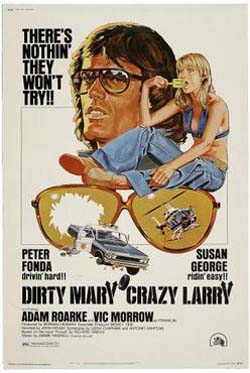
Peter Fonda’s Larry and his partner Deke (Adam Roarke) rob a supermarket manager for 150 large. On their getaway, they encounter the sluttish Mary who joins them on their high speed road trip in a blue Chevy. The law is on to them quickly leading to a number of spectacular chases. Off course the trio outsmarts the initially unmoved, but later fanatical police chief, played by Vic Morrow.

‘I’m gonna braid your tits’, the misogynist Larry tells Mary at one point during the movie. Not very politically correct but exploitation pur sang. Just check out the movie’s poster above: pure vintage 70’s cool. This film became a major drive-in cinema hit.

Dirty Mary, Crazy Larry is an excellent companion piece for Vanishing Point or Two-Lane Blacktop, philosophical, little story and big on car chases. That last element is especially well done. As soon as ‘the chase’ starts we get a 200 mph high-speed nitrous burnout. Very spectacular. The nihilistic tone doesn’t hurt the movie either.

The stupefying characters will be especially enjoyable for a stoned audience. Fonda plays a rougher (and crazier) version of his Easy Rider character Wyatt, and he pulls this off quite effectively. Mary’s part is harder to enjoy. We know she’s dirty, but why and what else is there to this girl?

The ending of Dirty Mary, Crazy Larry comes unexpectedly for those who are unfamiliar with this particular type of movie. It is shocking either way, and in a certain regard…beautiful. Especially as soon as the closing song ‘Time is Such a Funny Thing’ becomes audible.

Rating:

Biography: John Hough (1941, London) came into the picture with some low-budget horror flicks like Twins of Evil and The Legend of Hell House. He got his big break by securing himself a steady position as assistant director on the extremely popular TV-show The Avengers. Later he would try other stuff like sci-fi, fantasy, western, action and drama. He even directed a few Disney pictures. Late eighties he had a bump in the road, exemplified with the cruddy horror flick Howling IV: THe Original Nightmare. Hough’s last credit as a director to date was the gory Jack the Ripper tale Bad Karma.

Filmography (a selection): Wolfshead: The Legend of Robin Hood (1969), The Avengers (1968-69, TV episodes), Eyewitness (1970), Twins of Evil (1971), Treasure Island (1972), The Legend of Hell House (1973), Dirty Mary Crazy Larry (1974), Escape to Witch Mountain (1975), Return from Witch Mountain (1978), Brass Target (1978), The Watcher in the Woods (1980), Triumphs of a Man Called Horse (1982), Black Arrow (1985, TV), Biggles (1986), American Gothic (1987), Howling IV: The Original Nightmare (1988), A Ghost in Monte Carlo (1990, TV), Something to Believe In (1998), Bad Karma (2001)

The Gumball Rally

Director: Charles Bail
Written by: Charles Bail, Leon Capetanos
Cast: Michael Sarrazin, Norman Burton, Gary Busey, Raul Julia

Year / Country: 1976, USA
Running Time: 102 mins.

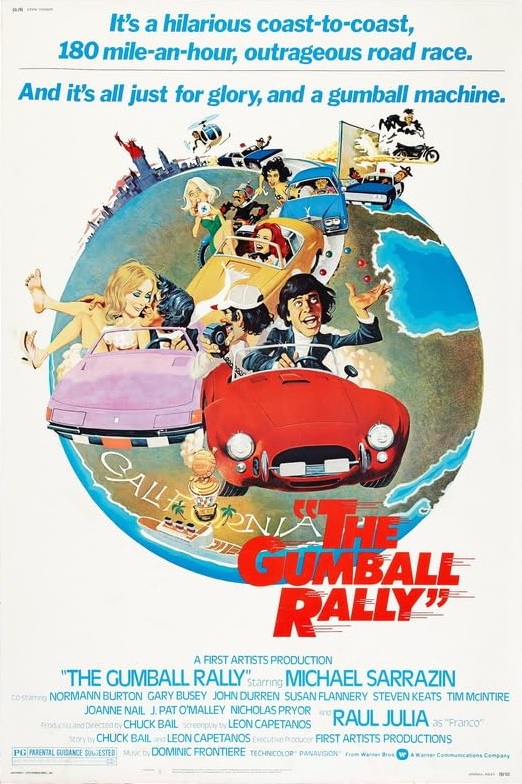
In the seventies, the classic ‘Cannonball Baker Sea-To-Shining-Sea Memorial Trophy Dash Run’ took place. One long run from New York to Los Angeles, organized by Brock Yates who later wrote a movie script about it. This became The Cannonball Run, a 1981 comedy starring Burt Reynolds. Two films about this race preceded it; Cannonball! and The Gumball Rally, both released in 1976.

This movie is the best of the three. It beats The Cannonball Run because it lacks the corny jokes. It is actually pretty funny at times and features some great characters. Most memorable are Gary Busey as a crazy mechanic and Raul Julia as the overly romantic Italian driver Franco. There are female drivers as well. One of them is a young Susan Flannery AKA Stephanie Forrester from The Bold and the Beautiful. Yes, really!

Besides the effective use of humor, the driving action beats that of Cannonball!, because you get an actual sense of high speed. Especially during a spectacular sequence in New York, where the race begins and in which the contestants drive through the city with at least 100 miles per hour. All the drivers use amazing cars, including a Cobra, Ferrari, Porsche, Dodge, Rolls, Mercedes, Bentley and Camaro. One guy, Lapchick the Mad Hungarian, even drives a Kawasaki bike. An awesome sight for racing fans as this movie is to the fans of this movie genre.

Rating:

Biography: Charles Bail AKA Chuck Bail (1935 – 2020) has an impressive show business career that spanned from the fifties up until the nineties. He basically did everything from performing to directing and being a stunt coordinator. He started his career as stuntman and guest star on many famous western shows. After that, he directed episodes for famous television series such as Knight Rider and Dragnet. He also directed several films, such as the blaxploitation classic Cleopatra Jones and the Casino of Gold. Bail is currently retired and lives in Texas.

Filmography: Black Samson (1974, short), Cleopatra Jones and the Casino of Gold (1975), The Gumball Rally (1976), CHiPs (1981-83, TV episodes), Manimal (1983, TV episodes), Knight Rider (1985/86, TV episodes), Choke Canyon (1986), Dragnet (1989-91, TV episodes), Adam 12 (1990/91, TV episodes), Baywatch Nights (995/96, TV episodes), Street Corner justice (1996)