
Director: Sergio Leone
Written by: Agenore Incrocci, Furio Scarpelli, Luciano Vincenzoni, Sergio Leone
Cast: Clint Eastwood, Lee Van Cleef, Eli Wallach
Year / Country: 1966, Italy, Spain, West Germany
Running Time: 171 mins.
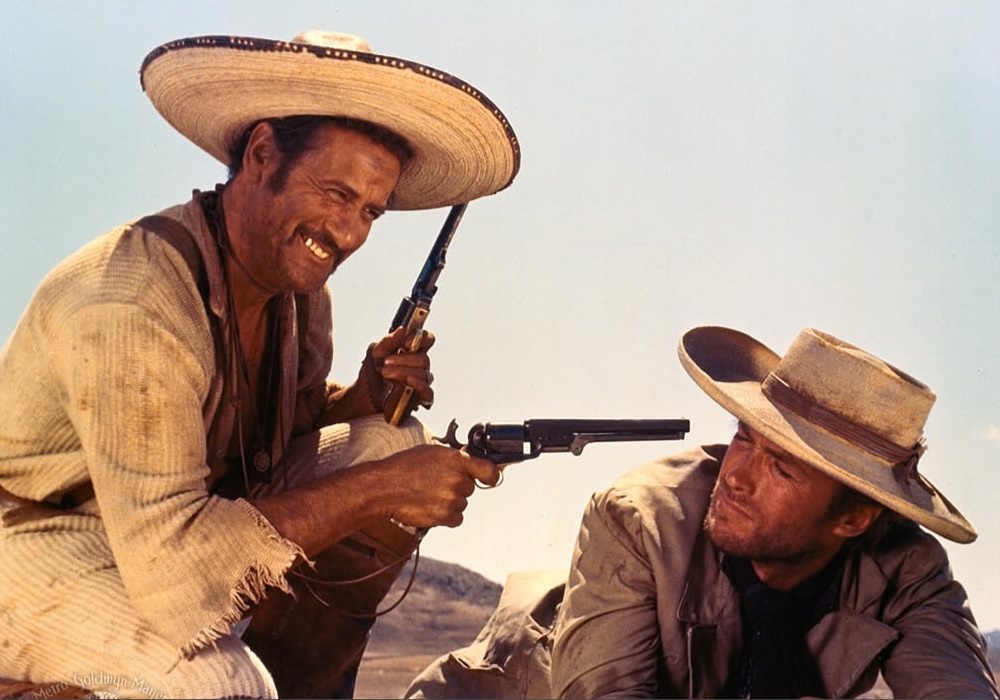
The final installment of Sergio Leone’s ‘Dollars Trilogy’ is a critically acclaimed masterpiece. Set against the backdrop of the American Civil War, three men are on a relentless quest for a fortune in hidden gold. While soldiers fight to determine the fate of a nation, these men pursue only their own interests. They are the Good, the Bad, and the Ugly. While the last two labels are fitting, the first is somewhat misleading – Eastwood’s character, Blondie, may be more principled than the others, but he doesn’t hesitate to kill when it serves his purpose.
Blondie and Tuco (the Ugly, played by Eli Wallach) form a crooked partnership built on mutual betrayal. After one double-cross nearly costs Blondie his life, they’re forced into a reluctant alliance when each comes into possession of a crucial piece of information that could lead them to the buried treasure. Meanwhile, Angel Eyes (the Bad, portrayed by Lee Van Cleef) is hot on their trail, determined to claim the gold for himself. The three men converge on a remote graveyard, where their fates – and the money – await.
Compared to the earlier two films in the trilogy, The Good, the Bad and the Ugly offers a surprisingly human touch. Eastwood’s Blondie reveals a gentler side, cradling a kitten in his hat and comforting a dying soldier with a cigar. Tuco, though undeniably a scoundrel, becomes unexpectedly poignant during a visit to the monastery where he confronts his estranged brother. This and other scenes flesh out Tuco into the trilogy’s most fully realized character, brought to life in a brilliant performance by Wallach. Despite the emotional depth, Leone doesn’t abandon his signature blend of dark humor and biting cynicism.
Visually, the film is a triumph. Leone’s mastery shines in the rhythmic interplay between intimate close-ups and sweeping, war-torn landscapes that seem to take on a character of their own – harsh and unforgiving, especially evident in the desert sequence where Blondie’s face is scorched by the sun. From the bold, stylized opening credits to the iconic, ritualistic cemetery shootout, the cinematography and editing are innovative and arresting. Add to that Ennio Morricone’s legendary score, and you have one of the most influential films of all time.
The Good, the Bad and the Ugly has been released in various versions, but nothing less than the full three-hour cut does it justice. Only in its complete form does this epic ‘horse opera’ truly come into its own. This is cinema as it was meant to be.
Rating:



Biography: Sergio Leone (1929, Rome – 1989, Rome) made his debut in the cinema working as a voluntary assistant and extra, among other things, in The Bicycle Thieves by Vittorio de Sica. Later, he became assistant director to Mario Bonnard. In 1959, when Bonnard was ill, he took over from him on the set of The Last Days of Pompeii. In 1961 he directed his first full-length film: The Colossus of Rhodes. But the film that was to bring him to the general attention came out in 1964: A Fistful of Dollars. His next films, For a Few Dollars More and The Good, The Bad and the Ugly complete what came to be known as the Dollars Trilogy and were a great box-office success. He would only make three more films before tragically passing away in 1989. He was taken from us by a heart attack in his house in Rome, while working on an ambitious project for a film on the Siege of Leningrad.
Filmography: The Colossus of Rhodes (1961), A Fistful of Dollars (1964), For a Few Dollars More (1965), The Good, The Bad and the Ugly (1966), Once Upon a Time in the West (1968), A Fistful of Dynamite (1971), Once Upon a Time in America (1984)
 FRAGMENTEN UIT HET SCHEMERLAND