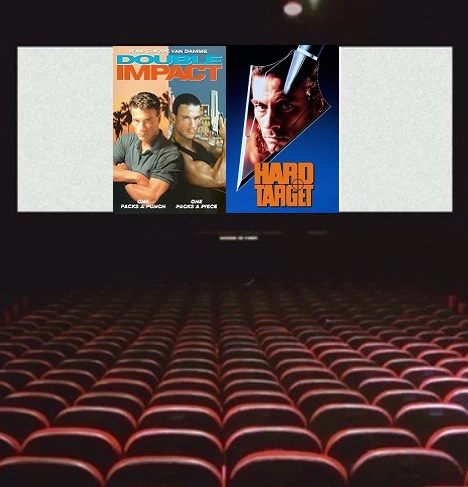
Double Bill #13: Double Impact & Hard Target

The eighties and nineties, the decades in which I grew up in, was the era of the action movie. And one of its main heroes was Jean-Claude Van Damme (real name: Jean-Claude Van Varenberg). For this Double Bill, I rewatched two of his most enjoyable and nostalgic movies of this period: Double Impact (1991) and Hard Target (1993). In the first one he plays a set of twin brothers, so it has double the Van Damage. The brothers go after a bunch of gangsters in Hong Kong who murdered their parents when they were babies. It has great bad guys, who are stylishly dispatched by the two Van Damme characters using both martial arts and a variety of firearms. The greatest threat is the triad member played by Bolo Yeung, a legendary Chinese martial arts expert who is also in Enter the Dragon and Van Damme’s Bloodsport. The final duel with him is one of the highlights of the movie. The film’s director Sheldon Lettich also directed Wrong Bet in 1990, another Van Damme classic. He is no John Woo, but skillful enough to give the audience what it wants: violent, bloody action and some humor on the side. Hard Target has plenty of this as well, but the choreography of the action scenes is of a whole different level. Van Damme takes on a gang of despicable white men, led by Lance Henriksen, who organize manhunts for the rich and bored. Van Damme’s character Chance grew up in the New Orleans Bayou and knows a thing or two about survival and asskicking. When he becomes the quarry of their next hunt, the roles are quickly reversed and we get to witness some of the most satisfying kills of Van Damme’s career. Hong Kong director John Woo’s American debut was produced by Robert Tappert and Sam Raimi (of Evil Dead fame). It is easy to see why they liked this project: Woo’s visual style is so immensely cool it matches Raimi’s. His action is an art form, a ballet of blood, bullets, explosions, falling bodies and flying kicks in slow motion. These are two classics of the era and highly enjoyable as a Double Bill.
Le samouraï (1967, Review)

Directed by:
Jean-Pierre Melville

Written by:
Jean-Pierre Melville
Georges Pellegrin

Cast:
Alain Delon … Jef Costello
Francois Périer … Superintendent
Nathalie Delon … Jane Lagrange
Cathy Rosier … Valérie, The Pianist
Jacques Leroy … Man in the passageway
Michel Boisrond … Wiener
Robert Favart … Bartender
Jean-Pierre Posier … Olivier Rey
Catherine Jourdan … Hatcheck Girl
Roger Fradet … First Inspector

‘There is no greater solitude than that of the samurai. Unless it is that of the tiger in the jungle. Perhaps…’
– BUSHIDO (Book of the Samuraï)

As the above quote that opens Le samouraï indicates, this film revolves around a loner. Hired killer Jef Costello (Alain Delon) lives in a greyish apartment with a bird as his only company. As soon as he gets up from his sofa, he engages in a dangerous mission: a contract murder in a crowded nightclub. Many patrons spot him in his conspicuous outfit: a raincoat, a hat and white gloves, much like how the gangsters in old Hollywood movies dressed.

After the murder, the police start to round up the usual suspects including Costello. He turns out to be a professional however; the beautiful Jane provides him with a watertight alibi. There is something strange at work though. The nightclub’s pianist, who clearly had a good look at Jef, lies to the police and says it wasn’t him. The cops are forced to release him, but the superintendent doesn’t trust it and has him tailed. In the meantime, we meet Jef’s employers who are unhappy with the many eyeball witnesses and plan to have him removed.

Le samouraï is a very minimalist film with also a sense of avant garde in it. It reminds a lot of John Boorman’s Point Blank that was released in the same year. The story is deceivingly simple, but leaves much room for various interpretations. Rather than on storytelling, director Melville focuses on style and he does so in a brilliant fashion. This movie is just perfectly crafted. Every image, many just showing uber-cool protagonist Jef roaming around in Paris, is shot amazingly and serves a purpose as well. The colour pallet consists of solely cold colours.

Although inspired by American gangster flicks, Le samouraï is still very distinguishable due to Melville’s master’s touch. In turn, it has inspired many modern gangster authors including John Woo and Quentin Tarantino. The films from Woo – most notably A Better Tomorrow and The Killer – feature scenes almost literally lifted from Le samouraï.

The first viewing is a bit awkward because of the cold, distant tone. But multiple viewings are bound to reveal a lot of hidden substance in the multi-layered screenplay. Both critically and commercially this is considered as one of Melville’s greatest successes.

Quote:
OLIVER REY: ‘A wounded wolf. He’ll leave a trace now. No, we have to get rid of him and quick.’

Trivia:
This is Johnnie To’s favourite film.