Mind Book #2 – The Spread Mind

Read also: Mind Book #1 – Being You
In The Spread Mind: Why Consciousness and the World Are One (2018), philosopher, psychologist, and AI expert Riccardo Manzotti offers a bold new perspective on the problem of consciousness. Rejecting the notion that experience arises from neural activity – the default view in contemporary science – Manzotti argues that experience and reality are fundamentally identical. While this might evoke comparisons to biocentrism, the Spread Mind is a distinct theory.

Biocentrism posits that consciousness actively creates the world. In contrast, the Spread Mind asserts that consciousness is physical yet external to the body. It is neither a property of the brain nor the body; rather, it is identical to the objects in the surrounding environment. So when you are looking at an object, let’s say an apple, that apple is not in space and time but where you experience it. Also, the apple is identical to your experience of it.

At first glance, this might again seem like a biocentric perspective, as both theories reject the idea of an apple existing independently in the outside world, waiting to be experienced. However, the distinction lies in where the apple resides: in biocentrism, the apple exists within the mind, whereas in the Spread Mind theory, the apple is the mind. The object is causal, active, relative, temporally-defined, and of course spread.

What we label ‘an object’, Manzotti asserts, is a physical occurrence that repeats itself whenever we put our bodies in the proper circumstances. As a result, even though we believe the same object perdures, what perdures is not the object but a set of circumstances that are favorable to the occurrence of a series of identical objects.

Relocating experience in the world – and therefore ‘spreading’ consciousness in spacetime – can pay back in terms of simplicity, states Manzotti. And he’s right. Up to now, the reduction of experience to neurons and their whereabouts, the usual candidates for the physical underpinnings of consciousness, has not been satisfactory for explaining the conscious mind, since experience and the brain do not resemble each other in the least. In his theory, consciousness will no longer be an unexpected addition to the physical world because appearance and reality are the same thing.

To explain why his theory is better, he uses the simple case of Emily experiencing a red apple. The common perception is that she reproduces the apple inside her brain. But is that really the best solution? Manzotti’s view: ‘The brain is pinkish-gray, gooey, and bloody. The red apple is red, round, and applish. Which entity is more similar to Emily’s experience of the red apple?’ (P. 9)

The theory of the Spread Mind asserts that phenomenal and physical properties are the same. We perceive the world as it is because we are the world we perceive. The properties of our experience are the properties of the physical world we live in. According to the Spread Mind theory, the mind is a set of objects. Manzotti describes the body as a causal object that ‘causes’ all the other objects to be part of the set. This is again close to biocentrism, where it is consciousness itself that is the causal entity that ‘collapses’ the objects it observes, including the body and brain of that conscious observer.

However biocentrism is a modern version of idealism and the Spread Mind posits itself as a form of physicalism. The difference with the standard form of physicalism is that it doesn’t state that conscious experience arises from matter, but that experiences of matter are the matter, and are therefore physical.

My thoughts about this book
I admire Riccardo Manzotti greatly for making a leap in thinking and going beyond the default view. Rather than following the – in my opinion – dead end street of materialism, he takes a highly original standpoint and locates consciousness outside the body. You are one with the objects you perceive. You are the collection of objects you are currently perceiving. Your body – also an object – is the cause of the other objects you experience to be ‘there’.

However, the spread mind fails to capture the essence of what a mind is in my opinion. My mind is not the trash can I just saw. Rather, it is the integrated collection of thoughts, feelings, memories and perceptions that make up that ‘me’ feeling. The trash can appears in my mind, but it is not the same as my mind. Once identity is the same as the objects we observe, this means that if I am drinking a glass of beer in a bar, I am that glass of beer, the bar and even the waitress that is currently serving me.

Manzotti also writes some things that seem contradictory. For example, he writes that in his physical theory, ‘realism is safe’. But according to his theory, objects are only present in relation to the body, and that would violate realism which assumes that an external reality is always present also in the absence of an observer or body.

In conclusion, it was a great and original move by Manzotti to take the mind out of the brain, but biocentrism is better equipped to explain the totality of mental experiences and their relation to the workings of the universe.

You can read more about biocentrism and consciousness on my platform:
http://free-consciousness.com

Review Observer (2023, Robert Lanza, Nancy Kress)

“You are the observer. You create the universe every day, every hour, every nano-second. Everything that can exist, will exist, somewhere, including your beloved dead. They can once again be alive, walking around, solid as the chair you sit in now, solid as this book you hold in your hand.”

In the new science fiction novel ‘Observer’ – written by an actual scientist and a sci-fi writer – the mindblowing implications of quantum mechanics are taken to the next level.

The scientist is Robert Lanza, who in 2009 published his masterpiece ‘Biocentrism’, a non-fiction book about his theory based solely on science that concludes that life and consciousness create the universe, not the other way around. The writer is American science fiction author Nancy Kress, who won several awards for her work, which includes ‘After the Fall, Before the Fall, During the Fall’ and ‘Fountain of Age’.

In ‘Biocentrism’, and its sequels ‘Beyond Biocentrism’ and ‘The Grand Biocentric Design’, Lanza explained how observers (humans and other animals) create physical reality. Without observers, the universe (spacetime and matter) would remain in a state of superposition. Being alive means you are collapsing wavefunctions and you are transforming a cloud of probabilities into one manifest reality.

The premise of ‘Observer’ is that this is indeed how reality works, and a group of scientists has developed new technology which changes the algorithms by which the brain processes information. This enables the characters to create alternative branches of the universe in which their deceased loved ones can once again be alive.

It happens often that new scientific views are communicated to the general public through popular culture. ‘Biocentrism’ has not yet transformed the mainstream scientific view that sees the universe as a huge space filled with marbles that accidentally also contains life and consciousness. ‘Observer’ is a solid attempt to translate the ideas of ‘Biocentrism’ into a compelling science fiction story. It was a smart move to team up with a writer because it has believable characters and reads like a bullet train.

One of the characters is physicist George Weigert who is basically a fictionalized version of Lanza himself. It is he who has developed the biocentric theory which he calls ‘the primacy of the observer’. His main motivation to do it is to see his dead wife Rose again. The main character is surgeon Caroline Soames-Walkins who joins the team on Cayman Brac to perform the operations needed to install the brain-chips that participants need in order to create other branches of the universe. She remains in doubt the whole time about the project and suspects that what the participants see is just an elaborate hallucination. What could convince her of the truth?

The book contains many of the same explanations that ‘Biocentrism’ first pioneered about the true nature of space, time and reality. Sometimes, they have characters explain these concepts in a way that’s not entirely believable. It is obviously Lanza talking. But this is a minor critique. What ‘Observer’ does very well is explaining real, revolutionary science in an understandable way. This doesn’t mean it becomes easy, because as Lanza has pointed out many times; language is a limited tool when it comes to explaining fundamental truths like the illusion of time.

Luckily, you don’t have to fully understand all the science to enjoy the story. If observers indeed create reality, this opens up many staggering possibilities. Some of these are explored in this book, but the writers didn’t overdo it. There is definitely a sequel suspended in superposition in which the future possibilities are explored further. Perhaps ‘Creator’ is a suitable title for this sequel?

More about biocentrism, quantum physics and the true nature of reality: Check out my new platform Free-Consciousness.

What Schrödinger’s Cat Tells Us About Reality

When you ask someone if it is possible to conduct an experiment in which a cat is both dead and alive simultaneously, she will wonder if you have gone mental (believe me, I tried it at work several times). “Off course this is not possible. That is complete rubbish!”

Or could it be that reality is much weirder than most people realize? In this short essay I will explain how this experiment is possible, why it works like it does, and what it means for our understanding of the world (it will turn out I have indeed gone mental, but in a different way). If you are willing to accept a paradigm shattering worldview, the result is not so crazy at all.

By the way, if you’re not yet familiar with the observer effect of quantum mechanics, check out this video first:

The Experiment
The Austrian quantum physicist Erwin Schrödinger (1887 – 1961) came up with the famous thought experiment to show how ridiculous the widely accepted Copenhagen interpretation of quantum mechanics is. According to this interpretation, physical systems generally do not have definite properties prior to being measured, and quantum mechanics can only predict the probabilities that measurements will produce certain results. The act of measurement causes the set of probabilities to reduce to only one of the possible values immediately after the measurement. This feature is known as wave function collapse.

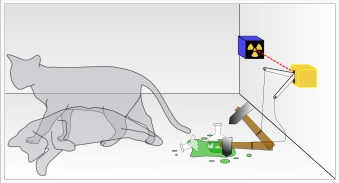
The experiment works like this: a cat is placed in a sealed box along with a Geiger counter, a bottle of poison and a radioactive particle that may or may not decay after an hour. If the Geiger counter detects that the particle has decayed, it will trigger the smashing of the bottle of poison and the cat will be killed. But because no one is observing the box, the radioactive particle exists in superposition, meaning it exists (or actually doesn’t exist) in all possible states at once. It is not until someone opens the box that the wave function collapses, the particle assumes a definite state and the cat is either killed or not.

The Implications
The paradigm that the world exists as independent reality and we are merely innocent bystanders is smashed by Schrödinger’s experiment. Nevertheless, this is still the dominant worldview today, especially in the West, while these experiments are already a century old. The observer is not observing an independent reality, but is in fact creating it. Not by herself; we are all part of a bigger consciousness that is determining what is manifested reality and what is not. It turns out that we are not living in a material world, but in a mental world. The only way to escape from the weirdness of the dead-alive cat is to accept mind as a property of reality besides matter. Off course I don’t mean mind as created by the material brain, but a mind that is linked to it, but also exists independent of the body.

What quantum mechanics shows us is that reality consists of two levels. One level is the everyday world we observe. Within this level we – as conscious observers – materialize objects within our relative perspectives of space and time. The other level is that of pure potentiality. At this level, everything merely exists as possibility, but nothing exists in a determined state. Within this level – that lies beyond the veil of our perception – space and time don’t exist as independent bedrock realities. And because these dimensions don’t exist, it is no longer possible to separate anything, so at this level we are all one. This is hard to grasp from our individual ego-states, but in special states of consciousness, such as near death, people experience it all the time.

That is the real radical stuff that quantum mechanics tells us, and most physicists don’t like it much. Schrödinger himself wanted to return to the objective worldview in which events were deterministic (meaning that if you have all information about a reality, you can predict what will happen). His experiment has become the perfect vehicle to demonstrate why this deterministic view does not work at all.

Quantum mechanics has shown us that a pure mechanical, material universe without mind could never exist. It has also shown us that living creatures could not have arisen out of dead matter, because without a conscious observer to begin with, matter has no definite place within reality. Consciousness must therefore be the unified basis of all existence.

Read also: Finally An Explanation For The Bizarre Phenomena In Quantum Mechanics