Read also: Mind Book #1 – Being You

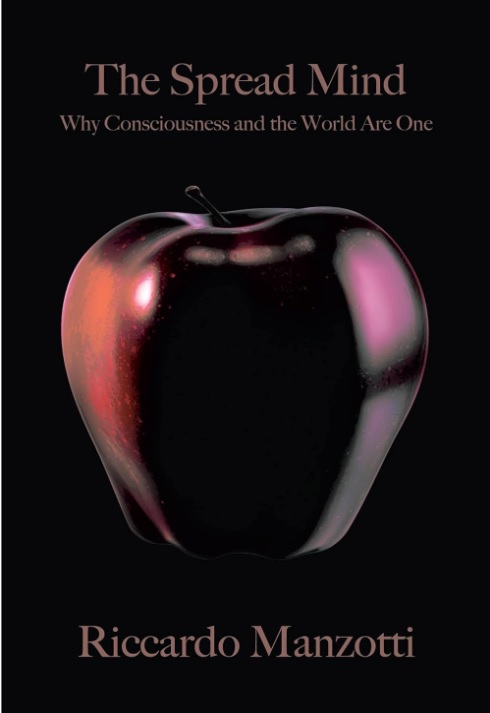
In The Spread Mind: Why Consciousness and the World Are One (2018), philosopher, psychologist, and AI expert Riccardo Manzotti offers a bold new perspective on the problem of consciousness. Rejecting the notion that experience arises from neural activity – the default view in contemporary science – Manzotti argues that experience and reality are fundamentally identical. While this might evoke comparisons to biocentrism, the Spread Mind is a distinct theory.
Biocentrism posits that consciousness actively creates the world. In contrast, the Spread Mind asserts that consciousness is physical yet external to the body. It is neither a property of the brain nor the body; rather, it is identical to the objects in the surrounding environment. So when you are looking at an object, let’s say an apple, that apple is not in space and time but where you experience it. Also, the apple is identical to your experience of it.
At first glance, this might again seem like a biocentric perspective, as both theories reject the idea of an apple existing independently in the outside world, waiting to be experienced. However, the distinction lies in where the apple resides: in biocentrism, the apple exists within the mind, whereas in the Spread Mind theory, the apple is the mind. The object is causal, active, relative, temporally-defined, and of course spread.
What we label ‘an object’, Manzotti asserts, is a physical occurrence that repeats itself whenever we put our bodies in the proper circumstances. As a result, even though we believe the same object perdures, what perdures is not the object but a set of circumstances that are favorable to the occurrence of a series of identical objects.
Relocating experience in the world – and therefore ‘spreading’ consciousness in spacetime – can pay back in terms of simplicity, states Manzotti. And he’s right. Up to now, the reduction of experience to neurons and their whereabouts, the usual candidates for the physical underpinnings of consciousness, has not been satisfactory for explaining the conscious mind, since experience and the brain do not resemble each other in the least. In his theory, consciousness will no longer be an unexpected addition to the physical world because appearance and reality are the same thing.
To explain why his theory is better, he uses the simple case of Emily experiencing a red apple. The common perception is that she reproduces the apple inside her brain. But is that really the best solution? Manzotti’s view: ‘The brain is pinkish-gray, gooey, and bloody. The red apple is red, round, and applish. Which entity is more similar to Emily’s experience of the red apple?’ (P. 9)
The theory of the Spread Mind asserts that phenomenal and physical properties are the same. We perceive the world as it is because we are the world we perceive. The properties of our experience are the properties of the physical world we live in. According to the Spread Mind theory, the mind is a set of objects. Manzotti describes the body as a causal object that ‘causes’ all the other objects to be part of the set. This is again close to biocentrism, where it is consciousness itself that is the causal entity that ‘collapses’ the objects it observes, including the body and brain of that conscious observer.
However biocentrism is a modern version of idealism and the Spread Mind posits itself as a form of physicalism. The difference with the standard form of physicalism is that it doesn’t state that conscious experience arises from matter, but that experiences of matter are the matter, and are therefore physical.
My thoughts about this book
I admire Riccardo Manzotti greatly for making a leap in thinking and going beyond the default view. Rather than following the – in my opinion – dead end street of materialism, he takes a highly original standpoint and locates consciousness outside the body. You are one with the objects you perceive. You are the collection of objects you are currently perceiving. Your body – also an object – is the cause of the other objects you experience to be ‘there’.
However, the spread mind fails to capture the essence of what a mind is in my opinion. My mind is not the trash can I just saw. Rather, it is the integrated collection of thoughts, feelings, memories and perceptions that make up that ‘me’ feeling. The trash can appears in my mind, but it is not the same as my mind. Once identity is the same as the objects we observe, this means that if I am drinking a glass of beer in a bar, I am that glass of beer, the bar and even the waitress that is currently serving me.
Manzotti also writes some things that seem contradictory. For example, he writes that in his physical theory, ‘realism is safe’. But according to his theory, objects are only present in relation to the body, and that would violate realism which assumes that an external reality is always present also in the absence of an observer or body.
In conclusion, it was a great and original move by Manzotti to take the mind out of the brain, but biocentrism is better equipped to explain the totality of mental experiences and their relation to the workings of the universe.
You can read more about biocentrism and consciousness on my platform:
http://free-consciousness.com



 FRAGMENTEN UIT HET SCHEMERLAND