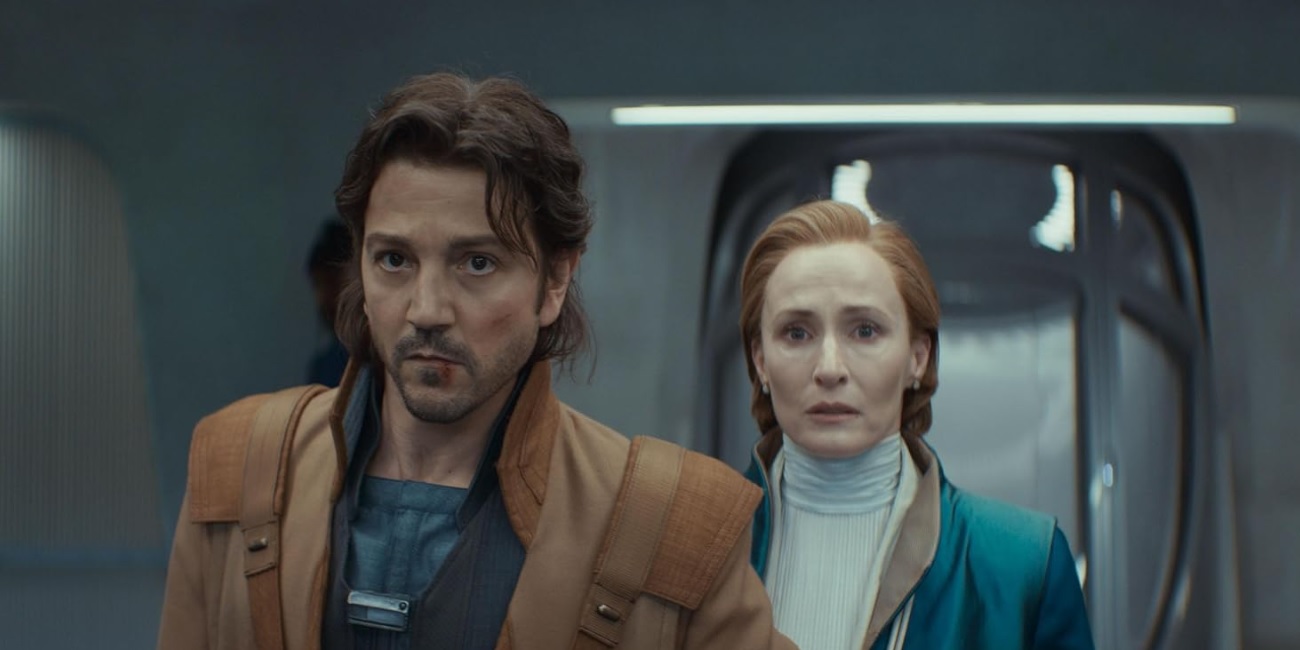
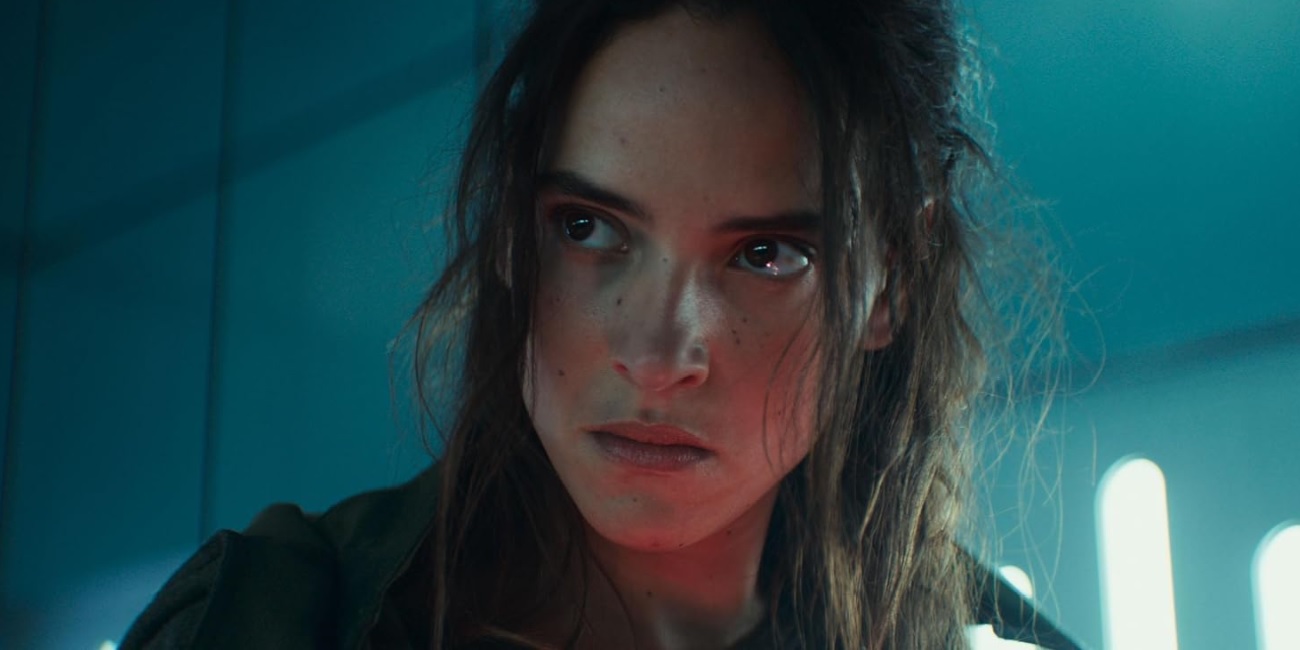

Andor (2022–2025 – 24 episodes)
Creator: Tony Gilroy
Starring: Diego Luna, Denise Gough, Stellan Skarsgård, Adria Arjona & Kyle Soller
The second season of Andor leads directly into the events of Rogue One, which itself sets the stage for A New Hope. It’s a story of rebellion, defiance, and resistance – values the world desperately needs right now but seems to be running short on. The timing of Andor is striking, coinciding with an authoritarian shift currently underway in the United States.
The series opens with a thrilling scene in which the main hero, Cassian Andor, steals a TIE fighter. He struggles to fly it, leading to a daring and spectacular escape. Before taking off, he tells a resistance ally: “The Empire cannot win. You will never be right unless you’re doing what you can to stop them.” It’s a line that feels less like fiction and more like prophecy.
In the original Star Wars films, the Empire was portrayed as an all-powerful, faceless regime with little internal resistance. Andor pulls back the curtain, revealing the machinery of authoritarianism – and the cracks within it. We see how such regimes function, and we meet those who make them work. These Imperial functionaries are a million times more competent than the members of Trump’s regime, but they still run into their share of challenges.
Among these enablers of evil, Dedra and Syril – introduced in Season 1 – are the most fascinating. Now involved in a love affair, their current mission is to work on an energy programme on the planet Ghorman. The Empire wishes to extract a valuable mineral called Kalkite. Sound familiar? Dedra gets the top job, and Denise Gough shines in the role – utterly convincing as a sycophantic bureaucrat championing a fascist program to “Make the Empire Great Again.”
Andor is a refreshingly original take on the Star Wars universe, offering a chilling portrayal of life under autocracy. Ironically, it’s produced by Disney which like so many other free institutions is currently under attack by the Trump government for its commitment to diversity and inclusion. But Andor responds in kind: with fierce resistance. Its rebels – Cassian, his partner Bix, Luthen, and Mon Mothma – are flawed, human, and fiercely dedicated. They’re all willing to risk everything for the cause.
The story unfolds slowly but deliberately, structured into four arcs of three episodes each, moving steadily toward the Battle of Yavin and the destruction of the Death Star. We follow Cassian as he escapes with resistance fighters in the stolen TIE fighter; Mon Mothma as she balances a strategic marriage for her daughter with her political double life; and Bix, suffering from PTSD, hiding during an immigrant crackdown on a farming planet; a clear parallel to current global events.
Meanwhile, Dedra and Syril navigate their lives on Coruscant. Dedra handles her overbearing mother-in-law while being invited to join a secret imperial operation on Ghorman.
The pacing can be slow at times, but the show remains compelling throughout. In episode 8, the tone turns especially grim when a massacre takes place on Ghorman – evoking contemporary parallels to the genocide in Gaza. The killer droids deployed during the assault give us a harrowing preview of what future wars might look like. The rebels – and the audience – finally discover that Orson Krennic (a scene stealing Ben Mendelsohn) has spent ten years developing the Death Star. The Ghorman minerals were essential to his work, regardless of the cost to the planet.
From that point on, the narrative builds steadily toward the beginning of Rogue One. With its second and final season, Andor now stands as the best Star Wars series Disney has produced. The visuals are stunning – hard to imagine 20 years ago that a series could look like this in 2025 – and the story offers a bold, original angle within the Star Wars mythology. The cast is uniformly excellent. While many deserve praise, Diego Luna (whose name feels fitting for the galaxy far, far away) anchors the series with a nuanced, committed performance.
The political parallels are unmistakable. A stormtrooper arresting a senator in the Senate, Mon Mothma’s colleagues afraid to vote against Palpatine, state propaganda distorting the truth: these are no longer just fantasy. They’re reflections of what’s happening in the real world.
Andor also reminds us what revolution really is. It’s not one dramatic act, but a thousand small ones by people willing to make sacrifices. In the end, everyone is drawn in. Everyone must choose: become an enabler of tyranny or a rebel prepared to risk everything. For the characters in Andor, the choice is stark. There are no grey areas anymore.
The heart of the show – and perhaps our current moment – is best captured in Mon Mothma’s impassioned Senate speech: “When truth leaves us. When we let it slip away, when it is ripped from our hands, we become vulnerable to the appetite of whatever monster screams the loudest.”

 FRAGMENTEN UIT HET SCHEMERLAND
Pingback: FilmDungeon – HOME | FRAGMENTEN UIT HET SCHEMERLAND
Pingback: In Brussels (1) | FRAGMENTEN UIT HET SCHEMERLAND
Pingback: An Open Letter to Bob Iger (and Other CEO’s) | FRAGMENTEN UIT HET SCHEMERLAND