Cult Radar: Part 5

FilmDungeon.com is glad to explore the video trenches to find that oddball treasure between the piles of crap out there. Off course a treasure in this context can also be a film that’s so shockingly bad it’s worth a look, or something so bizarre that cult fans just have to see it. Join us on our quest and learn what we learn. Hopefully we’ll uncover some well-hidden cult gems.

Researched by: Jeppe Kleijngeld
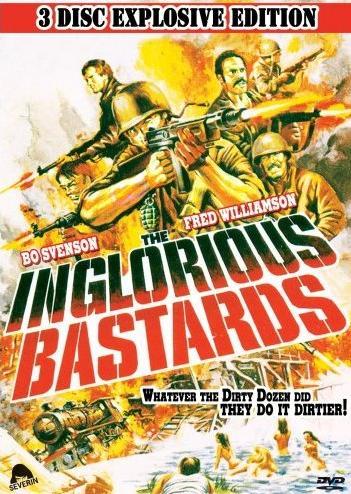
The Inglorious Bastards (Italy, 1978)
OT: Quel maledetto treno blindato

Directed by: Enzo G. Castellari
Written by: Sandro Continenza, Sergio Grieco, Franco Marotta,
Romano Migliorini, Laura Toscano
Cast: Bo Svenson, Peter Hooten, Fred Williamson, Michael Pergolani

Before Tarantino’s Inglourious Basterds, there was this WWII exploitation flick. A group of Dirty Dozen-like US soldiers get transported through France in order to be court-martialed. After they get ambushed by Germans, they manage to escape. They take one German hostage, who is to lead them to safe Switzerland. Underway they have to battle their way through hoards of Nazi’s and the US military. This film is characterized by loads of shoot-outs, explosions and humor. And of course some naked girls; every exploitation film needs a couple of those! The ‘Bastards’ (five in total) are well cast. Williamson is excellent as a badass motherfucker. While the movie never becomes truly great, it does manage to involve the viewer in the characters’ mission, and every time the glorious WWII music plays, you can’t help but cheer for these bastards.

EXTRA’S: As entertaining as the movie, is the excellent 38 minute discussion between Tarantino and director Enzo Castellari about their influences (Peckinpah) and the art of filmmaking.

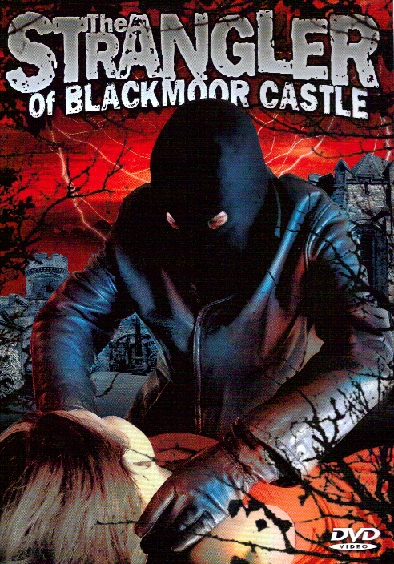
The Strangler of Blackmoor Castle (Germany, 1963)
OT: Der würger von schloß Blackmoor

Directed by: Harald Fodor
Written by: Ladislas Fodor, Gustav Kampendonk, Bryan Edgar Wallace
Cast: Karin Dor, Harry Riebauer, Rudolt Fernau, Hans Nielsen

A hooded figure invades Blackmoor Castle, during a party held by the castle’s tenant Lucius Clark. The ‘Strangler’ threatens him and demands the diamonds back that Clark supposedly stole. He also leaves one man dead with a ‘M’ marked on his forehead. A Scotland Yard inspector comes over to the estate to investigate the murder. He discovers a plot around the diamonds and a confrontation with the killer ensues. This detective movie uses the build-up of a horror. This makes the beginning quite suspenseful, but it becomes a bit dull halfway through, when it turns out to be just another mediocre whodunit. Still, it is not totally without a sense of style and humor. The electronic soundtrack is made by Oskar ‘The Birds’ Sala.

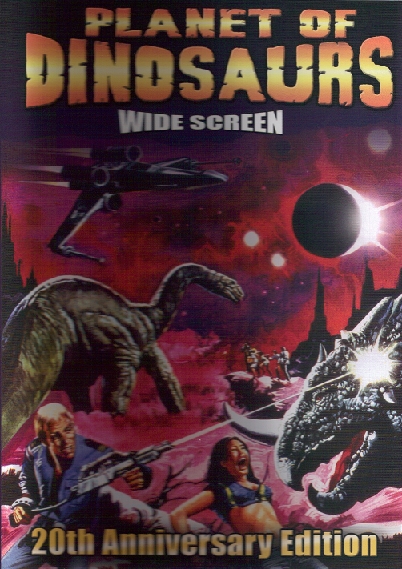
Planet of Dinosaurs (USA, 1978)

Directed by: James K. Shea
Written by: Jim Aupperle, Ralph Lucas
Cast: James Whitworth, Pamela Bottaro, Louie Lawless, Harvey Shain

The DVD cover of Planet of Dinosaurs is a true masterpiece, but does the movie live up to it? That depends on your taste for campy stop-motion creature features. The story: a spaceship crash lands on a seemingly deserted planet. There are initially nine survivors that start to scout the area. Within two minutes, there are eight survivors left. They have landed on the planet of the apes with dinosaurs!! Some observations:
– Space effects in the beginning, ships and stuff, are very funny.
– The crew has ‘four lasers’. Hmmm…[cynical]cool.[/cynical]
– One of the last stop motion creature flicks. It’s not Harryhausen, but there is quite a lot of variety in prehistoric monsters. Only too bad they are somewhat static.
– The actors are as convincing as the dinosaurs.
– Lame dialogues and synthesizer score.

Worth watching? Yes, if you find this type of thing hilarious. Otherwise avoid.
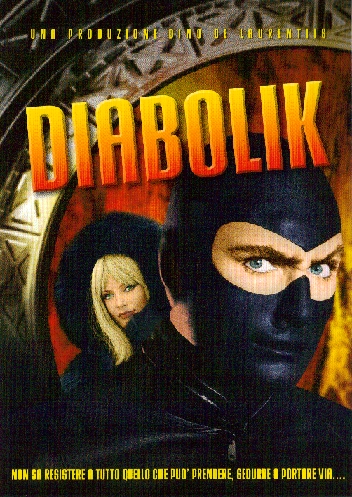
Diabolik (Italy / France, 1968)

Directed by: Mario Bava
Written by: Mario Bava, Brian Degas, Tudor Gates, Arduino Maiuri
Cast: John Phillip Law, Marisa Mell, Michel Piccoli, Adolfo Celi

Adaptation from the Italian comic book series, produced by Dino De Laurentiis and directed by horror author Mario Bava, doing a wonderful job outside of his usual territory. John Phillip Law plays anti hero Diabolik, a masked super thief who steals riches from both the government and the Mafia. His partner is the beautiful and voluptuous Eva (Marisa Mell). Together they fulfill the male fantasy: driving black and white jaguars, making love between 10 million dollars in a rotating bed and getting away with the most daring robberies. Their opponents are inspector Ginco and mob boss Valmont, who team up in an attempt to lure Diabolik and Eva into a trap. Bava directs this superhero movie with great style, while showing respect for the source material. He delivers one amazing set-piece after another, accompanied by a brilliant musical score from master Ennio Morricone. Camp was never before or after this spectacular. Diabolik = must see movie.

Mister Scarface (Italy / Germany, 1976)
OT: I padroni della città

Directed by: Fernando Di Leo
Written by: Peter Berling, Fernando Di Leo
Cast: Harry Baer, Al Cliver, Jack Palance, Gisela Hahn

Tony (Harry Baer) collects accounts receivable for gangster Luigi. His crime family gets involved in a power struggle with local bigshot ‘Scarface’ Manzari (Palance). Tony teams up with fellow collector Rick (Al Cliver). Together they plan to scheme Scarface out of a fortune and retire afterwards. This leads to an inevitable bloody confrontation with Scarface and his crew. The fuzzy plot and often inaudible dialogues (due to deteriorated picture quality) make this movie hard to follow at times. The good things are Palance’s demonic performance and the well crafted Napels underworld atmosphere. Lot’s of action and violence during the second half especially, make this worth a look for gangster film enthusiasts.
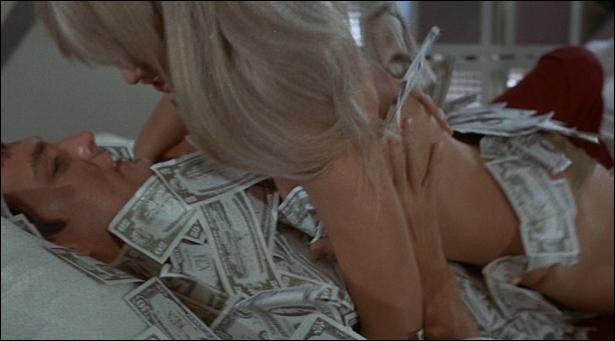

John Phillip Law and Marisa Mell in Diabolik.


For a Few Dollars More

Director: Sergio Leone
Written by: Fulvio Morsella, Sergio Leone, Luciano Vincenzoni
Cast: Clint Eastwood, Lee Van Cleef, Gian Maria Volontè

Year / Country: 1965, Italy, Spain, West Germany
Running Time: 126 mins.

A credit sequence can make or break a movie, and I’ve always loved the one that opens For a Few Dollars More. A lone rider approaches in an extreme long shot. Suddenly, a rifle cracks, the rider falls, and the horse gallops off. Then Ennio Morricone’s score bursts in, and the credits roll. Simple, yet brilliant.

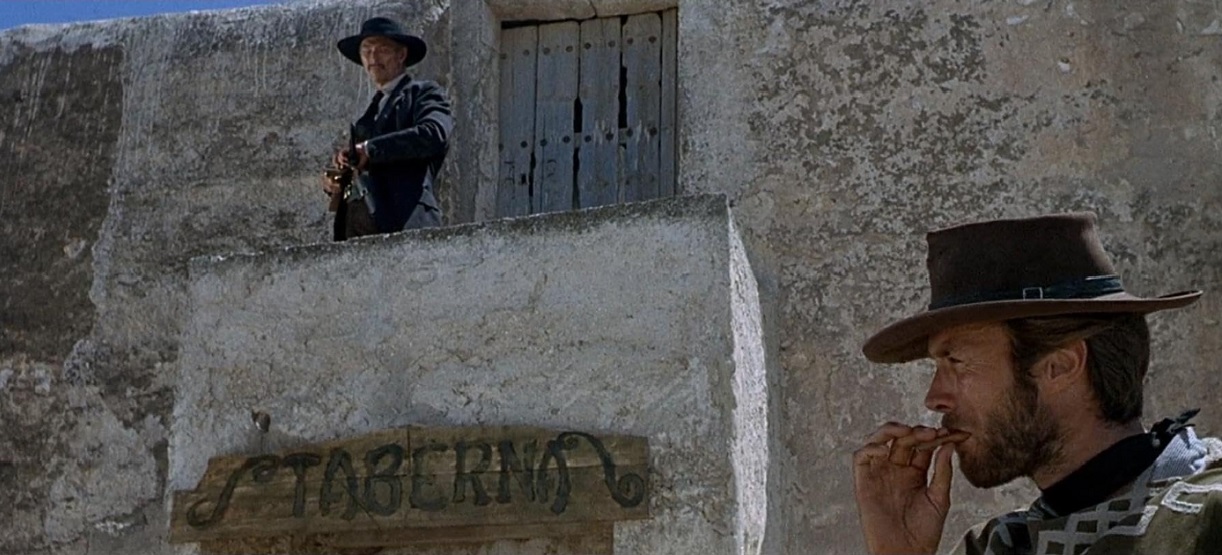
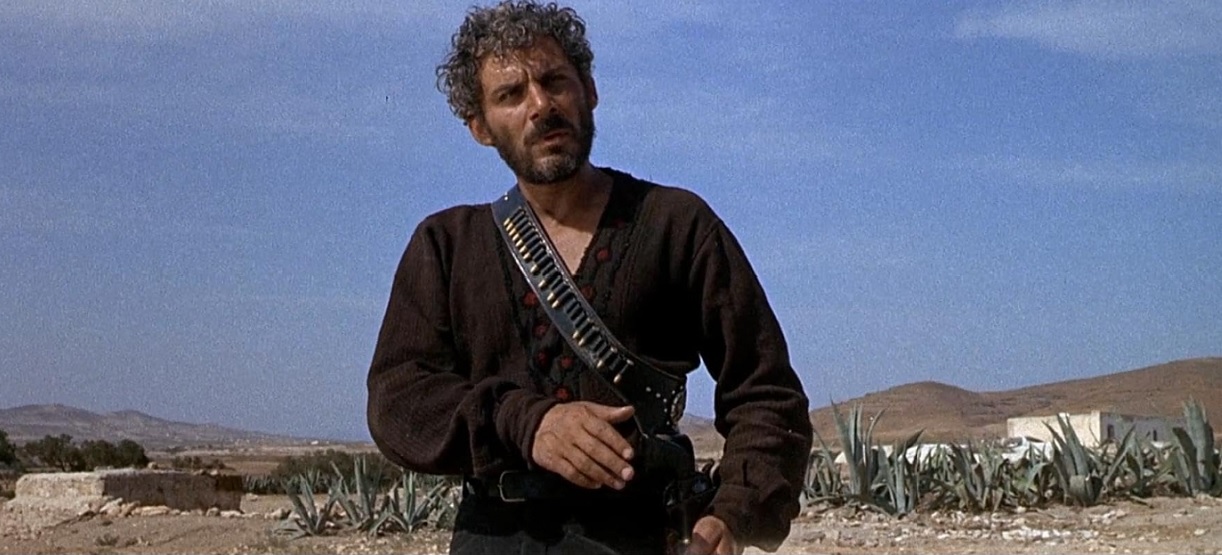
Next, a title card appears: “Where life had no value, death, sometimes, had its price. That is why the bounty killers appeared.” In the first half hour, we’re introduced to the film’s three central figures. Colonel Mortimer (Lee Van Cleef) and Monco (Clint Eastwood) are rival bounty hunters who form an uneasy alliance to take down the deranged bandit El Indio (Gian Maria Volontè).

This second installment in Sergio Leone’s world-famous ‘Dollars Trilogy’ is a tense, action-packed rollercoaster. Just one year after the excellent A Fistful of Dollars, Leone delivers an even more stylish and accomplished Western. It’s also the funniest film of his career.

The decision to cast Lee Van Cleef as Eastwood’s ultra-cool counterpart was inspired. Few actors could match Eastwood’s screen presence, but Van Cleef not only holds his own, he arguably matches him in sheer badassery. Volontè, already a memorable villain in A Fistful of Dollars, turns in an even more manic, menacing performance here. His gang of outlaws, including a wonderfully twitchy Klaus Kinski, adds further flavor to the mix.

If the film has a flaw, it’s that its pacing is occasionally uneven. Some sequences, like the El Paso bank heist, drag a bit. But this is a minor gripe in a film overflowing with memorable moments, sharp dialogue, and unforgettable characters. Leone’s blend of style, suspense, and morbid humor has rarely been better.

And the ending – well, no spoilers – but suffice to say, it’s one of those perfectly twisted moments that’s sure to leave a massive grin on your face.

Rating:

Biography: Sergio Leone (1929, Rome – 1989, Rome) made his debut in the cinema working as a voluntary assistant and extra, among other things, in The Bicycle Thieves by Vittorio de Sica. Later, he became assistant director to Mario Bonnard. In 1959, when Bonnard was ill, he took over from him on the set of The Last Days of Pompeii. In 1961 he directed his first full-length film: The Colossus of Rhodes. But the film that was to bring him to the general attention came out in 1964: A Fistful of Dollars. His next films, For a Few Dollars More and The Good, The Bad and the Ugly complete what came to be known as the Dollars Trilogy and were a great box-office success. He would only make three more films before tragically passing away in 1989. He was taken from us by a heart attack in his house in Rome, while working on an ambitious project for a film on the Siege of Leningrad.

Filmography: The Colossus of Rhodes (1961), A Fistful of Dollars (1964), For a Few Dollars More (1965), The Good, The Bad and the Ugly (1966), Once Upon a Time in the West (1968), A Fistful of Dynamite (1971), Once Upon a Time in America (1984)


A Fistful of Dollars

Director: Sergio Leone
Written by: Victor Andrés Catena, Jaime Comas, Sergio Leone
Cast: Clint Eastwood, Marianne Koch, Gian Maria Volontè, Wolfgang Lukschy

Year / Country: 1964, Italy / Spain / West Germany
Running Time: 96 mins.

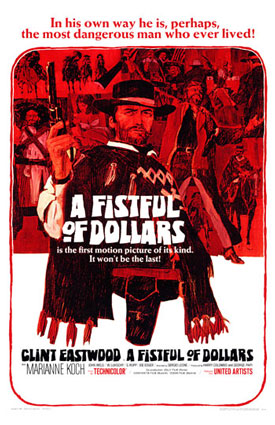
During the filming of The Last Days of Pompeii in Europe, directors Sergio Leone and Sergio Corbucci were struck by the idea of using the landscapes they encountered as the backdrop for a western. Five years later, A Fistful of Dollars arrived – a groundbreaking and hugely influential film that launched both Leone’s and Clint Eastwood’s international careers.

For its plot, Leone drew inspiration from Akira Kurosawa’s classic samurai film Yojimbo. A mysterious stranger arrives in a desolate town where no one works except the coffin maker. The town is controlled by two rival gangs – the Baxters and the Rojos – who each try to buy his loyalty. But the stranger is playing his own game. Instead of choosing a side, he orchestrates a deadly conflict to eliminate both gangs and free the town from their oppression.

At the time, Eastwood was virtually unknown, with his biggest credit being the TV show Rawhide. Leone had considered other actors for the role – James Coburn, Charles Bronson, Lee Marvin, and Henry Fonda – but ultimately, Eastwood’s brilliant performance became a key factor in the film’s success. As the enigmatic gunslinger, he exudes effortless cool. With his cobra-quick draw, sharp intellect, and signature poncho, hat, and cigar, he creates an unforgettable character. Despite his stoic presence and minimal dialogue, he also delivers moments of dry humor, particularly in the scene where he demands apologies from four outlaws for scaring his horse – a comic masterpiece.

From the opening animated credit sequence, A Fistful of Dollars pulls you in. Leone’s direction is flawless, blending breathtaking widescreen cinematography with expertly staged duels that brim with tension. Despite the film’s modest budget, its visual and narrative execution mask any limitations. A major part of its success is owed to Ennio Morricone’s unforgettable score – one of his early masterpieces – that elevates the film’s atmosphere and impact.

Initially, A Fistful of Dollars developed a cult following in Italy before becoming a mainstream box-office sensation. Word spread quickly – this was the must-see film of the year. It was soon followed by two sequels, For a Few Dollars More and The Good, the Bad and the Ugly, completing what would become the legendary Dollars Trilogy.

Rating:

Biography: Sergio Leone (1929, Rome – 1989, Rome) made his debut in the cinema working as a voluntary assistant and extra, among other things, in The Bicycle Thieves by Vittorio de Sica. Later, he became assistant director to Mario Bonnard. In 1959, when Bonnard was ill, he took over from him on the set of The Last Days of Pompeii. In 1961 he directed his first full-length film: The Colossus of Rhodes. But the film that was to bring him to the general attention came out in 1964: A Fistful of Dollars. His next films, For a Few Dollars More and The Good, The Bad and the Ugly complete what came to be known as the Dollars Trilogy and were a great box-office success. He would only make three more films before tragically passing away in 1989. He was taken from us by a heart attack in his house in Rome, while working on an ambitious project for a film on the Siege of Leningrad.

Filmography: The Colossus of Rhodes (1961), A Fistful of Dollars (1964), For a Few Dollars More (1965), The Good, The Bad and the Ugly (1966), Once Upon a Time in the West (1968), A Fistful of Dynamite (1971), Once Upon a Time in America (1984)