Crimewave

Director: Sam Raimi
Written by: Ethan Coen, Joel Coen, Sam Raimi
Cast: Reed Birney, Sheree J. Wilson, Paul L. Smith, Brion James

Year / Country: 1985, USA
Running Time: 79 mins.

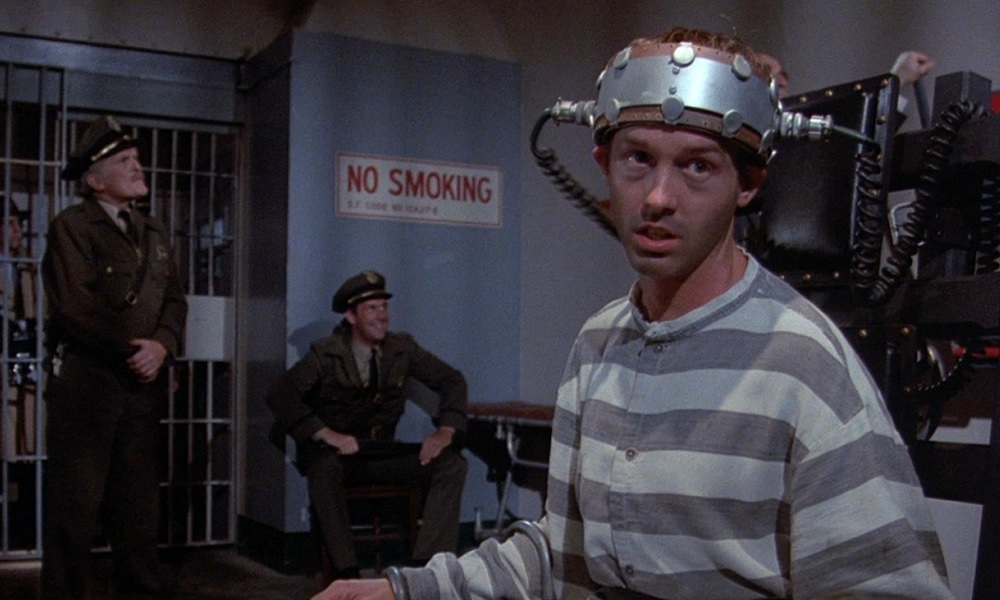
Victor Ajax, an electric repairman, is scheduled to be executed in the electric chair for a series of murders he didn’t commit. With five minutes to midnight, the hapless Ajax flashes back to the events that brought him to this precarious situation. Thanks to his former boss’s murderous schemes, he finds himself tangled up with a pair of maniacal exterminators, but also crosses paths with the woman of his dreams.

Raimi’s second feature film explores faith, fate, electricity, and the extermination business. Not only did Raimi direct Crimewave, but he co-wrote the screenplay with the Coen brothers. With that kind of talent involved, I was expecting something spectacular. In that sense, it was a letdown. But on re-watch, I found plenty to appreciate.

At this point in their careers, both Raimi and the Coens were still discovering their voices. Crimewave showcases Raimi’s trademark razzle-dazzle camerawork, while the Coens supply a parade of idiotic characters, absurd jokes, and bizarre scenarios. Still, it lacks the razor-sharp precision they would later master. Fans, however, will have a blast spotting the references, quirks, and trademarks that foreshadow their later work.

The budget here was clearly bigger than Raimi’s debut, The Evil Dead, and it shows in several standout set pieces. The sequence where Paul L. Smith stalks Louise Lasser through a corridor lined with doors is a highlight, and the film climaxes with a long, spectacular car chase reminiscent of a scene later perfected in Raising Arizona.

The casting is another strength. Paul L. Smith and Brion James are especially memorable in their feral performances as rat exterminators, while Bruce Campbell is very funny as a smooth skirt chaser. The Coen brothers themselves also briefly appear as journalists.

Rating:

Biography: Sam Raimi (1959, Royal Oak, Michigan) started making 8mm films when he was around ten years old. In his teenage years he first collaborated with his good friend Bruce Campbell, who would later appear in almost all of his films. The style of Raimi is influenced by the Three Stooges, of whom he is a huge fan. By making the short movie Within the Woods he managed to raise the required funds to make his first feature; the outrageous horror flick The Evil Dead. After that he made similar films with varying commercial success. In his films Raimi displays a great talent for creating inventive visuals. Most of his movies also feature slapstick and comic book elements. In 2002 Raimi made Spiderman, his biggest film to date. It was an enormous box-office success and Raimi would go on to make two sequels. Throughout his career Raimi has also produced many films and TV-series, mostly in the horror/fantasy genre. He remains a director with a huge fan base and many exciting future prospects.

Filmography (a selection): It’s Murder! (1977, short), Within the Woods (1978, short), Clockwork (1978, short), The Evil Dead (1981), Crimewave (1985), Evil Dead II (1987),  Darkman (1990), Army of Darkness (1992), The Quick and the Dead (1995), A Simple Plan (1998), For Love of the Game (1999), The Gift (2000), Spider-Man (2002), Spider-Man 2 (2004), Spider-Man 3 (2007), Drag Me to Hell (2009)

Barbarella

Director: Roger Vadim
Written by: Terry Southern, Roger Vadim, Claude Brulé
Cast: Jane Fonda, John Phillip Law, Anita Pallenberg

Year / Country: 1968, France / Italy
Running Time: 94 mins.

The sexy space adventurer Barbarella comes to life in this adaptation from the notorious comic series by Jean-Claude Forest. Jane Fonda is perfectly cast as the well-shaped and pretty naïve protagonist. Fonda was married to director Roger Vadim at the time, who had the habit of casting his beautiful wives (Brigitte Bardot / Catherine Deneuve) in sensual roles.

Barbarella is out to prevent a war that is threatening intergalactic peace. She uses every talent she possesses to get the job done. Yes, that does include sleeping with the men that help her in her quest. She is assigned to go to planet SoGo and retrieve doctor Durand Durand (pronounced as Duran Duran, the British pop band was named after this character). She meets many people on her way, including the Catchman, the blind angel Pygar and the Great Tyrant. She makes love to quite a few of them. Although the sex is never explicitly shown, the sensual atmosphere is certainly felt.

The title sequence of Barbarella, in which she undresses in zero gravity, became quite famous. The film was met with critique upon release though. It also didn’t perform well at the box-office. Later, the movie did establish a huge cult following and it influenced many products of popular culture. When viewed today it is outdated, but there is nevertheless plenty to enjoy: Fonda, the supporting cast including the excellent Law, the psychedelic images by talented director Vadim and the great comic book atmosphere.

Rating:

Biography: Roger Vadim (1928, Paris – 2000, Paris) was a French actor, director, writer and producer who also wrote several books. He started his career as a stage actor at the age of 16. His movie career began when he became an apprentice of director Marc Allégret. Then, he started a relationship with Brigitte Bardot and made his acting debut with her in 1952, although he remained uncredited. The same year they got married. Their groundbreaking film …And God Created Woman was Vadim’s directorial debut. It was a massive box-office hit and catapulted them both to stardom. In his later career Vadim also had relationships with Jane Fonda and Catherine Deneuve, but the films he made with them aroused less interest. He died of cancer in 2000.

Filmography (a selection): …And God Created Woman (1956), No Sun in Venice (1957), Dangerous Liaisons 1960 (1959), Blood and Roses (1960), Love on a Pillow (1962), Circle of Love (1964), The Game is Over (1966), Barbarella (1968), Pretty Maids All in a Row (1971), Don Juan 73 (1973), Charlotte (1974), The Faithful Woman (1976), Night Games (1980), The Hot Touch (1981), Surprise Party (1983), And God Created Woman (1988), Amour fou (1993, TV)

Keoma


Director
: Enzo G. Castellari
Written by: Enzo G. Castellari, Nico Ducci, George Eastman, Mino Roli
Cast: Franco Nero, Woody Strode, William Berger, Donald O’Brien

Year / Country: 1976, Italy
Running Time: 97 mins.

Besides the legendary spaghetti westerns by Sergio Leone, that due to their lyricism and sense of dimension, became true cinema classics, the genre consists almost solely of B-pictures. This B-genre started in 1966 with the release of Sergio Corbucci’s Django. This classic cult movie shaped the format of the genre with its mysterious hero driven by revenge, excessive violence, a limited budget and the absence of realism.

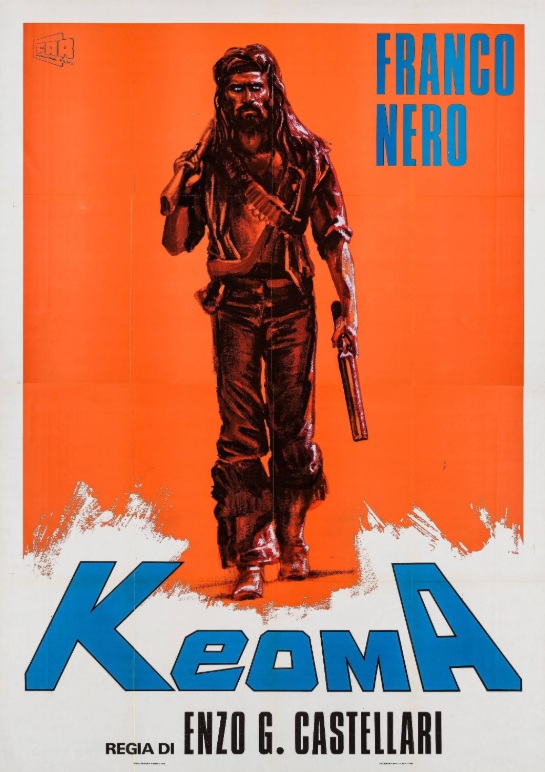
Exactly ten years later, Keoma was made, one of the last notable films of its genre. Like in Django, spaghetti star Franco Nero stars in the title role. The movie is also known as Django Rides Again, while it has nothing to do with the Django series. The producers probably wanted to cash in on this household name, just like approximately thirty other pseudo sequels and lousy spin-offs tried to do.

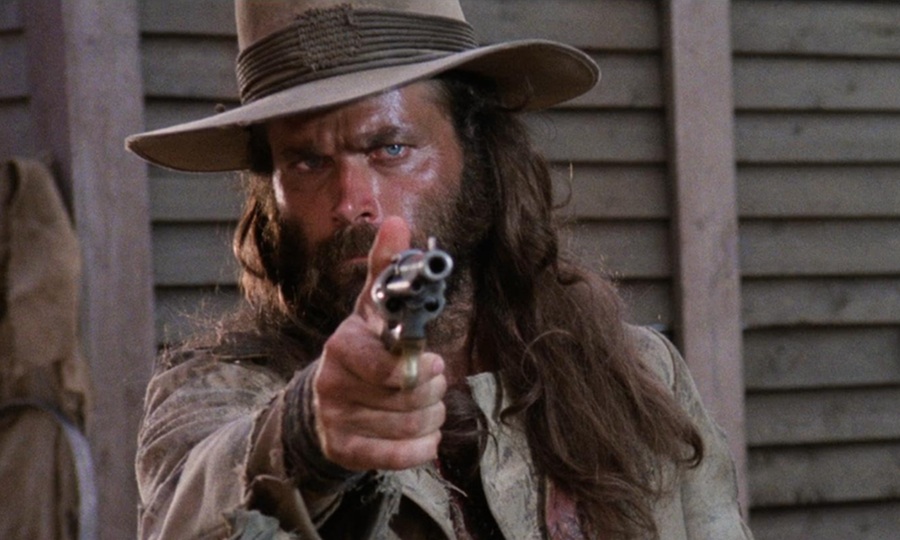
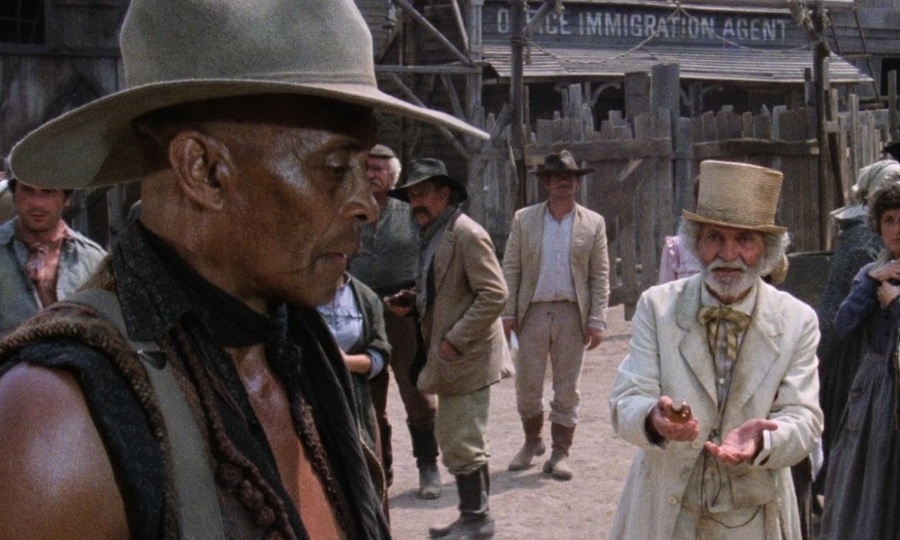
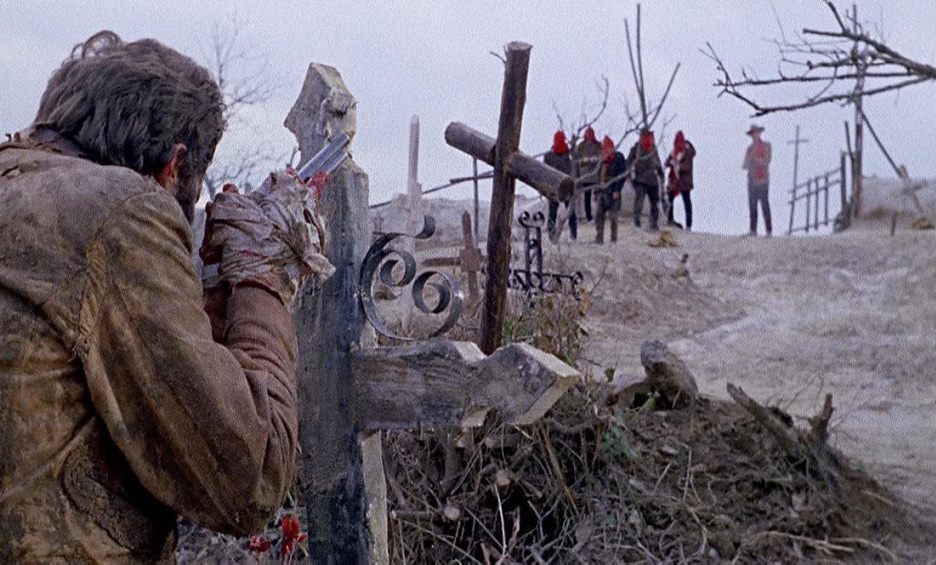
But Keoma is not a lousy film, on the contrary. It’s quite the action-western with Nero once again portraying a strong character. The half-breed Indian Keoma returns from civil war only to find his hometown in chaos and controlled by an evil gang led by the sadistic Caldwell. Keoma takes on Caldwell’s scum that includes his own three half brothers. He gets help only from his father and a black man named George, an outcast like Keoma, played by genre icon Woody Strode.

Through flashbacks we learn more about Keoma’s childhood. He was never accepted because of his Indian background. The racism in the film contributes to the movie’s depressing atmosphere. Other factors contributing to this are the hellish images of plague victims and general destruction. The dark, unpleasant atmosphere is enhanced by the wailing score by Guido and Maurizio De Angelis.

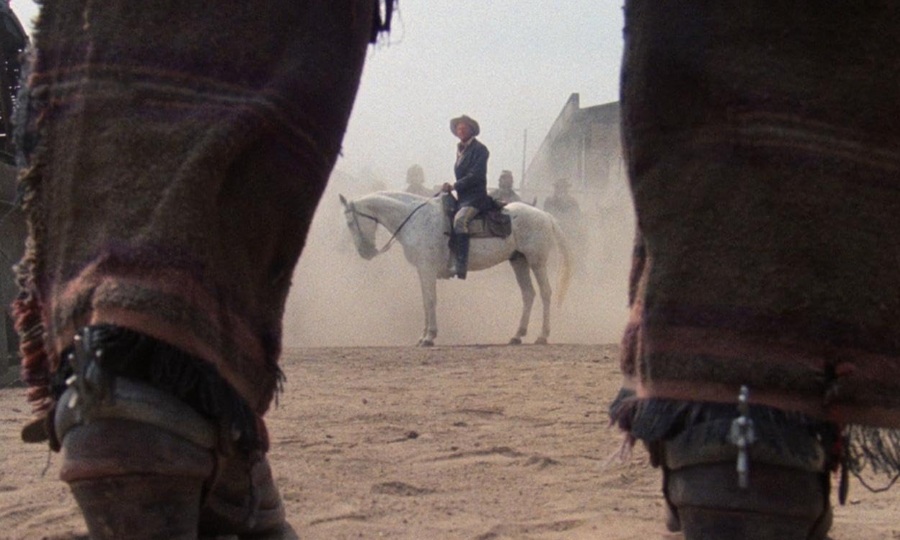
But Keoma isn’t that deep into deeper meaning. The action is what makes it stick. The slow-motion gunplay, a specialty of director Enzo Castellari, is done masterfully. While the film may be a little too dark and serious, and miss the irony and sarcasm of Leone’s films, it is a supreme spaghetti in terms of uncompromising action. A worthy finale to a glorious period.

Rating:

Biography: Enzo G. Castellari (1938, Rome) was born as Enzo Girolami, son of cult-director Marino Girolami (Zombi Holocaust). In the seventies and eighties he made a large number of exploitation movies. Most of them were low cost productions, but by using slow-motion and special editing techniques, Castellari differentiated his movies from the pure trash flicks. After the downfall of the Italian B-movie industry during the late eighties, Castellari turned to television like many of his colleagues did.

Filmography (a selection): Go Kill and Come Back (1967), Seven Winchesters for a Massacre (1967), That Dirty Story of the West (1968), Battle Squadron (1969), Cold Eyes of Fear (1971), Con Men (1972), High Crime (1973), Keoma (1976), The Big Racket (1976), The Heroin Busters (1977), The Inglorious Bastards (1978), Shark (1981), Bronx Warriors (1982), Bronx Warriors 2 (1993), Tuareg: The Desert Warrior (1984), Hammerhead (1987), Extralarge: Moving Target (190, TV), Extralarge: Black Magic (1991, TV), Jonathan of the Bears (1993)

Django

Director: Sergio Corbucci
Written by: Sergio Corbucci, Bruno Corbucci, Franco Rossetti
Cast: Franco Nero, José Bódalo, Loredana Nusciak, Ángel Álvarez

Year / Country: 1966, Italy / Spain
Running Time: 88 mins.

In 1964, Sergio Leone, an Italian director, redefined the western genre with A Fistful of Dollars, a groundbreaking remake of Akira Kurosawa’s Yojimbo. Starring a then-unknown Clint Eastwood, the film introduced audiences to the now-iconic figure of the nameless gunslinger, a drifter who arrives in a town torn apart by a bitter private war. Playing both sides against each other, he emerges victorious, setting the template for the spaghetti western genre.

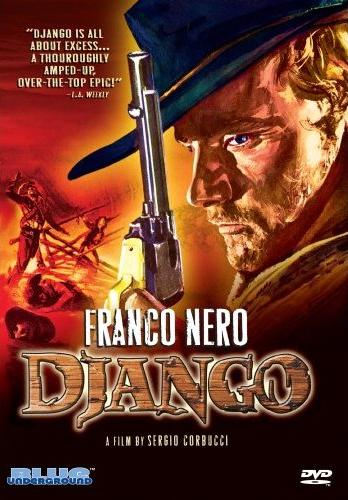
The overwhelming success of Leone’s film inspired a wave of imitations, varying in quality. Among these, Django (1966) by Sergio Corbucci stands out as one of the best and certainly the most famous. The film borrows heavily from A Fistful of Dollars but adds its own distinctive twist. Instead of a nameless drifter, we meet Django, a mysterious stranger trudging through a desolate landscape while dragging a coffin behind him. His identity is memorably introduced through Louis Bacalov’s haunting theme song, which passionately proclaims his name: Django!

The story follows Django as he rescues a prostitute named Maria from a gang of ruthless outlaws. He escorts her to a ghostly, near-abandoned town where he intends to settle an old score. There, he finds himself caught in a deadly conflict between Mexican revolutionaries and a band of racist Southern renegades led by his arch-nemesis, Major Jackson. Initially siding with the Mexicans to deal a crippling blow to Jackson, Django’s motivations soon come to light, setting the stage for an explosive and tragic finale. By the film’s end, only Django and Maria are left standing amidst the carnage, with the rest buried – literally and figuratively.

What elevates Django almost to the level of Leone’s masterpiece is Corbucci’s skillful execution of the genre’s defining elements. Franco Nero delivers a magnetic performance as the titular anti-hero, rivaling Eastwood’s cool and detached gunslinger. Bacalov’s score, while perhaps not as iconic as Ennio Morricone’s, is equally evocative, setting the perfect tone for the film. The supporting cast adds depth to the world, and the stylish, gritty action sequences ensure the audience remains captivated throughout.

Of course, Django is also notorious for its graphic violence, which was shocking for its time. Though modern audiences might find it less visceral compared to contemporary standards, the film doesn’t shy away from bloodshed. That said, the lack of squibs – a result of budgetary constraints – dampens some of the impact, as the gunplay often lacks the visual punch of more modern films.

The film’s pacing does falter slightly in the middle act, where the tension and momentum dip after the gripping opening sequences. However, Corbucci makes up for this with a thrilling and memorable climax that reaffirms the film’s status as a cult classic.

In conclusion, Django is a quintessential spaghetti western and a must-watch for fans of the genre. With its unforgettable protagonist, striking visuals, and bleak tone, it stands as a testament to the creativity and enduring appeal of Italian westerns.

Rating:

Biography: Sergio Corbucci (1926, Rome – 1990, Rome) was, alongside Sergio Leone, one of the most prominent directors of spaghetti westerns. Born and raised in Rome, Corbucci played a crucial role in popularizing the genre, particularly through his iconic films Django (1966) and The Great Silence (Il Grande Silenzio, 1968). He frequently collaborated with actor Franco Nero, crafting memorable characters and stories that helped define the genre’s unique style. His B-movies are characterized by brutal violence, surrealist and apocalyptic production design, black humour and politically left symbolism. Corbucci was a fanatical Marxist and many of his films show the hopelessness of the revolution. He kept working in Italy throughout his career and most of his films were barely released abroad. He died in Rome in 1990.

Filmography (a selection): Foreign Earth (1954), Water’s Love (1954), Supreme Confession (1957), Angel’s Sky (1957), Duel of the Titans (1961), Toto, Peppino and La Dolce Vita (1961), The Son of Spartacus (1963), Grand Canyon Massacre (1963), Django (1966), Navajo Joe (1966), The Mercenary (1968), The Great Silence (1968), Compañeros (1970), Bandera Bandits (1972), The White, the Yellow, and the Black (1975), The Payoff (1978), Super Fuzz (1980), My Darling, My Dearest (1982), Days of Inspector Ambrosio (1988)