The Verdict: Fear Street Trilogy

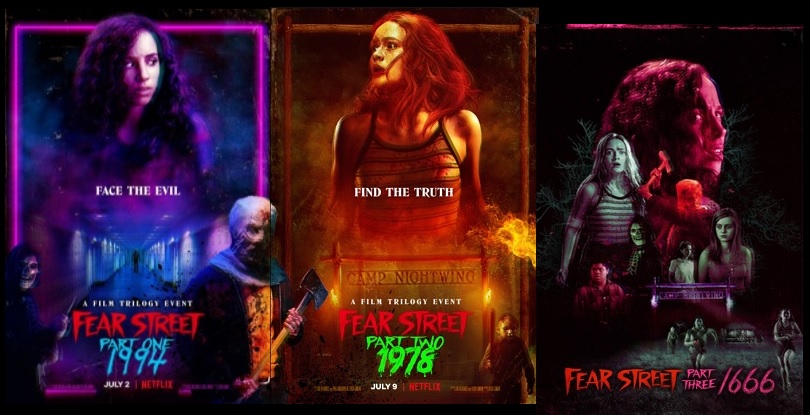
The Fear Street Trilogy (consisting of Fear Street: 1994, Fear Street: 1978 and Fear Street: 1666) is Netflix’s most surprising release so far this summer. It revives a genre that has been dead for a while now: the slasher. The first scene, in which a girl is stalked in a shopping mall by a skull-face masked killer, reminds of Scream. But soon it diverges from this genre classic by going supernatural. You see, the town of Shadyside is cursed by the witch Sarah Frier, who was hanged in 1666, and is therefore now plagued by possessed killers who go on murder sprees. The bordering town of Sunnyside, on the other hand, is perfectly peaceful.

In the first part, teenage girls Deena and Sam, who are having a sexual affair to please the male audience, have to survive the next rampage and find a way to end the curse. In the second movie, a killing spree occurs during a summer camp in 1978 (yes, very much like the first Friday the 13th). In the third and final film, we first learn the history of Shadyside and Sunnyside through a transcendent experience by Deena. And then, after a major plot twist, it is up to her and her friends to end the terror once and for all. While the first part gets the lowest rating on IMDb, I liked it best, because it has the most old fashioned horror moments. But the whole trilogy, successfully directed by relative newcomer Leigh Janiak, is entertaining throughout. With genuine scares, excellent casting and plenty of brutal kills. This is how you do a slasher.

The Fear Street Trilogy is now available on Netflix

The verdict: to stream or not to stream? To stream.
Maniac Cop

Director: William Lustig
Written by: Larry Cohen
Cast: Tom Atkins, Bruce Campbell, Laurene Landon

Year / Country: 1988, USA
Running Time: 85 mins.

In the eighties many, many (perhaps too many) slasher movies saw the light of day, trying to profit from the popularity of genre classics such as Halloween (1978) and Friday the 13th (1980). Many lacked the true passion for the art of exploitation filmmaking though and were merely cash-ins. This can not be said about Maniac Cop, because two inspired exploitation film makers are behind it. Larry Cohen produced and wrote the screenplay and William Lustig directed. Cohen was at the time mostly known as director of blaxploitation flicks Black Caesar and Hell Up in Harlem and the It’s Alive horror trilogy, while Lustig made the controversial Maniac in 1980.

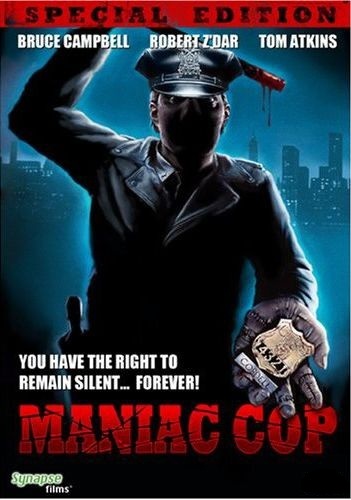
The potential for a real cult treat was certainly there. Besides Cohen and Lustig, the cast had Bruce Campbell and Richard Roundtree in it, enough to make cult fans drool. The concept is also promising: police brutality offers plenty of opportunity for both humour and scares. The poster and tagline really sell this flick: ‘You have the right to remain silent. Forever!’ Great!!! Let’s watch this.

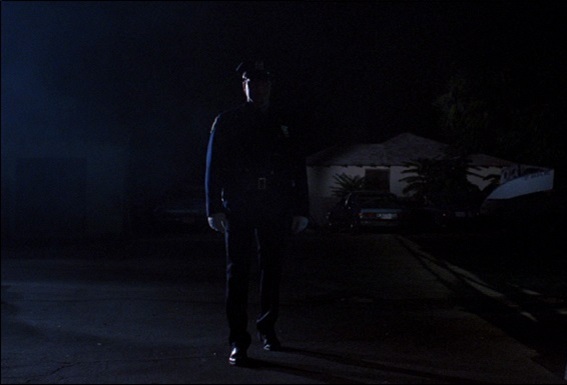
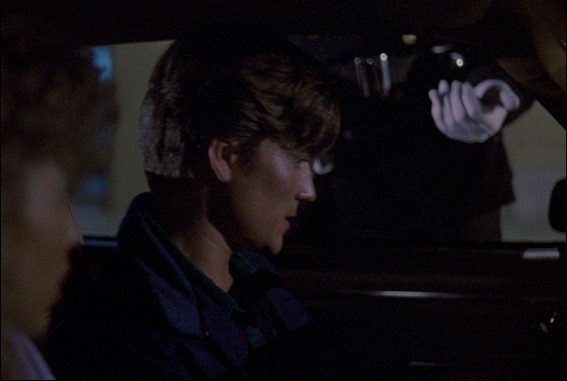
Unfortunately the execution of Maniac Cop is disappointing. As much as I wanted to enjoy this, it fell short on delivery. The positive critique is that the suspense is adequately delivered. The story is what you would expect it to be. A six foot tall cop is killing innocent people in New York and panic spreads through the city. Bruce Campbell’s cop Jack Forrest is wrongfully accused of the killings and he and a few accomplices have to discover the (supernatural) truth and stop the killer.

Why it is disappointing, is mostly because so much potential is wasted. There are no moments in which the police brutality angle is put to good use. There is hardly any humour in the movie and when you have Campbell in your cast that is a deadly sin. The action-packed finale of the film also fails to offer a satisfactory conclusion.

Perhaps part 2, which is said to be Lustig’s favourite entry in the trilogy, has more to offer. The third instalment Maniac Cop 3: Badge of Silence (1993) is best left alone though. When voodoo comes into play, it won’t do much good to this concept.

Rating:

Biography: William Lustig (1955, New York) always enjoyed exploitation flicks and wanted to pursue a career as filmmaker. After working as assistant on a few films, including Michael Winner’s Death Wish, he directed two porn movies under the alias Billy Bagg. In 1980, Lustig found himself at the center of a storm of controversy when he made the disturbing slasher film Maniac. Throughout the eighties and nineties he would continue to make exploitation films, including the Maniac Cop trilogy.

Filmography: Maniac (1980), Vigilante (1983), Maniac Cop (1988), Hit List (1989), Relentless (1989), Maniac Cop 2 (1990), Maniac Cop 3: Badge of Silence (1993), The Expert (1995), Uncle Sam (1996), Conducting Dario Argento’s ‘Opera’ (2011, short doc)