Director: Sergio Leone
Written by: Sergio Donati, Sergio Leone, Luciano Vincenzoni
Cast: Rod Steiger, James Coburn, Romolo Valli, Maria Monti
Year / Country: 1971, Italy
Running Time: 147 mins.
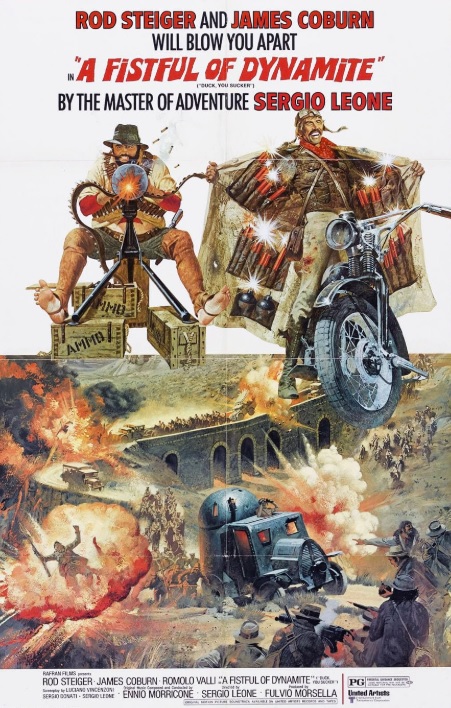
A Fistful of Dynamite (also known as Duck, You Sucker!) is the second entry in Sergio Leone’s loose trilogy of epic films, sandwiched between Once Upon a Time in the West and Once Upon a Time in America. It is Leone’s final spaghetti western and his most overlooked film. But frankly, that is because it is his weakest. That’s not to say it’s without merit, but it lacks the tight storytelling and grandeur of his greatest works.
Set against the backdrop of the Mexican Revolution in 1913, the film follows an unlikely duo: the cigar chewing hick Juan Miranda and the dynamite juggling Irishman John Mallory. Their partnership begins with a planned bank robbery, only for them to discover that the bank is actually a political prison. Juan is unexpectedly thrust into the role of a revolutionary hero, and together, he and John take on the formidable Mexican army, led by a sadistic officer.
The film’s opening is striking. Juan shares a stagecoach ride with a group of wealthy elites who openly insult him and his people, branding them as animals while indulging in gluttonous excess. This immediately earns Juan some sympathy – until his six sons arrive to rob and humiliate the passengers, with Juan even committing an off-screen rape. Leone challenges the audience’s perceptions, presenting prejudice and social injustice while also revealing Juan’s own flaws. Enter John Mallory, an Irish dynamite expert who quite literally blasts onto the scene in a moment of cultural stereotyping played for dark humor.
Rod Steiger’s performance as Juan is divisive. While the character is intentionally unsympathetic, Steiger’s over-the-top acting makes him difficult to watch. Originally, Leone wanted Eli Wallach for the role, but the studio refused. While Wallach’s casting might have risked echoing his Tuco character from The Good, the Bad and the Ugly, it’s hard not to wonder if he would have been a better fit.
Leone claimed the film is ultimately about friendship rather than revolution. This isn’t immediately convincing, given Juan and John’s rocky introduction, but by the end, their relationship develops into something genuine and poignant. John’s journey, revealed through flashbacks, makes the bond between them all the more meaningful.
Despite its flaws – an overlong runtime, a less sweeping feel than Leone’s other Once Upon a Time films, and an Ennio Morricone score that, while good, doesn’t reach the heights of their other collaborations – the film still has standout moments. The ambush at the bridge is classic cinema, boasting one of the greatest explosions ever filmed. The panning shot along the execution ditches is haunting, and the climactic train collision is truly spectacular. Overall, the film is just not the revolution Leone’s earlier westerns were.
Rating:


Biography: Sergio Leone (1929, Rome – 1989, Rome) made his debut in the cinema working as a voluntary assistant and extra, among other things, in The Bicycle Thieves by Vittorio de Sica. Later, he became assistant director to Mario Bonnard. In 1959, when Bonnard was ill, he took over from him on the set of The Last Days of Pompeii. In 1961 he directed his first full-length film: The Colossus of Rhodes. But the film that was to bring him to the general attention came out in 1964: A Fistful of Dollars. His next films, For a Few Dollars More and The Good, The Bad and the Ugly complete what came to be known as the Dollars Trilogy and were a great box-office success. He would only make three more films before tragically passing away in 1989. He was taken from us by a heart attack in his house in Rome, while working on an ambitious project for a film on the Siege of Leningrad.
Filmography: The Colossus of Rhodes (1961), A Fistful of Dollars (1964), For a Few Dollars More (1965), The Good, The Bad and the Ugly (1966), Once Upon a Time in the West (1968), A Fistful of Dynamite (1971), Once Upon a Time in America (1984)



 FRAGMENTEN UIT HET SCHEMERLAND