Mind Book #2 – The Spread Mind

Read also: Mind Book #1 – Being You
In The Spread Mind: Why Consciousness and the World Are One (2018), philosopher, psychologist, and AI expert Riccardo Manzotti offers a bold new perspective on the problem of consciousness. Rejecting the notion that experience arises from neural activity – the default view in contemporary science – Manzotti argues that experience and reality are fundamentally identical. While this might evoke comparisons to biocentrism, the Spread Mind is a distinct theory.

Biocentrism posits that consciousness actively creates the world. In contrast, the Spread Mind asserts that consciousness is physical yet external to the body. It is neither a property of the brain nor the body; rather, it is identical to the objects in the surrounding environment. So when you are looking at an object, let’s say an apple, that apple is not in space and time but where you experience it. Also, the apple is identical to your experience of it.

At first glance, this might again seem like a biocentric perspective, as both theories reject the idea of an apple existing independently in the outside world, waiting to be experienced. However, the distinction lies in where the apple resides: in biocentrism, the apple exists within the mind, whereas in the Spread Mind theory, the apple is the mind. The object is causal, active, relative, temporally-defined, and of course spread.

What we label ‘an object’, Manzotti asserts, is a physical occurrence that repeats itself whenever we put our bodies in the proper circumstances. As a result, even though we believe the same object perdures, what perdures is not the object but a set of circumstances that are favorable to the occurrence of a series of identical objects.

Relocating experience in the world – and therefore ‘spreading’ consciousness in spacetime – can pay back in terms of simplicity, states Manzotti. And he’s right. Up to now, the reduction of experience to neurons and their whereabouts, the usual candidates for the physical underpinnings of consciousness, has not been satisfactory for explaining the conscious mind, since experience and the brain do not resemble each other in the least. In his theory, consciousness will no longer be an unexpected addition to the physical world because appearance and reality are the same thing.

To explain why his theory is better, he uses the simple case of Emily experiencing a red apple. The common perception is that she reproduces the apple inside her brain. But is that really the best solution? Manzotti’s view: ‘The brain is pinkish-gray, gooey, and bloody. The red apple is red, round, and applish. Which entity is more similar to Emily’s experience of the red apple?’ (P. 9)

The theory of the Spread Mind asserts that phenomenal and physical properties are the same. We perceive the world as it is because we are the world we perceive. The properties of our experience are the properties of the physical world we live in. According to the Spread Mind theory, the mind is a set of objects. Manzotti describes the body as a causal object that ‘causes’ all the other objects to be part of the set. This is again close to biocentrism, where it is consciousness itself that is the causal entity that ‘collapses’ the objects it observes, including the body and brain of that conscious observer.

However biocentrism is a modern version of idealism and the Spread Mind posits itself as a form of physicalism. The difference with the standard form of physicalism is that it doesn’t state that conscious experience arises from matter, but that experiences of matter are the matter, and are therefore physical.

My thoughts about this book
I admire Riccardo Manzotti greatly for making a leap in thinking and going beyond the default view. Rather than following the – in my opinion – dead end street of materialism, he takes a highly original standpoint and locates consciousness outside the body. You are one with the objects you perceive. You are the collection of objects you are currently perceiving. Your body – also an object – is the cause of the other objects you experience to be ‘there’.

However, the spread mind fails to capture the essence of what a mind is in my opinion. My mind is not the trash can I just saw. Rather, it is the integrated collection of thoughts, feelings, memories and perceptions that make up that ‘me’ feeling. The trash can appears in my mind, but it is not the same as my mind. Once identity is the same as the objects we observe, this means that if I am drinking a glass of beer in a bar, I am that glass of beer, the bar and even the waitress that is currently serving me.

Manzotti also writes some things that seem contradictory. For example, he writes that in his physical theory, ‘realism is safe’. But according to his theory, objects are only present in relation to the body, and that would violate realism which assumes that an external reality is always present also in the absence of an observer or body.

In conclusion, it was a great and original move by Manzotti to take the mind out of the brain, but biocentrism is better equipped to explain the totality of mental experiences and their relation to the workings of the universe.

You can read more about biocentrism and consciousness on my platform:
http://free-consciousness.com

Mind Book #1 – Being You

Anil Seth is one of the world’s leading neuroscientists who is working on the ‘problem’ of consciousness. His ideas are discussed in the book Being You (2022). His working theory is that our conscious experiences of the world and the self are forms of brain-based prediction – ‘controlled hallucinations’ – that arise with, through, and because of our living bodies. We are conscious, beast machines, Seth believes.

The widely held assumption in science is that the brain is responsible for creating our conscious experiences. Philosopher David Chalmers, who introduced the term ‘the hard problem of consciousness’, wrote: ‘It is widely agreed that experience arises from a physical basis, but we have no good explanation of why and how it so arises.’

Why is there so much agreement about the physical nature of consciousness if it is totally unclear and unexplainable how something physical can cause a mental state? The opposite approach – consciousness producing physical states – is almost never considered in science.

Seth is honest in stating that his view is philosophical and not a proven scientific fact. He writes: ‘My preferred philosophical position, and the default position of many neuroscientists, is physicalism or materialism. This is the idea that the universe is made of physical stuff, and that conscious states are either identical to, or somehow emerge from particular arrangements of this physical stuff.’ He does not elaborate on why he favors this philosophy. Although he briefly acknowledges alternatives such as dualism and idealism, he does not engage in a detailed discussion of why materialism should be considered a preferable default, particularly over idealism – the view that the mind creates reality.

Seth’s theory is summarized in this following statement: ‘The experience of being you emerges from the way the brain predicts and controls the internal state of the body. The essence of selfhood is neither a rational mind nor an immaterial soul. It is a deeply embodied biological process. a process that underpins the simple feeling of being alive that is the basis for all our experiences of self, indeed for any conscious experience at all. Being you is literally about your body’ (P. 6/7).

Seth bypasses the hard problem of consciousness – solving the problem of why consciousness should arise from material interaction in brains – by introducing ‘the real problem of consciousness’. The real problem, he writes, accepts that conscious experiences exist and focuses primarily on their phenomenological properties. What is it like to be something? His task is then to explain, predict and control what happens in the brain leading to a certain experience. What happens in the brain that makes you see red rather than blue? What happens when you experience a jealous feeling?

What sets Seth’s theory apart is his view of the brain as a prediction machine. According to him, everything we see, hear, and feel is simply the brain’s best guess about the causes of its sensory inputs. Essentially, all our perceptions are hallucinations, and when these hallucinations align across individuals, we call it reality. Through examples of various visual illusions, Seth demonstrates that perception is a generative, creative act.

However, I struggle to see why materialism is necessary in this framework. Imagine you’re at the zoo and see a black and furry shape – your brain’s best guess about the most probable cause for this sensory input is that it’s a gorilla, so the perception of a gorilla is created. Why must this perceived gorilla correspond to a physical, material gorilla in the external world? In my view, the creation in the mind of the gorilla is the gorilla.

My thoughts about this book
Neuroscientists like Anil Seth have come a long way in explaining how the brain modulates conscious experiences, but they have one major conceptual leap to make, namely that the brain does not create conscious experiences, but merely puts restraints on it. Reality is not created by the brain, but by the mind itself: the brain and body are part of this controlled hallucination as well. Brains and neurons are not really ‘there’, but they are what consciousness looks like to observers from the outside. Why ‘they’ (the materialists) find this one so hard I can only speculate about. Perhaps it is that once you acknowledge that you are part of a larger consciousness, that means that you are truly immortal and forever part of nature. And this can be a frightening idea, I guess.

You can read more about my (very distinct) ideas about consciousness on my platform:
http://free-consciousness.com

The Mind-Body Problem (Resolved)

Since the 17th century, the march of science has swept all before it. The route mapped out by Copernicus, Newton, Darwin and Einstein is dotted with numerous significant milestones along the way giving hope that, in time, even the remotest regions of the universe and the innermost secrets of the atom will be exposed by science…

Or will they? There is at least one mystery that has so far resisted the best efforts of scientists and philosophers alike: the human mind. This mind/body problem is arguably the thorniest of all philosophical issues.

We are all immediately conscious of our consciousness. We have thoughts, feelings, desires that are subjective and private to us. In stark contrast, science is triumphantly objective. So how can something as strange as consciousness conceivably exist in the physical world that is being exposed by science?

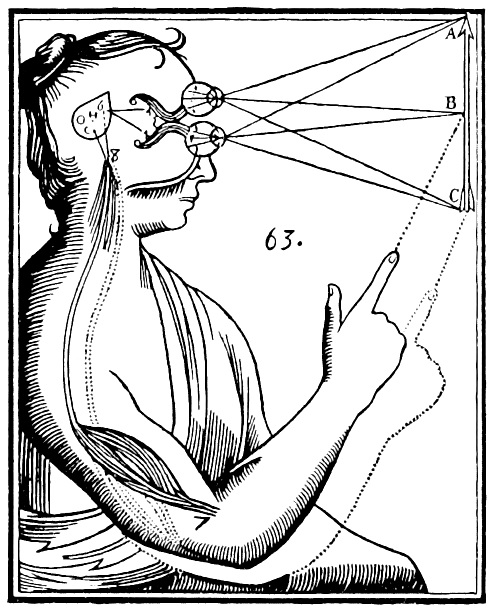
As in epistemology, the philosophy of knowledge, so in the philosophy of mind, the Frenchmen René Descartes made an impact in the 17th century that has reverberated through Western philosophy till this present day. Descartes’ refuge in the certainty of his own self naturally lead him to give an exalted status to mind in relation to everything in the world outside it. In metaphysical terms he conceived mind as an entirely distinct entity as mental substance whose essential nature is thinking. Everything else is matter or material substance whose defining characteristic is spatial extension a.i. filling physical space. Thus he envisioned two distinct realms; one of immaterial minds with mental properties such as thinking and feeling. Another of material bodies with physical properties such as mass and shape.

Problems for dualism
A desire to drink causes my arm to lift the glass. A drawing pin in my foot causes me pain. Mind and body interact. Mental effects bring about physical ones and vice versa. But the need for such interaction immediately casts doubt on the Cartesian picture. It is a basic scientific principle that a physical effect requires a physical cause. But by making mind and matter essentially different, Descartes appears to have made interaction impossible. Descartes himself recognized the problem, and realized it would take God’s intervention to enable the necessary causal relationship. But he did little else to resolve the issue.

Descartes younger contemporary and follower, Nicolas Malebranche, accepted the duality and took it upon himself to tackle the problem. His surprising resolution was to claim that interaction did not in fact occur at all. Instead, on every occasion when a conjunction of mental and physical interaction was required, God acted to make it happen. So creating the appearance of cause and effect. The awkwardness of this doctrine, known as occasionalism, got little support and serves mostly to highlight the seriousness of the problem it was intended to fix.

Idealism & physicalism
The obvious response to the difficulties facing the substance-dualism of Descartes, is to adopt a monistic approach to claim that there is only one kind of stuff in the world, either mental or physical. A few – most notably George Berkeley – have taken the idealist path claiming that reality consists of nothing but minds and their ideas. But the great majority – certainly amongst modern day philosophers have opted for some form of physicalist explanation. Driven on by the undeniable successes by science in other areas, the physicalist insists that the mind too must be brought within the purview of science and since the subject matter of science is exclusively physical, the mind must also be physical. The task then becomes to explain how mind – subjective and private – fits into a purely physical account of the world; objective and publically accessible.

Physicalism has taken a number of different forms. What they have in common is that they are all reductive. They claim to show that mental phenomena can be analyzed, fully and exhaustively, in purely physical terms. Advances in neuroscience have left little doubt that mental states are intimately related to states of the brain. The simplest cause for the physicalist is thus to claim that mental phenomena are actually identical to physical events and phenomena in the brain. The most radical versions of such identity theories are eliminative. They propose that – as out scientific knowledge advances – folk psychology, our ordinary ways of thinking and expressing our mental life in terms of believes, desires, intensions and so on, will disappear. They will be replaced by accurate descriptions and concepts drawn principally from neuroscience.

Physicalist solutions to the mind-body problem brush aside many of the difficulties of dualism at a stroke. Predictably, critics of physicalism complain that its proposers have brushed aside too much. That its successes have been achieved at the heaviest cost: a failing to capture the essence of conscious experience, its subjective nature.

Source: 50 philosophy ideas you really need to know, Ben Dupré

(Resolved)
Fast forward to present day 2017. Quite a few scientists have become frustrated with the failure of science to give an explanation for mind though the general public is not aware of this failure. Also, there is a growing body of evidence for consciousness existing separate from the physical brain and being continually present in the cosmos. This correlates precisely with cutting-edge physics, which posits that things in our time and space are not intrinsically real, but are manifestations of a hidden dimension where they exist in the forms of superstrings, information fields, and energy matrices.

I am personally convinced that the mind-body problem has already been resolved, and the exception amongst Western philosophers – George Berkeley – got it right. It will take a long time before the general paradigm is shifted though. This is a ‘the world is not flat’ type of turnaround that takes time for the science community and general population to digest.

See also: Free-Consciousness.com