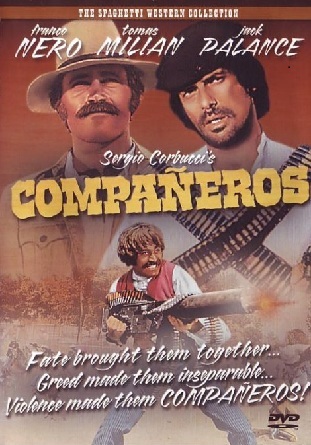
Compañeros

Director: Sergio Corbucci
Written by: Sergio Corbucci, Massimo De Rita, Fritz Ebert, José Frade, Dino Maiuri
Cast: Franco Nero, Tomas Milian, Jack Palance, Fernando Rey

Year / Country: 1970, Italy / West Germany / Spain
Running Time: 120 mins.

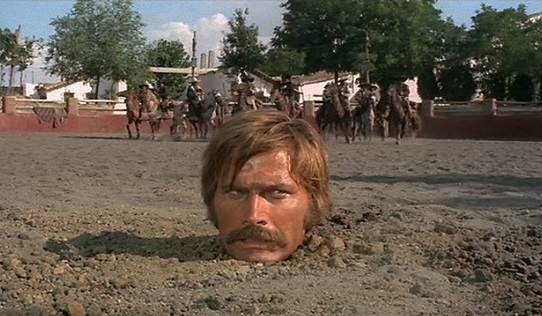
In a country torn apart by revolution, an unlikely duo teams up. The not too bright Mexican bandit Vasco (Tomas Milian) and the very polite arms dealer ‘The Swede’ (Franco Nero) go on a mission for the money hungry General Mongo. Their goal is to free Mongo’s pacifistic opponent Professor Xantos from a Texan jail because he knows the combination of a loaded safe. The two hate each other, so there is plenty of double-crossing along the way.

This spaghetti western, directed by the other Sergio, is an early buddy movie featuring two of the most established spaghetti western actors. The music is – of course – composed by Ennio Morricone and Jack Palance plays a very interesting supporting role as marijuana addicted gunslinger.

The movie misses the sharp humour and emotional depth that made genre films such as Django and the Dollar-trilogy so enjoyable, but it is certainly not the worst spaghetti western. The two strong leads fight, joke and shoot their way through a series of engaging adventures. The many last minute rescue scenes become kind of repetitive, so Corbucci could have been doing some heavier cutting. But, like the Mexican revolution, the movie ends in a massive shoot-out which is certainly worth the wait. Viva la Revolution!

Rating:

Biography: Sergio Corbucci (1926, Rome – 1990, Rome) is, alongside Sergio Leone, one of the most renowned directors of Spaghetti Westerns. He played a pivotal role in popularizing the genre, particularly through landmark films such as Django (1966) and Il grande silenzio (1968). Corbucci often collaborated with actor Franco Nero, creating some of the most iconic works of the genre. His films, often categorized as B-movies, are distinguished by their unflinching brutality, surreal and apocalyptic production design, dark humor, and politically left-leaning themes. A committed Marxist, Corbucci infused many of his works with a sense of revolutionary despair, reflecting the futility of social upheaval. Despite his significant contributions to cinema, Corbucci remained rooted in Italy throughout his career, with most of his films receiving limited international distribution. He passed away in Rome in 1990.

Filmography (a selection): Foreign Earth (1954), Water’s Love (1954), Supreme Confession (1957), Angel’s Sky (1957), Duel of the Titans (1961), Toto, Peppino and La Dolce Vita (1961), The Son of Spartacus (1963), Grand Canyon Massacre (1963), Django (1966), Navajo Joe (1966), The Mercenary (1968), The Great Silence (1968), Compañeros (1970), Bandera Bandits (1972), The White, the Yellow, and the Black (1975), The Payoff (1978), Super Fuzz (1980), My Darling, My Dearest (1982), Days of Inspector Ambrosio (1988)

A Bullet for the General

Director: Damiano Damiani
Written by: Salvatore Laurani (story), Franco Solinas (adaptation)
Cast: Gian Maria Volonté, Klaus Kinski, Martine Beswick, Lou Castel

Year / Country: 1966, Italy
Running Time: 113 mins.

Zapata Westerns are a subgenre of the Spaghetti Western. They deal with political themes and play against the backdrop of the Mexican Revolution between around 1910 and 1920, the years of the famous Mexican revolutionary Emiliano Zapata, after whom the genre is named. Famous examples include; Sergio Curbucci’s Companeros and The Mercenary, and Sergio Leone’s A Fistful of Dynamite. A Bullet for the General is an early contribution to the genre and is regarded as one of the best.

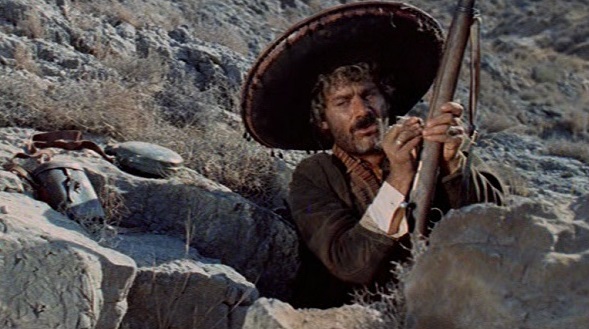
It deals with a group of cutthroat bandits, led by El Chuncho (Volonté). Their job is to steal guns for the revolutionary general Elias. During a violent train raid, they pick up young American Tate (Castel), who they take along with them as a welcome addition to their crew. What they don’t know is that Tate is secretly an assassin hired by the Mexican government to kill Elias with the golden bullet he carries with him.

Starring two actors familiar in the Spaghetti Western genre, namely the man with the characteristic laugh Gian Maria Volonté (Ramón Rojo in A Fistful of Dollars and El Indio in For a Few Dollars More) and, Klaus Kinski (The Great Silence, and also For a Few Dollars More), it became extremely popular in Europe, though butchered for both political and content reasons in overseas markets. The film makes many references to the Vietnam War. The character Tate for example is meant to represent the CIA’s interventions in Latin America.

A Bullet for the General is a fiesta with guns. Composer Luis Enriquez Bacalov (Django, Il Postino, Kill Bill) has provided a cheerful musical score, while El Chuncho and his bandits kill more Mexicans than the Wild Bunch. This is how a revolution works; misery and death contrast with joy and celebration. It is only difficult to sympathise with these hard characters. My general thought during the movie was therefore; ‘so, let’s kill this general and get it over with.’ A lot was made up by the excellent action and production design, and the final scene also delivers some heartfelt (and needed) emotion.

Rating:

Biography: Damiano Damiani (1922, Pasiano, Italy) is an Italian screenwriter, director and actor. He won awards for several of his films, such as the Mafia drama The Pizza Connection. In the eighties he also made the renowned mini-series La Piovra (The Octopus) about a prosecutor’s battle with the Mafia. This successful series ran for eight series on RAI Uno and turned out to be one of Italy’s best selling series abroad.

Filmography (a selection): The Hit Man (1960), Lipstick (1960), The Empty Canvas (1963), Strange Obsession (1966), A Bullet for the General (1966), The Day of the Owl (1968), The Most Beautiful Wife (1970), How to Kill a Judge (1974), A Genius, Two Partners and a Dupe (1975), Goodbye and Amen (1977), A Man on His Knees (1978), The Warning (1980), The Octopus (1984, mini-series), The Pizza Connection (1985), The Inquiry (1986), Massacre Play (1989), Angel With a Gun (1992), Killers on Holiday (2002)