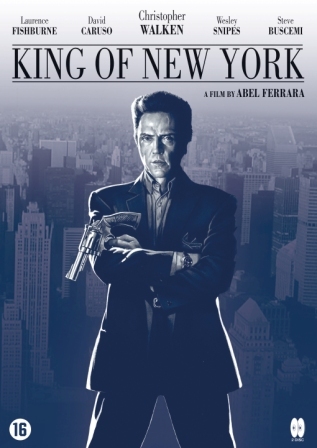
King of New York (1990)


‘Not everyone who runs a city is elected’

Directed by:
Abel Ferrara

Written by:
Nicholas St. John

Cast: Christopher Walken (Frank White), David Caruso (Dennis Gilley), Larry Fishburne (Jimmy Jump), Victor Argo (Roy Bishop), Wesley Snipes (Thomas Flanigan), Janet Julian (Jennifer), Joey Chin (Larry Wong), Giancarlo Esposito (Lance), Paul Calderon (Joey Dalesio), Steve Buscemi (Test Tube)

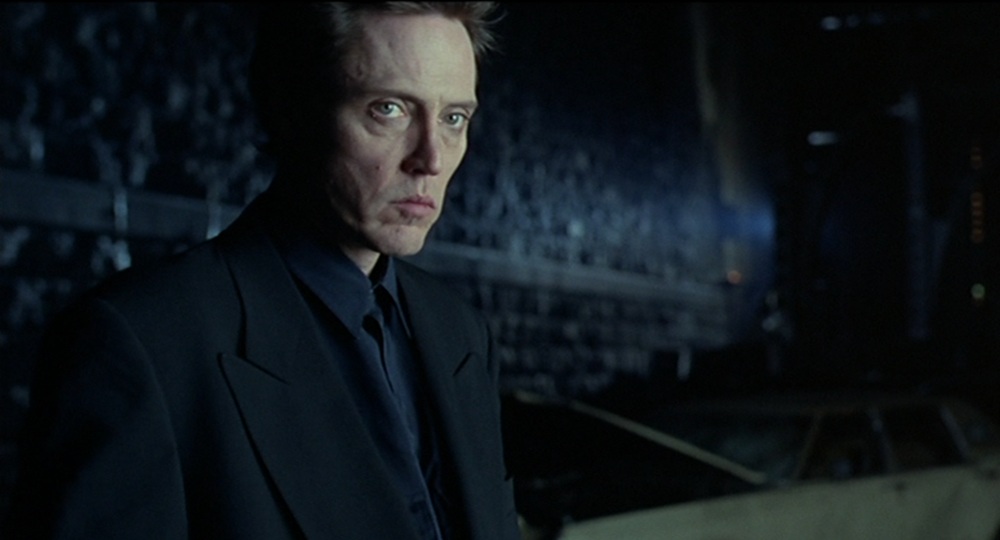
The Godfather meets Black Caesar in Abel Ferrara’s violent 90’s gangster tale. Christopher Walken plays the disturbing and eccentric gang lord Frank White, who is characterized by a short fuse temper, a Robin Hood-like attitude and a pretty cool haircut.

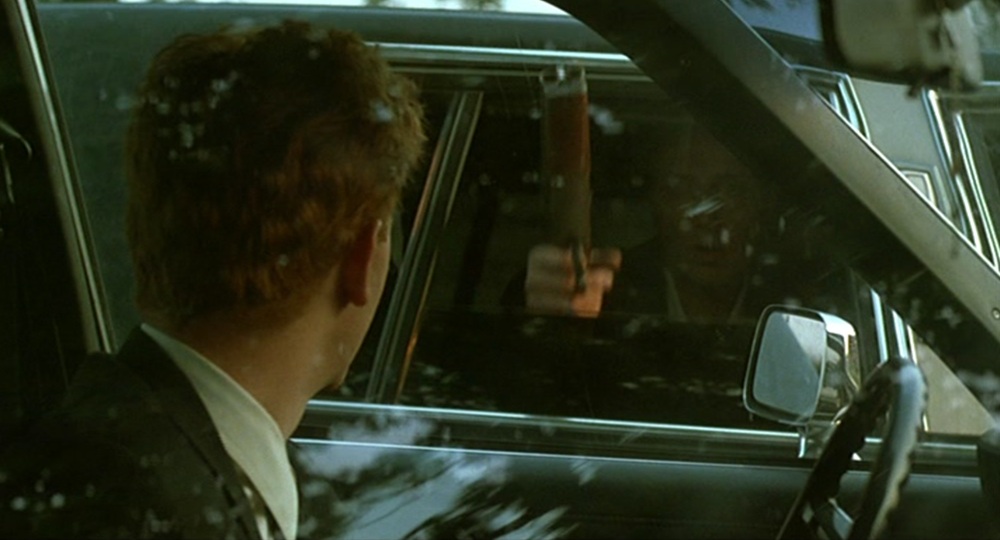
When White is released from prison he starts effectively wiping out all his competitors whom he views as the real scum of New York because they take money from the poor and weak. He is different: he uses his drug money to finance schools and hospitals. For him, this easily justifies the killing of some vermin, but a small group of Irish cops look at the matter entirely differently. They hate the idea that a drug dealer can get away with murder and so they start a war with Frank and his gang.

Ferrara and his regular screenplay writer Nicholas St. John show the viewer that crime is dirty. There is nothing glamorous about King of New York, not even the sex and coke parties. In the world these characters live in, death and betrayal could come any time. Frank knows this. In one scene he expresses his desire to stay around for just two more years, so he can finish his charity work. Death could come soon and it is hardly a heroes’ death waiting for him. Still, he has the makings of a hero.

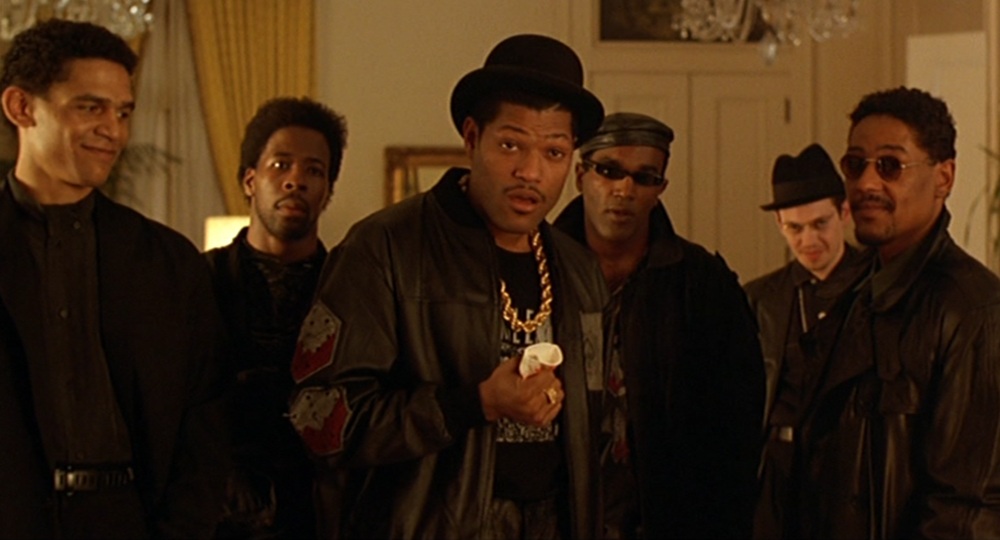
King of New York is easily Ferrara’s most accessible movie. There is hardly any complex subtext like in basically all of his other works, but it does contain some criticism on society as can be expected from an artist like Ferrara. Basically, it is a modern day morality tale, but the message is certainly delivered in an entertaining fashion. Apart from Walken’s excellent performance, many other cast members shine as well, most notably Larry Fishburne in scene stealing form. Also contains a fair amount of violent action.

Rating:

Quote:
LARRY WONG: “You know something Frank…this conversation made me realise how fucking crazy you really are.”

Trivia:
The work of real-life friends David Caruso and Wesley Snipes in this film helped them get casted in, respectively, NYPD Blue (1993) and New Jack City (1991) each of which launched both actors into stardom.

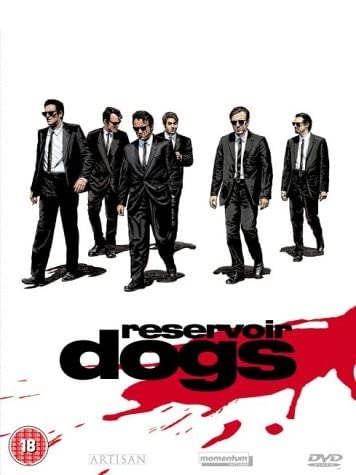
Reservoir Dogs (1992)


‘Let’s go to work’

Directed by:
Quentin Tarantino

Written by:
Quentin Tarantino

Cast:
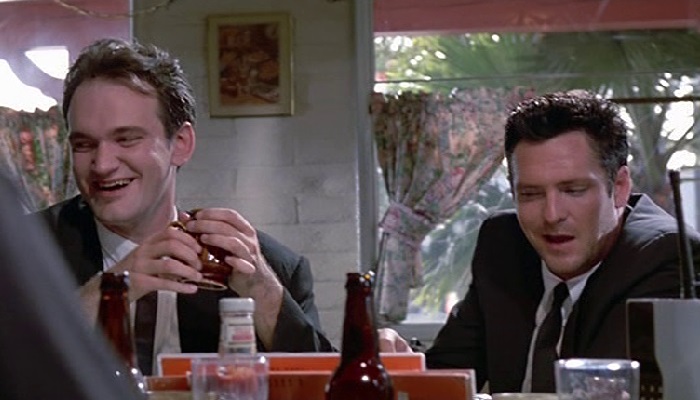
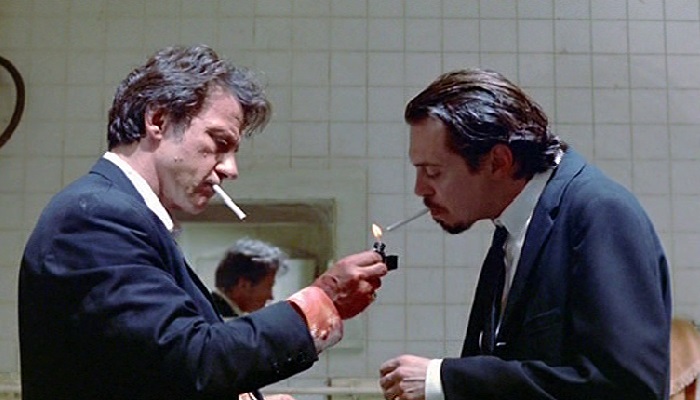
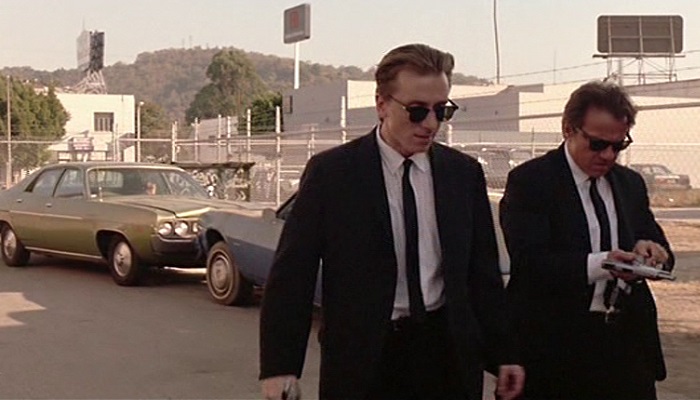
Harvey Keitel (Mr. White / Larry Dimmick), Tim Roth (Mr. Orange / Freddy Newandyke), Michael Madsen (Mr. Blonde / Vic Vega), Steve Buscemi (Mr. Pink), Lawrence Tierney (Joe Cabot), Chris Penn (Nice Guy Eddie Cabot), Eddie Bunker (Mr. Blue), Quentin Tarantino (Mr. Brown), Randy Brooks (Holdaway), Kirk Baltz (Marvin Nash)

‘Mr. Brown, Mr. White, Mr. Blonde, Mr. Blue, Mr. Orange, and Mr. Pink.’
‘Why am I Mr. Pink?’
‘Because you’re a faggot, all right!’

Meet the Reservoir Dogs. It’s 1992, and cinema firebrand Quentin Tarantino has just exploded onto the scene. Reservoir Dogs is easily the most impressive directorial debut of the 1990s – arguably of all time.

Joe Cabot and his son, Nice Guy Eddie, assemble a six-man crew for a daring diamond heist. None of the men have met before. To maintain anonymity and protect against betrayal, each is given an alias. Despite meticulous planning, the robbery goes catastrophically wrong. Someone talked. At the rendezvous point – an abandoned warehouse – the crew turns on each other in a deadly showdown.

This relatively simple premise is executed with striking ingenuity. Tarantino crafts a masterful nonlinear narrative, shifting back and forth in time between the heist’s setup and its bloody aftermath – yet never showing the actual robbery. Background details are revealed with precision, each revelation tightening the suspense until the traitor is unmasked and tensions reach a violent climax. It’s absolutely riveting cinema.

Since its release, Reservoir Dogs has inspired countless indie filmmakers hoping to capture the same low-budget brilliance, but few have come close. Why? Because they can’t write a screenplay this sharp, that’s why. Tarantino delivers more than just clever structure – he populates his film with complex, vividly drawn characters. And then there’s the dialogue: razor-sharp, darkly funny, and endlessly quotable.

At times, the film plays like a black comedy of the highest order. Yet it never loses its edge as a hyper-tense thriller. “My heart is beating so fast I’m about to have a heart attack”, Mr. Blonde says at one point and the same could be said for the audience. Whether it’s Mr. Pink’s frantic getaway, the desperate escape attempts, or the slow-burn mystery of the undercover cop, the tension never lets up.

The atmosphere swings from effortlessly cool – see the iconic opening credits—to grim and downright brutal. The casual banter gives way to explosive violence with little warning. The warehouse itself becomes a chamber of horrors: Mr. Orange bleeding out for most of the film, the infamous torture scene – it’s disturbing and hard to watch, and that’s exactly the point.

The cast seals the deal. With actors like Harvey Keitel and Steve Buscemi delivering Tarantino’s dialogue with perfect rhythm, even conversations about Madonna or tipping become electric. Chris Penn gives what might be his best performance, and Lawrence Tierney is unforgettable in his final tough-guy role.

Tarantino’s debut might still be his finest work. Pulp Fiction may be equally brilliant, but it occasionally meanders. Reservoir Dogs, in contrast, never loses momentum. It’s lean, vicious, and near-perfect – a film so good it’s almost a curse. Tarantino didn’t just enter the scene with a bang; he set the bar impossibly high from the very start.

Rating:

Quote:

MR. WHITE: “What you’re supposed to do is act like a fucking professional. A psychopath ain’t a professional. You can’t work with a psychopath. You don’t know what these sick assholes are gonna do next.”

Trivia:

Michael Madsen auditioned for the part of Mr. Pink. But Tarantino told him: “Here’s the thing: you’re not Mr. Pink, you’re Mr. Blonde. And if you’re not Mr. Blonde, then you’re not in the fucking movie.”

Cult Radar: Part 7

FilmDungeon is glad to explore the video trenches to find that oddball treasure between the piles of crap out there. Of Course, a treasure in this context can also be a film that’s so shockingly bad it’s worth a look, or something so bizarre that cult fans just have to see it. Join us on our quest and learn what we learn. Hopefully we’ll uncover some well-hidden cult gems.

Researched by: Jeppe Kleijngeld
Hell Ride (USA, 2008)

Directed by: Larry Bishop
Written by: Larry Bishop
Cast: Larry Bishop, Michael Madsen, Eric Balfour

Larry Bishop, who played in trashy biker films in the sixties and seventies such as The Savage Seven, Angel Unchained and Chrome and Hot Leather writes, directs and stars in a Tarantinoesque homage to the biker film. In it, a decade long battle between two biker gangs takes place; the Victors, lead by Pistolero (Bishop) Vs. the 666ers, lead by Billy Wings (Vinnie Jones). The concept and promising cast (Michael Madsen, Dennis Hopper, David Carradine) raises expectations, but the execution is far below par. Tarantino should have rewritten the script apart from producing. The dialogues appear to have been written by a 14 year old. There is some humor to be found, but it can hardly make up for the terrible script. Also Bishop is unfit to play the lead role. Interesting trivia: Madsen and Bishop share a scene in Kill Bill: Vol. 2 (2004). Madsen plays Budd and Bishop plays his boss in the strip club scene.

The Host (South Korea, 2006)
OT: Gwoemul

Directed by: Bong Joon-ho
Written by: Baek Chul-hyun, Bong Joon-ho, Ha Jun-won
Cast: Song Kang-ho, Byeon Hie-bong, Ko Ah-sung

On orders of a US doctor, a toxic substance is dumped in the Han River. Four years later in Seoul, ordinary Korean folk are enjoying a leisurely day along the river when the final result reveals itself. In 2006, this entertaining monster movie made a successful journey along the important international film festivals and the tentacles of the host soon attained a large cult following. The Host effectively balances between comedy and campy horror. Only with nearly two hours running time and a main character who screams too much the fun is somewhat lessened. Also a monster that looks like sewer calamari can be hardly called scary. Still, a couple of really good jokes and scenes and its undeniable cult appeal make The Host a worthy contender for the Mega Monster Mash.

Bronson (UK, 2008)

Directed by: Nicolas Winding Refn
Written by: Brock Norman Brock, Nicolas Winding Refn
Cast: Tom Hardy, James Lance, Matt King, Amanda Burton

The wacky British indie flick Bronson gives you the life story of Charles Bronson. No not the movie star YOU CUNT! We’re talking about Britain’s most violent prisoner. Since it is directed by Danish director Nicolas Winding Refn from the violent and brilliant Pusher trilogy, I was kind of expecting a gut-wrenching gorefest. It is not that bad, in fact this is more like a comedy. Crucial to the film is the central character who wants to become famous. He can’t sing and he can’t fucking act. So what does he do? This original idea is brought to the screen with Winding Refn’s usual sense of style. Tom Hardy delivers a knock-out performance as the protagonist. Don’t expect a cliché prison drama and you might find a place in your heart for Bronson. Special mention goes to the soundtrack which includes gems such as ‘It’s a sin’ by Pet Shop Boys.
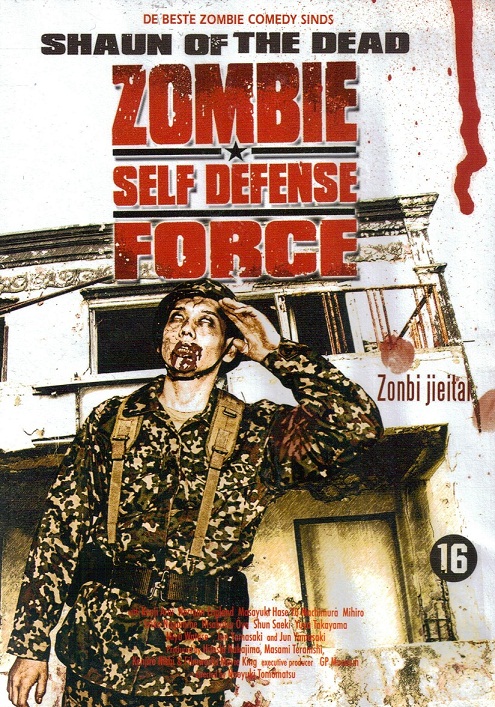
Zombie Self-Defense Force (Japan, 2006)

Directed by: Naoyuki Tomomatsu
Written by: Chisato Oogawara, Naoyuki Tomomatsu
Cast: Kenji Arai, Norman England, Masayuki Hase, Yû Machimura

On the cover of Zombie Self-Defense Force, this movie is compared to Peter Jackson’s Bad Taste. Although the extreme gore is sometimes similar – though far less creative – this is nothing like Jackson’s first movie. It totally misses a master’s touch – this is amateur night and they know it. Poor acting, horrible no budget FX and very little to enjoy overall. During the first half hour, a few nice character touches promise some cult delight, but as soon as a zombie baby appears (a homage to another Jackson classic), things start to look really bad. Pretty much a disgrace anyway you look at it.

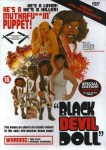
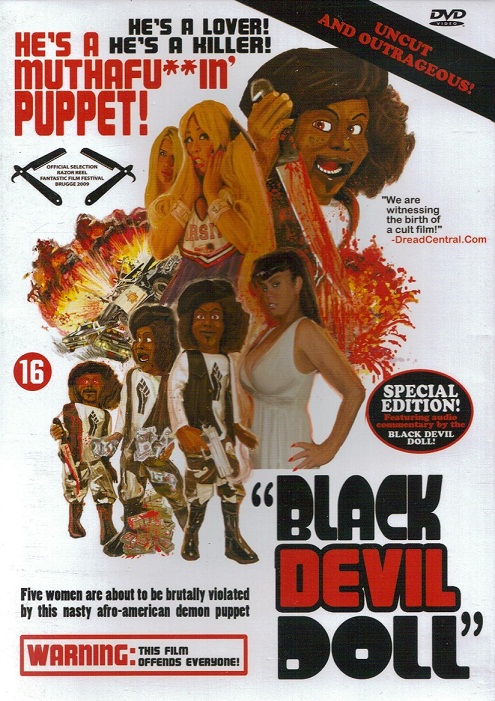
Black Devil Doll (USA, 2007)

Directed by: Jonathan Lewis
Written by: Shawn Lewis, Mitch Mayes
Cast: Heather Murphy, Natasha Talonz, Christine Svendsen

He’s a lover! He’s a killer! He’s a muthafu**in’ puppet! ‘A Lewis Brothers fiasco’, credits state after Mubia, a member of the black power movement, is executed. His last words: ‘I like to eat white butt’. We’re up for something special that is for sure. Mubia is brought back to life by big boob teenager Heather while she is messing around with a Ouija Board. Guess what? The dangerous rapist and murderer returns in puppet form! So, the sexploitation version of Child’s Play begins. Not subtle, but sleazy, nasty and offensive. Black Devil Doll does exactly what it promises to do on the cover. At times it is too dirty, but quite often it is pretty hilarious.


Tom Hardy as Charles Bronson in Bronson

The Valachi Papers (1972)


‘The Valachi Papers. Fact not Fiction’

Directed by:
Terence Young

Written by:
Peter Maas (book ‘Le Dossier Valachi’)
Dino Maiuri (screenplay)
Massimo De Rita (screenplay)

Cast:
Charles Bronson (Joe Valachi), Lino Ventura (Vito Genovese), Jill Ireland (Maria Reina Valachi), Walter Chiari (Gap), Joseph Wiseman (Salvatore Maranzano),
Gerald O’Loughlin (Ryan), Amedeo Nazzari (Gaetano Reina), Fausto Tozzi (Albert Anastasia), Pupella Maggio (Letizia Reina), Angelo Infanti (Lucky Luciano)

Joe Valachi is not a name that is spoken of with much respect in mob circles. He was the first Mafia rat and gave up the entire hierarchical structure of the Mafia to a crime committee. He revealed the five families of New York – Gambino, Lucchese, Colombo, Bonanno and Genovese – that were named after the ruling bosses at that time. This film tells Valachi’s life story. At the height of the Castellammarese war (1929 – 1931), the bold, small time crook Joseph ‘Joe Cargo’ Valachi joins the side of Don Salvatore Maranzano, an old Mustache Pete who is fighting a bloody war with his rival Joseph ‘Joe the Boss’ Masseria.

After the deaths of the two old Don’s, Valachi’s crime family evolves. First Lucky Luciano becomes boss, and after his imprisonment Vito Genovese takes over. In a Mafia-career spanning over 30 years, Valachi is involved with New York’s most legendary Mafia figures. He steals, frauds and murders for them, until finally the FBI manages to turn Genovese against Valachi in order for him to testify. He does so, and gives up his former associates along with all other major Cosa Nostra figures he knows of.

He becomes the first mob informer who makes sure that the existence of ‘La Cosa Nostra’ is no longer a secret for the public. Based on the novel by Peter Maas, The Valachi Papers was produced by Dino De Laurentiis in Italy with many scenes dubbed in English. It was directed by Terence Young, most well-known for directing the first official Bond movies. It came out in the same year as The Godfather, and helped to popularize the Mafia as a source of entertainment.

The Valachi Papers sticks to the steady pattern of the mob film; tough guys, half Italian dialogue, shoot-outs and violence (especially a castration scene is very brutal). Also the ‘rise and fall’ type of build-up has been done countless times. This is not the head of its class though. The beginning promises a rapid-pace movie, but after about 40 minutes, all the suspense has been drained from the script. Since the characters are not that fascinating to begin with, this becomes quite a doll viewing in the second half.

Rating:

Quote:
JOE VALACHI: “Senator, I am not talking about Italians. I am talking about the Mafia.”

Trivia:
In the final credits, it is stated that Joe Valachi outlived Vito Genovese by six months. It was actually two years.