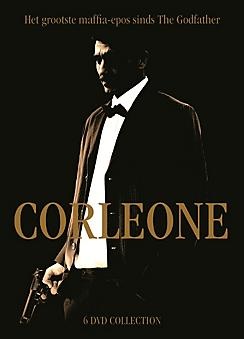
TV Dungeon: Corleone

(2007, mini-series, Italy)
AKA: Il capo dei capi

Directed by: Alexis Cahill & Enzo Monteleone

Cast: Claudio Gioè, Daniele Liotti, Simona Cavallari, Salvatore Lazzaro, Gioia Spaziani, Massimo Venturiello, Marco Leonardi

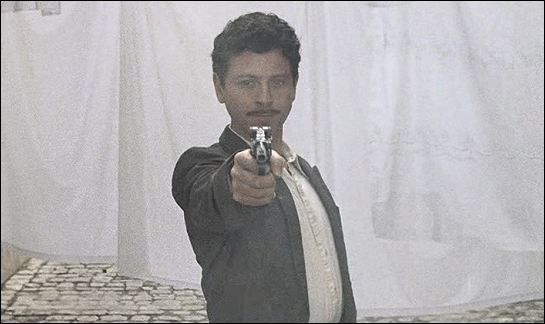
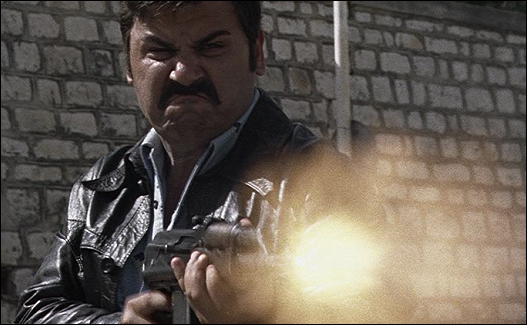
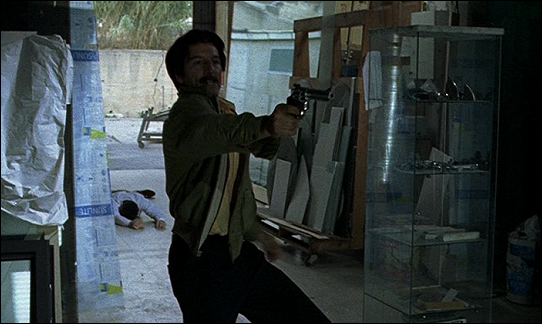
How does one become ‘il capo dei capi’ or boss of all bosses? That question is answered in the mini-series Corleone. In a fifty year period, Toto Riini grows up from little boy in Corleone on Sicily to the highest ranking member of the Sicilian Cosa Nostra (literally ‘Our Thing’). He does so by slowly murdering anybody who opposes him or who has any real power within the Mafia.

The Corleoneses, Toto Riina and his underboss Bernardo Provenzano, are provincial Mafiosi. They join the Mafia at a young age to escape from poverty. They rise to the top of the organisation quickly. In Sicily’s capital Palermo, the Corleoneses are perceived as hicks by the Mafia, but they are smart, ambitious and extremely ruthless as the Palermeans are about to find out. Riina was known as ‘the Beast’. It is a well chosen name considering the extreme high bodycount that can be attributed to him.

The mini-series is based on the book by Giuseppe D’Avanzo and Attilio Bolzoni. The makers wanted to not only show Riini’s rise to power and how he made it to the top, but also show the struggles of the law that wanted to put an end to him and his Mafia. Many judges and policemen died in this decade long battle. That much becomes clear in Corleone. For a long time, the law didn’t stand a real chance, but through sacrifice and perseverance they eventually got results.

To make the distinction between the good side and the evil side, the writers of this mini-series introduced a fictional character in this otherwise largely fact-based story. The true-hearted Biagio Schirò grows up with Riini in Corleone, but rather than becoming a mobster like his friends he joins the police. He follows Riini’s career closely and tries to bring him down, along with many real historical law figures, such as judge Giovanni Falcone. They stand for everything that the mob doesn’t.

In terms of production design, the makers did a good job of capturing the old times on the beautiful Sicily. Dramatically however, the series falls short. There isn’t enough suspense or character development to keep the viewer entertained for six times 100 minutes. Not even close. They could have told this story in a three hour mini-series. Now it quickly becomes repetitious. A shame, because the right basis is there.

Cult Radar: Part 3

FilmDungeon.com is glad to explore the video trenches to find that oddball treasure between the piles of crap out there. Of Course, a treasure in this context can also be a film that’s so shockingly bad it’s worth a look, or something so bizarre that cult fans just have to see it. Join us on our quest and learn what we learn. Hopefully we’ll uncover some well-hidden cult gems.

Researched by: Jeppe Kleijngeld

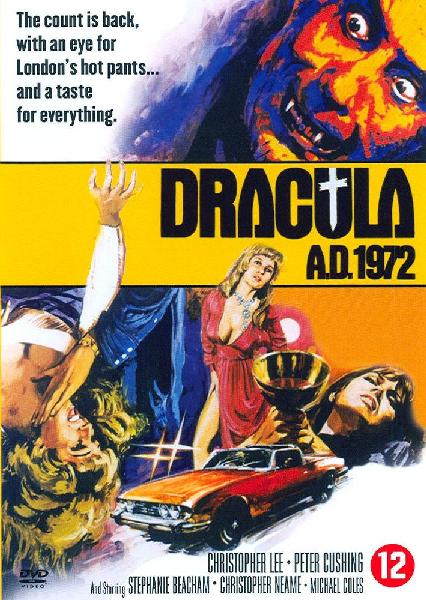
Dracula A.D. 1972 (UK, 1972)

Directed by: Alan Gibson
Written by: Don Houghton
Cast: Christopher Lee, Peter Cushing, Stephanie Beacham

This is the sixth Hammer production that stars Christopher Lee as the uncanny Count Dracula. This time he appears in London during the seventies, as one of his descendants. Johnny Alucard (spell his surname backwards), performs a ritual which brings his old master back to life. Dracula rapidly starts to suck the blood out of young girls. Luckily for the London hippie community, a descendant of the legendary Van Helsing (Peter Cushing), discovers what’s going on and he bows to destroy the evil count forever. Lee and Cushing are a joy to watch as always. They are very charismatic speakers, both equipped with a great voice that enables them to make almost everything they say sound interesting. It’s only a shame that Lee gets too little screen time. Also, the actors playing the hippie characters are extremely unconvincing. Just because someone’s on acid doesn’t mean he will barely react to strange and shocking occurrences. One of the weaker and duller Hammer Dracula flicks.


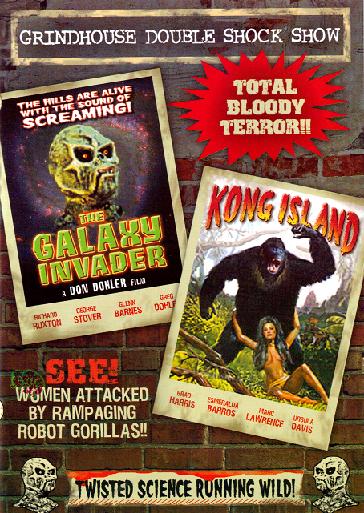
The Galaxy Invader (USA, 1985)

Directed by: Don Dohler
Written by: Don Dohler, David Donoho, Anne Frith
Cast: Richard Ruxton, Faye Tilles, George Stover

It starts with a Predator-like intro-shot of a fireball flying towards earth, followed by a pulpy credit sequence, including the typical cheesy synthesizer score. The fireball (spaceship) lands in Maryland and the aggressive alien creature onboard starts to roam the outside. A group of rednecks start to hunt it down for the money and a deadly confrontation ensues, while a UFO hobbyist and his former pupil get involved when they attempt to rescue the alien. The first time the Galaxy Invader appears (within five minutes), you’ll see a guy in a suit so ridiculous, it makes you wonder why they even bothered continuing this production at all. Despite these crappy effects, the movie is often quite hilarious because of the stupid (inter)actions of the yokels and the ludicrous action scenes. The alien shoots firework rockets from his gun for Christ sakes! It looks as though the budget was just a few thousand dollars. Great movie though, if you got a thing for the ultra-cheap stuff.
 

Kong Island (Italy, 1968)

Directed by: Robert Morris
Written by: Chang Cheh
Cast: Brad Harris, Marc Lawrence, Esmeralda Barros

Released on a Grindhouse double feature DVD together with The Galaxy Invader. The picture quality of this film is so bad that you can barely see what’s going on at times. Not that the story is very complicated. In the Nairobi jungle, a mad scientist creates a number of brain-controlled killer gorillas. They kidnap the young girl Diana who belongs to a local expedition group. Mercenary Burt leads a rescue party into the labyrinth jungle, financed by Diana’s father, a bastard who also secretly sponsors the scientist’s experiments. The rescue party gets ambushed and all except for Burt die. Soon after, he meets the ‘sacred monkey’, a girl raised by apes, who helps him find the scientist’s underground lab for a final showdown. Dull movie with virtually nothing to make it worth your while. Also known as Eve, The Wild Woman and King of Kong Island. Best to avoid.

 

Lucker (Belgium, 1986)

Directed by: Johan Vandewoestijne
Written by: Johan Vandewoestijne, John Kupferschmidt
Cast: Nick Van Suyt, Helga Vandevelde, Let Jotts

The heavily insane John Lucker (Nick Van Suyt) escapes from a mental institution. We learn that he has killed eight woman and performed sexual acts with their already decomposing corpses. That already says it all right? Lucker doesn’t talk much, which makes him all the more scary when he brutally murders someone. Not that it is so much better when he does talk. A prostitute, one of his victims, tells him “this is not my idea of a good time”. Same goes for the viewer: it’s all very unpleasant and nasty. But despite its dark and gloomy ugliness, there is something fascinating about Vandewoestijne’s approach. He created a visually impressive work that features good acting. Hats off for those poor victim girls, who make their torment seem very real. Also kudos for Van Suyt’s disturbing portrayal of John Lucker. A deeply messed-up maniac filled with misogyny. If you decide to watch this, prepare for the worst though.


Nightmare Concert (Italy, 1990)
OT: Un gatto nel cervello

Directed by: Lucio Fulci
Written by: John Fitzimmons, Lucio Fulci, Giovanni Simonelli, Antonio Tentori
Cast: Lucio Fulci, Brett Halsey, Ria De Simone

The DVD-cover of Nightmare Concert aka A Cat in the Brain describes this as Fulci’s bloodiest film. Hard to believe, but it is actually kind of true. I can’t remember many films with this much red in it. It is a special film as well: Fulci stars as himself, a film director with a taste for gore, who begins having violent fantasies. He visits a shrink who hypnotizes him. As a result, Fulci can no longer see the difference between his films and reality which results in loads of brutal slayings. The idea is crystal clear: screen violence leads to real violence. Many recognizable Fulci elements are present in Nightmare Concert: inventive kills (driving over a corpse ten times), less inventive kills (body part dismemberment by chainsaw), some sex and quite a lot of black humour. It is also completely over the top and contains a few lovely moments of self-parody. Just as trashy as most of Fulci’s films, but when the man is on a roll, who’s complaining?


Dracula A.D. 1972
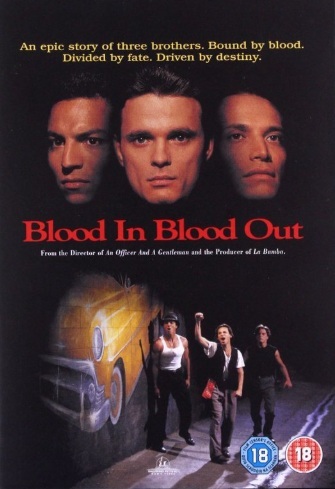
Blood In, Blood Out (1993)


‘An epic story of three brothers. Bound by blood. Divided by fate. Driven by destiny.’

Directed by:
Taylor Hackford

Written by:
Ross Thomas (story)
Jimmy Santiago Baca (screenplay)
Jeremy Lacone (screenplay)
Floyd Mutrux (screenplay)

Cast:
Damian Chapa (Miklo), Jesse Borrego (Cruz), Benjamin Bratt (Paco), Enrique Castillo (Montana), Victor Rivers (Magic Mike), Delroy Lindo (Bonafide), Tom Towles (Red Ryder), Carlos Carrasco (Popeye), Teddy Wilson (Wallace), Billy Bob Thornton (Lightning), Lanny Flaherty (Big Al)

Blood In, Blood Out explores the brutal initiation ritual of Latino gangs: to join, one must kill or risk being killed.

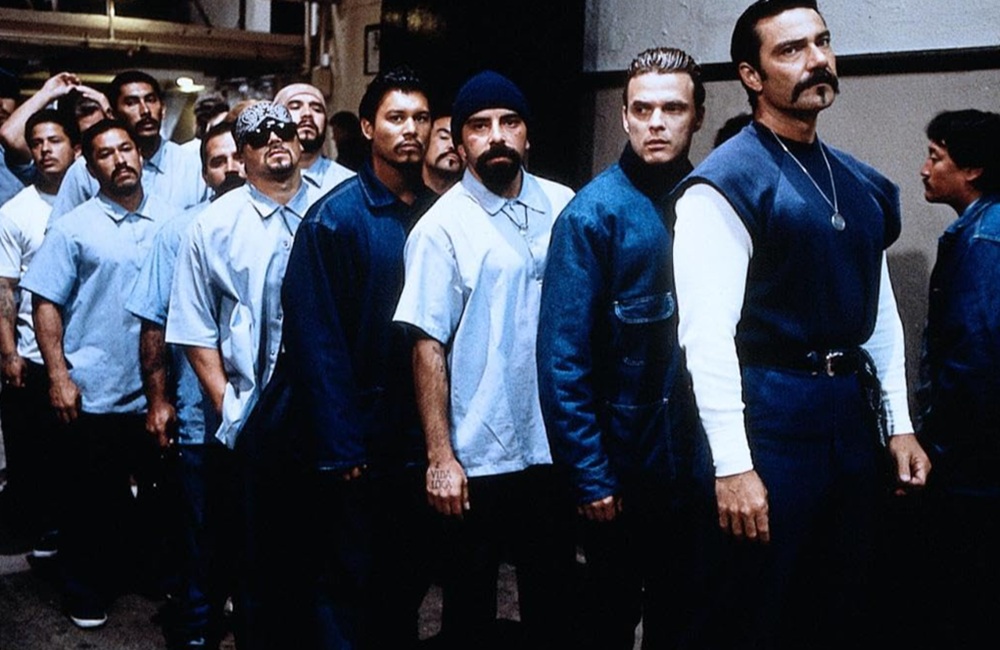
Miklo, a half-blatino outsider with white skin and blue eyes, returns to East L.A.’s barrios after a falling out with his Caucasian father. Reuniting with his cousins Paco and Cruz – members of the ‘Vatos Locos’ gang – he faces constant ridicule for his appearance. But when Miklo proves his loyalty by confronting the rival ‘Tres Puntos’ gang, he earns his place with a ‘VL’ tattoo on his hand.

Tragedy strikes soon after: a violent clash with ‘Tres Puntos’ leaves Cruz permanently disabled and Miklo imprisoned for murder. The film’s second act splits into three powerful narratives: Miklo’s harrowing first stint in San Quentin, Cruz’s descent into drug addiction, and Paco’s unexpected career as a narcotics agent.

Director Taylor Hackford delivers a gripping, if slightly overlong (nearly three hours), portrait of Latino life, where crime and poverty loom large, yet family bonds remain unbreakable. Inspired by poet Jimmy Santiago Baca’s real-life experiences, the intertwined stories are compelling and well-crafted, with Miklo’s prison arc standing out as the most gripping.

Jesse Borrego shines as Cruz, delivering a performance that is both heartbreaking and authentic. The film’s rich supporting cast – including standout turns from Danny Trejo and Billy Bob Thornton – adds depth to this intense, entertaining saga. Despite its length, Blood In, Blood Out offers enough raw emotion and drama to hold your attention until the end.

Rating:

Quote:
POPEYE: “Hey, Cinderella, go find yourself a fella, you’re on the clock bitch and midnight is coming, you got the wrong man.”

Trivia:
The original cut for this film lasted five and a half hours.

Roadracers

Director: Arthur Swerdloff
Written by: Stanley Kallis, Edward J. Lasko
Cast: Joel Lawrence, Marian Collier, Skip Ward, Sally Fraser

Year / Country: 1959, USA
Running Time: 73 mins.

Roadracers is not to be confused with Robert Rodriquez’ 1994 TV-movie of the same name. Interesting detail about that film is that it was part of the Rebel Highway series that took the titles of 1950’s-era B-movies and was produced by Lou Arkoff, son of Samuel Z. Arkoff, the producer of this movie, and according to IMDb 138 other B-movies.

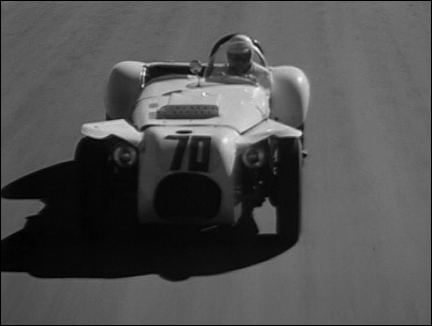
The story revolves around Rob Wilson, a young racer who was involved in a lethal accident years ago and recently started driving again. His father, a racing fanatic, wants him to be the best racer on the track. But Rob realizes he doesn’t like racing at all and breaks with his father. He goes to Europe where he continues his racing career, while his father takes Rob’s former competitor as his apprentice. Rob returns to the States to challenge his father in one last race: the Grand Prix.

Many Arkoff movies were shot in a couple of days and this appears to be one of them. A simple plot, lots of stock footage and some notable editing problems expose it for a B-movie pur sang. The upsides are some impressive black and white visuals and a couple of cool songs on the soundtrack. Unfortunately, despite its pleasant speed, Roadracers is a quite boring flick at the end of the day.

Rating:

Biography: Arthur Swerdloff (1921, Baltimore – 2008, Los Angeles) has directed a number of educational documentaries, mostly revolving around social themes. His only effort as feature director is Roadracers.

Filmography: Show ‘Em the Road (1954, short doc), Gang Boy (1954, short), Age 13 (1955, short), Roadracers (1959), What’s the Big Hurry (1977, short doc / co-dir)20