America is turning into an autocracy very fast. Every week there are new lows – like last week the arrest of a judge and the week before that Trump (He/him) regime’s refusal to return Kilmar Abrego Garcia from an El Salvador prison camp – despite the supreme court ordering them to do so.
Of the 71 million Americans who voted him in office, some might be wondering; how did we get here? I’ll argue that one significant moment played a key role in creating this disaster.
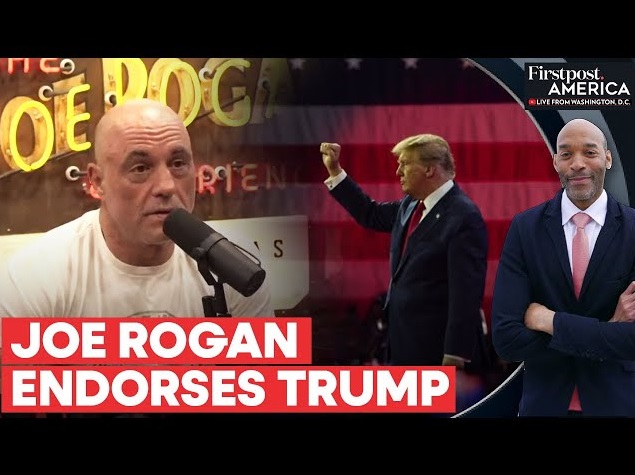
On the eve of the election day, on October 26, 2024, the extremely popular podcaster Joe Rogan interviewed Trump. I couldn’t bear to listen to his horse crap, but I recently watched one minute of the three hour interview on YouTube. In the fragment, Trump asked Rogan: “Come on, you’re not a Harris guy”.
And you see Rogan thinking: ‘shit, this guy is right. I am not a Harris guy’. Joe Rogan is manipulated at the spot. He lets himself be fooled by this con man. After that, he lets Trump get away with blatant lies about the 2020 election, which looks very bad for his interview ethos. I stopped viewing right after that.
What I took away from this short moment is that Trump – terrible person that he is – has at least one ‘quality’ that enabled him to become the 47th president of the USA: he knows just what to say to people to make them vote for him.
Of course this won’t work with everybody, but then again, he didn’t need everybody. He needed 71 million voters. He already had his loyal fan base secured, so he had to convince millions of others to vote for him. He and his campaign team put in all their efforts to convince right leaning people like Rogan to go for the Orange Turd. They were successful.
After the show, Rogan did something he had previously said he wouldn’t do: he endorsed Trump. With his immense reach amongst people for whom Rogan is their single source of news – tragic as this may be – he may have decided the fate of the United States.
How will he feel now, three months after Trump took office, and the country is sliding fastly into an authoritarian regime?
What we are watching right now might be the End of the American Empire.
The country is ruled by a mad king. Trump’s cabinet meetings are excruciatingly horrifying to watch. Every cabinet member that speaks, including Musk, first praises Trump for the absolutely brilliant leader that he is. And what an incredible honor it is to serve in his cabinet.
Then they proceed to tell absurd bullshit to cover up for their criminal actions. In the last cabinet meeting, Musk – in full Dr. Evil mode – bullshits about how he found 150 billion dollars in waste, fraud and abuse in the federal government. He says that ‘people are receiving social security that aren’t even born yet.’
This is just too much bullshit to handle.
Everybody knows how he is going to get this 150 billion. He will do it by slashing social security, medicaid, and other programmes for the poor – and recklessly fire tens of thousands of essential government employees. And Trump is gonna let him do it. The money saved will be given to billionaires like them as a tax cut.
Some still consider Trump a brilliant businessman, but he’s terrible in business – and that’s a fact. I mean, he bankrupted a casino once. Now, he’s going to bankrupt the country. He’s a fuck-up and a major fraudster.
The financial markets – who foolishly believed Trump would be good for business before – have now realised the terrible truth. Trump is so totally unstable and deranged that the risk for the world economy (countries, companies, currencies, and debt) is great. They finally realised, just like some voters did, that having a psychopathic gangster in charge of the largest economy in the world, might be bad for business.
It would have been exactly the same if they would have handed the reigns of the American government to Vladimir Putin or Kim Jung Un. That’s what the American’s did who voted this nut job into the White House.
Thank you, Joe Rogan.
Now maybe I am thinking too much of his endorsement. On the other hand, Trump thanked Rogan especially at his inauguration. Imagine that; that you would be responsible by having a cruel psycho elected who would then go on to create terrible suffering for millions of people. Who would send innocent people to an El Salvadorian prison camp to be tortured.

I have no idea how he feels about it, but this is a wound that he will have to live with. The same goes for all Americans, whether they voted for Trump or not. This is a national trauma and it will take decades to recover from it.
But first, they will have to remove Trump from office. Can it be done?
It will be very hard, that’s for sure. And even if they succeed, they will have a massive challenge waiting for them.
Let’s say they’ll have a revolution and remove Trump from office, will the two sides – the MAGA and the WOKE – reconcile and together restore the damage the Trump regime has caused? Will they think: ‘let’s go look at the root causes of this whole thing? Where did we go wrong? What laws are we going to introduce together to make sure something like this never happens again?’
The probability that this will happen is very small. Trump is a very severe symptom of a lethal disease: a mind virus that once it spreads through society – enhanced by anti-social media and AI – makes the country divided and ungovernable.
To stop this mind virus, we – the world – must regulate social media and AI. With AI becoming more powerful every day, we need to move fast to prevent every other democracy from sliding off the rails in the coming years and decades.
This will not be an easy feat – and America is in terrible shape. Still, the possibility also exists that the right leaders arise out of this sink hole and put the country on the right course again. A crisis can do that sometimes.
Right now, the crisis is not yet big enough. There are still many people, inside and outside of the USA, deluded by Trump and think it might not be so bad. But if enough people conclude: ‘this is not what we want’ and start fighting back in every way they can, it might bring about a new era of hopeful change.
Is this the end for the USA of merely the passage into a new prosperous era? Only time will tell.



 FRAGMENTEN UIT HET SCHEMERLAND