Once Upon a Time in America


As boys, they said they would die for each other. As men, they did.

Directed by:
Sergio Leone

Written by:
Harry Grey (book ‘The Hoods’)
Leonardo Benvenuti (screenplay)
Piero De Bernardi (screenplay)
Enrico Medioli (screenplay)
Franco Arcalli (screenplay)
Franco Ferrini (screenplay)
Sergio Leone (screenplay)

Cast:
Robert De Niro (David ‘Noodles’ Aaronson), James Woods (Maximilian ‘Max’ Bercovicz), Elizabeth McGovern (Deborah Gelly), James Hayden (Patrick ‘Patsy’ Goldberg), William Forsythe (Philip ‘Cockeye’ Stein), Tuesday Weld (Carol), Treat Williams (James Conway O’Donnell), Scott Tiler (Young Noodles), Rusty Jacobs (Young Max / David Bailey), Jennifer Connelly (Young Deborah)
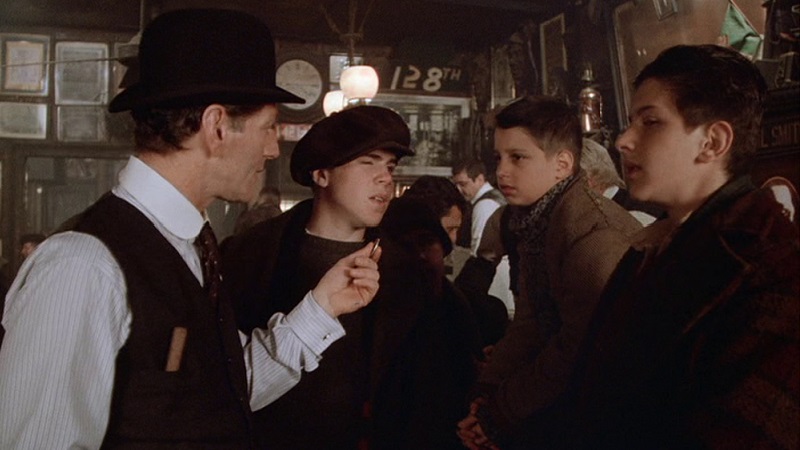
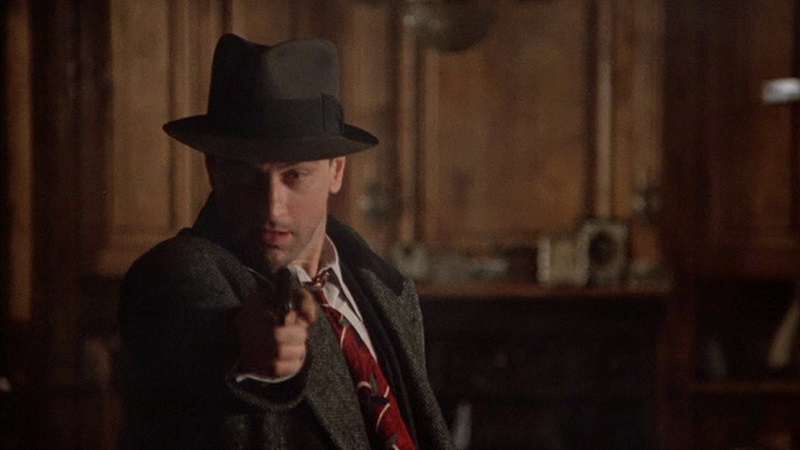
In the late 1970s, master director Sergio Leone turned down the offer to direct The Godfather in order to make another gangster film, this one based on the novel ‘The Hoods’ by former mobster Harry Grey. When filming was completed, the total footage ran between eight and ten hours. Leone and editor Nino Baragli trimmed it down to around six hours, intending to release the film as two three-hour features. The producers, however, rejected this idea and cut the film down to just over two hours for the American market. In doing so, they also abandoned the film’s non-linear structure, rendering the story almost incomprehensible. Unsurprisingly, the film flopped in the U.S., and Leone was left devastated.

Fortunately, a 3-hour and 49-minute version was prepared for international release, with the original non-chronological storytelling restored. Audiences overseas responded more positively, and many critics recognized it as a cinematic masterpiece. With his spaghetti westerns, Leone revealed the gritty, opportunistic side of the Old West. Here, he does the same for the American city ruled by mobsters. He strikes exactly the right tone. His sprawling gangland epic shows a world that may sparkle with a thin coat of glamour, but beneath that lies grime and plenty of it.

The narrative jumps across time, following Jewish gangster Noodles (Robert De Niro) through three phases of his life. First, his youth in the Lower East Side, where he meets his lifelong friend, the cunning but volatile Max (James Woods). In their prime during the Prohibition era, the two – along with childhood friends – rise to control a lucrative bootlegging operation. But tensions rise, and their friendship deteriorates with devastating consequences. In the third act, Noodles returns to New York as an old man after 35 years, confronting the ghosts of his past.

The fragmented screenplay may not feel intuitive, but it doesn’t need to be. The film works on a dreamlike, emotional logic. Many interpret the second half as nothing more than an opium-induced fantasy – a fugue state in which Noodles imagines a resolution, a reckoning, and perhaps a redemption that never truly came. It’s an ambiguous, melancholic meditation on memory, regret, and American myth. This is not a typical rise-and-fall gangster story; it’s about life itself. The psychological depth is extraordinary. Few films give you such an encompassing sense of a person’s entire existence: memories, pain, joy, death and, of course, love.

As with Leone’s finest work, the film is packed with haunting, unforgettable moments: Max and Noodles beaten in the alley, Noodles’ opium haze in the Chinese theater, Little Dominic dying in Noodles’ arms (“Noodles, I slipped”), and Noodles peeking through the wall at Deborah’s dance rehearsal. The art direction and cinematography render every frame like a painting, each one worthy of being hung on a wall. In that sense, this is Leone’s The Godfather.

Together with composer Ennio Morricone, Leone achieves true cinematic synergy. The film’s pacing often mirrors the rhythm of Morricone’s hauntingly beautiful score, enhancing the emotional impact to mesmerizing effect. The casting is another strength: De Niro brings nuance and reluctant sympathy to a deeply flawed anti-hero, while Woods is chillingly effective as Max. Strong supporting roles are delivered by Jennifer Connelly, Joe Pesci, Tuesday Weld, and Burt Young.

Though it may have its imperfections, Once Upon a Time in America remains a towering, influential achievement. Leone spent over a decade bringing this vision to life and it shows. It’s a shame it turned out to be his final film, but few directors could hope to end their career with something so ambitious, haunting, and unforgettable.

Rating:

Quote:
NOODLES: “You can always tell the winners at the starting gate. You can always tell the winners and you can tell the losers.”

Trivia:
Robert De Niro suggested that James Woods wear a set of perfect, bright white teeth to demonstrate Secretary Bailey’s wealth and vanity. The producers balked at the cost, so De Niro paid for them himself.
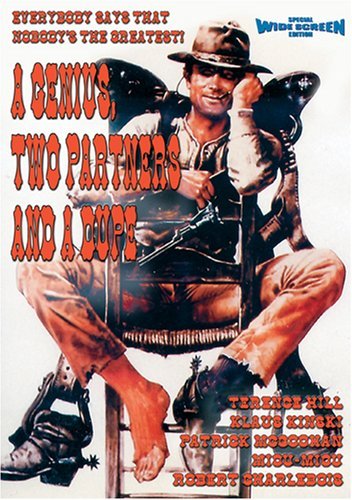

A Genius, Two Partners and a Dupe

Director: Damiano Damiani
Written by: Damiano Damiani, Ernesto Gastaldi, Fulvio Morsella
Cast: Terence Hill, Miou-Miou, Robert Charlebois, Patrick McGoohan

Year / Country: 1975, Italy, France, West Germany
Running Time: 118 mins.

By the 70’s, the spaghetti western had almost become a parody of itself. The serious violent westerns were barely released outside of Italy, while comedy-westerns such as the ‘Trinity’ movies were immensely popular internationally. Genre originator Sergio Leone decided to make the ultimate parody himself in 1973. This became My Name is Nobody, starring Terence Hill. It was a box office hit. In 1975 Leone produced the loose sequel called A Genius, Two Partners and a Dupe, also known as Nobody’s the Greatest. While it was once again popular at the box office due to Hill and Leone’s involvement, the critics didn’t like it. And understandably so.

Hill essentially reprises his Nobody role. His character Joe Thanks is a genius conman. Together with his friends Steam Engine Bill (Robert Charlebois) and Lucy (Miou-Miou) he cooks up an elaborate plan to steal 300.000 dollars from the Indian-hating Major Cabot (Patrick McGoohan). Whenever things are about to go wrong, Joe, the genius, knows exactly what to do.

Leone came up with the idea for the plot after seeing Las Valseuses, starring Miou-Miou, who he then cast as Lucy. Besides producing, Leone also directed the opening scene. The rest of the film is directed by Damiano Damiani, who made one of the greatest spaghetti’s in 1966: A Bullet For the General. This was the last western Leone worked on. He was disappointed with the result and chose to remain uncredited. I can’t blame him. This is pretty much a mess and most of the jokes miss their mark.

Like in all of Leone’s projects, the original score is composed by Ennio Morricone. The very electric score in this film is one of the few things it has going for it. His adaptation of Für Elise, combined with the wailing from The Good, the Bad and the Ugly is a beautifully constructed highlight. That is basically it though. One can only conclude that by this time, the spaghetti western was truly dead.

Rating:

Biography: Damiano Damiani (1922, Pasiano, Italy) is an Italian screenwriter, director and actor. He won awards for several of his films, such as the Mafia drama The Pizza Connection. In the eighties he also made the renowned mini-series La Piovra (The Octopus) about a prosecutor’s battle with the Mafia. This successful series ran for eight series on RAI Uno and turned out to be one of Italy’s bestselling series abroad.

Filmography (a selection): The Hit Man (1960), Lipstick (1960), The Empty Canvas (1963), Strange Obsession (1966), A Bullet for the General (1966), The Day of the Owl (1968), The Most Beautiful Wife (1970), How to Kill a Judge (1974), A Genius, Two Partners and a Dupe (1975), Goodbye and Amen (1977), A Man on His Knees (1978), The Warning (1980), The Octopus (1984, mini-series), The Pizza Connection (1985), The Inquiry (1986), Massacre Play (1989), Angel With a Gun (1992), Killers on Holiday (2002)

A Fistful of Dynamite

Director: Sergio Leone
Written by: Sergio Donati, Sergio Leone, Luciano Vincenzoni
Cast: Rod Steiger, James Coburn, Romolo Valli, Maria Monti

Year / Country: 1971, Italy
Running Time: 147 mins.

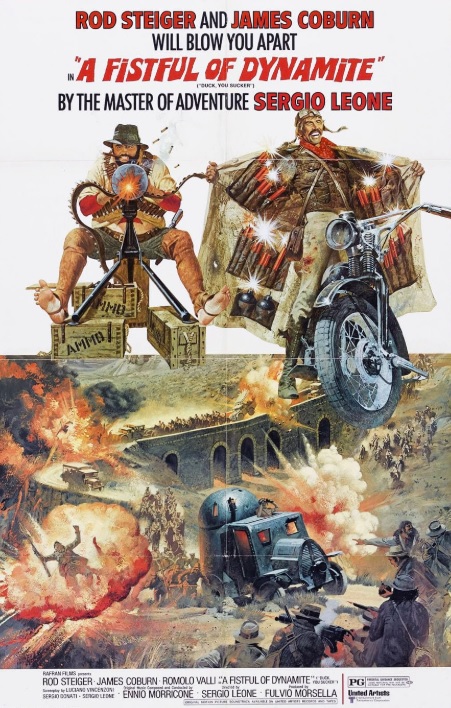
A Fistful of Dynamite (also known as Duck, You Sucker!) is the second entry in Sergio Leone’s loose trilogy of epic films, sandwiched between Once Upon a Time in the West and Once Upon a Time in America. It is Leone’s final spaghetti western and his most overlooked film. But frankly, that is because it is his weakest. That’s not to say it’s without merit, but it lacks the tight storytelling and grandeur of his greatest works.

Set against the backdrop of the Mexican Revolution in 1913, the film follows an unlikely duo: the cigar chewing hick Juan Miranda and the dynamite juggling Irishman John Mallory. Their partnership begins with a planned bank robbery, only for them to discover that the bank is actually a political prison. Juan is unexpectedly thrust into the role of a revolutionary hero, and together, he and John take on the formidable Mexican army, led by a sadistic officer.

The film’s opening is striking. Juan shares a stagecoach ride with a group of wealthy elites who openly insult him and his people, branding them as animals while indulging in gluttonous excess. This immediately earns Juan some sympathy – until his six sons arrive to rob and humiliate the passengers, with Juan even committing an off-screen rape. Leone challenges the audience’s perceptions, presenting prejudice and social injustice while also revealing Juan’s own flaws. Enter John Mallory, an Irish dynamite expert who quite literally blasts onto the scene in a moment of cultural stereotyping played for dark humor.

Rod Steiger’s performance as Juan is divisive. While the character is intentionally unsympathetic, Steiger’s over-the-top acting makes him difficult to watch. Originally, Leone wanted Eli Wallach for the role, but the studio refused. While Wallach’s casting might have risked echoing his Tuco character from The Good, the Bad and the Ugly, it’s hard not to wonder if he would have been a better fit.

Leone claimed the film is ultimately about friendship rather than revolution. This isn’t immediately convincing, given Juan and John’s rocky introduction, but by the end, their relationship develops into something genuine and poignant. John’s journey, revealed through flashbacks, makes the bond between them all the more meaningful.

Despite its flaws – an overlong runtime, a less sweeping feel than Leone’s other Once Upon a Time films, and an Ennio Morricone score that, while good, doesn’t reach the heights of their other collaborations – the film still has standout moments. The ambush at the bridge is classic cinema, boasting one of the greatest explosions ever filmed. The panning shot along the execution ditches is haunting, and the climactic train collision is truly spectacular. Overall, the film is just not the revolution Leone’s earlier westerns were.

Rating:

Biography: Sergio Leone (1929, Rome – 1989, Rome) made his debut in the cinema working as a voluntary assistant and extra, among other things, in The Bicycle Thieves by Vittorio de Sica. Later, he became assistant director to Mario Bonnard. In 1959, when Bonnard was ill, he took over from him on the set of The Last Days of Pompeii. In 1961 he directed his first full-length film: The Colossus of Rhodes. But the film that was to bring him to the general attention came out in 1964: A Fistful of Dollars. His next films, For a Few Dollars More and The Good, The Bad and the Ugly complete what came to be known as the Dollars Trilogy and were a great box-office success. He would only make three more films before tragically passing away in 1989. He was taken from us by a heart attack in his house in Rome, while working on an ambitious project for a film on the Siege of Leningrad.

Filmography: The Colossus of Rhodes (1961), A Fistful of Dollars (1964), For a Few Dollars More (1965), The Good, The Bad and the Ugly (1966), Once Upon a Time in the West (1968), A Fistful of Dynamite (1971), Once Upon a Time in America (1984)

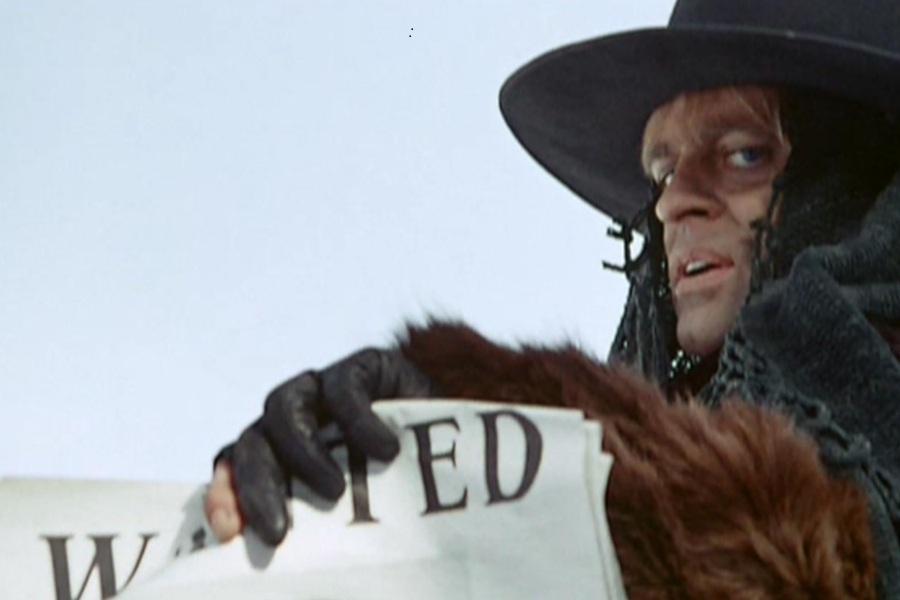
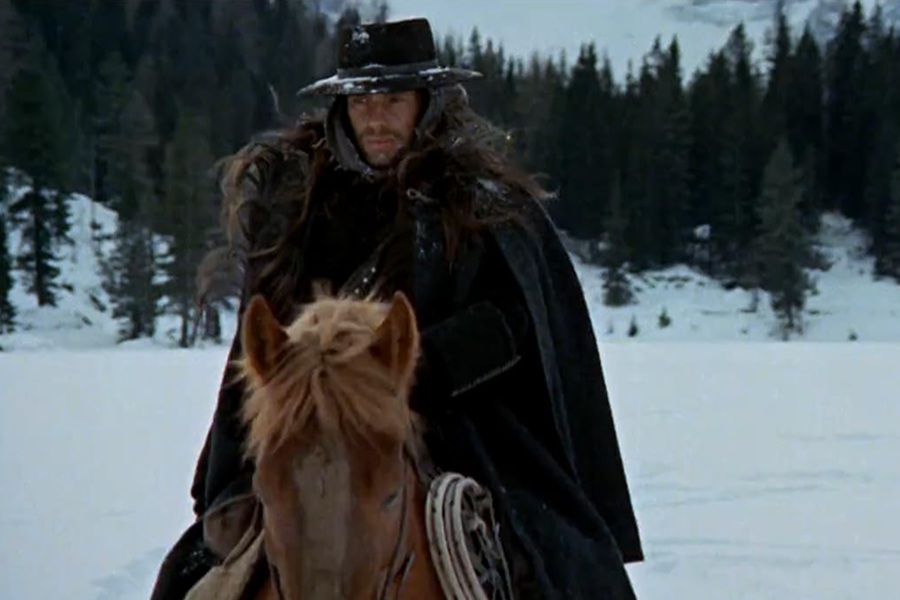
Death Rides a Horse

Director: Giulio Petroni
Written by: Luciano Vincenzoni
Cast: John Phillip Law, Lee Van Cleef, Mario Brega, Luigi Pistilli

Year / Country: 1967, Italy
Running Time: 110 mins.

In this gritty spaghetti western, a violent band of outlaws robs and murders a family, leaving their young son Bill (John Phillip Law) scarred and thirsting for vengeance. Fifteen years later, Bill has honed his skills as a sharpshooter, ready to hunt down the men responsible. But he’s not the only one seeking retribution. Ryan (Lee Van Cleef), a former outlaw betrayed by the same gang and imprisoned for fifteen years, is after payback – not in blood, but in compensation for his lost time.

When Bill eliminates gang leader Burt Cavanaugh (Anthony Dawson), Ryan shifts his focus to the remaining members for his payout. However, they’re unwilling to part with the cash, forcing an uneasy alliance between the two avengers. Together, Bill and Ryan set out to settle the score, but Bill is still in the dark about a critical piece of the puzzle.

The film follows the classic spaghetti western recipe: sweeping desert vistas with looming cliffs, a great score by Ennio Morricone, and a steady stream of duels and shootouts. While it’s less violent than many of its contemporaries and lacks the visual flair of Sergio Leone’s masterpieces, the story holds its own with a solid plot, strong performances – Lee Van Cleef is always excellent – and well-executed action sequences.

The windswept town of El Viento serves as the backdrop for an intense, extended finale reminiscent of The Seven Samurai – though not as grandiose. It’s a satisfying conclusion that caps the film’s blend of gritty revenge and campy Italian charm.

Rating:

Biography: Giulio Petroni (1920, Rome) is an Italian director who made name with a number of spaghetti westerns of which Tepepa (starring Tomas Milian and Orson Welles!) and Death Rides a Horse are the most liked and well-known. He also made drama, comedy and horror films, sometimes working under the pseudonym Jeremy Scott.

Filmography: La centro chilometri (1959), I piaceri dello scapoli (1960), I soliti rapinatori a Milano (1961), Always On Sunday (1962), Death Rides a Horse (1967), Tepepa (1968), And for a Roof a Sky Full of Stars (1968), Night of the Serpent (1970), Non commettere atti impuri (1971), Crescete e moltiplicatevi (1972), Life is Tough, Eh Providence? (1972), Labbra di lurido blu (1975), La profezia (1978)