A Fistful of Dynamite

Director: Sergio Leone
Written by: Sergio Donati, Sergio Leone, Luciano Vincenzoni
Cast: Rod Steiger, James Coburn, Romolo Valli, Maria Monti

Year / Country: 1971, Italy
Running Time: 147 mins.

A Fistful of Dynamite (also known as Duck, You Sucker!) is the second entry in Sergio Leone’s loose trilogy of epic films, sandwiched between Once Upon a Time in the West and Once Upon a Time in America. It is Leone’s final spaghetti western and his most overlooked film. But frankly, that is because it is his weakest. That’s not to say it’s without merit, but it lacks the tight storytelling and grandeur of his greatest works.

Set against the backdrop of the Mexican Revolution in 1913, the film follows an unlikely duo: the cigar chewing hick Juan Miranda and the dynamite juggling Irishman John Mallory. Their partnership begins with a planned bank robbery, only for them to discover that the bank is actually a political prison. Juan is unexpectedly thrust into the role of a revolutionary hero, and together, he and John take on the formidable Mexican army, led by a sadistic officer.

The film’s opening is striking. Juan shares a stagecoach ride with a group of wealthy elites who openly insult him and his people, branding them as animals while indulging in gluttonous excess. This immediately earns Juan some sympathy – until his six sons arrive to rob and humiliate the passengers, with Juan even committing an off-screen rape. Leone challenges the audience’s perceptions, presenting prejudice and social injustice while also revealing Juan’s own flaws. Enter John Mallory, an Irish dynamite expert who quite literally blasts onto the scene in a moment of cultural stereotyping played for dark humor.

Rod Steiger’s performance as Juan is divisive. While the character is intentionally unsympathetic, Steiger’s over-the-top acting makes him difficult to watch. Originally, Leone wanted Eli Wallach for the role, but the studio refused. While Wallach’s casting might have risked echoing his Tuco character from The Good, the Bad and the Ugly, it’s hard not to wonder if he would have been a better fit.

Leone claimed the film is ultimately about friendship rather than revolution. This isn’t immediately convincing, given Juan and John’s rocky introduction, but by the end, their relationship develops into something genuine and poignant. John’s journey, revealed through flashbacks, makes the bond between them all the more meaningful.

Despite its flaws – an overlong runtime, a less sweeping feel than Leone’s other Once Upon a Time films, and an Ennio Morricone score that, while good, doesn’t reach the heights of their other collaborations – the film still has standout moments. The ambush at the bridge is classic cinema, boasting one of the greatest explosions ever filmed. The panning shot along the execution ditches is haunting, and the climactic train collision is truly spectacular. Overall, the film is just not the revolution Leone’s earlier westerns were.

Rating:

Biography: Sergio Leone (1929, Rome – 1989, Rome) made his debut in the cinema working as a voluntary assistant and extra, among other things, in The Bicycle Thieves by Vittorio de Sica. Later, he became assistant director to Mario Bonnard. In 1959, when Bonnard was ill, he took over from him on the set of The Last Days of Pompeii. In 1961 he directed his first full-length film: The Colossus of Rhodes. But the film that was to bring him to the general attention came out in 1964: A Fistful of Dollars. His next films, For a Few Dollars More and The Good, The Bad and the Ugly complete what came to be known as the Dollars Trilogy and were a great box-office success. He would only make three more films before tragically passing away in 1989. He was taken from us by a heart attack in his house in Rome, while working on an ambitious project for a film on the Siege of Leningrad.

Filmography: The Colossus of Rhodes (1961), A Fistful of Dollars (1964), For a Few Dollars More (1965), The Good, The Bad and the Ugly (1966), Once Upon a Time in the West (1968), A Fistful of Dynamite (1971), Once Upon a Time in America (1984)

Race with the Devil

Director: Jack Starrett
Written by: Wes Bishop, Lee Frost
Cast: Peter Fonda, Warren Oates, Loretta Swit, Lara Parker

Year / Country: 1975, USA
Running Time: 84 mins.

You know these vacations where everything goes wrong? Not like it does in Race with the Devil I bet. Two friends go camping with their wives in a luxury RV. On the first night in the countryside, they accidentally witness a satanic ritual in which a girl gets sacrificed. Then they are spotted and have to flee in terror. Of course, the sheriff doesn’t believe a word they are saying, so they decide to head to Amarillo in Texas to talk to the cops there. But these devil worshippers are not to be messed with and they start a pursuit. A tense ride for life and death begins…

Peter Fonda plays a very different character in this movie than he does in the car chase flick Dirty Mary, Lazy Larry, in which he played a misogynist criminal. This time around, he is a normal American who has to experience America’s nightmare. The tension certainly rises to a boiling point when everybody seems to be part of the satanic cult. ‘Witnesses on the run movies’ can be fun and Race with the Devil is no exception. It’s like The Hills Have Eyes on the move with cannibals replaced by occult freaks.

The overload of stupid redneck people and the lack of feminist awareness are annoying, but are compensated by an entertaining story that has elements of action, horror and mystery in it. The race from the title doesn’t start until fifteen minutes from the ending, but when it does it’s a spectacular piece of action. The ‘surprise’ ending does not come entirely unexpected, but it still holds a clever twist and provides a fitting ending to an entertaining seventies car flick.

Rating:

Biography: Jack Starrett (1936, Texas – 1989, California) has a large résumé in early 70’s exploitation flicks in different genres, such as; blaxplotation, western, crime and biker movies. Although not all of his pictures received favorable critique, some are definitely considered as classics in their kind. Cleopatra Jones and The Gravy Train have a steady cult following and the devil worship car chase horror / action film Race with the Devil became Starrett’s biggest ever drive-in hit and one of his most well-regarded movies. Besides directing he also acted and delivered a few remarkable performances, amongst others in Blazing Saddles and First Blood.

Filmography: Run, Angel, Run! (1969), The Bold Ones: The New Doctors (1969, TV episodes), Nam’s Angels (1970), Cry Blood, Apache (1970), Night Chase (1970, TV), The Strange Vengeance of Rosalie (1972), Slaughter (1972), Cleopatra Jones (1973), The Gravy Train (1974), Planet of the Apes (1974, TV episode), Starsky and Hutch (1975, TV episodes), A Small Town in Texas (1976), Hollywood Man (1976), Roger & Harry: The Mitera Target (1977, TV), Nowhere to Hide (1977, TV), Final Chapter: Walking Tall (1977), What Really Happened to the Class of 65? (1977, TV episode), Thaddeus Rose and Eddie (1978, TV), Mr. Horn (1979, TV), The Dukes of Hazzard (1979-1980, TV episodes), Beyond Westworld (1980, TV episode), Eischied (1980, TV episode), Hill Street Blues (1981, TV episode), Kiss my Grits (1982)

Death Race

Director: Paul W.S. Anderson
Written by: Paul W.S. Anderson
Cast: Jason Statham, Joan Allen, Ian McShane, Tyrese Gibson

Year / Country: 2008, USA, Germany, UK
Running Time: 106 mins.

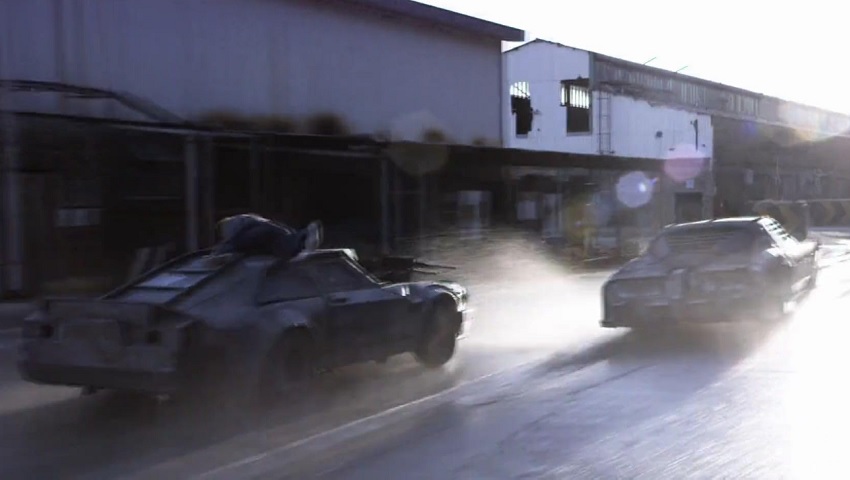
Death Race is supposed to be a remake of Death Race 2000, a Roger Corman produced cult gem from the seventies. While there is certainly resemblance; it is all about a gladiator-like futuristic car race, there are many differences as well. Death Race 2000 was a cynical, humoristic and over the top look at the future, while Death Race doesn’t seem to be more than a straightforward action flick. Not that there’s anything wrong with that, the target audience just might be a little different.

In 2012, a financial crisis threw the Western world into chaos. Jensen Ames (Statham) is an ex-racer who is framed for murdering his wife. In jail he has to replace legendary driver Frankenstein in the internet hit ‘Death Race’. While Ames makes a great Frankenstein, the real monster is warden Hennessey (Joan Allen) who directs the deadly race to make a killing from the broadcasting. But Ames is not one to simply play ball. He has an escape-plan to execute, a conspiracy to solve and enemies to exterminate.

The plot is very predictable, but the concept works well enough to forgive the film this flaw. It seems that in every movie director Anderson directs, he does one thing extremely well and a lot of other things very wrong. In this movie it is the action that blows off the screen. The internet streaming footage is also fabulous. His writing skills leave a lot to be desired though. This is mainstream Hollywood work.

Statham has become quite the badass action star. I preferred David Carradine in the Frankenstein role in the original, but Statham is nevertheless okay. However, Tyrese Gibson is a lousy replacement for Machine Gun Joe. Watching Sylvester Stallone in that part was a thousand times cooler, though it is not entirely Gibson’s fault. The script doesn’t give him much to work with. In the acting department, there is great support from Joan Allen as queen bitch and Ian McShane as Ames’ biggest supporter.

That leaves one comment to be made; the ending is excruciating. But since the largest part of the film is about racing, this movie can be called a modest success. It is certainly the best thing Anderson has done in years.

Rating:

Biography: Paul W.S Anderson (1965, Newcastle-upon-Tyne, UK) gained some notoriety in his native England with his ultra-violent feature debut Shopping in 1994. Its relative success allowed him to direct action / sci-fi films in Hollywood, including the financially successful Mortal Kombat. In 2002 he resurfaced another video game adaptation, Resident Evil. He next was given the helm for the long-awaited film adaptation of the popular Dark Horse comic book, AVP: Alien Vs. Predator.

Filmography (a selection): Shopping (1994), Mortal Kombat (1995), Event Horizon (1997), Soldier (1998), The Sight (2000, TV), Resident Evil (2002), AVP: Alien vs. Predator (2004), Death Race (2008), Resident Evil: Afterlife (2010), The Three Musketeers (2011), Resident Evil: Retribution (2012), Pompeii (2014), Resident Evil: The Final Chapter (2016), Monster Hunter (2020)

A Bullet for the General

Director: Damiano Damiani
Written by: Salvatore Laurani (story), Franco Solinas (adaptation)
Cast: Gian Maria Volonté, Klaus Kinski, Martine Beswick, Lou Castel

Year / Country: 1966, Italy
Running Time: 113 mins.

Zapata Westerns are a subgenre of the Spaghetti Western. They deal with political themes and play against the backdrop of the Mexican Revolution between around 1910 and 1920, the years of the famous Mexican revolutionary Emiliano Zapata, after whom the genre is named. Famous examples include; Sergio Curbucci’s Companeros and The Mercenary, and Sergio Leone’s A Fistful of Dynamite. A Bullet for the General is an early contribution to the genre and is regarded as one of the best.

It deals with a group of cutthroat bandits, led by El Chuncho (Volonté). Their job is to steal guns for the revolutionary general Elias. During a violent train raid, they pick up young American Tate (Castel), who they take along with them as a welcome addition to their crew. What they don’t know is that Tate is secretly an assassin hired by the Mexican government to kill Elias with the golden bullet he carries with him.

Starring two actors familiar in the Spaghetti Western genre, namely the man with the characteristic laugh Gian Maria Volonté (Ramón Rojo in A Fistful of Dollars and El Indio in For a Few Dollars More) and, Klaus Kinski (The Great Silence, and also For a Few Dollars More), it became extremely popular in Europe, though butchered for both political and content reasons in overseas markets. The film makes many references to the Vietnam War. The character Tate for example is meant to represent the CIA’s interventions in Latin America.

A Bullet for the General is a fiesta with guns. Composer Luis Enriquez Bacalov (Django, Il Postino, Kill Bill) has provided a cheerful musical score, while El Chuncho and his bandits kill more Mexicans than the Wild Bunch. This is how a revolution works; misery and death contrast with joy and celebration. It is only difficult to sympathise with these hard characters. My general thought during the movie was therefore; ‘so, let’s kill this general and get it over with.’ A lot was made up by the excellent action and production design, and the final scene also delivers some heartfelt (and needed) emotion.

Rating:

Biography: Damiano Damiani (1922, Pasiano, Italy) is an Italian screenwriter, director and actor. He won awards for several of his films, such as the Mafia drama The Pizza Connection. In the eighties he also made the renowned mini-series La Piovra (The Octopus) about a prosecutor’s battle with the Mafia. This successful series ran for eight series on RAI Uno and turned out to be one of Italy’s best selling series abroad.

Filmography (a selection): The Hit Man (1960), Lipstick (1960), The Empty Canvas (1963), Strange Obsession (1966), A Bullet for the General (1966), The Day of the Owl (1968), The Most Beautiful Wife (1970), How to Kill a Judge (1974), A Genius, Two Partners and a Dupe (1975), Goodbye and Amen (1977), A Man on His Knees (1978), The Warning (1980), The Octopus (1984, mini-series), The Pizza Connection (1985), The Inquiry (1986), Massacre Play (1989), Angel With a Gun (1992), Killers on Holiday (2002)