Cannonball!

Director: Paul Bartel
Written by: Paul Bartel, Don Simpson
Cast: David Carradine, Bill McKinney, Veronica Hamel, Gerrit Graham

Year / Country: 1976, USA
Running Time: 94 mins.

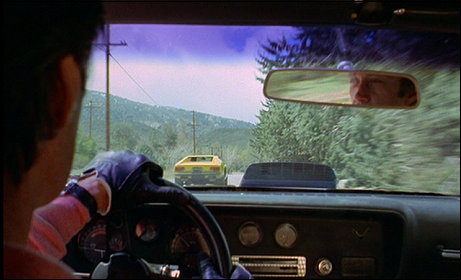
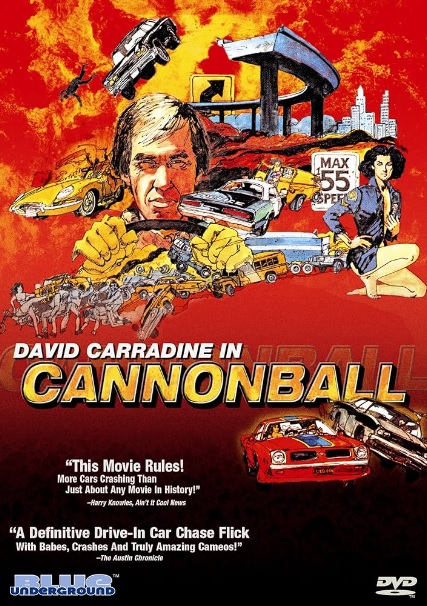
Your liking of Cannonball! aka Carquake will mainly depend on how you generally appreciate B-movies about car-racing. I personally like them a lot. Cool-ass heroes in slick cars; pretty girls; highway chase scenes; crashes; mayhem: the works. This movie is based on real illegal cross-continental road races that took place around the time this movie was made.

The seventies was a fruitful era for this type of film. In 1976, the year this movie came out, The Gumball Rally, was also released about the same topic. A year earlier, its director Paul Bartel had considerable B-movie success with the very similar film Death Race 2000 which also had David Carradine in the lead role and covered a road race through America. This is not exactly a sequel though. It’s no sci-fi for one thing and unlike Death Race 2000, it has not been produced by Roger Corman, but by Run Run Shaw (one of the Shaw Brothers). Corman does have a small cameo. So do Martin Scorsese, Joe Dante and Sylvester Stallone. The movie was written by Bartel and Don Simpson. That’s right, the now deceased Don Simpson who formed a team with Jerry Bruckheimer and made one Hollywood smash hit after another. This is the first film on his resume.

David Carradine plays Coy ‘Cannonball’ Buckman, a former convict who participates in the Trans-America Grand Prix, an illegal annual race from L.A. to New York City. The prize money for winning is 100.000 dollars, so most of the participants play any dirty trick in the book to rid themselves of the competition. The police also finds out about the race and plans to arrest all the participants. Buckman has to overcome many obstacles to reach the finish line, such as car damage, malicious competitors and hand-to-hand combat. The latter of course is no problem for David ‘Kung Fu’ Carradine, but the driving proves to be a bigger challenge. Buckman is no Frankenstein (Carradine’s character in Death Race 2000), who had a mechanical hand to shift his gears faster and who was designed to win. Buckman is not that mythological. At least it looks that way initially…

Director Bartel usually offers more satire in his films, but Cannonball! doesn’t seem to have any pretensions except to offer simple entertainment. The campy fun consists mostly of the drivers competing with each other through racing moves and fist fights. Unfortunately the lack of real excitement makes it look like a cheap cash-in on its predecessors.

Because besides its subversive character, Death Race 2000 had intriguing characters and many outrageous action scenes and dialogues. It appeared to have been made with great enthusiasm and care to provide the audience with as much entertainment as possible. And it worked. Cannonball! doesn’t really try to excel in anything. Not in the acting, the writing or the directing.

Even Carradine, an actor I normally love (to me he is the ultimate B-movie star) seems a bit out of his depth here. Some good stunts and a final scene of appropriate demolition save this from being a complete failure, but there is little to recommend it for. A shame really because all those involved did a lot of good work elsewhere. Oh well, if you’re up for a no-brainer, this flick may suit you well. Otherwise Death Race 2000 is the far better alternative.

Rating:

Biography: Paul Bartel (1938, New York – 2000, New York) majored in theater arts at UCLA and studied film directing in Rome. After getting his first work experience with Roger Corman he directed a number of low budget cult films. He also worked as a writer and an actor. He died in 2000 from a heart attack.

Filmography: The Secret Cinema (1968, short), Naughty Nurse (1969, short), Private Parts (1972), Death Race 2000 (1975), Cannonball! (1976), Eating Raoul (1982), Not for Publication (1984), Lust in the Dust (1985), The Longshot (1986), Amazing Stories (1986/87, TV episodes), Shelf Life (1993), The Comic Strip Presents…(1993, TV episode), Clueless (1996, TV episode)
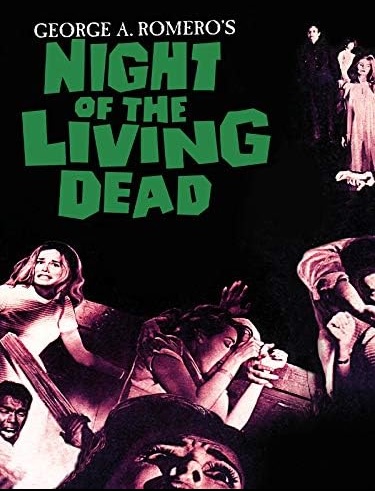
Night of the Living Dead

Director: George A. Romero
Written by: John A. Russo, George A. Romero
Cast: Duane Jones, Judith O’Dea, Karl Hardman, Marilyn Eastman

Year / Country: 1968, USA
Running Time: 96 mins.

Director George A. Romero, who would dedicate most of his film career to making zombie movies, lays much of the groundwork right here. His feature debut would become an example of how to make a low budget horror movie; unknown actors, one central location and elements of social satire that appeal to the more intellectual viewer.

John and Barbra are visiting a graveyard where their father is buried, when John notices a strange phenomenon in the sky. Soon after they are attacked by a living dead man. Barbra manages to flee to a seemingly deserted farmhouse, leaving the annoying John behind as a zombie snack. In the farmhouse, Barbra soon gets company from both the living and the dead.

A possible explanation for the catastrophe is radiation that was released as a result from a NASA operation whereby a satellite was blown into bits. Romero’s message comes to the surface: not only are humans the cause of the major crisis, they are unable to deal with it once it’s there.

What works so well about this concept is the notion of crisis that erupts once the zombies are there. Their insatiable lust for human flesh and their large numbers make them a major threat. However, they are not nearly as scary as humans can be; narrow-minded, cruel and incapable of collaboration. A crisis of this scope would undoubtedly destroy us all.

There are many other elements that Romero would repeat and elaborate on in the zombie sequels that would follow. These include a lot of infighting among the ethnically mixed group of survivors, many panicky TV- and radio broadcasts, and quite a lot of graphic violence. Certainly considering the time in which this film was released.

Then there is the unexpected twist at the end that contributes to Night of the Living Dead’s status as a groundbreaking classic. The only thing I found lacking was the humour that its sequels contained. However this is still a film that is as tense as it is relevant. Maybe even more so in present times than back in 68’.

Rating:

Biography: George A. Romero (1940, New York – 2017, Toronto), who lived in Pittsburgh, made his feature debut with Night of the Living Dead. It was a low budget zombie movie that was both groundbreaking and shocking in its time. Quickly, it became a major horror classic. He then directed some smaller, personal films in which he often combined horror and social commentary. In 1978 he topped the success of Night of the Living Dead with his brilliant follow-up Dawn of the Dead. In the eighties his career stagnated a bit when he created the third part in his zombie series Day of the Dead. It was a failure both commercially and critically. It is more appreciated nowadays. In a recent feature by Empire – The 25 Best Zombie Movies Of All Time – it is ranked second only after Dawn of the Dead. In 2005 Romero made a small comeback with Land of the Dead. He died in 2017.

Filmography (a selection): Night of the Living Dead (1968), There’s Always Vanilla (1971), Season of the Witch (1972), The Winners (1973, TV episodes), The Crazies (1973), O.J. Simpson: Juice on the Loose (1974, TV doc), Martin (1977), Dawn of the Dead (1978), Knightriders (1981), Creepshow (1982), Day of the Dead (1985), Monkey Shines (1988), Two Evil Eyes (1990) [with Dario Argento], The Dark Half (1993), Bruiser (2000), Land of the Dead (2005), Diary of the Dead (2007), Survival of the Dead (2009)

Diary of the Dead

Director: George A. Romero
Written by: George A. Romero
Cast: Michelle Morgan, Joshua Close, Shawn Roberts, Amy Lalonde

Year / Country: 2007, USA
Running Time: 95 mins.

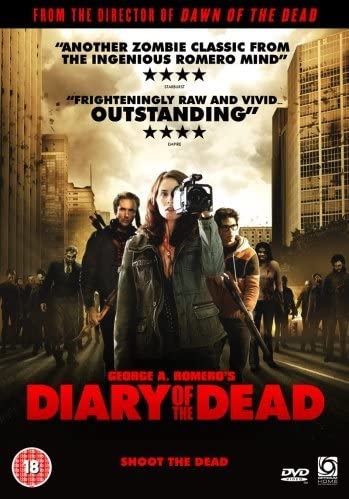
Romero is back in form after the mixed reception of Land of the Dead. Once again he successfully combines social satire with zombie horror. Diary of the Dead is not part of the timeline established in Romero’s earlier ‘Dead’ films. It stands on its own as the new millennium update of his zombie world in which media is the central theme.

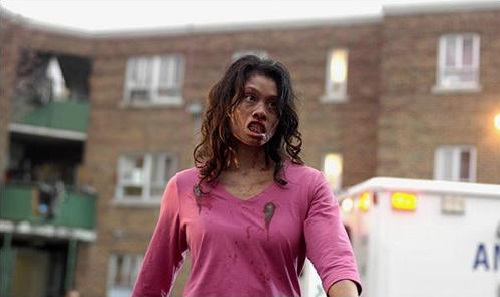
The movie starts with a common news story that has an uncommon outcome. A man has killed his wife and daughter and then turned the gun on himself. As their bodies are carried out on stretchers, filmed by a TV-crew, they come back to life and start attacking the social workers and media present at the scene. This is the beginning of a new living dead outbreak.

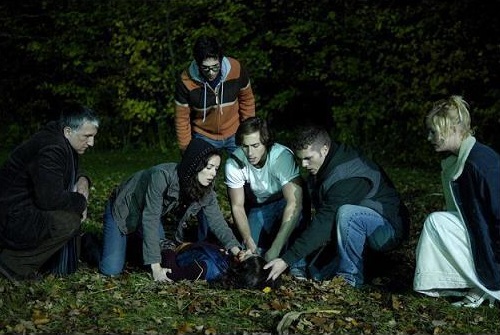
The movie continues with a group of film students who are shooting a low-budget horror flick. Their accompanying tutor describes it as a stupid horror movie with a social satire red line (as in a Romero movie). During the shoot, the first signs of crisis start showing and the crew decides to drive back home to Pittsburgh (Romero’s home and regular film setting). Soon after, they end up in a massive crisis that is as bloody as it is devastating.

Diary of the Dead brings back some of the elements that made Romero’s older movies so brilliant. The scenes in which zombies and humans are killed off in inventive and gruesome ways haven’t been done this well since Romero’s ultimate masterpiece Dawn of the Dead. It also contains hilarious lines and situations which make this probably Romero’s funniest film to date.

The underlying social satire is also fairly well communicated. The media controls our lives. Everybody now has the means to display their vision using cameras and the internet. But as we see in this film, footage is easily manipulated (this movie is edited during the story), so how can we ever know what’s really going on? And even if we can, does it even matter? The media makes us insensitive to the world around us and cruelty rapidly becomes normal.

Are we worth saving? Decide for yourself.

Rating:

Biography: George A. Romero (1940, New York – 2017, Toronto), who lived in Pittsburgh, made his feature debut with Night of the Living Dead. It was a low budget zombie movie that was both groundbreaking and shocking in its time. Quickly, it became a major horror classic. He then directed some smaller, personal films in which he often combined horror and social commentary. In 1978 he topped the success of Night of the Living Dead with his brilliant follow-up Dawn of the Dead. In the eighties his career stagnated a bit when he created the third part in his zombie series Day of the Dead. It was a failure both commercially and critically. It is more appreciated nowadays. In a recent feature by Empire – The 25 Best Zombie Movies Of All Time – it is ranked second only after Dawn of the Dead. In 2005 Romero made a small comeback with Land of the Dead. He died in 2017.

Filmography (a selection): Night of the Living Dead (1968), There’s Always Vanilla (1971), Season of the Witch (1972), The Winners (1973, TV episodes), The Crazies (1973), O.J. Simpson: Juice on the Loose (1974, TV doc), Martin (1977), Dawn of the Dead (1978), Knightriders (1981), Creepshow (1982), Day of the Dead (1985), Monkey Shines (1988), Two Evil Eyes (1990) [with Dario Argento], The Dark Half (1993), Bruiser (2000), Land of the Dead (2005), Diary of the Dead (2007), Survival of the Dead (2009)

Dawn of the Dead

Director: George A. Romero
Written by: George A. Romero
Cast: David Emge, Ken Foree, Scott H. Reiniger, Gaylen Ross

Year / Country: 1978, Italy / USA
Running Time: 139 mins.

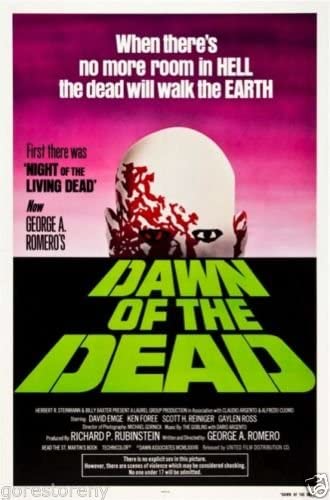
Ten years after the towering success of low-budget zombie flick Night of the Living Dead, its director George A. Romero finally delivered a follow-up. And when he did it exceeded all expectations. In this appropriately titled sequel, the zombie threat has grown alarmingly. There are barely places left that are zombie-free. In this apocalyptic nightmare, we follow a group of four survivors that want to fly to safety by helicopter.

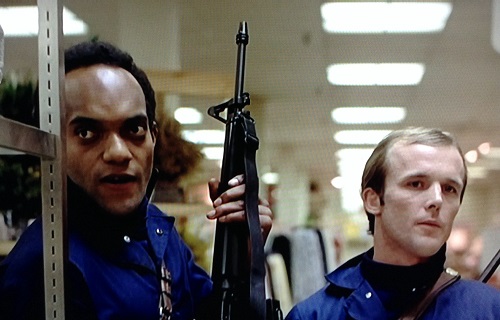
They manage to land on the roof of a zombie infested shopping mall. Once they have sealed off a ‘living room’, they realize this isn’t such a bad location considering the times. After all, a shopping mall offers them plenty of supplies and relative protection against the flesh eating things outside. But new problems arrive. Tensions within the group are a constant factor and a gang of sadistic bikers, armed to the teeth, want to invade the shopping mall.

Never before (and after) were zombie movies this tense, entertaining and metaphorically rich. Its basic concept works incredibly well. We have the heroes, the location and the multiple threats that ensure an amazing two-and-a-half hours. Typically for Romero, the group consists of two white men, one black man and a pregnant woman who together form an interesting Utopia in the barricaded shopping mall.

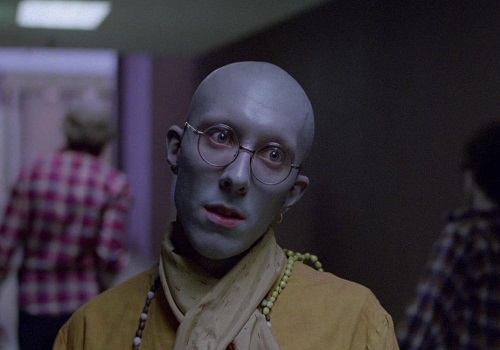
The zombies, a metaphor for consumerist society, are great in evoking a varied set of emotions. They can be scary, funny and sad. That the humans are more frightening than the monsters is shown through the constant infighting of the heroes, the bloodthirsty rednecks and the bikers pointless torturing of zombies. Romero effectively makes the point that humans are incapable of dealing with crises. The extremely gory effects by Tom Savini require a strong stomach – especially during the finale – and the Italian rock band Goblin provides the fitting musical score. All the wonderful elements combined ensure a movie experience that is both intelligent and a lot of fun.

Rating:

Biography: George A. Romero (1940, New York – 2017, Toronto), who lived in Pittsburgh, made his feature debut with Night of the Living Dead. It was a low budget zombie movie that was both groundbreaking and shocking in its time. Quickly, it became a major horror classic. He then directed some smaller, personal films in which he often combined horror and social commentary. In 1978 he topped the success of Night of the Living Dead with his brilliant follow-up Dawn of the Dead. In the eighties his career stagnated a bit when he created the third part in his zombie series Day of the Dead. It was a failure both commercially and critically. It is more appreciated nowadays. In a recent feature by Empire – The 25 Best Zombie Movies Of All Time – it is ranked second only after Dawn of the Dead. In 2005 Romero made a small comeback with Land of the Dead. He died in 2017.

Filmography (a selection): Night of the Living Dead (1968), There’s Always Vanilla (1971), Season of the Witch (1972), The Winners (1973, TV episodes), The Crazies (1973), O.J. Simpson: Juice on the Loose (1974, TV doc), Martin (1977), Dawn of the Dead (1978), Knightriders (1981), Creepshow (1982), Day of the Dead (1985), Monkey Shines (1988), Two Evil Eyes (1990) [with Dario Argento], The Dark Half (1993), Bruiser (2000), Land of the Dead (2005), Diary of the Dead (2007), Survival of the Dead (2009)