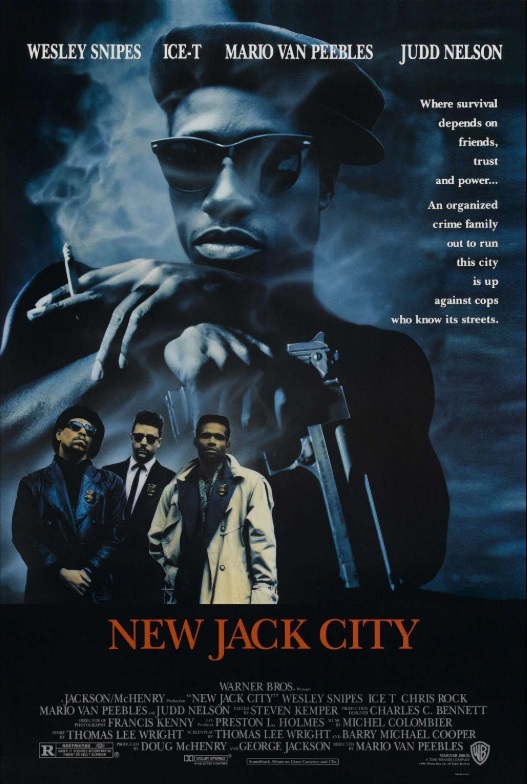
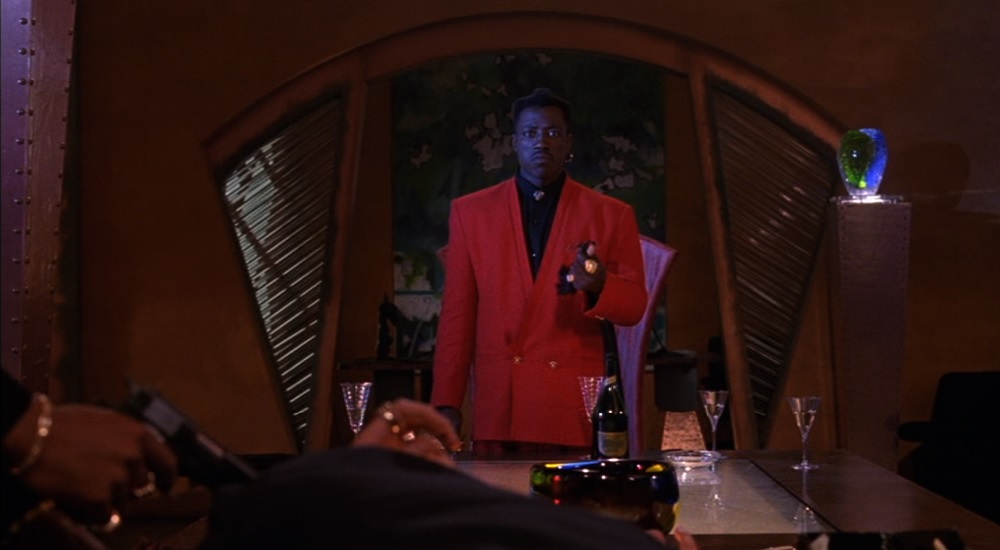
New Jack City (1991)


‘It was a time that there was a new gangster in………’

Directed by:
Mario Van Peebles

Written by:
Thomas Lee Wright
Barry Michael Cooper

Cast:
Wesley Snipes (Nino Brown), Ice-T (Det. Scotty Appleton), Allen Payne (Gee Money Wells), Chris Rock (Pookie Robinson), Mario Van Peebles (Stone), Michael Michele (Selina), Bill Nunn (Duh Duh Duh Man), Russell Wong (Park), Bill Cobbs (Old Man), Christopher Williams (Kareem Akbar), Judd Nelson (Det. Nick Peretti), Vanessa Williams (Keisha)

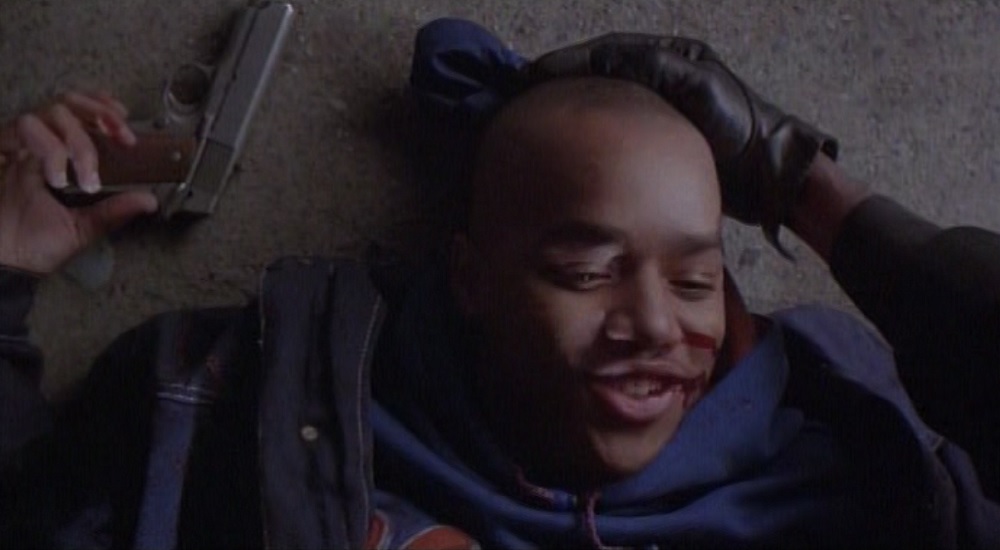
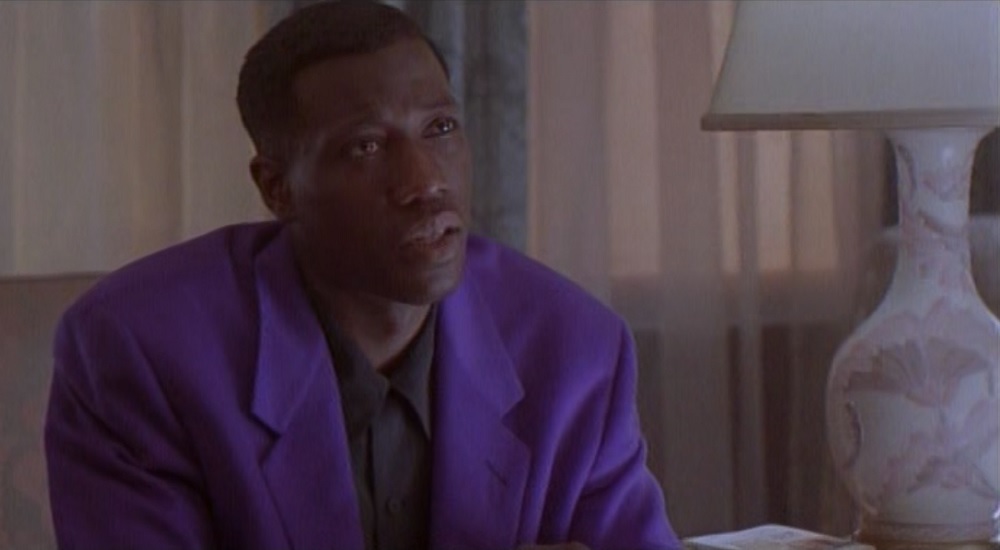
This trip back to the nineties opens with shots of New York and a news report about economic hardship. “The deficit now stands at an astounding 221 billion dollars, and income inequality is at its worst level since the Great Depression”, the voice-over says. Oh boy, if only they could see us now.

In an amazing shot, the camera swoops in on a bridge where a gangster is dangling a man by his feet. Drug kingpin Nino Brown (Wesley Snipes) steps out of his car and orders the man dropped, apparently over a drug dispute.

The movie sets the year at 1986, the height of the crack epidemic in Harlem. Brown, along with his lieutenants Gee Money and the Duh Duh Man – collectively known as the Cash Money Brothers – has seized control of the drug trade. They take over an entire apartment block called The Carter and run their crack empire from within its walls.

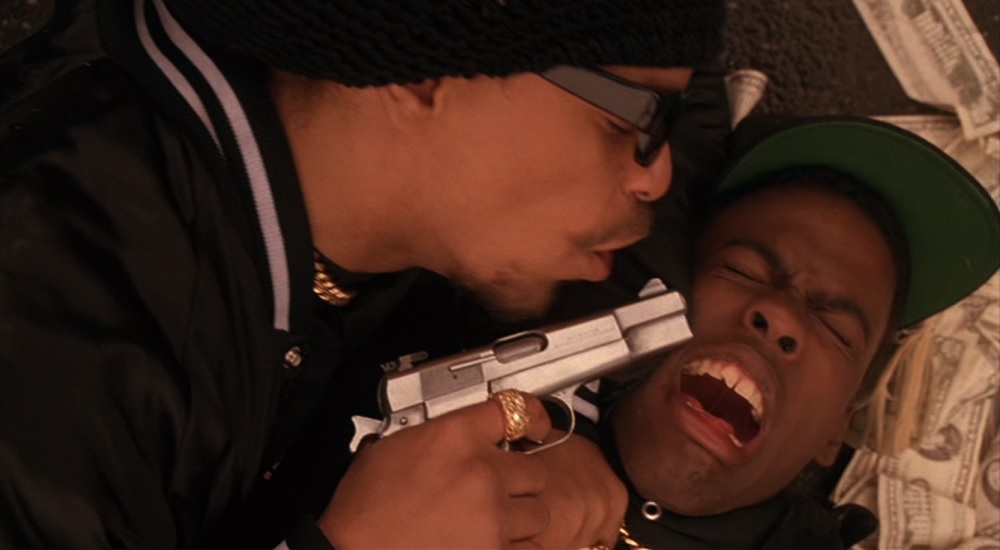
Ice-T plays Scotty Appleton, a detective with a personal grudge against Brown. He joins a special police unit tasked with taking down the increasingly megalomaniacal Brown and his CMB crew. The team is led by Stone (Mario Van Peebles, who also directed the film), Detective Nick Peretti (Judd Nelson), and the ex-junkie turned informant Pookie (an excellent Chris Rock).

New Jack City is a true product of its time: the nineties, the crack era, rap music, and capitalism gone wrong (though nothing like today). The costume designers clearly had a field day. The film is also distinctly postmodern: Nino Brown watches Scarface even as he heads toward the same mistakes Tony Montana made. Overall, it’s an effective crime flick: it pulls you in like a crack pipe does a junkie, and you ride it out until the end, when Nino Brown’s empire inevitably comes crashing down.

Rating:

Quote:
NINO BROWN: “You cut a side deal with that motherfucker. Yes, you did, Gee. Fucking Cain. My brother’s keeper. Was it this glass dick you’ve been sucking on? Was that it? Now I see how you let that motherfucker infiltrate. He used you, Gee. What ever happened to, ‘Am I my brother’s keeper?’”

Trivia:
Wesley Snipes originally wanted to play Scotty Appleton. However, Mario Van Peebles and screenwriter Barry Michael Cooper insisted that he play Nino Brown, as the part was written especially for him.

Mean Streets (1974)


‘You don’t make up for your sins in church. You do it in the streets…’

Directed by:
Martin Scorsese

Written by:
Martin Scorsese
Mardik Martin

Cast:
Harvey Keitel (Charlie Cappa), Robert De Niro (John ‘Johnny Boy’ Civello), David Proval (Tony DeVienazo), Richard Romanus (Michael Longo), Amy Robinson (Teresa Ronchelli), Cesare Danova (Giovanni Cappa), Victor Argo (Mario), George Memmoli (Joey ‘Clams’ Scala), Lenny Scaletta (Jimmy), Jeannie Bell (Diane)

Mean Streets marks the first collaboration between Martin Scorsese and Robert De Niro and right out of the gate, it’s a masterpiece. Set in the tight-knit world of Little Italy, the film follows four small-time hustlers: the conflicted Charlie (Harvey Keitel), hot-tempered bar owner Tony (David Proval), dim-witted loan shark Michael (Richard Romanus), and the reckless wildcard Johnny Boy (Robert De Niro).

Although it isn’t technically Scorsese’s debut, it feels like it. This is the movie in which his voice fully emerges for the first time. It showcases early yet commanding performances by Keitel and De Niro, two actors who would become his most trusted collaborators. Many of the hallmarks of Scorsese’s later masterpieces are already present: the gritty New York setting, the soundtrack full of sixties pop classics, the collision of religion and crime. This isn’t exactly a gangster film – it’s about small-time crooks – but it plays like a prelude to GoodFellas, with dialogues and moral tensions that already sound familiar.

Scorsese immediately sets the tone with a Super 8 projection of Charlie wandering the streets, underscored by the Ronettes’ ‘Be My Baby’. From there, we trail Charlie through his daily routine: drinking in bars, running minor cons, wrestling with Catholic guilt in church visits, and trying to reconcile his moral compass with his ambition.

Charlie wants to rise in the underworld by aligning with his mob-connected uncle, but his loyalty to Johnny Boy – a man drowning in debt and chaos – pulls him down a dangerous path. That loyalty is both touching and toxic, and Scorsese makes it clear early on that violence is never far away. A brutal barroom shooting foreshadows the storm gathering around these characters.

The film’s raw power lies in its atmosphere. Scorsese layers the story with a soundtrack of rock ’n’ roll classics – the Stones’ ‘Jumpin’ Jack Flash’ among them – injecting energy and immediacy into every scene. His restless camera, the naturalistic dialogue laced with profanity, and the lived-in performances combine to create a world that feels authentic and alive.

De Niro is magnetic as Johnny Boy, unpredictable and dangerous yet oddly charming, while Keitel gives a deeply human performance as Charlie, a man torn between sin and salvation. Their chemistry is the film’s beating heart. Scene after scene burns into memory: a drunken spree, a hilariously chaotic bar fight, an explosive confrontation on the street. The pacing is electric, and the details are so rich you’ll want to revisit it just to soak up more of Scorsese’s vision.

The film still feels fresh today. It is utterly original, with no real comparison except some of Scorsese’s later work. Mean Streets doesn’t just hint at the brilliance to come; it announces the arrival of one of cinema’s great storytellers.

Rating:

Quote:
CHARLIE: “You know something? She is really good-lookin’. I gotta say that again. She is really good-lookin’. But she’s black. You can see that real plain, right? Look, there isn’t much of a difference anyway, is there. Well, is there?”

Trivia:
The opening words are actually spoken by Martin Scorsese, not Harvey Keitel as we are led to believe.

Black Caesar (1973)

‘Hail Caesar, Godfather of Harlem…The Cat with the .45-Caliber Claws!’

Directed by:
Larry Cohen

Written by:
Larry Cohen

Cast:
Fred Williamson (Tommy Gibbs), Gloria Hendry (Helen), Art Lund (McKinney), D’Urville Martin (Rev. Rufus), Julius W. Harris (Mr. Gibbs), Minnie Gentry (Momma Gibbs), Philip Roye (Joe Washington), William Wellman Jr. (Alfred Coleman), James Dixon (‘Irish’ Bryant), Val Avery (Cardoza)

The James Brown–scored gangster film Black Caesar opens with Brown’s soulful ‘Down and Out in New York City’ playing over a gritty scene where a young Black boy helps carry out an underworld killing. That boy, Tommy Gibbs, grows up to become a fearless gangster who initially works for the Italian mafia before turning the tables and taking control of Harlem’s criminal rackets himself.

Throughout his ruthless rise to power, Tommy is driven by a deep desire for revenge against the racist cop who abused him as a child. Black Caesar follows the familiar gangster rise-and-fall trajectory, but with a crucial difference: its antihero is a Black man from the ghetto, a product of systemic oppression and limited opportunity. Used to enduring insults and abuse, Tommy learns to turn his rage into ambition—and his rivals fatally underestimate him. Once he reaches the top, his sociopathic streak surfaces, and he exacts brutal retribution on his enemies. The Italians begin dropping like flies across the city.

While the film clearly bears the hallmarks of a low-budget exploitation picture, it’s impressively crafted. Fred Williamson is outstanding as the fierce, charismatic lead, giving Tommy Gibbs both menace and magnetism. The gritty atmosphere, authentic New York settings, and James Brown’s powerful soundtrack combine to create a vivid, memorable experience. A standout sequence is a tense, extended chase through the streets of Harlem, with a wounded Tommy pursued by two gunmen—a masterfully shot moment of raw energy and desperation.

Black Caesar was followed later the same year by the sequel Hell Up in Harlem, also directed by Larry Cohen and starring Fred Williamson as Tommy Gibbs, continuing the saga of one of blaxploitation’s most iconic antiheroes.

Rating:

Quote:
TOMMY GIBBS: “Sauce looked like it needed a little more meat.” (after dropping an ear in a plate of spaghetti).

Trivia:
While filming in Harlem, Larry Cohen was accosted by local gangsters who threatened to disrupt the shoot unless they were paid off. Instead, Cohen offered them small roles in the film. They helped so enthusiastically that they attended the premiere to sign autographs.

Little Caesar (1931)


‘Big boss of racketeerdom. Master of men until he defied a girl in love!’

Directed by:
Mervyn LeRoy

Written by:
W.R. Burnett (novel)
Francis Edward Faragoh (screenplay)
Robert N. Lee (screenplay)

Cast:
Edward G. Robinson (Caesar Enrico ‘Rico’ Bandello), Douglas Fairbanks Jr. (Joe Massara), Glenda Farrell (Olga Stassoff), William Collier Jr. (Tony Passa), Sidney Blackmer (Big Boy), Ralph Ince (Pete Montana), Thomas E. Jackson (Sgt. Flaherty), Stanley Fields (Sam Vettori), Maurice Black (Little Arnie Lorch), George E. Stone (Otero)

Two friends, Joe Massera and Caesar Enrico ‘Rico’ Bandello, head East to work for a gang. Joe’s true dream is to be a dancer, but Rico is driven by ambition. He envies the powerful gangsters they encounter and craves the lifestyle—the women, the clothes, the respect.

During a New Year’s Eve nightclub heist, Rico impulsively shoots and kills the head of the newly formed crime commission. His boss is furious, but Rico quickly convinces the crew that he should take charge. As their leader, however, he brings the full weight of the police down on them.

Meanwhile, Joe falls in love with fellow dancer Olga and longs to leave the gang behind. Rico refuses to let him go. Though Rico proves himself a sharper and bolder leader than his predecessor, his recklessness and raw emotion expose the kind of flaws that would define countless cinematic mobsters to come.

Released just a year after The Doorway to Hell with James Cagney – a film that introduced many of the tropes later cemented in gangster cinema – Little Caesar is often considered the first fully realized entry in the genre. Edward G. Robinson, in his breakout role, is terrific as the hotheaded gangster desperate to show he fears no one.

The film’s ending – Rico’s death behind the billboard that advertises a dance performance by Joe and Olga – is extremely memorable (“Is this the end of Rico?). It has a great final shot, another hallmark of the genre. In those moments, and through Robinson’s commanding performance, Little Caesar reveals why it stands as such a landmark in gangster film history.

Rating:

Quote:
RICO BANDELLO: “I could do all the things that fella does, and more, only I never got my chance. Why, what’s there to be afraid of? And when I get in a tight spot, I shoot my way out of it. Why sure. Shoot first and argue afterwards. You know, this game ain’t for guys that’s soft!”

Trivia:
Speculation has it that a federal anti-organized crime law – The Racketeering Influence Corrupt Organization Act, or RICO – got its acronym from Edward G. Robinson’s character.