
FilmDungeon.com is glad to explore the video trenches to find that oddball treasure between the piles of crap out there. Of course, a treasure in this context can also be a film that’s so shockingly bad it’s worth a look, or something so bizarre that cult fans just have to see it. Join us on our quest and learn what we learn. Hopefully we’ll uncover some well-hidden cult gems.
Researched by: Jeppe Kleijngeld
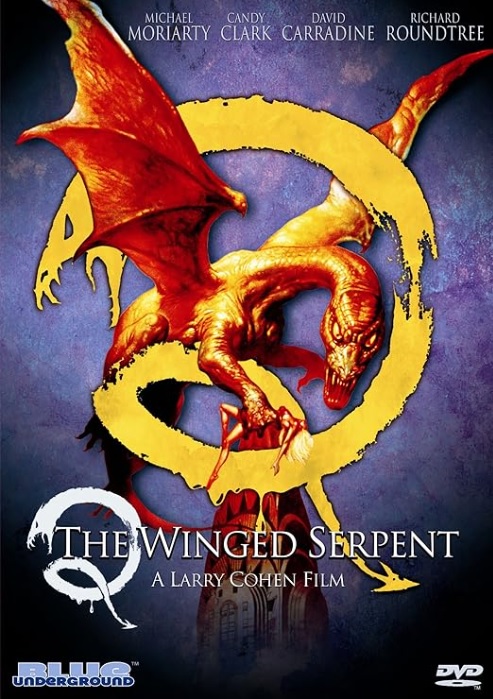 Q: The Winged Serpent (USA, 1982)
Directed by: Larry Cohen
Written by: Larry Cohen
Cast: David Carradine, Michael Moriarty, Candy Clark, Richard Roundtree
A series of unexplainable crimes occur in New York City: a girl sunbathing on a rooftop vanishes, and a window cleaner at the Empire State Building is decapitated. Two NYPD detectives (David Carradine and Richard Roundtree) investigate a ritualistic Aztec murder and soon discover that these crimes are connected. This entertaining supernatural fantasy-horror film by Larry Cohen (Black Caesar) was produced by legendary B-movie mogul Samuel Z. Arkoff and grew from a single idea by Cohen: what if the Chrysler Building housed the nest of a giant prehistoric bird? The special effects are mostly reserved for the film’s climax and they’re not even that bad. The characters are also surprisingly engaging. All in all, Q: The Winged Serpent is an enjoyable B-movie that will certainly appeal to fans of Arkoff’s cult film library.

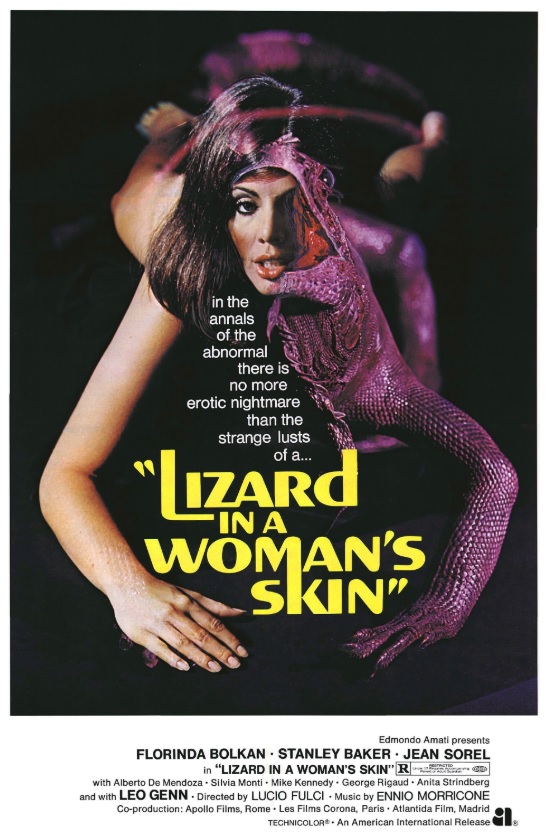
A Lizard in a Woman’s Skin (Italy, France, Spain, 1971)
 Directed by: Lucio Fulci
Written by: Lucio Fulci, Roberto Gianviti, José Luis Martínez Mollá
Cast: Florinda Bolkan, Stanley Baker, Jean Sorel
A Lizard in a Woman’s Skin is a strong example of the giallo genre – an Italian cinematic style that blends elements of slasher, thriller, psychological horror, and sexploitation, and that predates the later wave of American slasher films. The story follows the daughter of an influential politician (Florinda Bolkan), who dreams of an orgy at her ‘liberated’ neighbour’s house and of killing her after having sex with her. She recounts this dream to her psychiatrist, only to discover that the murder actually occurred exactly as she described. I initially took the film’s title literally and expected a Cronenberg-style body horror, but it turned out to be more of a lesson in Freudian dream analysis combined with a murder mystery set in London in the Swinging Sixties. One of the film’s most notorious moments is a dream sequence in which a dog is cut open so convincingly that director Lucio Fulci and his special effects artist were taken to court to prove it was fake. It’s a well-crafted film – stylish, atmospheric, and intriguing – though at times a bit slow and uneventful.
Street Trash (USA, 1987)
 Directed by: J. Michael Muro
Written by: Roy Frumkes, J. Michael Muro
Cast: Mike Lackey, Vic Noto, Bill Chepil, Mark Sferrazza
Just how trashy is a movie called Street Trash? Renowned Steadicam operator J. Michael Muro directs this body-horror comedy about hobos – an often underrepresented group in movies. The story centers on a cheap liquor called Viper that causes anyone who drinks it to melt. This independent production is a prime example of the curious horror subgenre known as ‘melt movies’ (The Blob is another prime example). The film has little in the way of a traditional plot; instead, it’s a series of loosely connected vignettes linked by the effects of the Viper drink. Among the recurring characters are a psychopathic Vietnam veteran terrorizing hobos and a mobster played by Tony Darrow (GoodFellas, The Sopranos). Street Trash has understandably gained quite a cult following over the years, though I didn’t enjoy it much myself. The scene in which a bunch of hobos toss a severed penis around with the owner running after it was a bit too much for me.

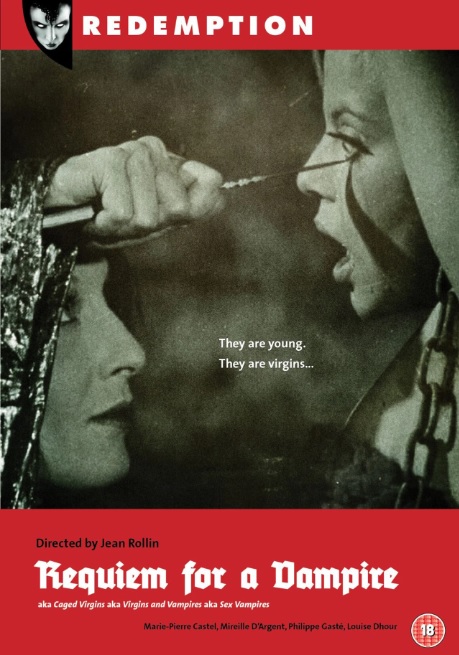
Requiem for a Vampire (France, 1972)
 Directed by: Jean Rollin
Written by: Jean Rollin
Cast: Marie-Pierre Castel, Mireille Dargent, Philippe Gasté
This French cult treasure begins intriguingly: two girls and a man dressed as clowns are chased by a car and shot at. They fire back. The man doesn’t survive the pursuit, but the two girls manage to escape, eventually hiding near an abandoned water tower. They’re clearly on the run, but from whom? No explanation is given. It feels like a deliberate play with mise-en-scène that nonetheless holds your attention. Only after a while does a plot emerge, when the girls stumble upon strange rituals taking place in a remote château. The film is captivating – almost like a silent movie. The two leads don’t speak until they’re hypnotized by a vampire, who commands them to lure in victims for the resurrection of an ancient race. To do so, however, they must first lose their virginity. The lead actresses are well cast, and the combination of eerie locations, sensual imagery, haunting music, and dreamlike camerawork creates a mood that never lets go.

Quatermass and the Pit (United Kingdom, 1967)
 Directed by: Roy Ward Baker
Written by: Nigel Kneale
Cast: James Donald, Andrew Keir, Barbara Shelley, Julian Glover
This Hammer production is more of a sci-fi mystery than the studio’s typical brand of horror. During the excavation of a new subway tunnel, workers uncover skulls and skeletons of ancient apemen. Professor Bernard Quatermass, a space scientist, is called in to investigate. When a strange metallic object is found nearby, he begins to suspect an alien origin and searches for the missing link in human evolution. This Quatermass film, the third based on a BBC television serial, feels very much like an old Star Trek episode, complete with familiar sci-fi elements such as telekinesis, telepathy, and alien insects. Though the pacing is a bit slow, several production aspects – especially the sound design – are excellently executed. The film also presents some intriguing science-fiction ideas, including the notion of recording the memories of a susceptible brain, revealing visions of insect wars that once took place on Mars.


 FRAGMENTEN UIT HET SCHEMERLAND