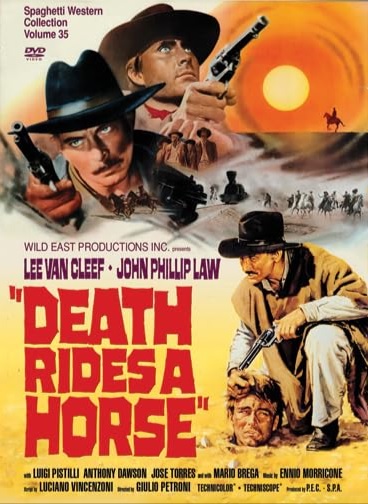
Death Rides a Horse

Director: Giulio Petroni
Written by: Luciano Vincenzoni
Cast: John Phillip Law, Lee Van Cleef, Mario Brega, Luigi Pistilli

Year / Country: 1967, Italy
Running Time: 110 mins.

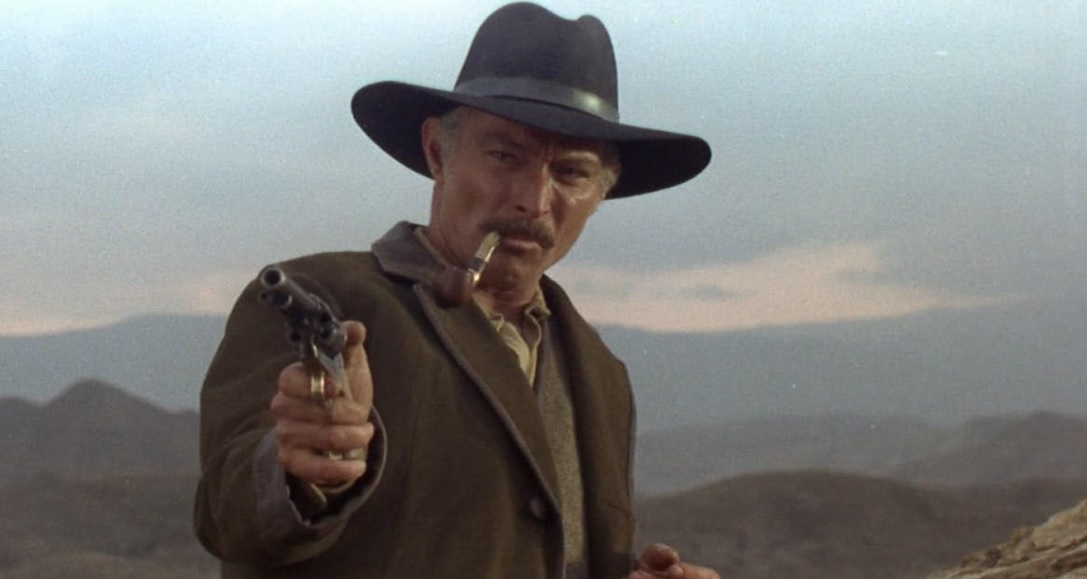
In this gritty spaghetti western, a violent band of outlaws robs and murders a family, leaving their young son Bill (John Phillip Law) scarred and thirsting for vengeance. Fifteen years later, Bill has honed his skills as a sharpshooter, ready to hunt down the men responsible. But he’s not the only one seeking retribution. Ryan (Lee Van Cleef), a former outlaw betrayed by the same gang and imprisoned for fifteen years, is after payback – not in blood, but in compensation for his lost time.

When Bill eliminates gang leader Burt Cavanaugh (Anthony Dawson), Ryan shifts his focus to the remaining members for his payout. However, they’re unwilling to part with the cash, forcing an uneasy alliance between the two avengers. Together, Bill and Ryan set out to settle the score, but Bill is still in the dark about a critical piece of the puzzle.

The film follows the classic spaghetti western recipe: sweeping desert vistas with looming cliffs, a great score by Ennio Morricone, and a steady stream of duels and shootouts. While it’s less violent than many of its contemporaries and lacks the visual flair of Sergio Leone’s masterpieces, the story holds its own with a solid plot, strong performances – Lee Van Cleef is always excellent – and well-executed action sequences.

The windswept town of El Viento serves as the backdrop for an intense, extended finale reminiscent of The Seven Samurai – though not as grandiose. It’s a satisfying conclusion that caps the film’s blend of gritty revenge and campy Italian charm.

Rating:

Biography: Giulio Petroni (1920, Rome) is an Italian director who made name with a number of spaghetti westerns of which Tepepa (starring Tomas Milian and Orson Welles!) and Death Rides a Horse are the most liked and well-known. He also made drama, comedy and horror films, sometimes working under the pseudonym Jeremy Scott.

Filmography: La centro chilometri (1959), I piaceri dello scapoli (1960), I soliti rapinatori a Milano (1961), Always On Sunday (1962), Death Rides a Horse (1967), Tepepa (1968), And for a Roof a Sky Full of Stars (1968), Night of the Serpent (1970), Non commettere atti impuri (1971), Crescete e moltiplicatevi (1972), Life is Tough, Eh Providence? (1972), Labbra di lurido blu (1975), La profezia (1978)


The Good, the Bad and the Ugly

Director: Sergio Leone
Written by: Agenore Incrocci, Furio Scarpelli, Luciano Vincenzoni, Sergio Leone
Cast: Clint Eastwood, Lee Van Cleef, Eli Wallach

Year / Country: 1966, Italy, Spain, West Germany
Running Time: 171 mins.

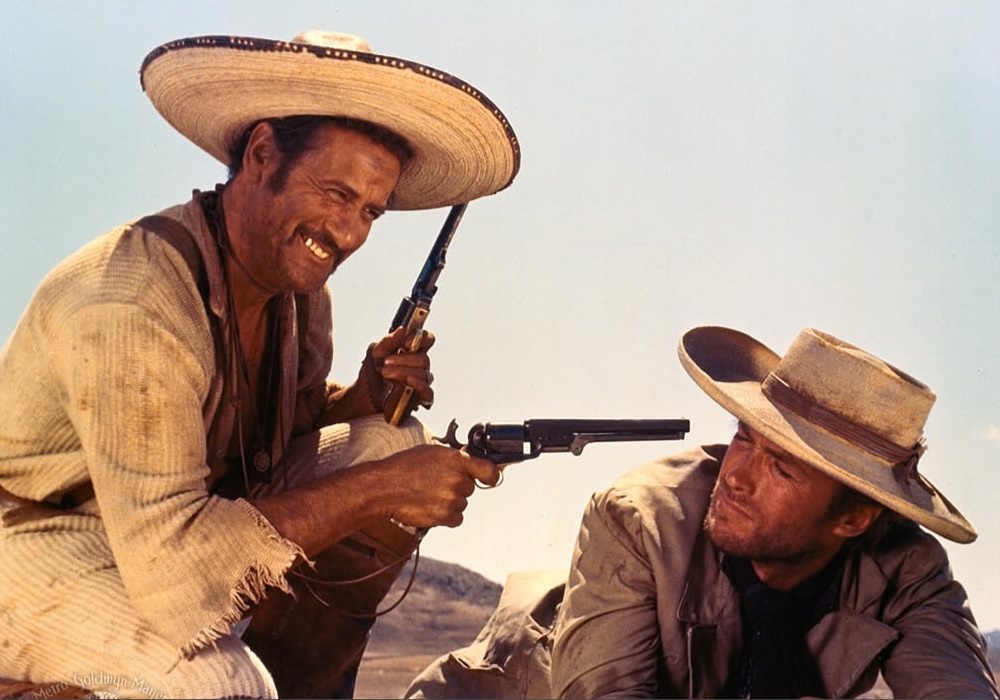
The final installment of Sergio Leone’s ‘Dollars Trilogy’ is a critically acclaimed masterpiece. Set against the backdrop of the American Civil War, three men are on a relentless quest for a fortune in hidden gold. While soldiers fight to determine the fate of a nation, these men pursue only their own interests. They are the Good, the Bad, and the Ugly. While the last two labels are fitting, the first is somewhat misleading – Eastwood’s character, Blondie, may be more principled than the others, but he doesn’t hesitate to kill when it serves his purpose.

Blondie and Tuco (the Ugly, played by Eli Wallach) form a crooked partnership built on mutual betrayal. After one double-cross nearly costs Blondie his life, they’re forced into a reluctant alliance when each comes into possession of a crucial piece of information that could lead them to the buried treasure. Meanwhile, Angel Eyes (the Bad, portrayed by Lee Van Cleef) is hot on their trail, determined to claim the gold for himself. The three men converge on a remote graveyard, where their fates – and the money – await.

Compared to the earlier two films in the trilogy, The Good, the Bad and the Ugly offers a surprisingly human touch. Eastwood’s Blondie reveals a gentler side, cradling a kitten in his hat and comforting a dying soldier with a cigar. Tuco, though undeniably a scoundrel, becomes unexpectedly poignant during a visit to the monastery where he confronts his estranged brother. This and other scenes flesh out Tuco into the trilogy’s most fully realized character, brought to life in a brilliant performance by Wallach. Despite the emotional depth, Leone doesn’t abandon his signature blend of dark humor and biting cynicism.

Visually, the film is a triumph. Leone’s mastery shines in the rhythmic interplay between intimate close-ups and sweeping, war-torn landscapes that seem to take on a character of their own – harsh and unforgiving, especially evident in the desert sequence where Blondie’s face is scorched by the sun. From the bold, stylized opening credits to the iconic, ritualistic cemetery shootout, the cinematography and editing are innovative and arresting. Add to that Ennio Morricone’s legendary score, and you have one of the most influential films of all time.

The Good, the Bad and the Ugly has been released in various versions, but nothing less than the full three-hour cut does it justice. Only in its complete form does this epic ‘horse opera’ truly come into its own. This is cinema as it was meant to be.

Rating:

Biography: Sergio Leone (1929, Rome – 1989, Rome) made his debut in the cinema working as a voluntary assistant and extra, among other things, in The Bicycle Thieves by Vittorio de Sica. Later, he became assistant director to Mario Bonnard. In 1959, when Bonnard was ill, he took over from him on the set of The Last Days of Pompeii. In 1961 he directed his first full-length film: The Colossus of Rhodes. But the film that was to bring him to the general attention came out in 1964: A Fistful of Dollars. His next films, For a Few Dollars More and The Good, The Bad and the Ugly complete what came to be known as the Dollars Trilogy and were a great box-office success. He would only make three more films before tragically passing away in 1989. He was taken from us by a heart attack in his house in Rome, while working on an ambitious project for a film on the Siege of Leningrad.

Filmography: The Colossus of Rhodes (1961), A Fistful of Dollars (1964), For a Few Dollars More (1965), The Good, The Bad and the Ugly (1966), Once Upon a Time in the West (1968), A Fistful of Dynamite (1971), Once Upon a Time in America (1984)


For a Few Dollars More

Director: Sergio Leone
Written by: Fulvio Morsella, Sergio Leone, Luciano Vincenzoni
Cast: Clint Eastwood, Lee Van Cleef, Gian Maria Volontè

Year / Country: 1965, Italy, Spain, West Germany
Running Time: 126 mins.

A credit sequence can make or break a movie, and I’ve always loved the one that opens For a Few Dollars More. A lone rider approaches in an extreme long shot. Suddenly, a rifle cracks, the rider falls, and the horse gallops off. Then Ennio Morricone’s score bursts in, and the credits roll. Simple, yet brilliant.

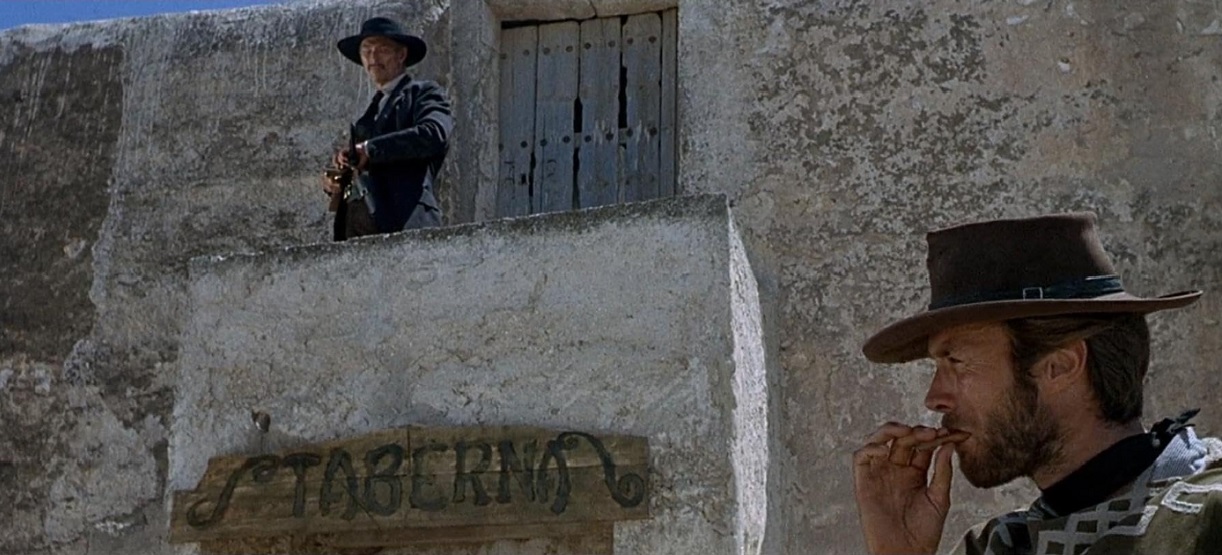
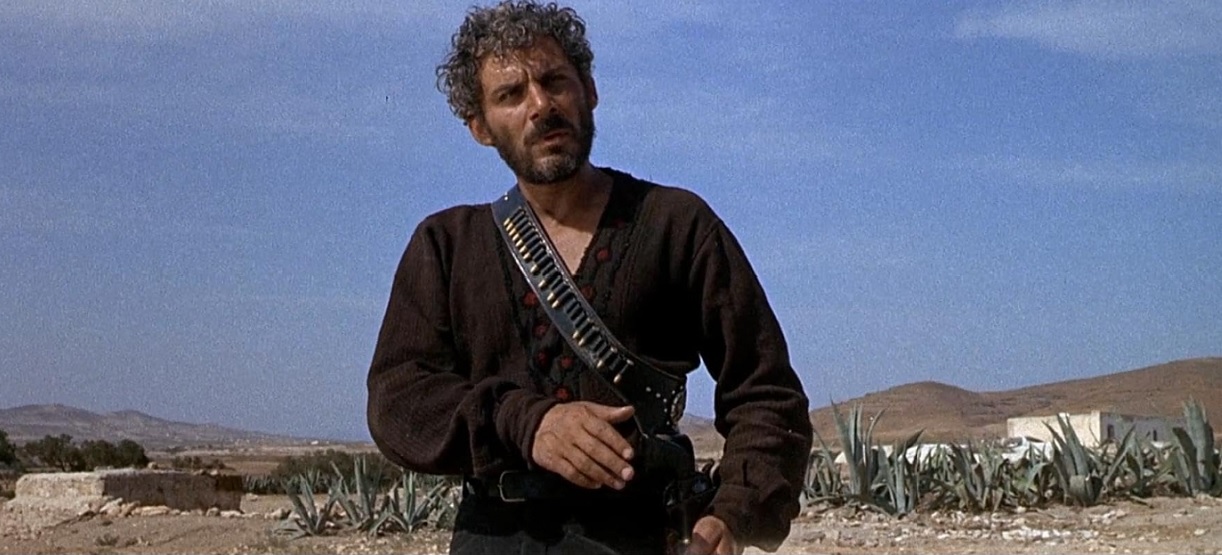
Next, a title card appears: “Where life had no value, death, sometimes, had its price. That is why the bounty killers appeared.” In the first half hour, we’re introduced to the film’s three central figures. Colonel Mortimer (Lee Van Cleef) and Monco (Clint Eastwood) are rival bounty hunters who form an uneasy alliance to take down the deranged bandit El Indio (Gian Maria Volontè).

This second installment in Sergio Leone’s world-famous ‘Dollars Trilogy’ is a tense, action-packed rollercoaster. Just one year after the excellent A Fistful of Dollars, Leone delivers an even more stylish and accomplished Western. It’s also the funniest film of his career.

The decision to cast Lee Van Cleef as Eastwood’s ultra-cool counterpart was inspired. Few actors could match Eastwood’s screen presence, but Van Cleef not only holds his own, he arguably matches him in sheer badassery. Volontè, already a memorable villain in A Fistful of Dollars, turns in an even more manic, menacing performance here. His gang of outlaws, including a wonderfully twitchy Klaus Kinski, adds further flavor to the mix.

If the film has a flaw, it’s that its pacing is occasionally uneven. Some sequences, like the El Paso bank heist, drag a bit. But this is a minor gripe in a film overflowing with memorable moments, sharp dialogue, and unforgettable characters. Leone’s blend of style, suspense, and morbid humor has rarely been better.

And the ending – well, no spoilers – but suffice to say, it’s one of those perfectly twisted moments that’s sure to leave a massive grin on your face.

Rating:

Biography: Sergio Leone (1929, Rome – 1989, Rome) made his debut in the cinema working as a voluntary assistant and extra, among other things, in The Bicycle Thieves by Vittorio de Sica. Later, he became assistant director to Mario Bonnard. In 1959, when Bonnard was ill, he took over from him on the set of The Last Days of Pompeii. In 1961 he directed his first full-length film: The Colossus of Rhodes. But the film that was to bring him to the general attention came out in 1964: A Fistful of Dollars. His next films, For a Few Dollars More and The Good, The Bad and the Ugly complete what came to be known as the Dollars Trilogy and were a great box-office success. He would only make three more films before tragically passing away in 1989. He was taken from us by a heart attack in his house in Rome, while working on an ambitious project for a film on the Siege of Leningrad.

Filmography: The Colossus of Rhodes (1961), A Fistful of Dollars (1964), For a Few Dollars More (1965), The Good, The Bad and the Ugly (1966), Once Upon a Time in the West (1968), A Fistful of Dynamite (1971), Once Upon a Time in America (1984)