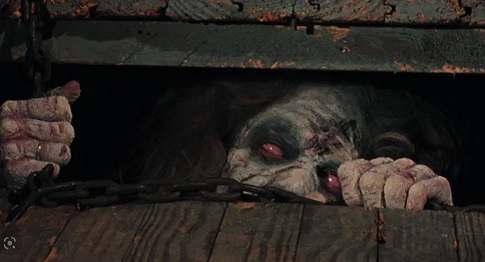
Miller’s Crossing (1990)


‘Up is down, black is white, and nothing is what it seems’

Directed by:
Joel Coen

Written by:
Joel Coen
Ethan Coen

Cast:
Gabriel Byrne (Tom Reagan), Marcia Gay Harden (Verna), John Turturro (Bernie Bernbaum), Jon Polito (Johnny Caspar), J.E. Freeman (Eddie Dane), Albert Finney (Leo), Mike Starr (Frankie), Al Mancini (Tic-Tac), Steve Buscemi (Mink), Richard Woods (Mayor Dale Levander)

‘I’m talkin’ about friendship. I’m talkin’ about character. I’m talkin’ about—hell, Leo, I ain’t embarrassed to use the word—I’m talkin’ about ethics.’ That’s how Italian crime boss Johnny Caspar (Jon Polito) begins his speech to Irish kingpin Leo O’Bannion (Albert Finney) in the opening of Miller’s Crossing. It immediately recalls the first scene of The Godfather, where undertaker Bonasera appeals in much the same way to Don Vito Corleone.

The favor Caspar asks of O’Bannion is permission to whack two-timing bookie Bernie Bernbaum (John Turturro). Leo refuses, since Bernie is the brother of Verna (Marcia Gay Harden), the woman he’s fallen in love with. Of course, Caspar wasn’t really asking permission—he was informing Leo as a courtesy, as he angrily makes clear after being turned down. Gangsters with ethics toward one another: that’s the foundation of Miller’s Crossing. When Leo breaks this unspoken code among the city’s corrupt rulers, the result is all-out war.

The theme of crooks with ethics is embodied in Leo’s right-hand man Tom Reagan (Gabriel Byrne), the film’s central character. He follows a personal code that only he fully understands. Though secretly having an affair with Verna, Tom – unlike Leo – believes Bernie should be handed over to the Italians. He knows that breaking the underworld code is bad for business. But Leo is stubborn, and their disagreement grows until Tom finally confesses the affair. Leo cuts ties, and Tom immediately shifts allegiance to Caspar. His motive, however, is not self-interest. Though finished with Leo, Tom’s loyalty to his old friend remains.

The web of deceit that quickly unfolds in Miller’s Crossing is complex enough to merit a second viewing. Adding to the intricacy are numerous characters referenced but rarely seen. Still, the story – drawn from Dashiell Hammett novels like ‘The Glass Key’ and ‘Red Harvest’, and infused with classic gangster and neo-noir elements – is masterfully told. The Coens integrate these influences into a killer script, ironically born from a period of writer’s block. Their trademark humor and eccentric characters are on full display, while the dialogue carries a poetic cadence that might even make Shakespeare jealous.

The plotlines themselves may not be original, but the Coens conjure a dreamlike world where, as the tagline promises, nothing is what it seems. The mood is unmistakably Irish – you can almost smell the whiskey. Carter Burwell’s haunting score, the gorgeous cinematography, and evocative settings all heighten the effect. The tone shifts effortlessly from cartoonish to brutally violent, without warning or transition.

The cast is uniformly excellent. Gabriel Byrne makes Tom a sympathetic bastard it’s hard not to root for; if I had to trade places with a Prohibition-era gangster, I’d pick him without hesitation. The supporting roles are just as strong, with John Turturro delivering a powerhouse turn as Bernie, a spineless schemer whose lack of ethics drives the story. Miller’s Crossing also reinvents the use of hats and overcoats. Not that there’s any hidden meaning – there’s nothing’s more foolish than looking for meaning in a hat.

Features a terrific cameo from the Coen’s friend Sam Raimi as a trigger happy cop.

Rating:

Quote:
Tom Reagan: Nobody knows anybody. Not that well.

Trivia:
The Coen Brothers suffered writer’s block while working on the script for Miller’s Crossing. They took a three-week break and wrote the script for their next movie Barton Fink during that time, about a writer with writer’s block. There are two references to Barton Fink in this film. The first one is the name of Tom Reagan’s residence called ‘The Barton Arms’. The second is a newspaper article that reads ‘Seven Dead in Hotel Fire’.
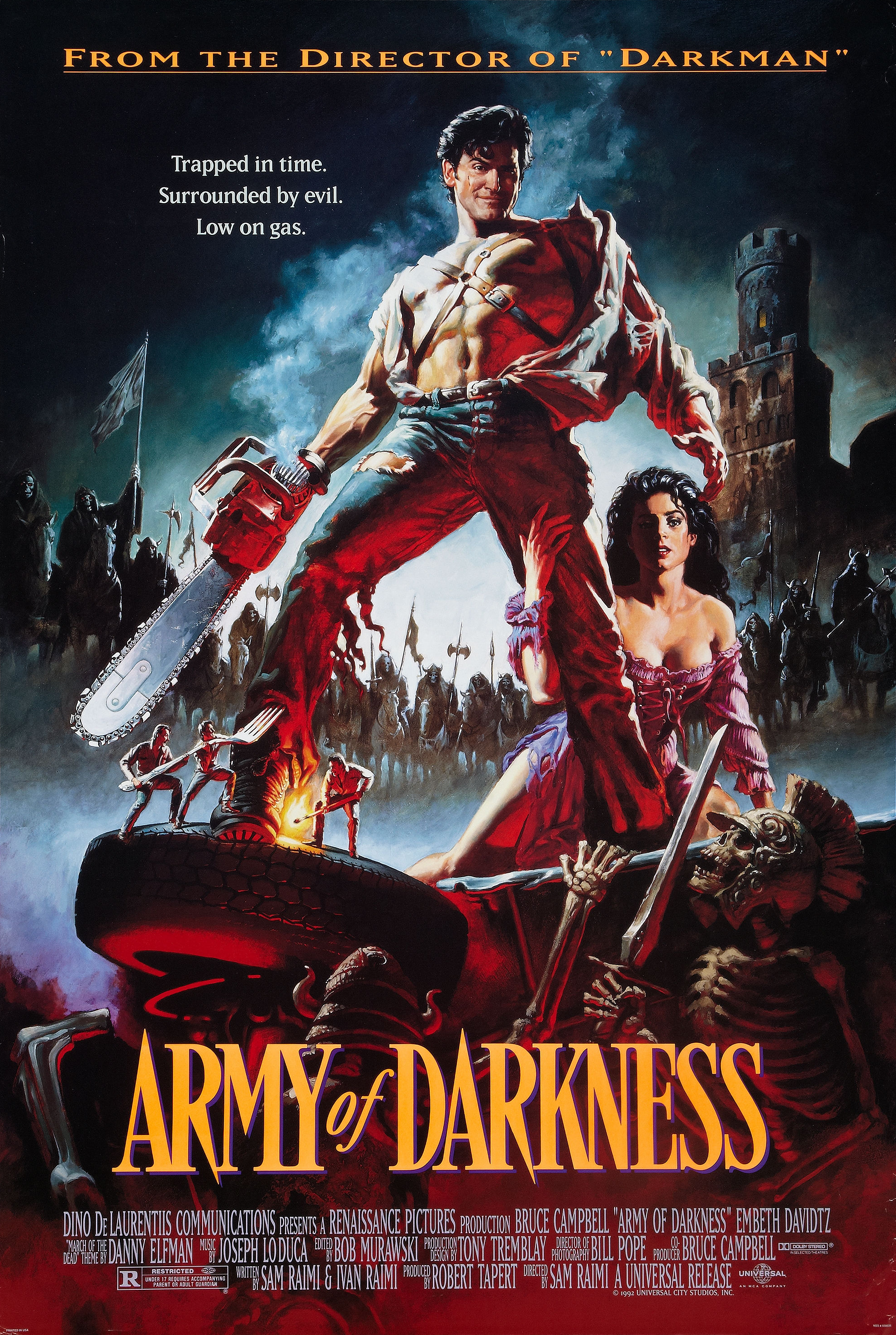

Army of Darkness

Director: Sam Raimi
Written by: Sam Raimi, Ivan Raimi
Cast: Bruce Campbell, Embeth Davidtz, Marcus Gilbert, Richard Grove

Year / Country: 1992, USA
Running Time: 85 mins.

You want some more Evil Dead? Come get some! Ash is back with a chainsaw attached to his wrist and a boomstick on his back. This time around he’s kicking Evil’s ass in medieval times. Isn’t it groovy? Well, yes it is.

Some horror fans have argued that this third and final entry in the Evil Dead series is too comical to be considered horror. While this notion might be true, Raimi should be applauded for taking his franchise in this direction. This movie is hilarious! And there is plenty of horror as well.

We literally get sucked into the action when our hero Ash disappears into a vortex. He is transported to the age of King Arthur where he is captured and mistaken for an ally of Arthur’s enemy Henry the Red. Arthur sentences him to a one-way ticket to ‘the pit’. After he has shown the primates some of his fancy tricks and gadgets they believe him to be the chosen one, who is to deliver them from evil.

Ash is sent on a holy quest to find the occult book Necronomicon. He finds it, but screws up the book lifting procedure and Evil is awoken. An army of deadites head towards Arthur’s castle to retrieve the book. Now Ash has to lead Arthur’s men into battle while he simultaneously has to rescue his girlfriend Sheila, who has been kidnapped by the evil forces.

Army of Darkness contains some fantastic set-pieces around which dynamic action scenes take place. My personal favorites are the pit and the S-Mart finale. The skeleton army is also an impressive accomplishment. Stop-motion pioneer Ray Harryhausen would certainly approve.

Besides Raimi’s action-packed script and trademark camera tricks, fans can enjoy a brilliant double turn from B-Movie star Bruce Campbell as Good Ash and Bad Ash. With his masterful comic timing, loads of one-liners and his lady man skills, he makes Ash a truly lovable hero. Not to mention a horror icon. Hail to the King baby!

Rating:

Biography: Sam Raimi (1959, Royal Oak, Michigan) started making 8mm films when he was around ten years old. In his teenage years he first collaborated with his good friend Bruce Campbell, who would later appear in almost all of his films. The style of Raimi is influenced by the Three Stooges, of whom he is a huge fan. By making the short movie Within the Woods he managed to raise the required funds to make his first feature; the outrageous horror flick The Evil Dead. After that he made similar films with varying commercial success. In his films Raimi displays a great talent for creating inventive visuals. Most of his movies also feature slapstick and comic book elements. In 2002 Raimi made Spiderman, his biggest film to date. It was an enormous box-office success and Raimi would go on to make two sequels. Throughout his career Raimi has also produced many films and TV-series, mostly in the horror/fantasy genre. He remains a director with a huge fan base and many exciting future prospects.

Filmography (a selection): It’s Murder! (1977, short), Within the Woods (1978, short), Clockwork (1978, short), The Evil Dead (1981), Crimewave (1985), Evil Dead II (1987),  Darkman (1990), Army of Darkness (1992), The Quick and the Dead (1995), A Simple Plan (1998), For Love of the Game (1999), The Gift (2000), Spider-Man (2002), Spider-Man 2 (2004), Spider-Man 3 (2007)

Evil Dead II

Director: Sam Raimi
Written by: Sam Raimi, Scott Spiegel
Cast: Bruce Campbell, Sarah Berry, Dan Hicks, Kassie DePaiva

Year / Country: 1987, USA
Running Time: 85 mins.

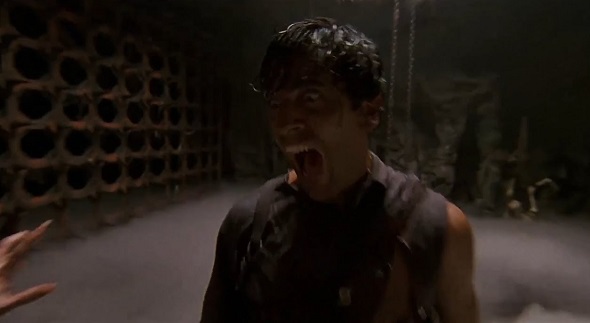
Evil Dead II marks a welcome return for director Raimi and star Campbell. It starts with a recap of the first film, with the distinction that five friends became just Ash (Campbell) and his girlfriend Linda. After Linda is possessed by evil, Ash hacks her up and buries her. However the evil returns and possesses Ash himself. This is the point where the first film ended. It then turns out that when dawn arrives, evil vanishes and Ash is back to his old self again. He now has till evening to get the hell out of dodge. Of course he can’t (bridge broken, what do you know?) and Ash’s everlasting struggle continues.

Humor makes an entry in this second Evil Dead flick. Big time. But luckily the terror hasn’t been forgotten. The combination of the two make this an even more enjoyable film than the first one. Raimi also takes his visual style to the next level and does an outstanding job in creating one breathtaking shot after the other. The camerawork and editing are just seamless.

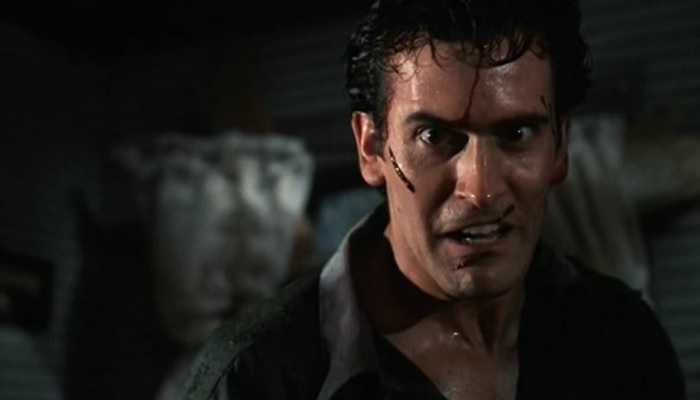
Then there’s the great performance by Campbell who deserves much credit for carrying this flick. During a lot of screen time, it is just him alone in the cabin (without other humans that is). With his brilliant physical acting and his great comical timing he totally absorbs the audience’s attention. The slapstick fight with his own hand is an outrageous and comical masterpiece.

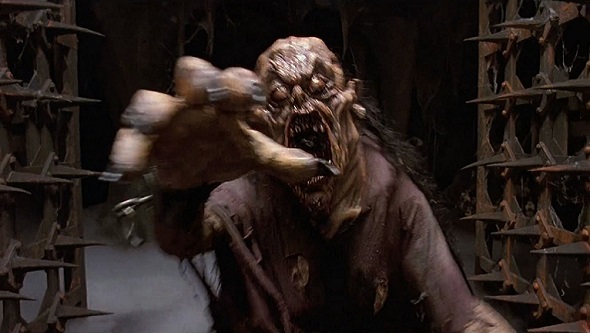
But there is more twisted humor to be found. Often this is accomplished with inventive gruesomeness, like the hilarious flying eyeball or the work-shed flight. Another fantastic achievement is the nerve shattering sequence around the witch in the fruit cellar. With this film Raimi, may well have delivered his finest one to date, making this an absolute must-see horror flick.

Rating:

Biography: Sam Raimi (1959, Royal Oak, Michigan) started making 8mm films when he was around ten years old. In his teenage years he first collaborated with his good friend Bruce Campbell, who would later appear in almost all of his films. The style of Raimi is influenced by the Three Stooges, of whom he is a huge fan. By making the short movie Within the Woods he managed to raise the required funds to make his first feature; the outrageous horror flick The Evil Dead. After that he made similar films with varying commercial success. In his films Raimi displays a great talent for creating inventive visuals. Most of his movies also feature slapstick and comic book elements. In 2002 Raimi made Spiderman, his biggest film to date. It was an enormous box-office success and Raimi would go on to make two sequels. Throughout his career Raimi has also produced many films and TV-series, mostly in the horror/fantasy genre. He remains a director with a huge fan base and many exciting future prospects.

Filmography (a selection): It’s Murder! (1977, short), Within the Woods (1978, short), Clockwork (1978, short), The Evil Dead (1981), Crimewave (1985), Evil Dead II (1987),  Darkman (1990), Army of Darkness (1992), The Quick and the Dead (1995), A Simple Plan (1998), For Love of the Game (1999), The Gift (2000), Spider-Man (2002), Spider-Man 2 (2004), Spider-Man 3 (2007)

The Evil Dead

Director: Sam Raimi
Written by: Sam Raimi
Cast: Bruce Campbell, Ellen Sandweiss, Richard DeManincor, Betsy Baker

Year / Country: 1981, USA
Running Time: 85 mins.

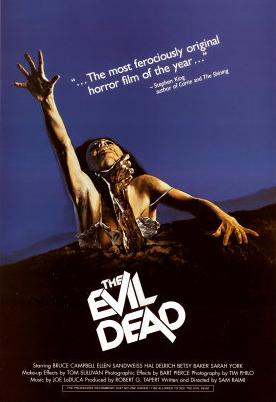
Sam Raimi’s first feature film is a low budget horror shocker that would find an enormous cult support and send its creator to the Hollywood directors A-list. It would also spawn two sequels, comic books, lots of toys, a number of videogames and even a musical.

The story is simple: five friends take a holiday to a deserted cabin in the woods. Over there, they find a morbid archaeological artifact; Necronomicon Ex Mortis, the book of the dead. They also find a tape-recorder and –stupidly– play the recordings. The professor’s voice on the tape utters spells from the book and thereby resurrects the evil spirits in the forest. These spirits quickly head towards the cabin to possess the living. Once a human is possessed, bodily dismemberment is the only way to beat the demon that inhabits the body.

The execution of this gruesome tale is nearly flawless. From a slow and suspenseful build-up to the gore-drenched ending. In the meantime it provides more scares than a truckload of other eighties horror flicks. The young cast performs well. As opposed to many modern horrors the viewer can genuinely believe that these people are terrified. Raimi also creates tension with good use of sound and dazzling camerawork. The Evil-POV shots are especially a brilliant invention. The special make-up and gore effects are impressive considering the shoestring budget.

There are also some scenes of controversy. Most notably of course the tree-rape scene. Although the envelope in horror has been pushed further over the years, this remains a shocking scene when viewed today. Bruce Campbell’s character Ash is still fairly undeveloped at this point. Something that would drastically change with the follow-up Evil Dead 2: Dead by Dawn.

Rating:

Biography: Sam Raimi (1959, Royal Oak, Michigan) started making 8mm films when he was around ten years old. In his teenage years he first collaborated with his good friend Bruce Campbell, who would later appear in almost all of his films. The style of Raimi is influenced by the Three Stooges, of whom he is a huge fan. By making the short movie Within the Woods he managed to raise the required funds to make his first feature; the outrageous horror flick The Evil Dead. After that he made similar films with varying commercial success. In his films Raimi displays a great talent for creating inventive visuals. Most of his movies also feature slapstick and comic book elements. In 2002 Raimi made Spiderman, his biggest film to date. It was an enormous box-office success and Raimi would go on to make two sequels. Throughout his career Raimi has also produced many films and TV-series, mostly in the horror/fantasy genre. He remains a director with a huge fan base and many exciting future prospects.

Filmography (a selection): It’s Murder! (1977, short), Within the Woods (1978, short), Clockwork (1978, short), The Evil Dead (1981), Crimewave (1985), Evil Dead II (1987),  Darkman (1990), Army of Darkness (1992), The Quick and the Dead (1995), A Simple Plan (1998), For Love of the Game (1999), The Gift (2000), Spider-Man (2002), Spider-Man 2 (2004), Spider-Man 3 (2007)