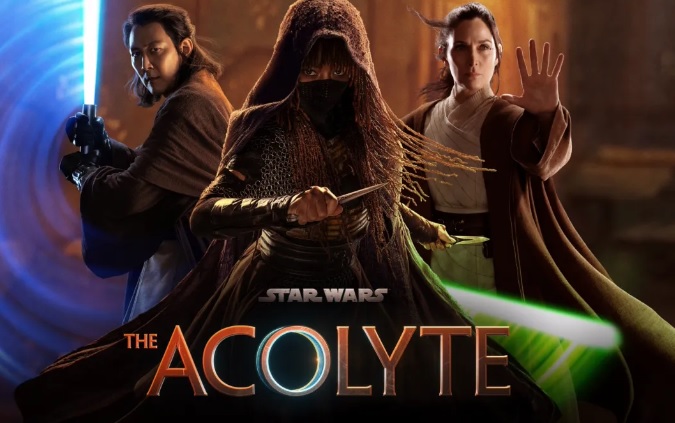
In recent years, Disney has released one Star Wars series after the other. Most were pretty good with especially The Mandalorian and Andor getting rave reviews. The latest is The Acolyte, of which the first two episodes were released on June 5 on Disney Plus.
If you ask the critics, the series is a successful addition to the SW universe. If you ask the fans you get quite a different view. At IMDb, the show is currently rated with a painful 3,4 and most of the 1.5 K user reviews are extremely negative. A sample of the comments: ‘Jar Jar Binks was a museum masterpiece next to this’, ‘this is laughably bad writing & direction’ and ‘the worst Star Wars project since the Holiday Special.’ Autch.
I am aware of the fact that Star Wars fans are notoriously difficult to please. Many of the prequels and sequels were also harshly criticized when they first came out, although since the Disney takeover of Lucas Film, the prequel films by George Lucas’ have risen somewhat in popularity again .
After viewing the first five episodes of The Acolyte, I have to say I am with the fans on this one though. Judging the series on the basis of plot, characters, acting, action and atmosphere, I find it to be a pretty terrible show. Yes, the fifth episode indeed contains some excellent lightsabre action, but because the writing is so weak, the showdowns lose almost all of their potential impact.
The Acolyte is the first series to venture outside of the Skywalker era. It takes place about a hundred years before the rise of the Empire in the peaceful High Republic era. The story revolves around a female force user who is killing off Jedi’s. Her twin sister is accused of the crime, but after her innocence is proven, she joins the Jedi in order to track down her sister and we learn of their family tragedy that caused her sister to crave for revenge. We also learn that she is guided by a dark master, whose appearance is very Sith-like.
The main point thematically, seems to be that the Jedi themselves can be an oppressive force, which in this case has resulted in the rise of evil. The problem is that the characters and their motivations are not one bit convincing. It is also problematic that this feels like another rise of the Sith story for which we have no need. Lucas has done this already in the prequels, and in my opinion he did a fine job, although certainly not flawless.
The show really gets embarrassing in episode 3 when the Witches are introduced: a new group of force users. The dialogues make George Lucas seem like a William Shakespeare. Things don’t improve in the following episodes. Were there no question marks with the producers when they read the scripts? What is it that convinced them to invest 180 million dollars (!) in this show? It’s mind boggling.
I am not gonna finish it after watching episode 5. It is now revealed who the bad guy is and frankly, I thought this was a terrible choice as well. I am not curious to find out what Sol is hiding nor do I care to find out how the relationship between the twin sisters is gonna develop. I am still interested in new Star Wars series by Disney, but The Acolyte is pretty much a disaster as far as I’m concerned. I can only hope that Disney will learn from this costly mistake.