Van Capo tot CEO: Bedrijfslessen van de maffia

Voor de jaarlijkse CFO Day vonden we bij Sijthoff Media dit jaar een bijzondere spreker. Jan-Joost Kroon is organisatiedeskundige én maffia-expert. Sinds hij Scarface zag in zijn jeugd is hij gefascineerd door de Italiaanse en Siciliaanse misdaadorganisaties.

Hij vond mijn blogs over gangsterfilms erg tof – en we hadden dus meer dan genoeg reden om bij elkaar te komen voor een sit-down. Erg leuk om iemand te ontmoeten die weet wie Anthony ‘The Ant’ Spilotro en Benjamin ‘Lefty’ Ruggiero zijn.

In 2022 bracht hij een boek uit dat de basis was voor zijn CFO Day verhaal: ‘Van CAPO naar CEO: Leerzame inzichten van de Italiaanse maffia’.

In zijn boek bestudeert hij de Drie, de drie grote organisaties/families die de georganiseerde misdaad besturen in Italie en Sicilie:
● ‘Ndrangheta – Oorsprong: Calabrië
● Camorra – Oorsprong: Napels
● Cosa Nostra – Oorsprong: Sicilië

Deze Zuid-Italiaanse organisaties zijn al decennialang succesvol – hun gezamenlijke jaaromzet wordt geschat op zo’n 150 miljard euro. Jan-Joost beschrijft hoe dat succes tot stand komt.

Sterke tradities
Iedere business professional kent de uitspraak ‘culture eats strategy for breakfast’. Een hele serie tradities houdt de organisatie bij elkaar. Denk aan de doop van Michael Corleone’s neefje in The Godfather, de ceremonie in The Sopranos waarin van Christopher Moltisanti een ‘made guy’ wordt gemaakt, en het communiefeest van Michael Corleone’s zoontje waarmee The Godfather: Part 2 geopend wordt. Rituelen borgen de groepsidentiteit.

Loyaliteit
Het zakelijkste succesvol van de Drie is nu de ‘Ndrangheta met een geschatte omzet van 80 miljard euro per jaar. Terwijl de Cosa Nostra een tijdlang met de Italiaanse staat in gevecht was, is de ‘Ndrangheta in stilte doorgegroeid. Het is een echt familiebedrijf, schrijft Jan-Joost. Alleen familie komt erbij via een gearrangeerd huwelijk. Krachtig, want familie verraad je niet zomaar. Plus voor familie ben je bereid een stap extra te zetten.

Flexibiliteit
De Camorra kan meer vergeleken worden met een MKB-bedrijf vanwege de flexibiliteit, de compacte manier van werken en de snelheid waarmee ze handelen en inspringen op kansen. Zoals na de grote aardbeving van 1980 was de Camorra er als de kippen bij om bouwcontracten af te sluiten voor de bouw van nieuwe huizen. De maffia kent geen comfort keuzes: ze zijn altijd bezig met de volgende stap. Met actie. Met de beste willen zijn.

Onderdeel van de lokale samenleving
Het bekendste van de drie is nog altijd de Cosa Nostra – vrij vertaald: ‘onze zaak’. Deze organisatie heeft een klassieke piramidestructuur en functioneert als een soort multinational die in elk economisch aspect van een regio meespeelt. Ze bepaalt wat er wél en niet gebeurt in de wijk. Door slim in te spelen op het wantrouwen richting de Noord-Italiaanse overheid, positioneert de Cosa Nostra zich als beschermheer: “Laat die mensen in Rome maar, wij weten wat hier speelt en zorgen voor jullie.”

Heldere rolverdeling en structuur
De kracht van de Cosa Nostra zit hem in de sterke structuur en de duidelijkheid van ieders werkzaamheden. De organisatie zélf is de kracht, een leider kan vervangen worden. Iedere medewerker van een maffia-organisatie weet wat er van hem verwacht wordt en hoe hij kan bijdragen aan het succes. Ontwikkelkansen voor persoonlijke carrière zijn daarmee ook duidelijk. De maffia heeft ook heldere kernwaarden die nooit veranderen: Eer, loyaliteit, macht en respect.

Goed in talentmanagement
De maffia blijkt verrassend goed in talentontwikkeling. Een belangrijke les: bemoei je niet te veel met het werk van je mensen. Vind de juiste mensen, leid ze goed op, geef heldere kaders, en laat ze dan hun werk doen. De leiding is wel beschikbaar, maar niet betuttelend. Ook op het gebied van belonen en straffen valt er iets te leren. Bij de maffia zijn de consequenties van falen of succes kraakhelder. In veel bedrijven ontbreekt die duidelijkheid.

De maffia is een blijver
Jan-Joost beschrijft ook hoe diep de maffia-politiek verweven is met de samenleving, en waarom hij denkt dat deze organisaties – mede door culturele factoren – nooit zullen verdwijnen. Een schokkende constatering, maar overtuigend onderbouwd. Het versterkt het centrale punt van zijn boek: de maffia is, hoe immoreel ook, een extreem goed geleide, veerkrachtige en succesvolle organisatie. Daar kun je als bedrijfsleider van leren – zónder mee te gaan in het gebrek aan ethiek.

LEES OOK: 10 Management Lessons From Highly Successful Gangsters

#####

Hieronder nog een LinkedIn-post van Jan Joost:

Graphic Novel Classics: The Thirteenth Floor

Graphic novel which ran from 1984 till 1987 in the weekly comic magazines Scream! and Eagle. The story is about a tower building and the A.I. Max that governs it. Max his primary directive is ensuring the welfare of his tenants, a job he takes extremely seriously. Whenever their wellbeing is being threatened by outsiders, he takes these perps to the thirteenth floor, a nightmarish virtual world Max invented, where he can treat them to a frightening punishment for their wrongdoings. We, as readers, quickly become accomplices of the friendly Max, who has the most creative mind for coming up with the most fiendish lessons for horrible people who deserve a lesson. But after more and more people start dying or disappearing, a nosy detective figures something strange might be happening at Maxwell Tower… The beautiful black and white art work is drawn by José Ortiz and the stories are written by John Wagner and Alan Grant. Rebellion Developments, who also re-published classic ‘The Rise and Fall of the Trigan Empire’ by Don Lawrence, recently published ‘The Thirteenth Floor’ in a number of beautiful books. Highly recommended. Not to be confused with the science fiction movie The Thirteenth Floor (1999) which is also about virtual worlds.

Mind Book #2 – The Spread Mind

Read also: Mind Book #1 – Being You

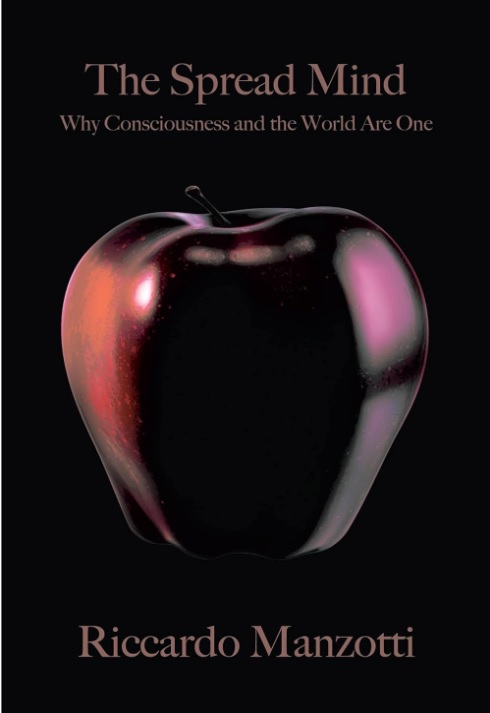
In The Spread Mind: Why Consciousness and the World Are One (2018), philosopher, psychologist, and AI expert Riccardo Manzotti offers a bold new perspective on the problem of consciousness. Rejecting the notion that experience arises from neural activity – the default view in contemporary science – Manzotti argues that experience and reality are fundamentally identical. While this might evoke comparisons to biocentrism, the Spread Mind is a distinct theory.

Biocentrism posits that consciousness actively creates the world. In contrast, the Spread Mind asserts that consciousness is physical yet external to the body. It is neither a property of the brain nor the body; rather, it is identical to the objects in the surrounding environment. So when you are looking at an object, let’s say an apple, that apple is not in space and time but where you experience it. Also, the apple is identical to your experience of it.

At first glance, this might again seem like a biocentric perspective, as both theories reject the idea of an apple existing independently in the outside world, waiting to be experienced. However, the distinction lies in where the apple resides: in biocentrism, the apple exists within the mind, whereas in the Spread Mind theory, the apple is the mind. The object is causal, active, relative, temporally-defined, and of course spread.

What we label ‘an object’, Manzotti asserts, is a physical occurrence that repeats itself whenever we put our bodies in the proper circumstances. As a result, even though we believe the same object perdures, what perdures is not the object but a set of circumstances that are favorable to the occurrence of a series of identical objects.

Relocating experience in the world – and therefore ‘spreading’ consciousness in spacetime – can pay back in terms of simplicity, states Manzotti. And he’s right. Up to now, the reduction of experience to neurons and their whereabouts, the usual candidates for the physical underpinnings of consciousness, has not been satisfactory for explaining the conscious mind, since experience and the brain do not resemble each other in the least. In his theory, consciousness will no longer be an unexpected addition to the physical world because appearance and reality are the same thing.

To explain why his theory is better, he uses the simple case of Emily experiencing a red apple. The common perception is that she reproduces the apple inside her brain. But is that really the best solution? Manzotti’s view: ‘The brain is pinkish-gray, gooey, and bloody. The red apple is red, round, and applish. Which entity is more similar to Emily’s experience of the red apple?’ (P. 9)

The theory of the Spread Mind asserts that phenomenal and physical properties are the same. We perceive the world as it is because we are the world we perceive. The properties of our experience are the properties of the physical world we live in. According to the Spread Mind theory, the mind is a set of objects. Manzotti describes the body as a causal object that ‘causes’ all the other objects to be part of the set. This is again close to biocentrism, where it is consciousness itself that is the causal entity that ‘collapses’ the objects it observes, including the body and brain of that conscious observer.

However biocentrism is a modern version of idealism and the Spread Mind posits itself as a form of physicalism. The difference with the standard form of physicalism is that it doesn’t state that conscious experience arises from matter, but that experiences of matter are the matter, and are therefore physical.

My thoughts about this book
I admire Riccardo Manzotti greatly for making a leap in thinking and going beyond the default view. Rather than following the – in my opinion – dead end street of materialism, he takes a highly original standpoint and locates consciousness outside the body. You are one with the objects you perceive. You are the collection of objects you are currently perceiving. Your body – also an object – is the cause of the other objects you experience to be ‘there’.

However, the spread mind fails to capture the essence of what a mind is in my opinion. My mind is not the trash can I just saw. Rather, it is the integrated collection of thoughts, feelings, memories and perceptions that make up that ‘me’ feeling. The trash can appears in my mind, but it is not the same as my mind. Once identity is the same as the objects we observe, this means that if I am drinking a glass of beer in a bar, I am that glass of beer, the bar and even the waitress that is currently serving me.

Manzotti also writes some things that seem contradictory. For example, he writes that in his physical theory, ‘realism is safe’. But according to his theory, objects are only present in relation to the body, and that would violate realism which assumes that an external reality is always present also in the absence of an observer or body.

In conclusion, it was a great and original move by Manzotti to take the mind out of the brain, but biocentrism is better equipped to explain the totality of mental experiences and their relation to the workings of the universe.

You can read more about biocentrism and consciousness on my platform:
http://free-consciousness.com

Mind Book #1 – Being You

Anil Seth is one of the world’s leading neuroscientists who is working on the ‘problem’ of consciousness. His ideas are discussed in the book Being You (2022). His working theory is that our conscious experiences of the world and the self are forms of brain-based prediction – ‘controlled hallucinations’ – that arise with, through, and because of our living bodies. We are conscious, beast machines, Seth believes.

The widely held assumption in science is that the brain is responsible for creating our conscious experiences. Philosopher David Chalmers, who introduced the term ‘the hard problem of consciousness’, wrote: ‘It is widely agreed that experience arises from a physical basis, but we have no good explanation of why and how it so arises.’

Why is there so much agreement about the physical nature of consciousness if it is totally unclear and unexplainable how something physical can cause a mental state? The opposite approach – consciousness producing physical states – is almost never considered in science.

Seth is honest in stating that his view is philosophical and not a proven scientific fact. He writes: ‘My preferred philosophical position, and the default position of many neuroscientists, is physicalism or materialism. This is the idea that the universe is made of physical stuff, and that conscious states are either identical to, or somehow emerge from particular arrangements of this physical stuff.’ He does not elaborate on why he favors this philosophy. Although he briefly acknowledges alternatives such as dualism and idealism, he does not engage in a detailed discussion of why materialism should be considered a preferable default, particularly over idealism – the view that the mind creates reality.

Seth’s theory is summarized in this following statement: ‘The experience of being you emerges from the way the brain predicts and controls the internal state of the body. The essence of selfhood is neither a rational mind nor an immaterial soul. It is a deeply embodied biological process. a process that underpins the simple feeling of being alive that is the basis for all our experiences of self, indeed for any conscious experience at all. Being you is literally about your body’ (P. 6/7).

Seth bypasses the hard problem of consciousness – solving the problem of why consciousness should arise from material interaction in brains – by introducing ‘the real problem of consciousness’. The real problem, he writes, accepts that conscious experiences exist and focuses primarily on their phenomenological properties. What is it like to be something? His task is then to explain, predict and control what happens in the brain leading to a certain experience. What happens in the brain that makes you see red rather than blue? What happens when you experience a jealous feeling?

What sets Seth’s theory apart is his view of the brain as a prediction machine. According to him, everything we see, hear, and feel is simply the brain’s best guess about the causes of its sensory inputs. Essentially, all our perceptions are hallucinations, and when these hallucinations align across individuals, we call it reality. Through examples of various visual illusions, Seth demonstrates that perception is a generative, creative act.

However, I struggle to see why materialism is necessary in this framework. Imagine you’re at the zoo and see a black and furry shape – your brain’s best guess about the most probable cause for this sensory input is that it’s a gorilla, so the perception of a gorilla is created. Why must this perceived gorilla correspond to a physical, material gorilla in the external world? In my view, the creation in the mind of the gorilla is the gorilla.

My thoughts about this book
Neuroscientists like Anil Seth have come a long way in explaining how the brain modulates conscious experiences, but they have one major conceptual leap to make, namely that the brain does not create conscious experiences, but merely puts restraints on it. Reality is not created by the brain, but by the mind itself: the brain and body are part of this controlled hallucination as well. Brains and neurons are not really ‘there’, but they are what consciousness looks like to observers from the outside. Why ‘they’ (the materialists) find this one so hard I can only speculate about. Perhaps it is that once you acknowledge that you are part of a larger consciousness, that means that you are truly immortal and forever part of nature. And this can be a frightening idea, I guess.

You can read more about my (very distinct) ideas about consciousness on my platform:
http://free-consciousness.com