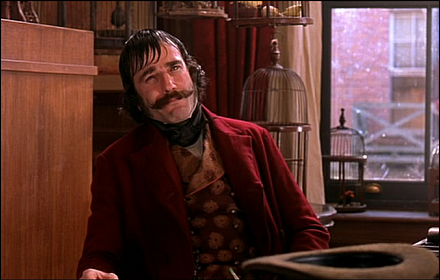
20. Bill the Butcher

Played by: Daniel Day-Lewis
Film(s): Gangs of New York (2002)
Line: ‘Ears and noses will be the trophies of the day. But no hand shall touch him.’
Nothing goes too far for William ‘Bill the Butcher’ Cutting in his personal mission to oppress the new immigrants whom Bill sees as mere cockroaches. His name is very appropriate: whenever he joins the street fights, he slaughters enemies by the dozens using his vast set of knives and stabbing weapons. He shows a softer side around Amsterdam, who he sees as the son he never had, but in the end, Bill is a bad man. Played to perfection by Daniel Day Lewis.
19. Mr. Joshua
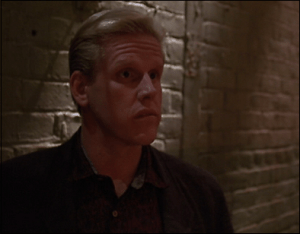
Played by: Gary Busey
Film(s): Lethal Weapon (1987)
Line: ‘See, Martin, we have a problem. Since we have Murtaugh, we don’t really need you. But I believe in being thorough.’
The ultra blond Mr. Joshua is pretty much a badass. He shows his macho behavior in his intro-scene by letting his employer hold a lighter under his arm for a pretty long time. Riggs and Murtaugh have a lot of trouble with this ex-commando. In his mission to smuggle heroin into the United States, he lets nothing or nobody get in his way. He scores extra points for his pretty good fighting skills.
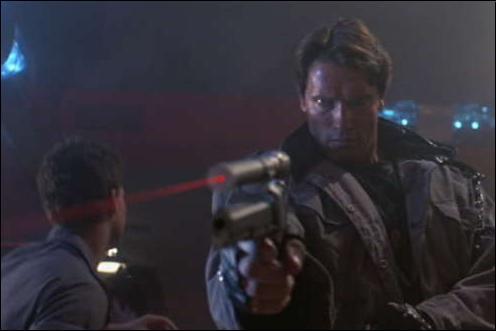
18. The Terminator

Played by: Arnold Schwarzenegger
Film(s): The Terminator (1984)
Line: ‘Your clothes – give them to me, now.’
Schwarzenegger is perfectly cast as a killing machine. The Terminator is one scary motherfucker. ‘Sarah Connor? Yes. Boom!!!’ He is efficient and unstoppable. The perfect invention really. James Cameron (director) and Stan Winston (special effects) have really outdone themselves. The highlight? There are many, but Schwarzenegger barging in the police station killing everybody is pretty damn exciting.
17. Amon Goeth

Played by: Ralph Fiennes
Film(s): Schindler’s List (1993)
Line: ‘Ah, an educated Jew… like Karl Marx himself. Unterscharfuehrer! Shoot her.’
Can a psycho Nazi killer still be charismatic? Leave it to Ralph Fiennes to pull it off. Even though Goeth commits horrible acts and certainly deserves to die for it, he can be touching in a strange and remote way. A truly remarkable bad guy, right up until his ‘Heil Hitler’ sent off.
16. Judge Doom

Played by: Christopher Lloyd
Film(s): Who Framed Roger Rabbit (1988)
Line: ‘Soon, where Toon Town once stood will be a string of gas stations, inexpensive motels, restaurants that serve rapidly prepared food.’
Christopher Lloyd who nailed the ultimately sympathetic ‘Doc’ in Back to the Future, plays a really scary dude here. Judge Doom is one malicious bastard and the type of villain we could use more of: wacky, evil-lookin’ and carrying a dark secret. Brilliant character in a brilliant movie.
15. Anton Chigurh

Played by: Javier Bardem
Film(s): No Country for Old Men (2007)
Line: ‘What’s the most you have ever lost in a coin toss?’
Chigurh is one weird psycho killer for sure. Armed with an oxygen tank and a shotgun he makes life very difficult for the people in the wasteland of the Texas-Nevada borderlands His entrance in No Country for Old Men alone is enough to earn him this position. Add to that his terrible haircut, his deep voice and his seemingly random killing spree and you got an A-grade villain that’s just hard to forget.
14. Freddy Krueger

Played by: Robert Englund
Film(s): A Nightmare on Elm Street series (1984-2003)
Line: ‘I’m your boyfriend now, Nancy.’
The child murdering Freddy literally gives his victims nightmares. Both his burned face and his evil mind tricks can make everybody crap their pants. Freddy is without a doubt the greatest supernatural killer to ever appear on the white screen.
13. Annie Wilkes

Played by: Kathy Bates
Film(s): Misery (1990)
Line: ‘You! You dirty bird! How could you?’
Pour Paul Sheldon. Being captured by his greatest fan is a nightmare beyond imagination. He is constantly walking on eggshells as the slightest provocation will set off Annie Wilkes big time. It’s hard to say what kind of disorder she actually ‘suffers’ from, but there is no doubt that she is completely batshit.
12. Skeletor

Played by: Frank Langella
Film(s): Masters of the Universe (1987)
Line: ‘I am Skeletor.’
Masters of the Universe is no masterpiece, but Frank Langella really elevates the movie with his highly enjoyable appearance. His portrayal of Skeletor, who was already a favorite villain in cartoons, became a most memorable bad guy. His looks are spot on, and he rules his underlings with an iron fist. It’s a total shame that He-Man kicks him into a dark, deep shaft at the end of the movie.
11. Saruman
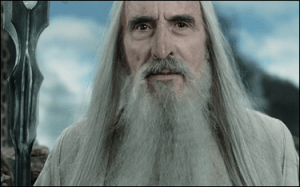
Played by: Christopher Lee
Film(s): The Lord of the Rings Trilogy (2001 / 2002 / 2003)
Line: ‘Hunt them down! Do not stop until they are found. You do not know pain, you do not know fear. You’ll taste men-flesh!’
While Sauron may be the real bad guy in The Lord of the Rings, Saruman makes a far greater impression. His voice is perhaps his greatest asset. The way he utters spells and commands is just the ultimate in evil cool. Christopher Lee, almost 80 when he played this, is remarkable in the role that he was born to play. When it comes to evil old wizards surrounded by Orcs, Saruman is the man.
10. Agent Smith

Played by: Hugo Weaving
Film(s): The Matrix (1999) / The Matrix Reloaded (2003) / The Matrix Revolutions (2003)
Line: ‘I will enjoy watching you die…Mr. Anderson.’
Who ever thought a software application could be this menacing? Smith may be funny with his monotone voice and robotic locomotion, but he can be vicious as well. It’s really hard to relax with this guy around, and he is always around. When you think he’s finally gone, he returns with clone abilities. Smith is an unstoppable force of destruction and can ultimately be only stopped by himself. Now that’s pretty bad.
9. Clarence Boddicker

Played by: Kurtwood Smith
Film(s): RoboCop (1987)
Line: ‘Can you fly Bobby?’
It’s not exactly his looks that make Clarence Boddicker ultra villain material. It is his ruthless and merciless attitude. He first shows his vileness, when he kicks one of his wounded cronies out of a moving truck. Soon after, he displays a real sadistic streak when he brutally murders Murphy. Although he’s a street level boss, he meets personally with Dick Jones, Vice President at OCP (Omni Consumer Products) showing he is also an intelligent and competent gang leader.
8. T-1000

Played by: Robert Patrick
Film(s): Terminator 2: Judgment Day (1991)
Line: ‘Thank you for your cooperation.’
Robert Patrick as the liquid metal T-1000 is an example of perfect casting. This unstoppable and constantly morphing killing machine is pretty scary at times. The fact that he is wearing a police uniform makes this even worse. Rather than ‘protect and serve’, he fanatically chases John Connor around while killing everybody that gets in his way. Glad to have Schwarzenegger around, the only one with a remote chance to stop it. Now that’s pretty telling.
7. Bill

Played by: David Carradine
Film(s): Kill Bill: Vol. 1 (2003) / Kill Bill: Vol. 2 (2004)
Line: ‘Do you find me sadistic?’
Bill is a murderous bastard, but he can be honorable as well. When the Bride arrives to take revenge on Bill for shooting her in the head, he grants her one night with her daughter, who she had presumed to be dead. Make no mistake though, in the duel that follows he would have killed her without mercy if it hadn’t been for her special skills. A classic villain who gets extra points for his great knowledge of martial arts and pop culture.
6. Major Arnold Toht

Played by: Ronald Lacey
Film(s): Raiders of the Lost Ark (1981)
Line: ‘You Americans, you’re all the same. Always overdressing for the wrong occasions.’
The boring communists in The Kingdom of the Crystal Skull showed again what great villains Nazi’s can be. Major Toht is an absolute favorite. A very unpleasant appearance and an equally disturbing voice can make someone cringe. It’s a true relief when his face starts melting towards the end of Raiders of the Lost Ark.
5. Emperor Palpatine

Played by: Ian McDiarmid
Film(s): Star Wars: Episode VI – Return of the Jedi (1983)
Line: ‘Welcome young Skywalker. I’m looking forward to completing your training. In time, you will call me…master!’
While the Ewoks made Return of the Jedi just a little too child friendly, Ian McDiarmid restored the balance with his dark portrayal of the Emperor. Allegedly, serial killer Jeffrey Damner was a huge fan of Palpatine. This figures, because Palpatine is a true incarnation of evil. Every line he utters comes out as pure poison. He is often underestimated because of his fragile old appearance, but make no mistake! When Palpatine starts using his dark side force techniques there is nobody who can stop him. Well there’s always one.
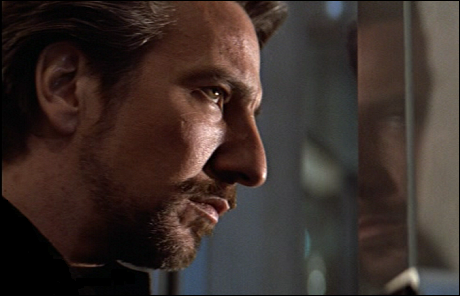
4. Hans Gruber

Played by: Alan Rickman
Film(s): Die Hard (1988)
Line: ‘Nice suit. John Phillips, London. I have two myself. Rumor has it Arafat buys his there.’
Another German villain to make the list. It is just hard to ignore their bad guy potential. Hans Gruber is the perfect baddie against Bruce Willis’ hero John McClane. He is both ruthless and smart, but certainly not without a sense of humor and style. You gotta hand it to this guy. Up till now, the Die Hard creators haven’t yet found a suitable replacement for him as the villains in the four sequels all made far less of an impression.
3. Frank

Played by: Henry Fonda
Film(s): Once Upon a Time in the West (1968)
Line: ‘I could crush you like a wormy apple.’
Not a businessman but ‘just a man’. If that is true, humanity is truly fucked. Look at Frank’s sins: killing a young boy in his first appearance, raping Jill McBain and off course the thing he did to royally piss off Harmonica. Nobody figured the sympathetic Henry Fonda could play a bad guy this well. He proved them dead wrong. Frank is one of the most accomplished villains ever, and Fonda should have won an Oscar for the part.
2. Dr. Hannibal Lecter

Played by: Anthony Hopkins
Film(s): The Silence of the Lambs (1991)
Line: ‘I’m having an old friend for dinner.’
Anthony Hopkins delivers a wicked and Oscar-winning performance as Dr. Hannibal Lecter. Charming, extremely intelligent, psychically strong: Lecter has it all. One of the few baddies in this list who actually survives the films he is in, Lecter stands above the regular laws of good and evil. He just does what he does. His character has been exploited a little too much in modern cinema and literature, but his turn in The Silence of the Lambs remains one of the most chilling and spellbinding performances ever in cinema history.
1. Darth Vader

Played by: David Prowse, James Earl Jones (voice)
Film(s): Star Wars Trilogy (1977 / 1980 / 1883)
Line: ‘If you only knew the power of the dark side.’
Its villains have always been the best thing about Star Wars, but Darth Vader is the baddest motherfucker of them all. It is hard to say which is cooler; his voice (and breathing), his name or his appearance. His introduction in A New Hope alone makes him the best movie villain ever. But he also has a fair share in fighting skills, force power and strategy. Just a fantastic character altogether.