Smokey and the Bandit II

Director: Hal Needham
Written by: Michael Kane, Jerry Belson, Brock Yates
Cast: Burt Reynolds, Jerry Reed, Jackie Gleason, Sally Field

Year / Country: 1980, USA
Running Time: 96 mins.

After the box-office smash hit Smokey and the Bandit, director and stunt expert Hal Needham got a much higher budget to create the next instalment. The result is another silly trucking comedy, once again featuring Burt Reynolds as the cowboyish trucker Bandit and Jackie Gleason as the clownish law enforcer Smokey. Sally Field also returns as Bandit’s love interest Carrie and Jerry Reed is back as his partner Snowman. The only real new addition to the cast is the annoying Dom DeLuise.

The makers didn’t bother to come up with a new plot. Bandit and Snowman have to move a package from Miami to Texas. For this job they get 400.000 dollars. Carrie, like in the first movie, wants to marry Smokey’s son, but leaves the ceremony at the last minute to join Bandit and Snowman on their trip. The package turns out to be an elephant and Smokey once again initiates a major pursuit. When the travelling makes the elephant ill, it places our heroes in an ethical dilemma.

The lack of an original screenplay is compensated with lots of humour (the love/hate type) and impressive stunt work. Needham really shows his craftsmanship as a talented stunt coordinator. We get to see a collapsing rollercoaster, many car stunts and a spectacular police chase towards the end. The density of ‘innocent’ jokes is high, with some better than others. For those who like this sort of thing, Smokey and the Bandit II is a likable film with notable chemistry between the leads. About as cheery as the country songs on the soundtrack.

Rating:

Biography: Hal Needham (1931, Memphis, Tennessee) served in the Korean war before becoming a stuntman. His break came in 1957 with TV western Have Gun – Will Travel as a stunt double for Richard Boone. In the sixties he became a top stuntman working on western hit movies such as The Man Who Shot Liberty Valance, How the West Was Won and Donovan’s Reef. In his long career, Needham also worked on many TV-shows including Gunsmoke, Rawhide and Black Saddle. He was also stunt double for Clint Walker, Burt Reynolds and others. In the seventies he became stunt coordinator on several Burt Reynolds films including White Lightning, The Longest Yard and Gator. He made his debut as a director in 1977 with Smokey and the Bandit. It became a massive hit. Throughout the next two decades he made many follow-ups and similar films usually starring Reynolds. In the nineties, his work consisted mostly of TV projects including four Bandit TV films.

Filmography: Smokey and the Bandit (1977), Hooper (1978), The Villain (1979), Death Car on the Freeway (1979, TV), Stunts Unlimited (1980, TV), Smokey and the Bandit II (1980), The Cannonball Run (1981), The Stockers (1981, TV), The Stockers (1981, TV), Megaforce (1982), Stroker Ace (1983), Cannonball Run II (1984), Rad (1986), Body Slam (1986), B.L. Stryker (1990, TV episode), Bandit: Bandit Goes Country (1994, TV), Bandit: Bandit Bandit (1994, TV), Bandit: Beauty and the Bandit (1994, TV), Bandit: Bandit’s Silver Angel (1994, TV), Street Luge (1996), Hard Time: Hostage Hotel (1999, TV)
 

Smokey and the Bandit

Director: Hal Needham
Written by: James Lee Barrett, Charles Shyer, Alan Mandel
Cast: Burt Reynolds, Sally Field, Jerry Reed, Jackie Gleason

Year / Country: 1977, USA
Running Time: 96 mins.

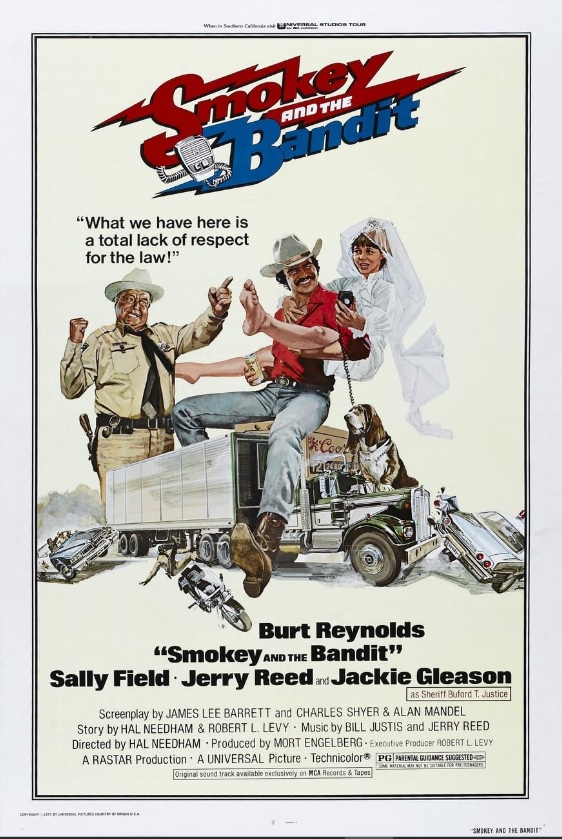
Trucking comedy Smokey and the Bandit was originally conceived as a B-movie, but became more of a mainstream project when Burt Reynolds got involved. Upon release it was a huge box office hit (second highest grossing movie after Star Wars in 1977). Nowadays, the comedy elements are pretty much outdated, but for nostalgic reasons it can still be a guilty pleasure.

The movie’s director, Hal Needham, was a professional stuntman at that time and not a filmmaker. He came up with the story and showed a script draft to Reynolds, for whom he had been a stunt double on various movies such as The Longest Yard and Gator. Reynolds agreed to do it and thereby replaced Jerry Reed who had originally been cast as the Bandit. Reed was cast instead as Bandit’s friend Snowman and would later play Bandit in Smokey and the Bandit Part 3.

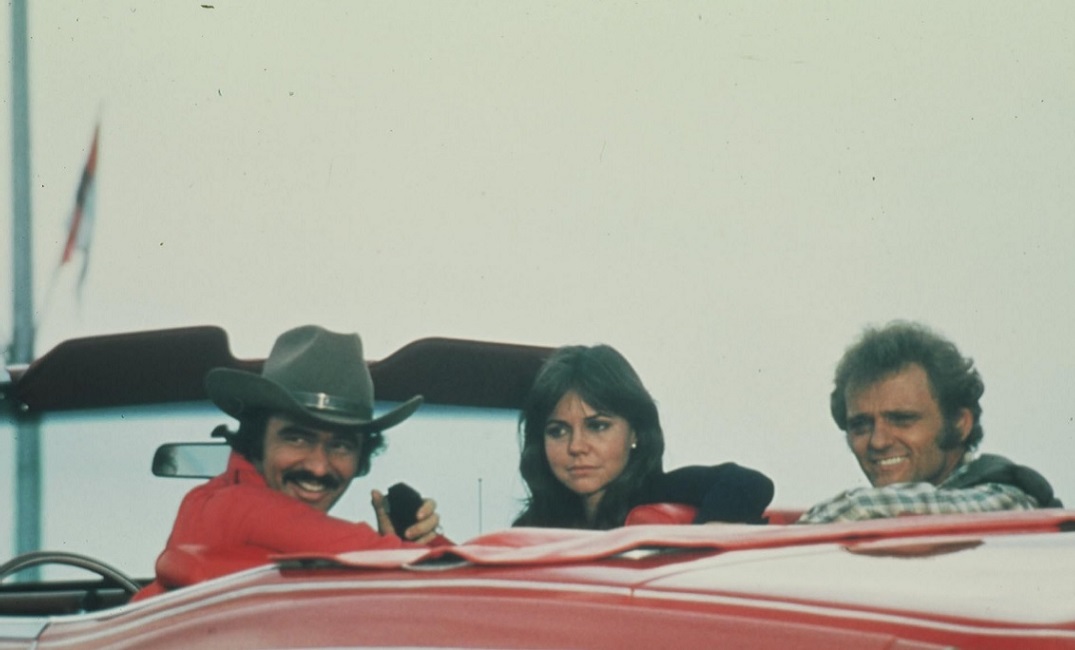
The plot of this movie is anorexic. Bandit is a cowboy truck driver who accepts the job to haul a truckload of Coors beer to a car race in Georgia. This was considered bootlegging at the time and pretty soon, the Bandit is pursued by Sheriff Buford T. Justice aka Smokey (Jackie Gleeson). He also picks up hitchhiker Carrie (Sally Field), a runaway bride from Smokey’s son Junior. A cross-country pursuit begins that doesn’t end until the credits roll.

As a racing film, it is a little disappointing. There are decent stunts surely, but from a professional like Needham I had expected more innovation. Oh well, this is mostly just a pleasant reminder of the good ol’ days. Though it’s unlikely to attract many viewers from a younger generation I would still recommend it to anyone who likes to go through a time machine. The humour of this film has long been reinvented but is still infectious enough to put a smile on one’s face. The cartoonish characters also add to the fun factor.

Rating:

Biography: Hal Needham (1931, Memphis, Tennessee) served in the Korean war before becoming a stuntman. His break came in 1957 with TV western Have Gun – Will Travel as a stunt double for Richard Boone. In the sixties he became a top stuntman working on western hit movies such as The Man Who Shot Liberty Valance, How the West Was Won and Donovan’s Reef. In his long career, Needham also worked on many TV-shows including Gunsmoke, Rawhide and Black Saddle. He was also stunt double for Clint Walker, Burt Reynolds and others. In the seventies he became stunt coordinator on several Burt Reynolds films including White Lightning, The Longest Yard and Gator. He made his debut as a director in 1977 with Smokey and the Bandit. It became a massive hit. Throughout the next two decades he made many follow-ups and similar films usually starring Reynolds. In the nineties, his work consisted mostly of TV projects including four Bandit TV films.

Filmography: Smokey and the Bandit (1977), Hooper (1978), The Villain (1979), Death Car on the Freeway (1979, TV), Stunts Unlimited (1980, TV), Smokey and the Bandit II (1980), The Cannonball Run (1981), The Stockers (1981, TV), The Stockers (1981, TV), Megaforce (1982), Stroker Ace (1983), Cannonball Run II (1984), Rad (1986), Body Slam (1986), B.L. Stryker (1990, TV episode), Bandit: Bandit Goes Country (1994, TV), Bandit: Bandit Bandit (1994, TV), Bandit: Beauty and the Bandit (1994, TV), Bandit: Bandit’s Silver Angel (1994, TV), Street Luge (1996), Hard Time: Hostage Hotel (1999, TV)

Death Proof

Director: Quentin Tarantino
Written by: Quentin Tarantino
Cast: Kurt Russell, Vanessa Ferlito, Rosario Dawson, Sydney Poitier

Year / Country: 2007, USA
Running Time: 114 mins.

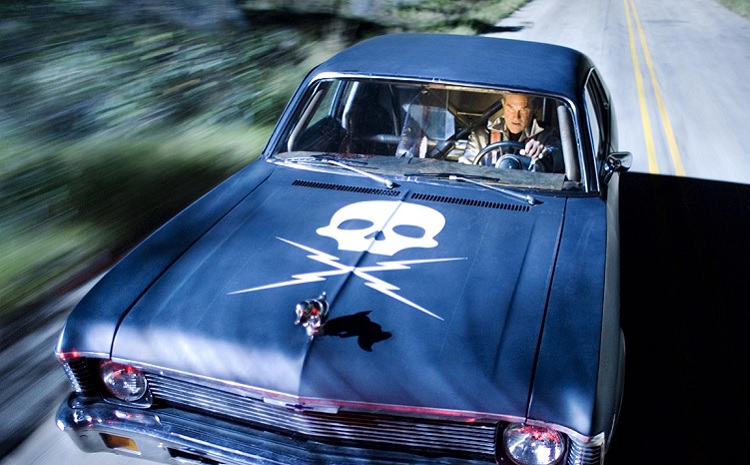
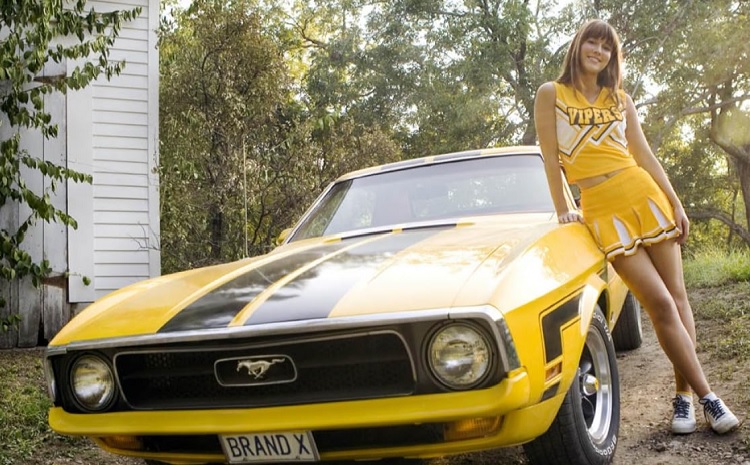
The tone of Death Proof is set right at the beginning. We hear loud engine sounds and follow a pair of feet bungling out the window of a driving car as the credits roll by. Tarantino’s half of Grindhouse is obviously some homage to cheap car chase and serial killer exploitation films. Originally part of a double bill with Robert Rodriquez’s Planet Terror, it was released outside the US as a separate movie to increase box office revenue. Not a great decision from an artistic viewpoint, but Death Proof does work as a stand-alone film.

Kurt Russell plays Stuntman Mike, a weird and burned-out stunt driver who happens to be a psycho as well. He ‘suffers’ from a chick habit: stalking and eventually killing groups of beautiful young girls by crashing his ‘death proof’ car into them. Out of this he gets his sexual kicks. The first time, his plan works fine, but the second time around he should have done a little more research on his targets. This group of girls consist of fellow stunt drivers who get quite homicidal when Mike tries to pull his crap.

Tarantino uses various techniques, such as a damaged print and deliberate continuity mistakes to make Death Proof appear as a typical film that would have been shown in grindhouse theaters in the seventies. He has also included his typical trademark movie references, this time to genre classics such as Vanishing Point. In order to make it match with Planet Terror, the film also shares some characters with that film, such as Dr. Block and of course Texas ranger Earl McGraw.

One problem I have with Death Proof is that the dialogues, that normally seem effortless in a Tarantino film, come across here as sort of synthetic. This is probably done deliberately to fit the film’s campy B-style, but it is still distracting and it takes up a large part of the movie. Luckily this is made up with an interesting structure, a groovy soundtrack and a great old-school car chase scene at the end. Kurt Russell is also awesome as the movie’s central character. Stuntman Mike is a serial killer who belongs in the gallery of great Tarantino characters.

This may not be a masterpiece but it works very well as the type of experience it attempts to simulate. It is also a better balanced movie than Planet Terror. Sometimes it is a little ‘too Tarantino’ if there is such a thing, most noticeable by the casting of ‘super cool’ chicks and the overly hip dialogues. But Death Proof is nevertheless a film that has plenty of excitement and genuine coolness to offer.

Rating:

Biography: Quentin Tarantino (1963, Knoxville, Tennessee) made a big impression on the international film world when his feature debut Reservoir Dogs premiered at Sundance in 1992. After his second film Pulp Fiction screened at Cannes in 1994 and won the Palme D’or, Tarantino quickly became a household name. Since then he has enjoyed his fame by making more homages to the films he loves and grew up with.

Filmography (a selection): My Best Friend’s Birthday (1987), Reservoir Dogs (1992), Pulp Fiction (1994), Four Rooms (1995, segment ‘The Man From Hollywood’), Jackie Brown (1997), Kill Bill: Vol. 1 (2003), Kill Bill: Vol. 2 (2004), Sin City (2005, special guest director), CSI (2005, TV episodes), Grindhouse (2007, segment ‘Death Proof’), Inglourious Basterds (2009), Django Unchained (2012), The Hateful Eight (2015), Once Upon a Time… in Hollywood (2019)

Cannonball!

Director: Paul Bartel
Written by: Paul Bartel, Don Simpson
Cast: David Carradine, Bill McKinney, Veronica Hamel, Gerrit Graham

Year / Country: 1976, USA
Running Time: 94 mins.

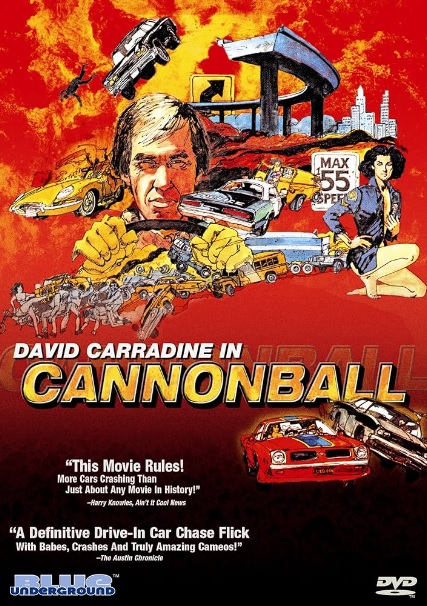
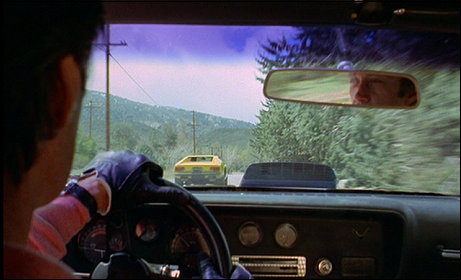
Your liking of Cannonball! aka Carquake will mainly depend on how you generally appreciate B-movies about car-racing. I personally like them a lot. Cool-ass heroes in slick cars; pretty girls; highway chase scenes; crashes; mayhem: the works. This movie is based on real illegal cross-continental road races that took place around the time this movie was made.

The seventies was a fruitful era for this type of film. In 1976, the year this movie came out, The Gumball Rally, was also released about the same topic. A year earlier, its director Paul Bartel had considerable B-movie success with the very similar film Death Race 2000 which also had David Carradine in the lead role and covered a road race through America. This is not exactly a sequel though. It’s no sci-fi for one thing and unlike Death Race 2000, it has not been produced by Roger Corman, but by Run Run Shaw (one of the Shaw Brothers). Corman does have a small cameo. So do Martin Scorsese, Joe Dante and Sylvester Stallone. The movie was written by Bartel and Don Simpson. That’s right, the now deceased Don Simpson who formed a team with Jerry Bruckheimer and made one Hollywood smash hit after another. This is the first film on his resume.

David Carradine plays Coy ‘Cannonball’ Buckman, a former convict who participates in the Trans-America Grand Prix, an illegal annual race from L.A. to New York City. The prize money for winning is 100.000 dollars, so most of the participants play any dirty trick in the book to rid themselves of the competition. The police also finds out about the race and plans to arrest all the participants. Buckman has to overcome many obstacles to reach the finish line, such as car damage, malicious competitors and hand-to-hand combat. The latter of course is no problem for David ‘Kung Fu’ Carradine, but the driving proves to be a bigger challenge. Buckman is no Frankenstein (Carradine’s character in Death Race 2000), who had a mechanical hand to shift his gears faster and who was designed to win. Buckman is not that mythological. At least it looks that way initially…

Director Bartel usually offers more satire in his films, but Cannonball! doesn’t seem to have any pretensions except to offer simple entertainment. The campy fun consists mostly of the drivers competing with each other through racing moves and fist fights. Unfortunately the lack of real excitement makes it look like a cheap cash-in on its predecessors.

Because besides its subversive character, Death Race 2000 had intriguing characters and many outrageous action scenes and dialogues. It appeared to have been made with great enthusiasm and care to provide the audience with as much entertainment as possible. And it worked. Cannonball! doesn’t really try to excel in anything. Not in the acting, the writing or the directing.

Even Carradine, an actor I normally love (to me he is the ultimate B-movie star) seems a bit out of his depth here. Some good stunts and a final scene of appropriate demolition save this from being a complete failure, but there is little to recommend it for. A shame really because all those involved did a lot of good work elsewhere. Oh well, if you’re up for a no-brainer, this flick may suit you well. Otherwise Death Race 2000 is the far better alternative.

Rating:

Biography: Paul Bartel (1938, New York – 2000, New York) majored in theater arts at UCLA and studied film directing in Rome. After getting his first work experience with Roger Corman he directed a number of low budget cult films. He also worked as a writer and an actor. He died in 2000 from a heart attack.

Filmography: The Secret Cinema (1968, short), Naughty Nurse (1969, short), Private Parts (1972), Death Race 2000 (1975), Cannonball! (1976), Eating Raoul (1982), Not for Publication (1984), Lust in the Dust (1985), The Longshot (1986), Amazing Stories (1986/87, TV episodes), Shelf Life (1993), The Comic Strip Presents…(1993, TV episode), Clueless (1996, TV episode)