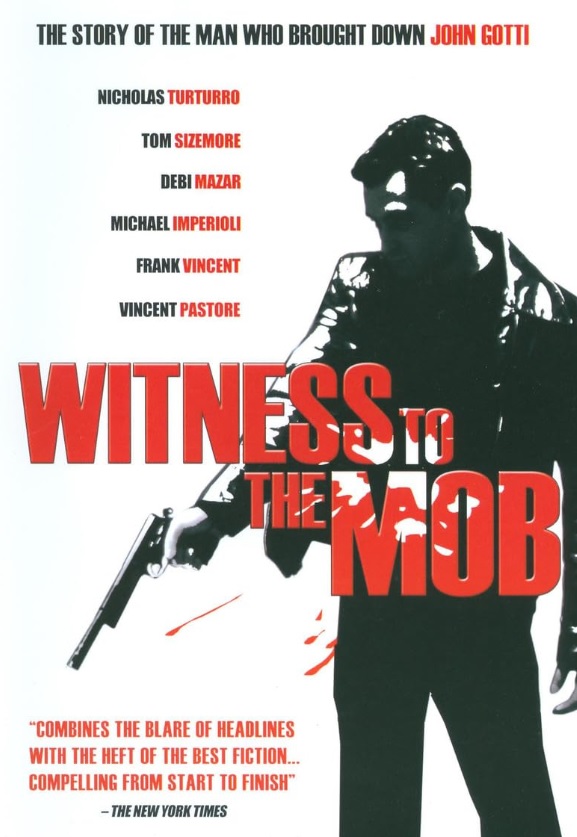
Witness to the Mob (1998)

Directed by:
Thaddeus O’Sullivan

Written by:
Stanley Weiser

Cast:
Nicholas Turturro (Sammy ‘The Bull’ Gravano), Tom Sizemore (John Gotti), Debi Mazar (Deborah Gravano), Michael Imperioli (Louie Milito), Abe Vigoda (Paul Castellano), Frankie Valli (Frank LoCascio), Katherine Narducci (Linda Milito), Arthur J. Nascarella (Bruce Mouw), Frank Vincent (Frankie DeCicco), Vincent Pastore (Mikey De Bat)
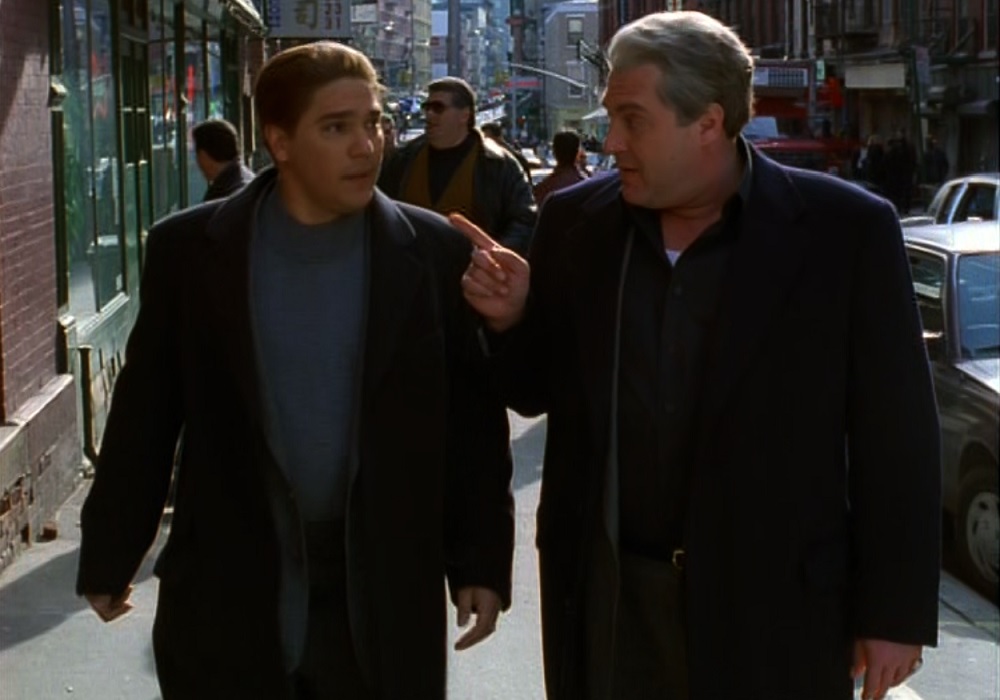
Sammy ‘The Bull’ Gravano is remembered as one of the most notorious informants in mob history. He betrayed the Dapper Don, John Gotti – whom he believed had first betrayed him. Before making that fateful decision, the story flashes back nineteen years to his childhood in Brooklyn. There, he and his best pal Louie (Michael Imperioli) begin their careers in organized crime as part of the powerful Gambino family.

Gravano rises quickly through the ranks. His willingness to follow orders to the letter – and to kill without hesitation – earns him the respect of higher-ups. Before long, he’s made an official member by boss Paul Castellano himself.

Around the same time, John Gotti (Tom Sizemore) is on the rise as well. When Castellano begins to break the mob’s code of honor, Gravano and Gotti conspire to take him out and seize control. Gotti becomes boss, while Gravano becomes his second-in-command. But Gotti’s flashy lifestyle draws unwanted attention from the press, the public, and the FBI – setting the stage for a conflict that will bring everything crashing down.

This made-for-TV film was released just two years after HBO’s Gotti. Both screenplays are based on the real Gravano–Gotti saga, and the similarities are striking – not only in story but also in style. Several familiar faces from The Sopranos and Goodfellas (Tony Sirico, Frank Vincent, Vincent Pastore) appear in both films. The key difference is perspective: Witness to the Mob is told through Gravano’s eyes, while Gotti presents Gotti’s side of the story.

Still, there’s something about Witness to the Mob that doesn’t quite ring true. Despite the strong ensemble, the interactions don’t always feel believable. Nicholas Turturro (brother of John) lacks the presence and charisma needed to carry Gravano’s role, and most of the actors have delivered stronger mob performances elsewhere. That said, fans of mob movie clichés – the talk, the mannerisms, the hits – may still enjoy Witness to the Mob. It has plenty of all that, even if it never quite rises above the familiar.

Rating:

Quote:
JOHN GOTTI: “So the boss of bosses is dead?”
SAMMY GRAVANO: “He lived a long life. His maid is gonna miss him.”
JOHN GOTTI: “His wife won’t.”

Trivia:
Arthur J. Nascarella plays FBI special agent Bruce Mouw, who is in charge of breaking up the Gambino family. In The Sopranos, his character Carlo Gervasi eventually betrays mob boss Tony Soprano.

Gotti (1996)

Directed by:
Robert Harmon

Written by:
Jerry Capeci (book ‘The Last Gangster: Winning the War Against John Gotti and the Mob’)
Gene Mustain (book ‘The Last Gangster: Winning the War Against John Gotti and the Mob’)
Steve Shagan (teleplay)

Cast:
Armand Assante (John Gotti), William Forsythe (Sammy Gravano), Richard C. Sarafian (Paul Castellano), Frank Vincent (Robert DiBernardo), Anthony Quinn (Neil Dellacrose), Dominic Chianese (Joe Armone), Robert Miranda (Frank DeCicco), Scott Cohen (Gene Gotti), Vincent Pastore (Angelo Ruggiero), Tony Sirico (Joe Dimiglia)

John Gotti seemed destined for the Mafia. He was smart, tough, loyal to the code of omertà, never skimmed from the top, and respected the boss’s policy on narcotics. These qualities helped him rise to become boss of the infamous Gambino family in the 1980s. But Gotti also had his flaws: he craved media attention and was too careless about discussing sensitive business in unsecured settings.

Gotti is the biography of one of history’s best-known mobsters. The story begins in 1973, when Gotti first comes to the attention of his crime family, the Gambinos – then the most powerful of New York’s Five Families. Boss of bosses Carlo Gambino asks Gotti for a personal favor, which nearly goes wrong due to the interference from underboss Paul Castellano. The conflict almost dooms Gotti, but his mentor, second underboss Neil Dellacroce (Anthony Quinn), steps in to resolve it.

In the years that follow, Gotti steadily rises through the ranks alongside his close associate and fellow captain Sammy Gravano. When Gambino dies of old age in 1976, he names Castellano as his successor, to the disapproval of Gotti and other top figures. While Gotti was seen as a true man of Cosa Nostra, Castellano was regarded more as a businessman. Tensions eventually culminate in one of the most infamous gangland hits in history: the 1985 assassination of Castellano and his partner outside Sparks Steak House in Manhattan.

Now John Gotti is the boss. But, as noted earlier, his weaknesses ensured that his reign would be relatively short-lived (until 1992 to be precise). As a biographical made-for-tv HBO production, Gotti stands out for offering a complete look at the life and times of a legendary mobster. Armand Assante is memorable in the lead. The supporting cast – featuring many future Sopranos actors – is also strong, with Anthony Quinn and William Forsythe delivering standout performances. If you watch only one television production about the mob, make it Gotti .

Rating:

Quote:
JOHN GOTTI: “A Mexican, a Puerto-Rican and a black guy are sitting in a car. Who’s driving? The police.”

Trivia:
According to IMDb, this film was the highest rated original telefilm in HBO history at that time. The success of the film convinced HBO to cast film co-stars, Dominic Chianese, Vincent Pastore and Tony Sirico in a series in development at the time called The Sopranos (1999).

De maffiaboeken van Nicholas Pileggi – Deel 1

Door Jeppe Kleijngeld

Wiseguy: Life in a Mafia Family

Op 12 juni 2012 overleed voormalig gangster Henry Hill aan hartcomplicaties. Hij was 69 jaar oud. Hill was de centrale figuur in het boek ‘Wiseguy: Life in a Mafia Family’ van Nicholas Pileggi dat in 1990 verfilmd werd als ‘GoodFellas’ door Martin Scorsese. Mijn favoriete film aller tijden!!! ‘As far back as I could remember, I always wanted to be a gangster.’

Het boek ‘Wiseguy’ voegt zeker het nodige toe aan de film, namelijk meer inzichten in hoe het is om deel uit te maken van een maffia familie halverwege de jaren 50 tot en met de jaren 80. Het doel van Pileggi was om de maffia te laten zien van binnenuit en door de ogen van de werkende maffioos en niet iemand die deel uitmaakt van de top. Hill is hiervoor perfect. Hij heeft van alles meegemaakt, had toegang tot alle niveaus van de onderwereld en kan zich alles levendig herinneren.

Henry Hill werd op jonge leeftijd opgenomen in de maffiagroep van Paul Vario, een rijzende ster in één van de vijf families van New York: de Lucchese familie (de andere zijn: Gambino, Genovese, Bonanno en Colombo). Het was de jaren 50’ en het waren gouden tijden voor de maffia in New York. Ze zaten nog niet zo onder de radar van de FBI en ze profiteerden van de rijzende economie.

Hill wist zijn weg op een organische manier te vinden in de familie en hij maakte veel vrienden en contacten, waaronder de levensgevaarlijke beroepscrimineel Jimmy Burke (Jimmy Conway in ‘GoodFellas’, gespeeld door Robert De Niro). ‘Jimmy was knettergek en levensgevaarlijk’, aldus Hill. ‘Hij kon met je lachen tijdens het eten en je overhoop schieten tijdens het toetje.’ Jimmy was eng, zelfs in dat gewelddadige wereldje. Maar hij was ook slim en bracht veel geld in het laatje voor Paul Vario. Daarom werd zijn gekheid getolereerd. Henry maakt ook kennis met Tommy DeSimone, een heetgebakerde gangster die zich wilde bewijzen omdat zijn broer Anthony politie-informant was geworden en daarvoor vermoord zou zijn door een andere familie. In GoodFellas speelt Tommy (meesterlijk vertolkt door Joe Pesci) een grotere rol. Maar de moorden die hij in de film pleegt zitten wel allemaal in het boek. Hill beschrijft hem als complete psychopaat.

Het beeld van de maffia is vaak een wereld van glamour: geld, macht, de duurste auto’s, Hollywood sterren en vijfsterren diners. Maar in werkelijkheid is de maffia niet zo glamoureus, blijkt uit ‘Wiseguy’. Een voorbeeld geeft Henry Hill over zijn baas Paul Vario. Paulie ging altijd met zijn vrouw uit eten en dan betaalde hij met gestolen creditcards. Waarom zou de kapitein van de Lucchese misdaadfamilie zo’n groot risico nemen? ‘Omdat dat het aspect van zijn avond was, waar hij het meeste van genoot’, vertelt Hill. ‘Hij vond niet het eten het leukste aspect, terwijl hij gek was op eten. Ook van het gezelschap van zijn vrouw genoot hij niet het meeste, terwijl hij echt heel veel van haar hield. Waar hij het meeste van genoot was het idee dat hij iemand aan het beroven was en ermee weg kwam. Een echte wiseguy begrijpt dat.’

Dat is de maffia: ze houden zich over het algemeen bezig met kleine straatzwendels: inbraken, vrachtwagens stelen, overvallen plegen, illegale sigaretten en drank verkopen. Dat zijn de maffia-activiteiten in de wereld van echte wiseguys. En het geld dat ze verdienen geven ze direct weer uit aan onzin: eten, gokken, grote fooien, etc. Ze zijn net zo snel weer blut als ze tijdelijk rijk zijn.

De Paul Vario-groep stond lange tijd bekend als gewelddadigste bende van de stad. En het is door geweld dat maffiosi zich onderscheiden. Ze zijn niet bijzonder slim, snel, knap of talentvol, maar ze zijn bereid om geweld te gebruiken; ze genieten er zelfs van. Als een maffia figuur je met geweld bedreigt betaal je hem, want hij doet het. Hij zal niet twijfelen je arm te breken, je uit een raam te gooien of een pistool in je mond te steken en naar je ogen te kijken als hij de trekker overhaalt. Dat is uiteindelijk waar de maffia op is gebaseerd: angst door de dreiging van geweld. Maar daarin zit ook hun zwakte; ze gebruiken het geweld namelijk ook te snel onder elkaar. ‘Wiseguy’ is een verhaal met weinig overlevenden.

Een prachtig voorbeeld van hoe het fout kan gaan in de volatiele maffiawereld is de waargebeurde Lufthansa overval die een grote rol speelt in het boek. Het is de grootste overval ooit; 6 miljoen dollar maakten ze buit, maar het grote succes was ook het grootste probleem. Jimmy Burke stond aan het hoofd van de circa 10 man die de overval beraamde en uitvoerde. Nu moet hij dus al zijn handlangers bedragen tot wel 500.000 per persoon uitbetalen. Voor hem is het dan meteen de keuze; geef ik hem een half miljoen of krijgt hij een kogel in zijn nek? Voor Jimmy is dat eigenlijk geen keuze. In de nasleep van Lufthansa werden 10 mensen vermoord.

Uiteindelijk werd Hill gepakt voor cocaïne en dreigde hij voor 25 jaar de bak in te gaan. Doordat hij zo kwetsbaar was, werd hij een doelwit voor de maffia, maar door in het getuigen beschermingsprogramma te gaan wist hij met een nieuwe identiteit een nieuw leven op te bouwen, terwijl zijn oude vrienden de bak in draaide.

‘Wiseguy’ is verreweg het beste boek ooit geschreven over de wereld van de georganiseerde misdaad en biedt een niet te versmaden blik in deze smerige wereld. Een enorme aanrader voor liefhebbers van het misdaadgenre. Deze non-fictie is opwindender dan de meeste fictie ooit zal worden.

The Valachi Papers (1972)


‘The Valachi Papers. Fact not Fiction’

Directed by:
Terence Young

Written by:
Peter Maas (book ‘Le Dossier Valachi’)
Dino Maiuri (screenplay)
Massimo De Rita (screenplay)

Cast:
Charles Bronson (Joe Valachi), Lino Ventura (Vito Genovese), Jill Ireland (Maria Reina Valachi), Walter Chiari (Gap), Joseph Wiseman (Salvatore Maranzano),
Gerald O’Loughlin (Ryan), Amedeo Nazzari (Gaetano Reina), Fausto Tozzi (Albert Anastasia), Pupella Maggio (Letizia Reina), Angelo Infanti (Lucky Luciano)

Joe Valachi is not a name that is spoken of with much respect in mob circles. He was the first Mafia rat and gave up the entire hierarchical structure of the Mafia to a crime committee. He revealed the five families of New York – Gambino, Lucchese, Colombo, Bonanno and Genovese – that were named after the ruling bosses at that time. This film tells Valachi’s life story. At the height of the Castellammarese war (1929 – 1931), the bold, small time crook Joseph ‘Joe Cargo’ Valachi joins the side of Don Salvatore Maranzano, an old Mustache Pete who is fighting a bloody war with his rival Joseph ‘Joe the Boss’ Masseria.

After the deaths of the two old Don’s, Valachi’s crime family evolves. First Lucky Luciano becomes boss, and after his imprisonment Vito Genovese takes over. In a Mafia-career spanning over 30 years, Valachi is involved with New York’s most legendary Mafia figures. He steals, frauds and murders for them, until finally the FBI manages to turn Genovese against Valachi in order for him to testify. He does so, and gives up his former associates along with all other major Cosa Nostra figures he knows of.

He becomes the first mob informer who makes sure that the existence of ‘La Cosa Nostra’ is no longer a secret for the public. Based on the novel by Peter Maas, The Valachi Papers was produced by Dino De Laurentiis in Italy with many scenes dubbed in English. It was directed by Terence Young, most well-known for directing the first official Bond movies. It came out in the same year as The Godfather, and helped to popularize the Mafia as a source of entertainment.

The Valachi Papers sticks to the steady pattern of the mob film; tough guys, half Italian dialogue, shoot-outs and violence (especially a castration scene is very brutal). Also the ‘rise and fall’ type of build-up has been done countless times. This is not the head of its class though. The beginning promises a rapid-pace movie, but after about 40 minutes, all the suspense has been drained from the script. Since the characters are not that fascinating to begin with, this becomes quite a doll viewing in the second half.

Rating:

Quote:
JOE VALACHI: “Senator, I am not talking about Italians. I am talking about the Mafia.”

Trivia:
In the final credits, it is stated that Joe Valachi outlived Vito Genovese by six months. It was actually two years.