Written by:
Jean-Pierre Melville
Georges Pellegrin
Cast:
Alain Delon … Jef Costello
Francois Périer … Superintendent
Nathalie Delon … Jane Lagrange
Cathy Rosier … Valérie, The Pianist
Jacques Leroy … Man in the passageway
Michel Boisrond … Wiener
Robert Favart … Bartender
Jean-Pierre Posier … Olivier Rey
Catherine Jourdan … Hatcheck Girl
Roger Fradet … First Inspector
‘There is no greater solitude than that of the samurai. Unless it is that of the tiger in the jungle. Perhaps…’
– BUSHIDO (Book of the Samuraï)
As the above quote that opens Le samouraï indicates, this film revolves around a loner. Hired killer Jef Costello (Alain Delon) lives in a greyish apartment with a bird as his only company. As soon as he gets up from his sofa, he engages in a dangerous mission: a contract murder in a crowded nightclub. Many patrons spot him in his conspicuous outfit: a raincoat, a hat and white gloves, much like how the gangsters in old Hollywood movies dressed.
After the murder, the police start to round up the usual suspects including Costello. He turns out to be a professional however; the beautiful Jane provides him with a watertight alibi. There is something strange at work though. The nightclub’s pianist, who clearly had a good look at Jef, lies to the police and says it wasn’t him. The cops are forced to release him, but the superintendent doesn’t trust it and has him tailed. In the meantime, we meet Jef’s employers who are unhappy with the many eyeball witnesses and plan to have him removed.
Le samouraï is a very minimalist film with also a sense of avant garde in it. It reminds a lot of John Boorman’s Point Blank that was released in the same year. The story is deceivingly simple, but leaves much room for various interpretations. Rather than on storytelling, director Melville focuses on style and he does so in a brilliant fashion. This movie is just perfectly crafted. Every image, many just showing uber-cool protagonist Jef roaming around in Paris, is shot amazingly and serves a purpose as well. The colour pallet consists of solely cold colours.
Although inspired by American gangster flicks, Le samouraï is still very distinguishable due to Melville’s master’s touch. In turn, it has inspired many modern gangster authors including John Woo and Quentin Tarantino. The films from Woo – most notably A Better Tomorrow and The Killer – feature scenes almost literally lifted from Le samouraï.
The first viewing is a bit awkward because of the cold, distant tone. But multiple viewings are bound to reveal a lot of hidden substance in the multi-layered screenplay. Both critically and commercially this is considered as one of Melville’s greatest successes.
Quote:
OLIVER REY: ‘A wounded wolf. He’ll leave a trace now. No, we have to get rid of him and quick.’
20 years ago the pilot of The Sopranos aired: the beginning of a total classic and still my all time favorite tv show. It was followed by many greats, such as The Wire, Mad Men, Breaking Bad, Game of Thrones and Westworld. What was that first episode about that started it all? Looking back at the beginning of a golden era of television.
Episode 1: Pilot
Directed by: David Chase
Written by: David Chase
Regular Cast
James Gandolfini … Tony Soprano
Lorraine Bracco … Dr. Jennifer Melfi
Edie Falco … Carmela soprano
Michael Imperioli … Christopher Moltisanti
Dominic Chianese … Corrado ‘Junior’ Soprano
Vincent Pastore … Salvatore ‘Big Pussy’ Bonpensiero
Steven Van Zandt … Silvio Dante
Tony Sirico … Paulie ‘Walnuts’ Gualtieri
Robert Iler … Anthony ‘A.J.’ Soprano
Jamie-Lynn Sigler … Meadow Soprano
Nancy Marchand … Livia Soprano
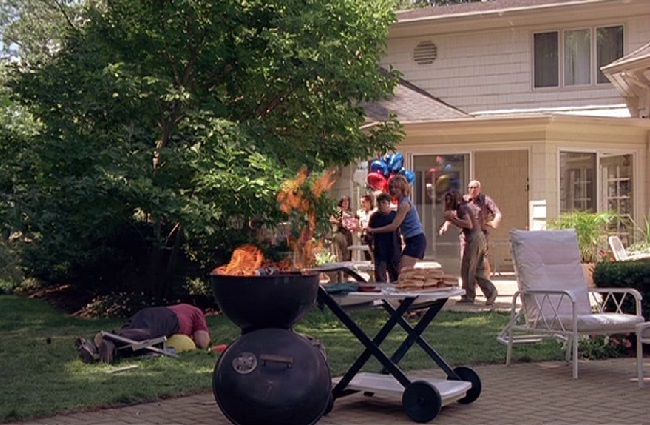
This is it. The first installment of a milestone in television history. Tony Soprano, family man and captain for the New Jersey Mafia, sits in the waiting room for his first therapy session with Dr. Jennifer Melfi. The session is a result of an anxiety-attack Tony had at his son’s A.J.’s birthday party.
Off course because of being a made man and all, it is only natural that Tony is at first reluctant to talk to Dr. Melfi. Tony feels that the whole world is seeing a shrink and he wonders what happened to the strong, silent type, like Gary Cooper. “He wasn’t in touch with his feelings. He just did what had to be done”, Tony tells the slightly intrigued Dr. Melfi.
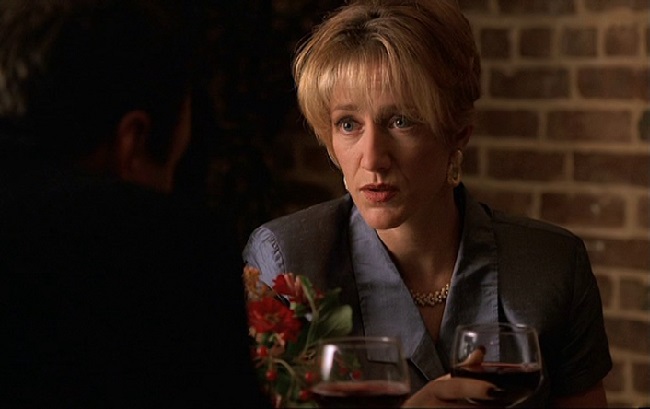
After a while Tony starts to talk. About a family of ducks no less. These ducks landed in Tony’s swimming pool a couple of months earlier and seem to be influencing his moods. Then, Tony starts to talk about his own family. His uncle Junior, also a Jersey Mob captain who in Tony’s words adds to his general stress level. His nephew Christopher, a kid who just bought a 60.000 dollar Lexus and who’s “learning the business”. His wife Carmela, jealous at Tony’s goomars (girlfriends) and having problems getting along with their daughter Meadow.
At work Tony also faces problems. His uncle Junior is planning to whack Little Pussy Malanga (often confused with Tony’s associate Sal ‘Big Pussy’ Bonpensiero). The hit is to take place in a restaurant owned by Tony’s old neighborhood buddy Artie Bucco. Tony wants the hit to take place somewhere else or Artie will lose business. So he sends his associate Silvio Dante to go and blow the place up. And Artie can collect the insurance money. In the meantime there are problems in Tony’s waste management business. The Czechoslovakian Emil Kolar is moving in on one of Tony’s garbage stops so he has to be dealt with. The ambitious Christopher is more than willing to whack Emil in the hope that Tony can open up the books, and Christopher can finally become a made guy.
Could these problems be the reasons for Tony’s attacks or is there more to it than just stress? What for example has been the role of Tony’s borderline mother Livia? This will prove a challenge for Dr. Melfi to find out if she and Tony decide to continue the treatment. One resolution is made already however. When Tony’s ducks fly away his depression kicks in and he is put on Prozac. He also dreams that one of the ducks takes off with his penis which indicates his fear for losing his family (and the beginning of a period of impotence).
This introduction in the Soprano world is absolutely terrific. We are thrown into this entrancing, twisted, funny, mysterious and often violent world where ‘good guys’ are virtually non-existent. Even most woman in the series are often portrait as materialistic and hypocrite. There are many things to phrase this first pilot episode for, the magnificent cast, the casual and sometimes off-putting violence, the humor, the brilliant dialogues, the inspired soundtrack, the beautiful realism of Tony’s therapy sessions, the fantastic film references and the mystery by which it totally engages it’s audience. This first episode creates a thousand promises to come.
Gangster movie references in episode 1
Reference to The Godfather
(Dialogue)
CHRISTOPHER: Louis Brasi sleeps with the fishes.
BIG PUSSY: Luca! Luca Brasi
CHRISTOPHER: Whatever…
BIG PUSSY: There’s differences Christopher. From the Luca Brasi situation and this.
Reference to The Godfather Trilogy and GoodFellas
(Dialogue)
FATHER PHIL: Darn, these laser discs are incredible!
CARMELA: Tony watches Godfather II all the time. He says the camerawork looks just as good as in the movie theatre.
FATHER PHIL: Gordon Willis. Tony prefers II not I?
CARMELA: Yeah, he likes the part where Vito goes back to Sicily. With III he was like ‘What happened’?
FATHER PHIL: Where does Tony rank GoodFellas?
(Someone knocks on door)
Reference to GoodFellas
(Dialogue)
CHRISTPHER: You know my cousin Gregory’s girlfriend is what they call a development girl out in Hollywood, right? She said I could sell my life story. Make fucking millions. I didn’t do that. I stuck it out with you.
TONY(Grabs him): I’ll fucking kill you. What are you gonna do go Henry Hill* on me now?
* Henry Hill is a famous wiseguy who joined the Witness Protection Programme and gave up many of his former associates. His life story is told in the novel Wiseguy by Nicolas Pileggi on which the movie GoodFellas is based.
Dialogues in episode 1
TONY: A couple month before, these two ducks landed in my pool. It was amazing. They’re from Canada or some place and it was mating season. They had some ducklings.
LIVIA: And don’t start with the nursing home business again.
TONY: It’s not a nursing home! How many times have I got to say this. It’s a retirement community!
TONY: Hey all I’m saying is no marriage is perfect.
CARMELA: Well having that goomar on the side helps.
TONY: I told you I’m not seeing her anymore. How do you think I feel with having that priest around all the time?
CARMELA: Don’t even go there alright. Father is a spiritual mentor. He’s making me a better Catholic!
TONY: Yeah well we all got different needs.
CARMELA: What’s different between you and me is you’re going to hell when you die!
HESH: So ehh…I hear that junior wants to whack Pussy Bompensiero?
TONY: Pussy Malanga.
HESH: Oh Little Pussy.
TONY: Yeah Little Pussy. What? You think he’s gonna fuck with Big Pussy? My Pussy?
10 June 2007, 10 years ago today, the legendary finale of the legendary HBO-show ‘The Sopranos’ was aired. It became perhaps the most discussed moment in television-history…
I remember the day after when everybody was confused as hell about it (or just pissed off). Creator David Chase said he hadn’t intended to be coy, he just wanted to entertain his audience. That may be so, but what was the audience to make of the ambiguous ending in which protagonist Tony Soprano – after having his arch enemy Phil Leotardo killed – visits an American diner with his family to have onion rings? A suspicious looking man sits at the bar and goes to the bathroom later. And Tony tells his wife Carmella that one of his crew members, Carlo, will testify against him. That’s basically it. Then the screen suddenly goes black while on the jukebox, the song ‘Don’t Stop Believing’ by Journey is still playing. At ‘don’t stop’, it stops.
For those who need a reminder, it’s right here:
One theory that quickly appeared was that the suspicious man shot Tony when exiting the bathroom and that the moment this happened, the camera switched to Tony’s point of view, indicating his death with the black screen. Others claimed that the ‘hints’ for Tony’s suggested death didn’t mean anything, and that the show ‘just ended’.
These two opinions lead to furious debate on the International Movie Database that went on for nearly ten years, until IMDb shut down the message board early 2017.
In this article I will explain what really happened, what David Chase meant (and didn’t mean), and how we are to interpret certain clues. But in advance: both of the theories stated above are wrong. Chase has said so himself. Obviously there were clues for Tony’s death – it’s ridiculous and insulting to Chase to state the show simply ended. But he didn’t intend for the viewer to interpret these clues as Tony’s definitive death either… Here’s why…
‘There are only two endings for a high profile guy like me, dead or in the can, big percent of the time.’
– Tony Soprano in ‘For All Debts Public and Private’ (SE4, EP1)
In retrospect, this quote already told us how the show would end. Except it wasn’t one or the other. Rather, Tony Soprano got both. The New Jersey mob boss ended up like physicist Schrödinger’s cat, both dead and alive at the same time.
Why did he get both endings? Well, there are certainly clues that a hitman is after Tony in the final scene. I won’t go into great detail about this, but the most important clues are several instances of foreshadowing during the final season, most notably his brother-in-law Bobby Bacala telling Tony: ‘you probably don’t even hear it when it happens’ and New York mobster Gerry Torciano being murdered in a restaurant and Silvio not realizing it till blood splattered in his face. The way the final scene is shot – moving in and out Tony’s point of view – could mean a bullet entered his brain the moment the screen goes black.
But murder is certainly not the only option, as there is also the threat of indictment. as one of Tony’s associates, Carlo, has flipped and is about to spill his guts to the FBI. That means that besides the option of Tony getting whacked, he could be indicted. I refer once again to the quote above.
Dead or in the can… Wasn’t it Carmela who – earlier during the final season – feared these two options like a piano hanging over their heads? It was also Carmela who asked Tony in the episode ‘Sopranos Home Movies’ (during the opening scène of the final season, that should not be overlooked): ‘Is this it?’, referring to the FBI ringing the doorbell.
David Chase has said about the ending: ‘There was nothing definite about what happened, but there was a clean trend on view – a definite sense of what Tony and Carmela’s future looks like. Whether it happened that night or some other night doesn’t really matter.’
It is interesting that Chase uses the word ‘it’. This could refer to Tony’s death, but it might as well be referring to Tony’s arrest. Both options would have a significant impact on Tony and Carmela’s (lack of) future. That is the explanation for the ending right there. There is a sense of impending doom, but by the time the screen goes black, nothing has happened yet, unless a bullet has entered Tony’s brain at that point, ending his life immediately. And there are certainly reasons to think that, but it remains only one out of several bleak options for Tony’s future.
The ending is just simply showing us how Tony’s life is at this point. What has the show been about in the first place? In simple terms: a mobster in therapy. The ending shows us that Tony has made his choices. He had the opportunity to change his ways, but didn’t. So the consequences are his and are very likely going to be severe, like the monks told him in his coma dream in the episode ‘Join the Club’. A very significant scene earlier in the season was a conversation Tony had with Little Carmine Lupertazzi in which Lupertazzi (who was generally considered an idiot in mob circles) told Tony he had quit the gangster life in order to spend more time with his family in peace and happiness. If only Tony had made the same decision he could have perhaps avoided the only two endings of the mob life. Now it’s definitely too late.
That is the point the final scene makes. Death could come knocking at any time and for any reason. An indictment could come at any time as well. With Carlo in the hands of the feds, it is only a matter of time before they come for Tony….
We have witnessed the life of Tony for eight years. We have seen him steal, scheme, cheat and murder. He also reaped the benefits of his criminal life: woman, luxury, respect, money. But off course a price has to be paid. The mobster’s life is destructive, as we have seen many times during the series…
Most of Tony’s mob friends, who lived the same type of life, are now dead or in the can (but mostly dead) or in a coma. For Tony, who was always a little luckier and smarter, the consequences come a little later. David Chase didn’t want to show that crime doesn’t pay, but he also didn’t want to show that crime does pay. The ending gives us exactly that; a mosaic of possibilities, limited down to the overall negative. Logical consequences of a life in crime, but nowhere moralistic. The ending in that sense is crystal clear, but to explain it would be to diminish it. And that’s what Chase meant with: ‘there is no mystery’ and ‘I’m not trying to be coy’.
The major point is to not look at the ending as storytelling, but more in terms of the overall themes that the show was covering. David Chase has said he was inspired by ‘2001: A Space Odyssey’ in creating the final scene. What did Kubrick say about that ending? “They are the areas I prefer not to discuss because they are highly subjective and will differ from viewer to viewer. In this sense, the film becomes anything the viewer sees in it. If the film stirs the emotions and penetrates the subconscious of the viewer, if it stimulates, however inchoately, his mythological and religious yearnings and impulses, then it has succeeded.”
This 2001-influence was very palpable. For example when Tony enters the restaurant, he looks at a seat and then suddenly… he is sitting there without having crossed the space in between! That is quantum-weirdness going on… Chase is telling us: this is an experience, not straightforward storytelling. Chase has also said many times that he was inspired by David Lynch in making ‘The Sopranos’. Nobody ever claimed to fully understand a David Lynch film. They are moving paintings. There are always possible interpretations, but never convey one definite meaning or truth.
Chase is making a philosophical statement about the nature of life and death rather than showing death itself. It often arrives suddenly and you’re not necessarily ready or prepared. In the case of a Mafia member it is even worse. Murders usually happen from behind, so that makes for a shitty death experience. Ironically, sudden death came for James Gandolfini, one of the greatest actors ever who made Tony Soprano such an unforgettable character.
But it doesn’t have to be a murder that ends the mobster, there is prison too. What is the point of mentioning Carlo if the scene is only about the supposed hit on Tony? Another consequence of the life of the mobster is that you can get busted at any moment, and since a made member has certainly committed crimes that can get him into prison for life (like Johnny Sack who died in prison earlier this season), he is constantly facing the end. Tony and Carmella both knew this. What a way to live…
And since death comes suddenly, it is important to enjoy the good times with your family, exactly like A.J. reminds his father to do. David Chase has confirmed the above open interpretation in an interview with The Directors Guild of America. He states:
“I thought the possibility would go through a lot of people’s minds or maybe everybody’s mind that he was killed … Whether this is the end here, or not, it’s going to come at some point for the rest of us. Hopefully we’re not going to get shot by some rival gang mob or anything like that. I’m not saying that [happened]. But obviously he stood more of a chance of getting shot by a rival gang mob than you or I do because he put himself in that situation. All I know is the end is coming for all of us.”
He continues: “The biggest feeling I was going for, honestly, was don’t stop believing. It was very simple and much more on the nose than people think. That’s what I wanted people to believe. That life ends and death comes, but don’t stop believing. There are attachments we make in life, even though it’s all going to come to an end, that are worth so much, and we’re so lucky to have been able to experience them. Life is short. Either it ends here for Tony or some other time. But in spite of that, it’s really worth it. So don’t stop believing.”
Conclusion
This is the end. It might not be the epic conclusion some were hoping for, but it’s a unique scene nevertheless. Chase makes an almost cosmic experience out of something ordinary like eating onion rings in an American diner. Like he said, there is nothing definite about what happened, but we do get a clean trend on view on what Tony and Carmela’s future looks like. ‘The Sopranos’ was never the show to tie up everything neatly anyway. In that sense, there is quite a lot of closure in the final season. Therefore, the ending is as fitting an ending as it can be with loads of stuff to analyze for the fans even 10 years later. Salute.
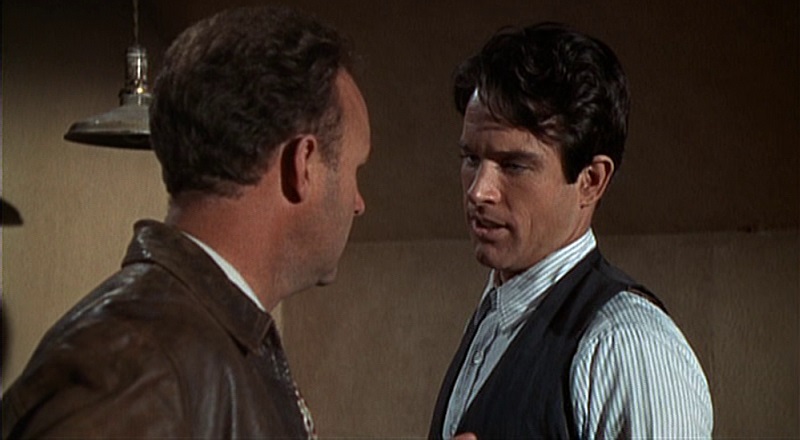
“I’ll tell you right now, I ain’t much of a lover boy.” That is what Clyde Barrow tells Bonnie Parker, a pretty waitress he just snatched from a dull Texas town after robbing a grocery store. Still, they fall in love and take off together and go on a crime spree with no ending in sight. It is the time of the Great Depression, and Bonnie and Clyde would soon belong to the most legendary gangsters of this period.
The people would read about these young robbers in the newspaper and they were fascinated. A large part of this fascination was due to the fact that these were young and beautiful people that were obviously sleeping together. Little did they know that Clyde almost never touches Bonnie (in the movie that is, in real life this is unlikely). Still without the sex, this is one hell of a sexy movie due to the appearance and performance of the two leads.
Bonnie and Clyde will now always be synonymous with violent young lovers on the run. For a long time they seemed to be uncatchable, and they caused terror and excitement everywhere they went. Very soon they were joined by other robbers, including Clyde’s brother Buck and his wife blanche (great performances by Gene Hackman and Estelle Parsons), and ‘the Barrow Gang’ soon became the talk of every town between Texas and Louisiana.
Bonnie and Clyde became a controversial movie back in its time because of the violence (and sex, yes there is some despite Barrow’s initial reluctance). Especially the famous ending in which Bonnie and Clyde are riddled with bullets by law enforcers is still iconic in its depiction of graphic screen violence (and it inspired the way Sonny is killed in The Godfather). Bonnie and Clyde grew out to become an absolute classic in American cinema history. It is one of the 100 films selected for archiving in the AFI archive. It also won two Oscars for Best Cinematography and Best Actress in a Supporting Role (Estelle Parsons).
Rating:
Quote:
BONNIE PARKER: “Your advertising is just dandy. Folks would never guess you don’t have a thing to sell.”
Trivia:
The hostage Eugene Grizzard is played by Gene Wilder. His girlfriend Velma Davis is played by Evans Evans, the daughter of director John Frankenheimer.







 FRAGMENTEN UIT HET SCHEMERLAND