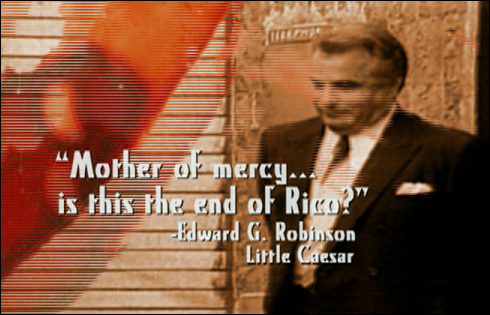
Bullets Over Hollywood

Bullets Over Hollywood (2005, USA)

Director: Elaina Archer
Written by: John McCarty (book), Elaina Archer, Tom Marksbury
Features: Paul Sorvino (narrator), Leonard Maltin, Michael Madsen, Edward McDonald, ao.

Running Time: 70 mins.

This Hugh Hefner produced documentary shows the fascination of moviegoers with the mob. ‘Once in the racket, always in the racket’, Al Capone said who became the archetype of the gangster and role-model for some legendary movie characters like Caesar ‘Rico’ Bandello (Little Caesar) and Tony Camonte/Montana (Scarface) This also applies to Hollywood when it comes to making gangster films. Every time you think the realms of the genre have been fully explored, some new masterpiece comes along. After the time that Cagney, Robinson and Bogart dominated the screen, a new generation of filmmakers emerged in the seventies with Coppola, Scorsese and De Palma. Then at the brink of the new millennium, the Hollywood gangster legend continued on the small screen with The Sopranos.

Bullets Over Hollywood opens with the very first gangster film: The Musketeers Of Pig Alley, made in 1912. It then goes on to chronologically move through gangster film history right up until The Sopranos. The documentary combines film fragments, interviews and real gangster footage while Paul Sorvino (GoodFellas) provides the narrative. It is an interesting viewing for enthusiasts of the genre, but misses real insight in the works that it covers. Some interesting facts are revealed such as the story that Howard Hawks was forced by Hollywood to add ‘the shame of the nation’ to his gangsterfilm Scarface, because they didn’t want to glorify gangsters. Also interesting is some behind-the-scene footage of gangster classics, but these fragments are unfortunately a little brief. Altogether this is worth a look. If only to hear Leonard Maltin rave about The Godfather and to re-experience some of the finest sequences in the history of this fascinating American phenomenon.

Rating:


The Musketeers Of Pig Alley (1912, D.W. Griffith)

The Public Enemy


All his life he took what he wanted…Why not women?

Directed by:
William A. Wellman

Written by:
Kubec Glasmon
John Bright
Harvey F. Thew

Cast:
James Cagney (Tom Powers), Jean Harlow (Gwen Allen), Edward Woods (Matt Doyle), Joan Blondell (Mamie), Donald Cook (Mike Powers), Leslie Fenton (Nails Nathan), Beryl Mercer (Ma Powers), Robert O’Connor (Paddy Ryan), Murray Kinnell (Putty Nose)

William A. Wellman’s The Public Enemy stands as one of the defining works of early gangster cinema. Released in 1931 – the same year as Little Caesar starring Edward G. Robinson – it helped kick off a gritty, hard-hitting genre that would become a Hollywood staple.

The film opens in industrial America circa 1909, where barrels of bootleg booze roll through the streets and petty crime leads to organized underworld dealings. At the heart of the story are two Irish-American youths who drift into gang life. One of them is Tom Powers, a volatile and ambitious thug played by the electric James Cagney in a star-making performance.

Cagney’s Tom Powers isn’t just another gangster – he’s a smoldering embodiment of the American outlaw spirit, tough, unpredictable, and ultimately doomed. And while the film famously features Cagney’s brutal shooting of a horse (what is it with gangsters and horses?), it’s the iconic grapefruit scene – where he smashes a half grapefruit into Mae Clarke’s face – that has become the movie’s enduring image.

Though Edward G. Robinson’s Little Caesar beat The Public Enemy to theaters by a few months, Wellman’s film surpasses it in terms of visual style and production value. Beautifully shot with a sharp eye for period detail, the direction gives the film a sense of realism and cinematic flair that feels advanced for its time. Interestingly, the film’s lead role was originally assigned to Edward Woods, with Cagney cast as his sidekick. But during rehearsals, Wellman recognized Cagney’s screen presence and wisely switched the roles. The result is one of the most memorable debuts in film history; Cagney utterly commands the screen.

The story charts Tom Powers’ rise through the criminal ranks during Prohibition, chronicling his growing influence and inevitable downfall. Like many gangster films of the era, such as Scarface (1932), The Public Enemy operates as a cautionary tale. While it thrills with its violence and bravado, it ultimately condemns the gangster lifestyle. As Powers’ actions begin to take a toll on those around him, the film steers toward its grim, uncompromising conclusion. Cagney’s final line – “I ain’t so tough” – rings with bitter irony.

The Public Enemy marked the beginning of two major cinematic milestones: the emergence of James Cagney as a major star and the ascendance of the gangster film as a serious Hollywood genre. Nearly a century later, it remains a landmark of American cinema: stylish, shocking, and still relevant.

Rating:

Quote:
PADDY RYAN: “As far as I’m concerned there’s only two kinds of people: Right and wrong. Now, I think you’re right. You’ll find that I am, unless you cross me.”

Trivia:
The scene where Tom shoots the horse that threw and killed Sam ‘Nails’ Nathan in a riding accident was based on an actual incident. In 1924, Sam ‘Nails’ Morton, a member of Dion O’Banion’s gang, was thrown from his horse and killed while riding in Chicago’s Lincoln Park. Other members of the gang, led by Louis ‘Two Gun’ Alteri, kidnapped the horse, took it to the spot where the accident occurred, and shot it dead. Source: Carl Sifakis, ‘Encyclopedia Of American Crime.’