Einstein Vs. Bohr: The Great Debate

For my upcoming new platform Free-Consciousness, I am publishing some video fragments on the accompanying Youtube channel. One of these is a sequence from the Discovery series Genius in which Albert Einstein (Geoffrey Rush) and Niels Bohr (David Dencik) discuss the meaning of quantum physics for reality.

This is one of the most famous debates in science. Bohr played a huge role in formulating the Copenhagen Interpretation of Quantum Mechanics, which states that one cannot know anything about an object prior to a measurement, which means that the universe is indeterministic. Einstein did not like this. He was a realist, meaning that he believed that spacetime is real and exists independently of whether it is observed or not.

Einstein spent most of the second half of his career trying to disprove the Copenhagen Interpretation, most notably by coming up with the Einstein–Podolsky–Rosen (EPR) paradox in 1935. This thought experiment involves a pair of entangled particles that are sent in opposite directions through space. According to Copenhagen, if you measure the position of one particle, you could instantly predict the position of the other entangled particle. This would violate Einstein’s laws of special relativity, because information between particles one and two would have to travel faster than light.

Of course, later experiments first conducted by Alain Aspect, Anton Zeilinger and John Clauser demonstrated that this is exactly what happens. The inescapable conclusion is that quantum entanglement exists and is non-local. Einstein’s locality is on shaky ground nowadays…. Anyway, If you regularly read my fragments, you know on whose side I am standing in this debate.

In the clip below, you can see that although Bohr’s view seems illogical and counter intuitive, it is 100% compatible with the findings of quantum physics.
Thinking, Fast & Slow: Dialogues on Reality (1)

By J.H. Kash

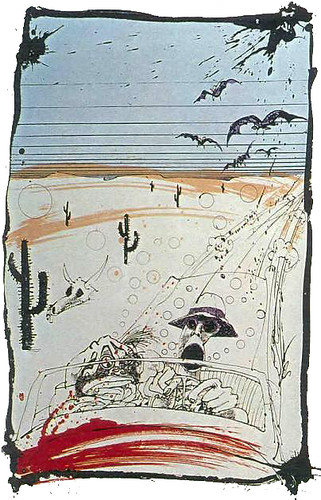
I was on my way to Vegas for a conference on quantum mechanics and the nature of reality with the famous Dr. Lanza. He was driving our fire red convertible as we discussed the difference between mind and brain.

“If the mind is not the brain, then what is it?” I asked.
“The mind is that which experiences. That which perceives. By definition, that means it cannot perceive itself”, he answered.
“But here’s the problem”, I objected. “How can it do anything if it is not physical? You say it’s some sort of super turbine creating reality as we know it.”
“Right.”
“Right. So if it is an engine, but it’s not made of anything, then how can it function? And this is not just me asking, but anyone being skeptical of the mind being anything other than the brain.”
He took a sip of his coffee.
“You ask good questions, Kash. You see, the mind is part of the non-local domain, that is powered by zero point energy. That is energy so powerful a teaspoonful could easily blow Nevada to smithereens. This mind field also possesses phenomenality. Because of this energy, of which we cannot even comprehend how powerful it is, it can create worlds without breaking a sweat. Including our world.”
“You’re a fucking lunatic”, I said. “I love it.”

“So how do you look at this mind-at-large concept?” I continued. “That what we experience is merely a fragment of the potential mind that encapsulates the cosmos?”
“It makes perfect sense. If the brain localises the consciousness to the body, it means it only uses a insignificantly small piece of the mind power that exists.”
“Many people who’ve had near-death experiences say they experienced this mind-at-large. When their consciousness was temporarily detached from their brain, due to say… cardiac arrest, they all of a sudden understood… quantum mechanics.”
“That’s very possible. The brain slows our thought processes way down to accommodate our experience on earth. Would we be in a different dimension, our conscious experience could be entirely different. Perhaps unbounded, completely free from filters.”
“Imagine that.”
“We can’t. Our slow brains normally prevent us from experiencing that.”
“Let’s drop some acid then.”
He laughed. “Yeah, let’s.”

Fragment from what might one day become a novel called ObserverWorld. Right now it merely exists in the ocean of possibilities we call the quantum realm. But it might be in the future manifested by a number of conscious agents, including me, Lanza and you dear readers.