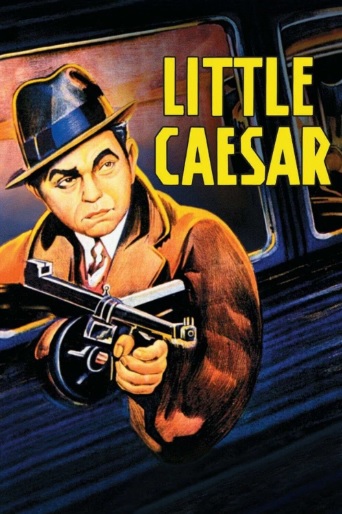
Little Caesar (1931)


‘Big boss of racketeerdom. Master of men until he defied a girl in love!’

Directed by:
Mervyn LeRoy

Written by:
W.R. Burnett (novel)
Francis Edward Faragoh (screenplay)
Robert N. Lee (screenplay)

Cast:
Edward G. Robinson (Caesar Enrico ‘Rico’ Bandello), Douglas Fairbanks Jr. (Joe Massara), Glenda Farrell (Olga Stassoff), William Collier Jr. (Tony Passa), Sidney Blackmer (Big Boy), Ralph Ince (Pete Montana), Thomas E. Jackson (Sgt. Flaherty), Stanley Fields (Sam Vettori), Maurice Black (Little Arnie Lorch), George E. Stone (Otero)

Two friends, Joe Massera and Caesar Enrico ‘Rico’ Bandello, head East to work for a gang. Joe’s true dream is to be a dancer, but Rico is driven by ambition. He envies the powerful gangsters they encounter and craves the lifestyle—the women, the clothes, the respect.

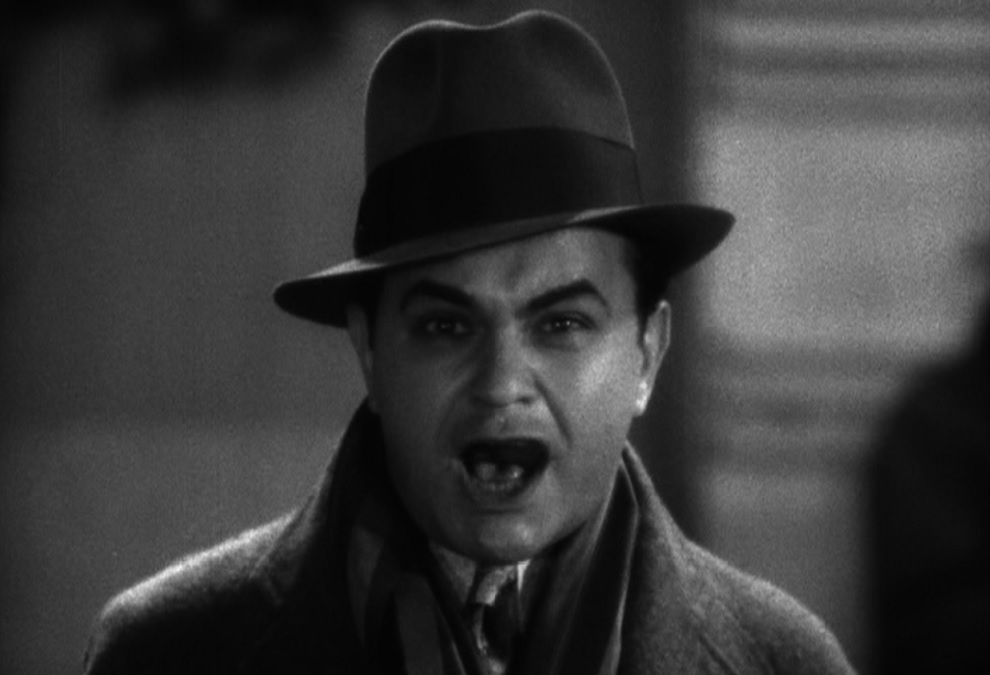
During a New Year’s Eve nightclub heist, Rico impulsively shoots and kills the head of the newly formed crime commission. His boss is furious, but Rico quickly convinces the crew that he should take charge. As their leader, however, he brings the full weight of the police down on them.

Meanwhile, Joe falls in love with fellow dancer Olga and longs to leave the gang behind. Rico refuses to let him go. Though Rico proves himself a sharper and bolder leader than his predecessor, his recklessness and raw emotion expose the kind of flaws that would define countless cinematic mobsters to come.

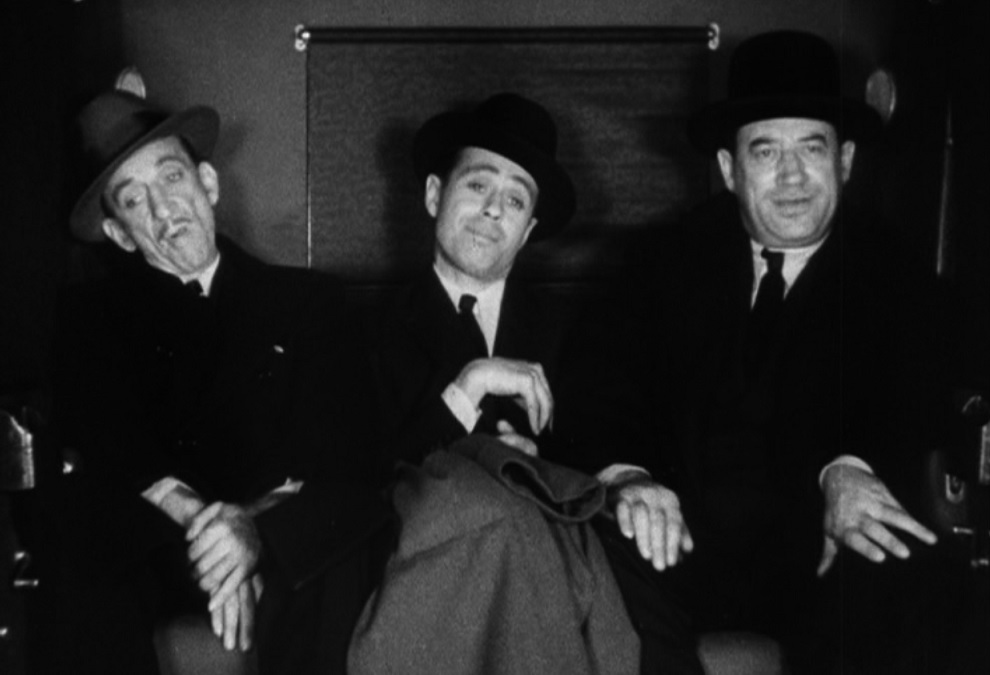
Released just a year after The Doorway to Hell with James Cagney – a film that introduced many of the tropes later cemented in gangster cinema – Little Caesar is often considered the first fully realized entry in the genre. Edward G. Robinson, in his breakout role, is terrific as the hotheaded gangster desperate to show he fears no one.

The film’s ending – Rico’s death behind the billboard that advertises a dance performance by Joe and Olga – is extremely memorable (“Is this the end of Rico?). It has a great final shot, another hallmark of the genre. In those moments, and through Robinson’s commanding performance, Little Caesar reveals why it stands as such a landmark in gangster film history.

Rating:

Quote:
RICO BANDELLO: “I could do all the things that fella does, and more, only I never got my chance. Why, what’s there to be afraid of? And when I get in a tight spot, I shoot my way out of it. Why sure. Shoot first and argue afterwards. You know, this game ain’t for guys that’s soft!”

Trivia:
Speculation has it that a federal anti-organized crime law – The Racketeering Influence Corrupt Organization Act, or RICO – got its acronym from Edward G. Robinson’s character.

Double Bill #14: Yesterday & Nowhere Boy

For the ultimate Beatles movie experience, we’ll have to Wait until 2028, when Sam Mendes is set to release a series of four biopics – one for each Beatle. This promises to be a magnificent, once-in-a-lifetime cinematic event. Until then, there are already some great films out there that celebrate the legacy of the Greatest Band Ever. A perfect place to start is with this Double Bill, featuring two films inspired by Beatles’ songs – one named after a John Lennon track and the other after a Paul McCartney classic. Once you’ve enjoyed these two movies, Across the Universe (2007) is another highly recommended Beatles-inspired film. For a deeper dive into their early days, Backbeat (1994) dramatizes the band’s formative years in Hamburg. But back to this Double Bill: Nowhere Boy (2009) explores John Lennon’s troubled childhood. Raised by his strict aunt Mimi after his parents couldn’t – or wouldn’t – take care of him, the film delves into his complex relationship with his biological mother Julia, beautifully played by Anne-Marie Duff, alongside Kristin Scott Thomas as Mimi. It also highlights the origins of The Quarrymen, the band that would eventually evolve into the Beatles, and Lennon’s legendary first meeting with Paul McCartney. Aaron Johnson shines as the young Lennon, perfectly capturing his wit, imagination, and artistic genius. Having read Lennon’s biography, I feel this film authentically portrays his early life and character. Mendes’ upcoming film will likely draw inspiration from Nowhere Boy, especially in its portrayal of touching moments from the band’s early days, such as their first gigs and the tragic loss of John’s mother, Julia. Yesterday (2019) takes a more fantastical approach, blending comedy and romance with a unique premise: what if the world forgot the Beatles, except for one profoundly unsuccessful singer-songwriter called Jack Malik? Malik suddenly finds himself performing these forgotten classics and skyrocketing to fame. The film delivers plenty of laughs, with witty lines like “The White Album has some diversity issues” and “A Hard Day’s Night – what does that even mean?” But it also offers deeper, more poignant moments, including a memorable scene where Jack competes in a songwriting duel with Ed Sheeran. Perhaps the film’s most touching sequence is Jack’s encounter with John Lennon, who, in this alternate reality, never became a Beatle but instead lives quietly as a fisherman, much like his father once did. It’s a beautifully imagined moment, one that makes the film much more than just a fun, nostalgic ride. Ultimately, both Nowhere Boy and Yesterday share a common message: All you need is love… and The Beatles.

Witness to the Mob (1998)

Directed by:
Thaddeus O’Sullivan

Written by:
Stanley Weiser

Cast:
Nicholas Turturro (Sammy ‘The Bull’ Gravano), Tom Sizemore (John Gotti), Debi Mazar (Deborah Gravano), Michael Imperioli (Louie Milito), Abe Vigoda (Paul Castellano), Frankie Valli (Frank LoCascio), Katherine Narducci (Linda Milito), Arthur J. Nascarella (Bruce Mouw), Frank Vincent (Frankie DeCicco), Vincent Pastore (Mikey De Bat)

Sammy ‘The Bull’ Gravano is remembered as one of the most notorious informants in mob history. He betrayed the Dapper Don, John Gotti – whom he believed had first betrayed him. Before making that fateful decision, the story flashes back nineteen years to his childhood in Brooklyn. There, he and his best pal Louie (Michael Imperioli) begin their careers in organized crime as part of the powerful Gambino family.

Gravano rises quickly through the ranks. His willingness to follow orders to the letter – and to kill without hesitation – earns him the respect of higher-ups. Before long, he’s made an official member by boss Paul Castellano himself.

Around the same time, John Gotti (Tom Sizemore) is on the rise as well. When Castellano begins to break the mob’s code of honor, Gravano and Gotti conspire to take him out and seize control. Gotti becomes boss, while Gravano becomes his second-in-command. But Gotti’s flashy lifestyle draws unwanted attention from the press, the public, and the FBI – setting the stage for a conflict that will bring everything crashing down.

This made-for-TV film was released just two years after HBO’s Gotti. Both screenplays are based on the real Gravano–Gotti saga, and the similarities are striking – not only in story but also in style. Several familiar faces from The Sopranos and Goodfellas (Tony Sirico, Frank Vincent, Vincent Pastore) appear in both films. The key difference is perspective: Witness to the Mob is told through Gravano’s eyes, while Gotti presents Gotti’s side of the story.

Still, there’s something about Witness to the Mob that doesn’t quite ring true. Despite the strong ensemble, the interactions don’t always feel believable. Nicholas Turturro (brother of John) lacks the presence and charisma needed to carry Gravano’s role, and most of the actors have delivered stronger mob performances elsewhere. That said, fans of mob movie clichés – the talk, the mannerisms, the hits – may still enjoy Witness to the Mob. It has plenty of all that, even if it never quite rises above the familiar.

Rating:

Quote:
JOHN GOTTI: “So the boss of bosses is dead?”
SAMMY GRAVANO: “He lived a long life. His maid is gonna miss him.”
JOHN GOTTI: “His wife won’t.”

Trivia:
Arthur J. Nascarella plays FBI special agent Bruce Mouw, who is in charge of breaking up the Gambino family. In The Sopranos, his character Carlo Gervasi eventually betrays mob boss Tony Soprano.

Gotti (1996)

Directed by:
Robert Harmon

Written by:
Jerry Capeci (book ‘The Last Gangster: Winning the War Against John Gotti and the Mob’)
Gene Mustain (book ‘The Last Gangster: Winning the War Against John Gotti and the Mob’)
Steve Shagan (teleplay)

Cast:
Armand Assante (John Gotti), William Forsythe (Sammy Gravano), Richard C. Sarafian (Paul Castellano), Frank Vincent (Robert DiBernardo), Anthony Quinn (Neil Dellacrose), Dominic Chianese (Joe Armone), Robert Miranda (Frank DeCicco), Scott Cohen (Gene Gotti), Vincent Pastore (Angelo Ruggiero), Tony Sirico (Joe Dimiglia)

John Gotti seemed destined for the Mafia. He was smart, tough, loyal to the code of omertà, never skimmed from the top, and respected the boss’s policy on narcotics. These qualities helped him rise to become boss of the infamous Gambino family in the 1980s. But Gotti also had his flaws: he craved media attention and was too careless about discussing sensitive business in unsecured settings.

Gotti is the biography of one of history’s best-known mobsters. The story begins in 1973, when Gotti first comes to the attention of his crime family, the Gambinos – then the most powerful of New York’s Five Families. Boss of bosses Carlo Gambino asks Gotti for a personal favor, which nearly goes wrong due to the interference from underboss Paul Castellano. The conflict almost dooms Gotti, but his mentor, second underboss Neil Dellacroce (Anthony Quinn), steps in to resolve it.

In the years that follow, Gotti steadily rises through the ranks alongside his close associate and fellow captain Sammy Gravano. When Gambino dies of old age in 1976, he names Castellano as his successor, to the disapproval of Gotti and other top figures. While Gotti was seen as a true man of Cosa Nostra, Castellano was regarded more as a businessman. Tensions eventually culminate in one of the most infamous gangland hits in history: the 1985 assassination of Castellano and his partner outside Sparks Steak House in Manhattan.

Now John Gotti is the boss. But, as noted earlier, his weaknesses ensured that his reign would be relatively short-lived (until 1992 to be precise). As a biographical made-for-tv HBO production, Gotti stands out for offering a complete look at the life and times of a legendary mobster. Armand Assante is memorable in the lead. The supporting cast – featuring many future Sopranos actors – is also strong, with Anthony Quinn and William Forsythe delivering standout performances. If you watch only one television production about the mob, make it Gotti .

Rating:

Quote:
JOHN GOTTI: “A Mexican, a Puerto-Rican and a black guy are sitting in a car. Who’s driving? The police.”

Trivia:
According to IMDb, this film was the highest rated original telefilm in HBO history at that time. The success of the film convinced HBO to cast film co-stars, Dominic Chianese, Vincent Pastore and Tony Sirico in a series in development at the time called The Sopranos (1999).