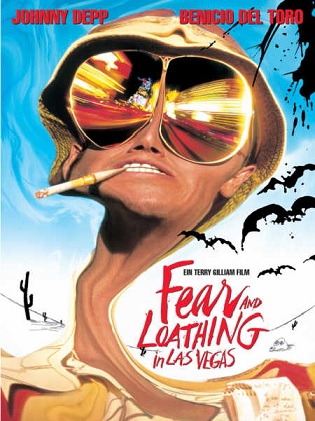
Director: Terry Gilliam
Written by: Hunter S. Thompson (book), Terry Gilliam (screenplay), Tony Grisoni (screenplay), Tod Davies (screenplay), Alex Cox (screenplay)
Cast: Johnny Depp, Benicio Del Toro, lot’s of cameo’s including; Tobey Maguire, Gary Busey, Ellen Barkin, Christina Ricci, Cameron Diaz, Flea and Harry Dean Stanton
Year / Country: 1998, USA
Running Time: 118 mins.
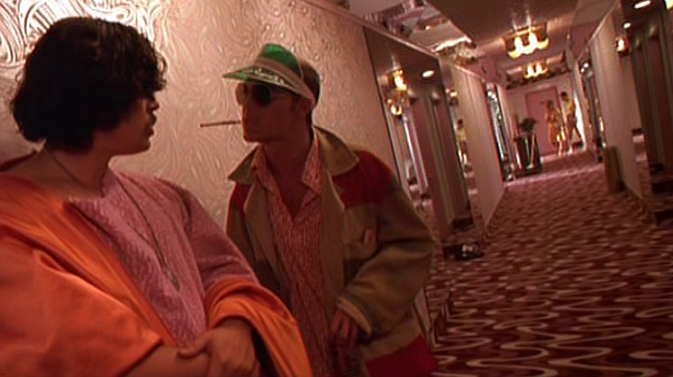
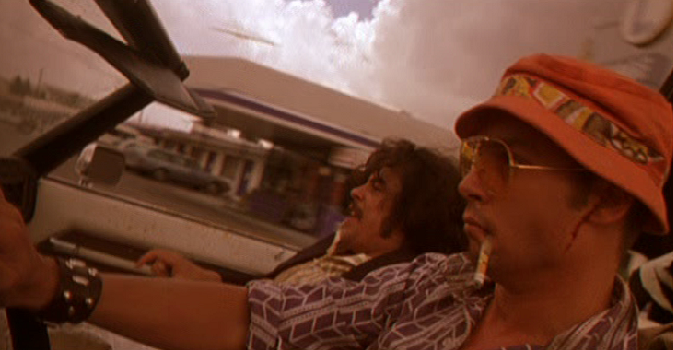
It is the foul year of our lord 1971 and Gonzo journalist Hunter S. Thompson (Raoul Duke in the story) and his Samoan attorney Dr. Gonzo decide to undertake the ultimate trip of the seventies. The official assignment is to cover the Mint 400 desert race in Las Vegas, but they have something bigger in mind. They want to find the American dream. Armed to the teeth with highly dangerous narcotics, they head out to Las Vegas in their fire red convertible… Some trip it’s gonna be…
While searching for the American dream, Thompson and Dr. Gonzo only find fear and loathing. Intolerable vibrations in a town not at all suitable for the use of psychedelic drugs. The atmosphere is extremely menacing, but as they behave as animals, nobody even notices them. Vegas turns out to be a savage town. And while soldiers are dying in Vietnam, used car dealers from Dallas throw their money in the slot machines, Debbie Reynolds sings in the Desert Inn and the national police force meets at a congress about marijuana. Thompson and Dr. Gonzo are there.
Thompson’s novel ‘Fear and Loathing in Las Vegas’, which was first published in two parts in Rolling Stone Magazine, became a cultural phenomenon (and my personal favorite book of all time). The movie adaptation by Terry Gilliam is a literal one. Thompson wrote his famous novel Gonzo style, which means the events are told through the eyes and vision of the author who fully participates in the story himself. Since Thompson was heavily under the influence during the writing process, he claims he can’t fully remember which parts truly happened and which ones did not (fully). Therefore this literal adaptation is a highly enjoyable blast, though not always realistic.
There is one downside to director Gilliam’s literal approach. In the novel, all the psychedelic escapades form an integral part of what is obviously a literary masterpiece. In the translation to film however, these escapades sometimes appear to be useless fuckarounds, especially during the final part of the film. However, that is a minor criticism for this is obviously a highly enjoyable movie. Depp and Del Toro are both terrific in their method acting approaches to their roles. Thompson’s poetic writing, beautifully narrated by Depp in voice-over, runs through the movie that captures the era and hallucinogenic nightmare perfectly. Combined with a beautiful seventies soundtrack and Grade A settings, the great time capsule that is Fear and Loathing in Las Vegas is complete. Also, it is one of the funniest movies of all time. So buy the ticket and take the ride.
Rating:


Biography: Terry Gilliam (1940, Minneapolis) started his career as the only American member of the British comedy group Monty Python. As animator, he was responsible for the bizarre cartoons used in the sketches. In 1975 he directed his first movie for Monty Python, namely Monty Python and the Holy Grail. After his period with Monty Python, he moved on as independent director and had remarkable success with his bizarre masterpiece Brazil in 1985. After that success, things went downhill for Gilliam; The Adventures of Baron Munchausen became an expensive flop and the disastrous production of the never completed Don Quichotte became legendary. Despite these problems, Gilliam returned and directed a number of valuable contributions to cinema, including sci-fi masterpiece Twelve Monkeys and cult classic Fear and Loathing in Las Vegas.
Filmography: Storytime (1968, short) / The Miracle of Flight (1974, short) / Monty Python and the Holy Grail (1975) / Jabberwocky (1977) / Time Bandits (1981) / The Crimson Permanent Assurance (1983, short) / The Adventures of Baron Munchausen (1988) / The Fisher King (1991) / Twelve Monkeys (1995) / Fear and Loathing in Las Vegas (1998) / The Brothers Grimm (2005) / Tideland (2005) / The Imaginarium of Doctor Parnassus (2009) / The Legend of Hallowdega (2010, short) / The Wholly Family (2011, short) / The Zero Theorem (2013) / The Man Who Killed Don Quixote (2018)


 FRAGMENTEN UIT HET SCHEMERLAND