Review Observer (2023, Robert Lanza, Nancy Kress)

“You are the observer. You create the universe every day, every hour, every nano-second. Everything that can exist, will exist, somewhere, including your beloved dead. They can once again be alive, walking around, solid as the chair you sit in now, solid as this book you hold in your hand.”

In the new science fiction novel ‘Observer’ – written by an actual scientist and a sci-fi writer – the mindblowing implications of quantum mechanics are taken to the next level.

The scientist is Robert Lanza, who in 2009 published his masterpiece ‘Biocentrism’, a non-fiction book about his theory based solely on science that concludes that life and consciousness create the universe, not the other way around. The writer is American science fiction author Nancy Kress, who won several awards for her work, which includes ‘After the Fall, Before the Fall, During the Fall’ and ‘Fountain of Age’.

In ‘Biocentrism’, and its sequels ‘Beyond Biocentrism’ and ‘The Grand Biocentric Design’, Lanza explained how observers (humans and other animals) create physical reality. Without observers, the universe (spacetime and matter) would remain in a state of superposition. Being alive means you are collapsing wavefunctions and you are transforming a cloud of probabilities into one manifest reality.

The premise of ‘Observer’ is that this is indeed how reality works, and a group of scientists has developed new technology which changes the algorithms by which the brain processes information. This enables the characters to create alternative branches of the universe in which their deceased loved ones can once again be alive.

It happens often that new scientific views are communicated to the general public through popular culture. ‘Biocentrism’ has not yet transformed the mainstream scientific view that sees the universe as a huge space filled with marbles that accidentally also contains life and consciousness. ‘Observer’ is a solid attempt to translate the ideas of ‘Biocentrism’ into a compelling science fiction story. It was a smart move to team up with a writer because it has believable characters and reads like a bullet train.

One of the characters is physicist George Weigert who is basically a fictionalized version of Lanza himself. It is he who has developed the biocentric theory which he calls ‘the primacy of the observer’. His main motivation to do it is to see his dead wife Rose again. The main character is surgeon Caroline Soames-Walkins who joins the team on Cayman Brac to perform the operations needed to install the brain-chips that participants need in order to create other branches of the universe. She remains in doubt the whole time about the project and suspects that what the participants see is just an elaborate hallucination. What could convince her of the truth?

The book contains many of the same explanations that ‘Biocentrism’ first pioneered about the true nature of space, time and reality. Sometimes, they have characters explain these concepts in a way that’s not entirely believable. It is obviously Lanza talking. But this is a minor critique. What ‘Observer’ does very well is explaining real, revolutionary science in an understandable way. This doesn’t mean it becomes easy, because as Lanza has pointed out many times; language is a limited tool when it comes to explaining fundamental truths like the illusion of time.

Luckily, you don’t have to fully understand all the science to enjoy the story. If observers indeed create reality, this opens up many staggering possibilities. Some of these are explored in this book, but the writers didn’t overdo it. There is definitely a sequel suspended in superposition in which the future possibilities are explored further. Perhaps ‘Creator’ is a suitable title for this sequel?

More about biocentrism, quantum physics and the true nature of reality: Check out my new platform Free-Consciousness.

Een gevalletje synchroniciteit

Onlangs schreef ik een blog over Carl Jung en zijn principe van synchroniciteit. Het optreden van betekenisvolle toevalligheden die geen oorzaak lijken te hebben. Oftewel, er gebeurt iets in de geest en gelijktijdig gebeurt er iets in de fysieke wereld dat gerelateerd lijkt te zijn. Bijvoorbeeld, je oma is net overleden en kort daarna vliegt er een vogel door je raam naar binnen die op tafel gaat zitten. Of je realiseert je dat je toe bent aan een nieuwe baan en dezelfde dag wordt je via een kennis benaderd voor een interessante opdracht.

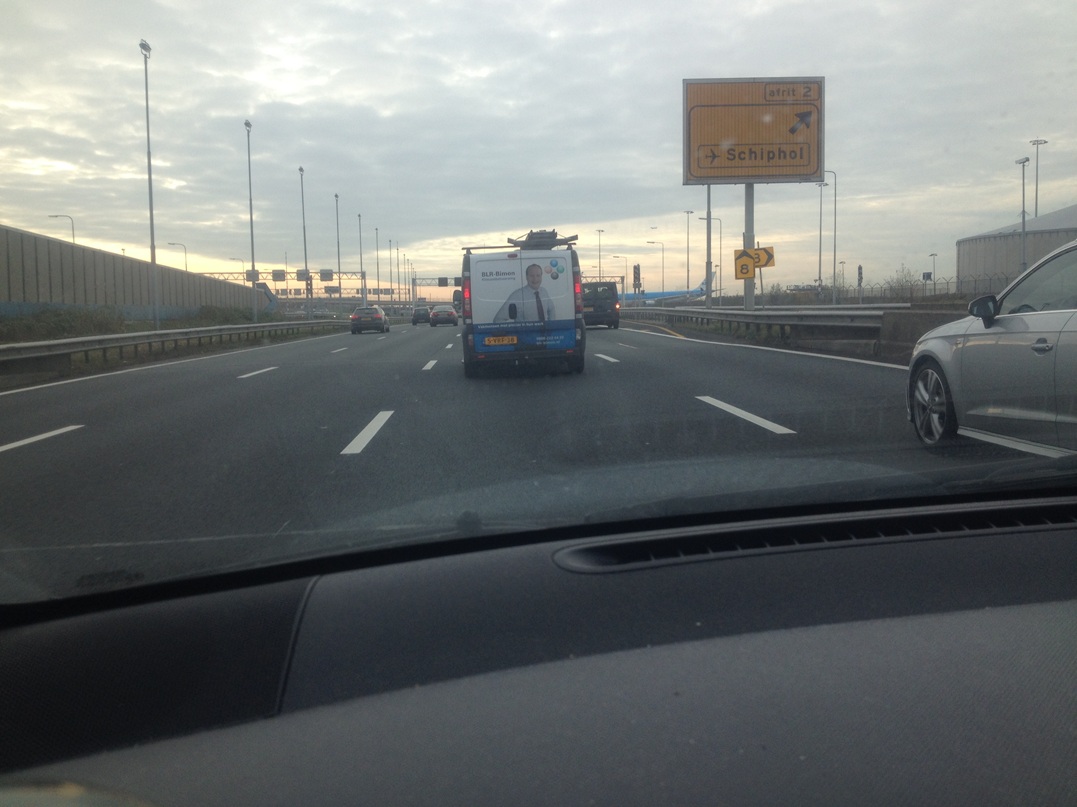
Ik dacht bij het schrijven van de blog na of ik zulke dingen heb meegemaakt en kon me er weinig voor de geest halen. Maar in 2013 heb ik wel een vrij vreemde meegemaakt. Een maand voordat het gebeurde was ik op een korte vakantie met Loesje en Rosa in de Veluwe. Onderweg reden we achter een bedrijfsbusje met een clown-achtig gezicht op de achterkant. We maakten hier wat grappen over; ‘als je reclame wilt maken voor je bedrijf moet je niet een ‘clown gone bad’ op je bus plakken.’ Ook leek de beste man, die waarschijnlijk de directeur-eigenaar van het bedrijf is, op iemand die we kenden.

Ik had de naam van het bedrijf in mijn telefoon opgeslagen om er later een keer een marketingblog over te schrijven. ‘5 don’ts bij autobestickering’, of iets dergelijks. Toen ik een maand later op straat liep in Amstelveen dacht ik daar opeens weer aan – god mag weten waar mijn hersens zich mee bezighouden – en toen zag ik opeens dat busje geparkeerd langs de weg staan. 100 kilometer van waar we hem tijdens de vakantie hadden gezien! Terwijl ik er net over aan het nadenken was – en geloof me, zoveel dacht ik niet terug aan dat incident. What are the odds? Ik heb maar een foto gemaakt als herinnering.

Volgens biocentrisme is zo’n gebeurtenis redelijk makkelijk te verklaren. Alles komt voort uit hetzelfde mentale eenheidsveld. Jung noemde dit het collectieve onbewuste. Het enige probleem in mijn geval: hij beschreef zulke gebeurtenissen als betekenisvol. En wat is de betekenis van die man op het busje? Misschien had het iets te maken met die vriend van me. Ik heb heb onze vriendschap verbroken in 2009, dus misschien had het daar mee te maken? Inmiddels heb ik wel weer contact met hem, maar in die tijd was daar geen sprake van. Of misschien is de clown één van Jung’s archetypes. En juist degene die geen betekenis heeft en als enige boodschap te verkondigen heeft: ‘life is weird’. Klinkt als een solide Jungiaanse analyse al zeg ik het zelf.

Review ‘The Grand Biocentric Design’

In 2017 I read the most important book of my lifetime: Biocentrism (2009) by renowned scientists Robert Lanza and Bob Berman. It deserves to have an impact at least as great as Immanuel Kant’s Critique of Pure Reason in the 17th century. And the main message is very similar: space and time are tools of the animal mind. Only how the authors reach their conclusions is different. Kant by brilliant philosophical reasoning. Lanza by backing up these insights by evidence from modern physics and astronomy.

In this third entry in the Biocentrism series (after Biocentrism and Beyond Biocentrism), Lanza wisely added a physicist to his writing team: Matej Pavšič. Also, there is no longer a reference from Deepak Chopra on the cover like there was on the previous books. This ‘name-dropping’ was understandable from the publisher’s position: Chopra can definitely add to the commercial success of any book that challenges the materialistic paradigm. But the science minded crowd is already extremely skeptical of any reference made to consciousness in relation to physics. So, the authors will have to be as credible as they can be to persuade the ones that may be persuaded.

I was already convinced by the first book. Not because of the credentials of the authors – that are extremely impressive – but because of the arguments presented. In the years after reading the mind blowing revelations of the first Biocentrism book, I tried to find counter arguments, but never found them. At least not arguments that cannot be easily refuted (which in this book, the authors do in one of the appendixes). Lanza and his co-authors successfully make their scientific perspective totally compatible with the findings of quantum mechanics and other unsolved mysteries of science.

The core of biocentrism is that consciousness is equivalent to reality itself. It is absolutely fundamental and cannot be reduced. If we accept this fact, everything falls into place. Quantum mechanics reveals that the physical world arises not from interactions, but the awareness of interactions. The mind computes the where and the when objects appear in relation to the observer. An observer with a functioning brain and memory is therefore crucial for the universe to be there. These authors make the case completely obvious.

The first two books were an exploration of how science in the past hundred years has been steadily moving towards this paradigm shattering realization. That conscious life and the cosmos are one and the same and cannot be separated. In the third book Lanza and his co-authors go further to explain how the mind manages the impressive feat of creating reality. The subject matter is complex, but through lucid writing the authors manage to make these ideas understandable for a wide audience.

Also some previously unexplored scientific topics are looked at through biocentric glasses, like Libet’s famous free will experiments that get a completely different interpretation than the usual ‘we are our brains’. They also offer fascinating insights on topics like animal consciousness and dreams. It is really great stuff.

Towards the end, Lanza and co give the readers a good sense of how this new perspective may impact science and what spectacular possibilities it offers for future science. Time travel is just one of them. Lanza and his co-authors did it again. They further improved my understanding of this ’mental thing’ that we’re all a part of. But no matter how much one reads about it or meditates on it, it remains mind-bending stuff. If you want to learn why the exploration of the universe must start within ourselves, this is your definitive guide.

⟿ Jeppe Kleijngeld, January 2021

Meer over biocentrisme: A Shift In Scientific Worldview – Part 1: Robert Lanza’s Biocentrism

Closing chapter: Terugblik op dramatisch 2020

Zeg me dat het niet zo is.
Zeg me dat het niet waar is…

In de kerstvakantie neem ik altijd twee weken vrij om op te laden. Ik herbekijk dan altijd een van mijn favoriete filmseries, zoals The Lord of the Rings, The Hobbit of de originele Star Wars trilogie. Dit jaar ben ik bezig met een herkijk van The Sopranos, mijn favoriete serie ooit. Ik heb hem bijna tien jaar niet gezien en het is zelfs nog beter dan ik me herinner. Het is zo goed geschreven en gespeeld. Waanzinnig goed. Ik ben bezig met een e-book over de show. Dat verschijnt waarschijnlijk volgend jaar; er liggen al veel teksten klaar. Ik geniet ook van het nieuwe album van Paul McCartney, ‘McCartney III’. En over Paul gesproken: In 2021 komt Peter Jackson, een van mijn lievelingsfilmmakers en hardcore Beatles-fan, met de documentaire Get Back. Ik heb vijf minuten materiaal gezien op Disney Plus en het ziet er waanzinnig uit. Intiemere beelden van The Beatles heb ik zelden gezien. En dus, als er één film is waar ik naar uitkijk volgend jaar is deze het wel. En als ik er nog eentje mag noemen is dat The Many Saints of Newark, een prequel van The Sopranos, gerealiseerd door Sopranos-bedenker en schrijver David Chase. Met in een van de hoofdrollen Michael Gandolfini, zoon van de legendarische James Gandolfini die overleed in 2013, maar onsterfelijk werd door zijn vertolking van Tony Soprano. Nu stapt zijn zoon in zijn voetsporen. 2021 wordt een heel goed filmjaar.

Qua films was 2020, net als in vele andere opzichten, juist een waardeloos jaar. Ik heb een filmpje in mijn hoofd, waarin het liedje ‘It was a very good year’ van Frank Sinatra speelt en we beelden zien van verlaten straten, mondkapjes, begrafenissen, dramatische toestanden op de IC’s en sombere toespraken van politici. Ik heb zelf niet te klagen overigens. Toen in maart de eerste lockdown werd aangekondigd vond ik het stiekem wel spannend. Een ongekende gebeurtenis. Een hele lichte versie van een zombie apocalypse, zoals in Dawn of the Dead. Het had wel wat: verplicht thuis met toch alle luxes van het moderne leven: speciaalbier, wijn, een koelkast vol met eten, een enorme collectie films en boeken en via het internet verbonden met de hele wereld. Maar ik begrijp natuurlijk dat corona heel veel mensen in de ellende heeft gestort met verliesgebeurtenissen, financiële problemen en gevoelens van eenzaamheid.

Van mijn persoonlijke vrienden is de eigenaar van het bedrijf waar ik sinds 2008 voor werk getroffen. Hij kon niet verdragen dat zijn levenswerk ten gronde ging en stapte op 1 juli uit het leven. Net voordat hij zijn aandelen zou overdragen aan een overnemende partij. Voor de rest van ons (werknemers) was de overname een redding, een veilige haven. Maar voor Alex voelde dit helemaal anders. Wat er precies in zijn hoofd heeft afgespeeld zullen we nooit weten, maar de aanhoudende paniek veroorzaakt door corona heeft vrijwel zeker een doorslaggevende rol gespeelt in zijn dramatische actie. Onze directeur Melle wist het rampjaar onlangs goed onder woorden te brengen. “Stel dat iemand in december vorig jaar gezegd had; ‘er komt in 2020 een dodelijk virus waardoor er niemand meer naar onze events en trainingen komt en dan maakt Alex er een einde aan’, dan hadden we gezegd: wat een slecht filmscenario.” De werkelijkheid is soms uiterst vreemd en onvoorspelbaar. Als een Zwarte Zwaan.


Voorwoord Quote, editie oktober, 2020

Maar los van deze misère waar ik nog dagelijks aan denk, ben ik er tot nu toe goed doorheen gekomen. Ik kijk documentaires over wat de mensen uit Syrië is overkomen en kan deze lockdown makkelijk relativeren. Ik zit in een fijne bubbel. Wat betreft 2021 ben ik voorzichtig positief. Het kan nog wel een tijdje gaan duren, maar ik hoop dat we in de zomer het sociale verkeer weer redelijk op de rit hebben. Mijn professionele leven ziet er ondanks corona goed uit: een groter bedrijf, meer mogelijkheden, nieuwe collega’s. En ik heb een fantastisch team met Charles, Willem, Jan, Yilmaz, Henk en Tomer. De mensen waar ik problemen mee had zijn allemaal weg. 2021 wordt op werkgebied ongetwijfeld een heel goed jaar. Persoonlijk gaat het ook goed. Rosa ontwikkelt zich als een heel sociaal en vrolijk meisje. En Loesje blijft worstelen met chronisch pijnsyndroom en (andere) psychologische issues, maar ervaart veel succes op werkgebied als begeleidster van jongeren en om een of andere reden vindt ze het ook met mij ook nog steeds leuk en dat is geheel wederzijds.

De reden dat ik dramatisch boven deze blog heb geschreven is dus eigenlijk puur de dood van Alex en omdat ik meeleef met alle mensen die getroffen zijn door corona. Maar zelf vind ik het leven mooi en interessant en een overwegend positieve exercitie. We zijn zelfs nog getrakteerd op een nederlaag van Trump en een implosie van Forum voor Democratie. De silver linings zijn dus niet moeilijk te vinden voor mij. Een laatste positief gebeurtenis om het jaar mee af te sluiten is het verschijnen van ‘The Grand Biocentric Design’, het derde deel in de serie over biocentrisme van Robert Lanza, het boek dat mijn leven in 2017 heeft veranderd. Hierin wordt nog meer bewijsmateriaal gepresenteerd dat aantoont dat leven en de kosmos één zijn en dat de dood niet echt kan bestaan in een dergelijk bewustzijns-systeem.

Deze blog heet fragmenten omdat alle aspecten van mijn leven erin voorbij komen: films, mijn filosofie, boeken die ik gelezen heb, mijn persoonlijke leven… Samen vormen die wat ik beschouw als ‘ik’. Maar uiteindelijk bestaat er geen ik en maakt deze illusionaire verschijning onderdeel uit van een veel grotere entiteit. En ik ben er helemaal oké mee om een oneindig klein element te zijn van iets veel groters. Ik zou zelfs niks anders willen. Een gevolg is dat je er nooit uit kan stappen. En dus is de actie van Alex niets meer geweest dan een reset. Een hoofdstuk in het boek heet ‘Quantum Suicide and the Impossibility of Being Dead’. Let wel, dit is een boek over natuurkunde en geen filosofie.

Voor de familie van de overledene blijft zo’n gebeurtenis overigens wel heel naar, want vanuit hun perspectief is die persoon permanent vertrokken. Vanuit het perspectief van de overledene kan er echter geen sprake zijn van ‘weg zijn’. Het gaat allemaal door en door en door en door. Ook corona is maar een heel klein streepje op een oneindig lang toneelstuk. Laat die volgende lock down dus maar komen. ‘Ik’ houd het nog wel even uit.