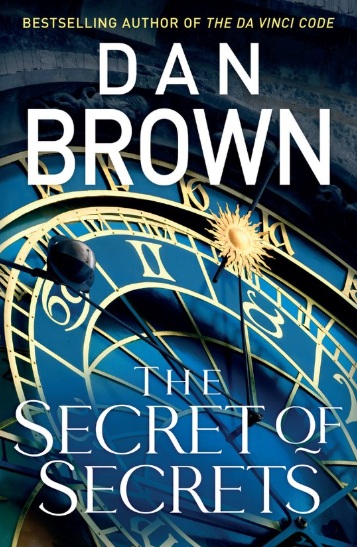
Dan Brown’s ‘The Secret of Secrets’ Explores a Radical New Paradigm of Consciousness

Is the world headed to a new scientific mindset? I think this might be happening, even though with the current political hellscape in the USA, the Ukraine war still raging, the genocide in Gaza, and countless other atrocities unfolding across the globe, it can feel as if human evolution is running backwards.

Yet online – in discussion forums, academic debates, and emerging intellectual communities – there are signs that the long-standing dominance of materialism may be beginning to fade.

Changing the collective ‘mega-mind’ of the public is no small feat; such shifts often take generations. Quantum mechanics brought the mind into the realm of physics as early as the twentieth century, and yet public understanding of consciousness has remained largely unchanged.

What is a huge contributor to a new mindset is popular culture. New ways of thinking can spread virus-like, thanks to books, movies, television series, social media, and now also A.I. The material mindset – that sees the universe as unintelligent, and life and consciousness as having no relation to the physical world – has been largely resistant to change.

For that to change, the biocentric ideas researched on my website Free-Consciousness.com have to reach a contagion level, so that they can replicate like a virus. It cannot be predicted when this will happen, but products of popular culture can help to speed up the transition. The latest of such products is a brand new novel by best selling author Dan Brown (‘The Da Vinci Code’). It is called ‘The Secret of Secrets’ and it’s the sixth novel in the Robert Langdon series.

The book opens with the near-death experience of a neuroscientist. She explains to herself in clear terms that what she is experiencing – floating above the city of Prague, massless, and formless – cannot be happening. In the materialist perspective, death is the end and all experience, which is created by chemical compounds held in suspension by electrical charges in our brains, dissolve into nothing. The afterlife is a shared illusion… created to make our actual lives more bearable.

This is the typical materialist mindset. Brown immediately invites the reader to question that assumption…

Read the Entire Essay on Free-Consciousness (Free-Access)

Double Bill #01: 2001: A Space Odyssey & A Clockwork Orange

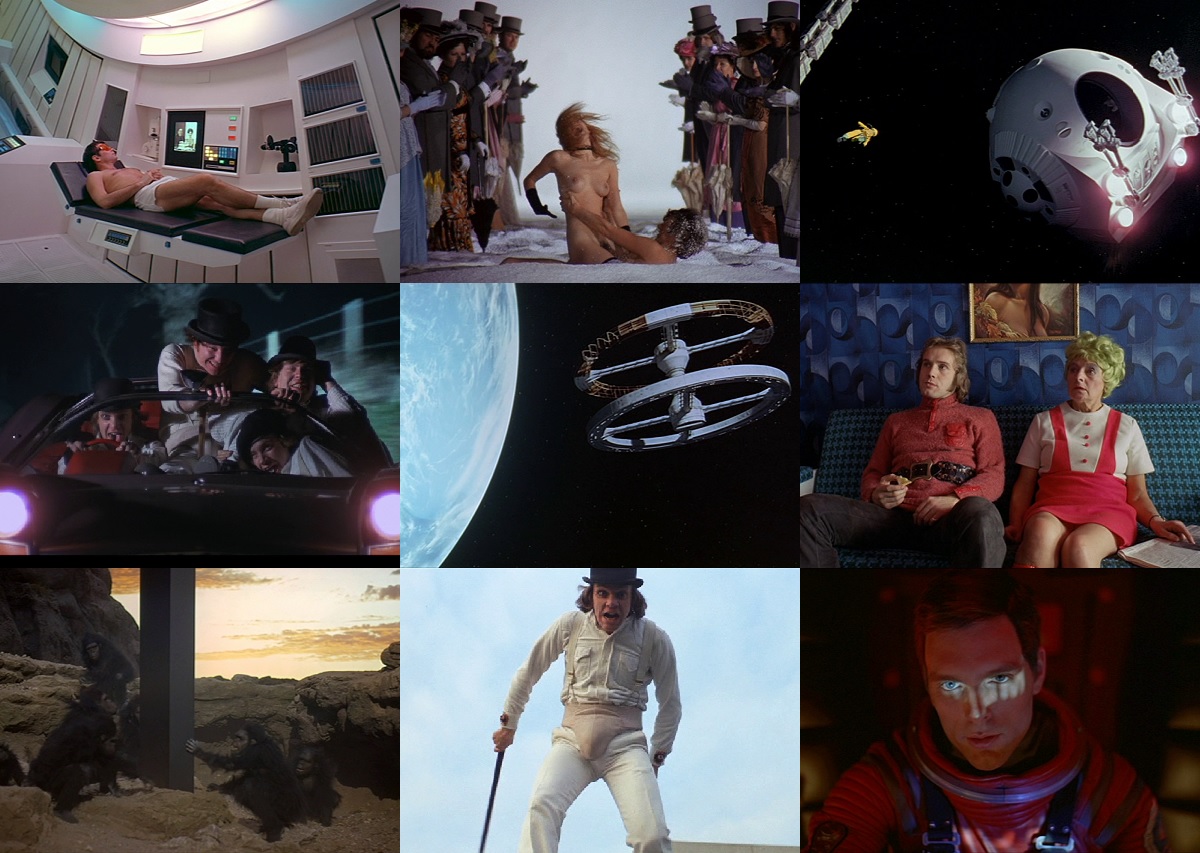
In 1968 and 1971 master director Stanley Kubrick released his two best movies as far as I’m concerned. 2001: A Space Odyssey and A Clockwork Orange are both as perfect as films can be. They are also linked in an interesting way and therefore I thought it would be appropriate to couple them for this first edition of my new feature ‘Double Bill’. The connection is as follows; In 2001 we witness the next phase of evolution for mankind. This civilization appears to be peaceful and focussed on deploying technology to improve society for the better. In A Clockwork Orange on the other hand, we witness a society much like our own in which many people are still little more than violent savages. There is a shot of main hooligan Alex that is visually very similar to one of 2001’s angry apes. We are really not yet that evolved and the space age is still a distant dream. This point is made abundantly clear in the very beginning when Alex and his three droogs batter an old homeless drunk nearly to death just for kicks. “What kind of world is it at all? Men on the moon. Men spinning around the world. And there’s not no attention paid to earthly law and order no more”, the man tells them before the beating and he is right. Another link or rather similarity is the magnificent use of classical music. One of 2001’s highlights is the space waltz on Strauss’s The Blue Danube.

The cinematography alone of these immense, beautiful objects floating in space is breathtaking and then this beautiful music added to it makes this a unique accomplishment in cinema. Kubrick wanted to create a non-verbal experience that did not rely on the traditional techniques of narrative cinema, and in which music would play a vital role in evoking particular moods. Alex would certainly approve. Only he imagines quite different imagery when he listens to his favorite symphonies by Beethoven. In A Clockwork Orange too, many of the best scenes feature fantastic classical tracks that effectively enchant the viewer. Every time I watch these movies, the images and music stay in my mind for weeks afterwards. Another reason to appreciate these films is the intelligence of the screenplays. For instance, HAL9000 is still today – more than 50 years later – the finest depiction of machine intelligence in a film. And A Clockwork Orange treats various themes like free will, politics and good versus evil in a fascinating way. But what these films do absolutely better than any before or since is depicting what mankind is really capable of, both in the very good and the very bad sense. Humanity at its most beautiful and most terrible (and with A Clockwork Orange sometimes a twisted combination of both). An amazing feat by a director who is still unsurpassed in his skill and dedication.