Altered States

Director: Ken Russell
Written by: Paddy Chayefsky (novel & screenplay)
Cast: William Hurt, Blair Brown, Bob Balaban

Year / Country: 1980, USA
Running Time: 102 mins.

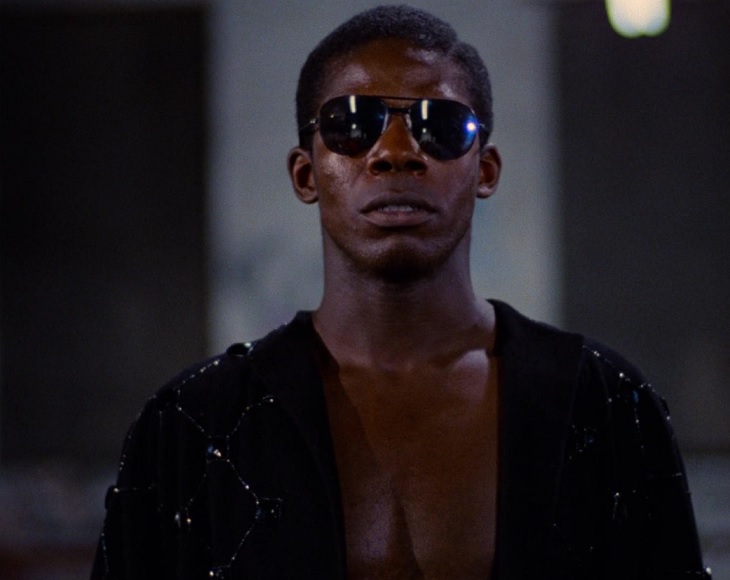
Altered States is a wild and thought-provoking journey into the mind of Dr. Eddie Jessup, a psycho-physiologist in the 1960s who becomes obsessed with exploring the boundaries of human consciousness. Plagued by unresolved childhood trauma, Jessup is driven by an insatiable curiosity about the meaning of existence. His experiments with a mind-altering isolation tank trigger intense religious hallucinations featuring visions of God, Jesus, and crucifixion scenes, blending spirituality with the surreal.

The story takes a darker turn after Jessup encounters a remote Mexican tribe and brings home a powerful psychedelic compound. Incorporating this substance into his experiments, he discovers that the altered states of consciousness he experiences are not merely internal, but can manifest physically. This revelation pushes the film into unsettling body-horror territory, shifting its tone to something more visceral and disturbing. The escalating tension and grotesque transformations make the latter half of the film both unnerving and memorable.

While Altered States begins with fascinating philosophical and scientific ideas, it struggles to maintain its initial momentum. Despite this, there is much to admire. William Hurt delivers an outstanding performance in his film debut, capturing Jessup’s intense obsession and vulnerability. The hallucinatory sequences are stunningly crafted, offering surreal imagery that lingers in the mind.

The film’s controversial themes and bold exploration of consciousness, faith, and identity make it a product of its time, yet it remains daring even by today’s standards. Though it doesn’t fully sustain its excitement throughout, Altered States is an ambitious and visually arresting experience that’s worth exploring for fans of psychological horror.

Rating:

Biography: Ken Russell (1927, Southampton, Hampshire – 2011, Lymington, Hampshire) was a visionary British filmmaker celebrated for his flamboyant and provocative style. He initially pursued a career in dance and photography before turning to filmmaking in the 1950s. His early work in documentaries demonstrated a flair for blending artistic innovation with compelling storytelling. His breakthrough came with Women in Love (1969), an adaptation of D.H. Lawrence’s novel, which earned critical acclaim and an Academy Award for actress Glenda Jackson. He followed this with audacious films like The Music Lovers (1971), The Devils (1971), and Tommy (1975), each characterized by their bold visuals, experimental narratives, and controversial themes. Known for his unflinching exploration of sexuality, religion, and human eccentricity, Russell’s work was often polarizing but undeniably influential. He continued to push boundaries with films like Altered States (1980) and Gothic (1986), cementing his reputation as a maverick artist.

Filmography (a selection): Peepshow (1956, short), A House in Bayswater (1960, short), French Dressing (1964), Billion Dollar Brain (1967), Women in Love (1969), The Devils (1971), Savage Messiah (1972), Mahler (1974), Tommy (1975), Lisztomania (1975), Valentino (1977), Altered States (1980), Crimes of Passion (1984), Faust (1985, TV-Movie), Gothic (1986), Salome’s Last Dance (1988), The Rainbow (1989), Whore (1991)

Duel

Director: Steven Spielberg
Written by: Richard Matheson
Cast: Dennis Weaver, Jacqueline Scott, Eddie Firestone

Year / Country: 1971, USA
Running Time: 90 mins.

A business commuter, played by Dennis Weaver, leaves his home in the morning unsuspecting that this will be a day from hell. He is targeted by an enormous, menacing truck for termination and he doesn’t know why. The duel of the title refers to the showdown between him and the unknown truck driver on the desert highways that lasts the entire movie.

Duel is Steven Spielberg’s masterful debut that captures the peril of an ordinary man thrust into extraordinary circumstances. Duel immediately establishes his cinematic genius. Originally made for television, the movie transcends its medium with exceptional production quality, boasting sharp editing, stunning cinematography, and masterful pacing. Spielberg demonstrates an innate ability to generate tension, crafting nail-biting action scenes that foreshadow the brilliance he would later bring to iconic films like Indiana Jones and Jurassic Park.

The running time could have been cut with ten minutes to make it perfect, but overall, he manages to maintain tension throughout its running time. The film also features clever visual metaphors, such as subtle nods to themes of impotence and primal survival instincts. The main character David Mann comments that it takes nothing to be back inside the jungle again. And that is precisely what happens to him. Instinct takes over and man becomes a force for survival. In Duel, Spielberg proves he is a director of extraordinary promise, blending tension, action, and deeper thematic layers into an unforgettable cinematic experience.

Rating:

Biography: Steven Spielberg (1946, Cincinnati, Ohio), is one of the most influential and celebrated filmmakers in cinema history. A pioneer of modern blockbuster filmmaking, Spielberg’s career spans over five decades, encompassing a wide range of genres and iconic films. Spielberg’s breakthrough came in 1975 with Jaws, a suspenseful thriller that became the first modern blockbuster. He followed this success with a string of iconic films, including Close Encounters of the Third Kind (1977), Raiders of the Lost Ark (1981), E.T. the Extra-Terrestrial (1982), and Jurassic Park (1993). Spielberg’s versatility as a director is evident in his more serious works, such as Schindler’s List (1993), which earned him his first Academy Award for Best Director, and Saving Private Ryan (1998), which won him a second. These films cemented his reputation as a master of both spectacle and substance.

Filmography (a selection): Amblin’ (1968, short), Duel (1971, TV-Movie), The Sugarland Express (1974), Jaws (1975), Close Encounters of the Third Kind (1977), Indiana Jones and the Raiders of the Lost Ark (1981), E.T. the Extra-Terrestrial (1982), Indiana Jones and the Temple of Doom (1984), The Color Purple (1985), Empire of the Sun (1987), Indiana Jones and the Last Crusade (1989), Jurassic Park (1993), Schindler’s List (1993), Saving Private Ryan (1998), Minority Report (2002), War of the Worlds (2005), Lincoln (2012), Ready Player One (2018)

Dungeon Classics #36: Braindead

FilmDungeon’s Chief Editor JK sorts through the Dungeon’s DVD-collection to look for old cult favorites….

Braindead (1992, New Zealand)

Director: Peter Jackson
Cast: Timothy Balme, Diana Peñalver, Elizabeth Moody
Running Time: 104 mins.

Probably nobody predicted that the maker of New Zealand horror comedies would one day direct the epic The Lord of the Rings trilogy. Then again, perhaps people should have, because Braindead, Peter Jackson’s third film after Bad Taste and Meet the Feebles, is an exceptionally well made movie. It’s about the young man Lionel who lives in Wellington with his controlling mom (the movie’s real horror). When he takes his first date Paquita to the zoo, his mother (who has followed them of course) is bitten by a Sumatran Rat-Monkey. This turns her into a bloodthirsty zombie that cannot die, not even by dismemberment. Very soon, Lionel’s house is packed with these things and he has to get very inventive to get rid of them. Like iconic horror director Sam Raimi developed his trademark style with the Evil Dead movies, Jackson does so here: sweeping camera moves, inventive special effects (by Jackson’s partner in crime Richard Taylor), New Zealand scenery, the dead becoming alive, and lots of demented humor. And talking about Evil Dead, Timothy Balme’s Lionel certainly resembles its hero Ash when he wields his lawnmower in the infamous splatter finale (Braindead set the world record for most fake blood used in a movie). This has become a legendary moment in horror cinema, like the slapstick scene in which Lionel takes a zombie baby to the park. It is stuff like that that should have told us back then; this Jackson fella is gonna make it big someday.

Double Bill #12: The Big Lebowski & The Jesus Rolls

In the nineties the Coen Brothers rolled two strikes in a row with Fargo (1996) and The Big Lebowski (1998), two instant classics that both feature a kidnapping. Fargo is a bloody North Dakota-set crime story with humor that is darker than a black steer’s tookus on a moonless prairie night. The Big Lebowski is a Raymond Chandler-style mystery featuring a valued rug, bowling balls, white Russians and the question of what it means to be a man. I considered coupling them for this feature; in terms of bizarre characters, endlessly quotable dialogues and outrageous situations these movies certainly match, but for some reason I chose The Jesus Rolls (2019, dir: John Turturro) instead. Jesus Quintana (played by John Turturro) was one of the many memorable characters from The Big Lebowski and even though he was only in two scenes totaling less than six minutes in screen-time, he got his own movie. It’s as if Ned Ryerson would get his own flick two decades after Groundhog Day (Ned Ryerson Insures!). The Coens had nothing to do with it: but they gave John Turturrro permission to run with the character. It is both a spinoff and a remake of the French movie Going Places (1974), which was very controversial at the time for its vulgarity, depiction of sexual acts and amorality. The story revolves around a road trip taken by Quintana, Petey (Bobby Cannavale) and Marie (Audrey Tautou) during which they engage in sex and petty crime. Petey is an ex-convict like Jesus and Marie is what Maud Lebowski would call a nymphomaniac: a woman who engages in sex compulsively and without joy. The movie has one bowling scene and Jesus repeats some of his Lebowski lines, but the movie has nothing to do whatsoever with the events of The Big Lebowski (it even turns out that Jesus is not a pederast, he was only falsely accused of exposing himself to an eight year old). For a comedy it is not funny enough, and for a road movie it is too strange. But as a dessert after watching the masterpiece The Big Lebowski for the hundredth time, it is alright.