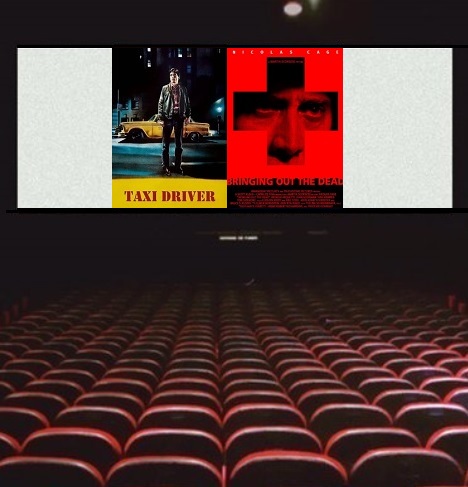
In Scorsese’s oeuvre, this is the most obvious Double Bill together with Casino and GoodFellas. Taxi Driver and Bringing Out the Dead share a great deal in common. Both revolve around a driving protagonist who suffers from urban isolation in New York City while interacting with colleagues. Both were written by Paul Schrader, feature a dark atmosphere, and explore urban madness and crime. Visually, each film reflects the protagonist’s mental state within the cityscape – often through POV shots of grim street scenes. In both, the anti-hero is driven by a desire to save others, particularly women. Each also features a rapid-fire cameo by Scorsese himself (in Bringing Out the Dead, he’s the voice of the radio dispatcher). Both films include moments that likely exist only in the protagonist’s mind: Frank Pierce (Nicolas Cage) sees visions of ghosts and corpses on the streets, while Travis Bickle (Robert De Niro) probably imagines the entire ending of Taxi Driver. Of the two movies, Taxi Driver is obviously the masterpiece. It captures the transformation of this complex main character perfectly. From oddball, to radical, to killer. De Niro’s performance is deeply unsettling; he truly becomes Travis, and it shows. His voice-over beautifully conveys his descent into psychological darkness, and the lines have a raw, poetic quality. Shot on a low budget in a documentary style, the film has a gritty authenticity. Add Bernard Herrmann’s haunting score and the outstanding supporting cast (Jodie Foster, Peter Boyle, Harvey Keitel, and Cybill Shepherd), and you have a truly iconic classic on your hands. While Bringing Out the Dead never reaches that same status, it remains an underrated entry in Scorsese’s filmography. It vividly captures the stress and chaos of working as an ambulance driver, with striking imagery – like Frank literally lifting spirits in the city. Philosophically, it reflects on life and death in the modern metropolis and, unlike Taxi Driver, includes moments of humor (in Taxi Driver, the only joke is Travis taking his date to a porn movie). Viewed together, these films form a fascinating pair: after descending into the darkness of Taxi Driver, Bringing Out the Dead feels almost like a cathartic, even therapeutic, experience.
Tagarchief: Jodie Foster
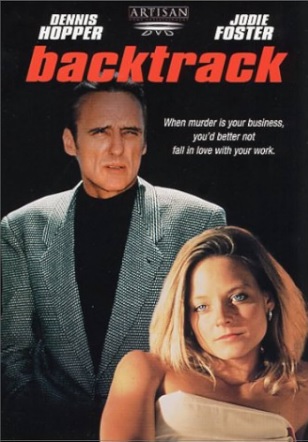
Backtrack (1990)

‘When murder is your business, you’d better not fall in love with your work.’
Directed by:
Dennis Hopper
Written by:
Rachel Kronstadt Mann, Ann Louise Bardach
Cast:
Dennis Hopper (Milo), Jodie Foster (Anne Benton), Joe Pesci (Leo Carelli), Dean Stockwell (John Luponi), Vincent Price (Lino Avoca), John Turturro (Pinella), Fred Ward (Pauling), Julie Adams (Martha), Tony Sirico (Greek), Sy Richardson (Capt. Walker)
Alright, so this is quite a strange film by Dennis Hopper. It was originally released as Catchfire, but that version was apparently so bad that Hopper had his name replaced in the credits with the pseudonym Alan Smithee. Backtrack is the 18-minutes-longer cut made for cable TV, with Hopper’s directorial credit restored.
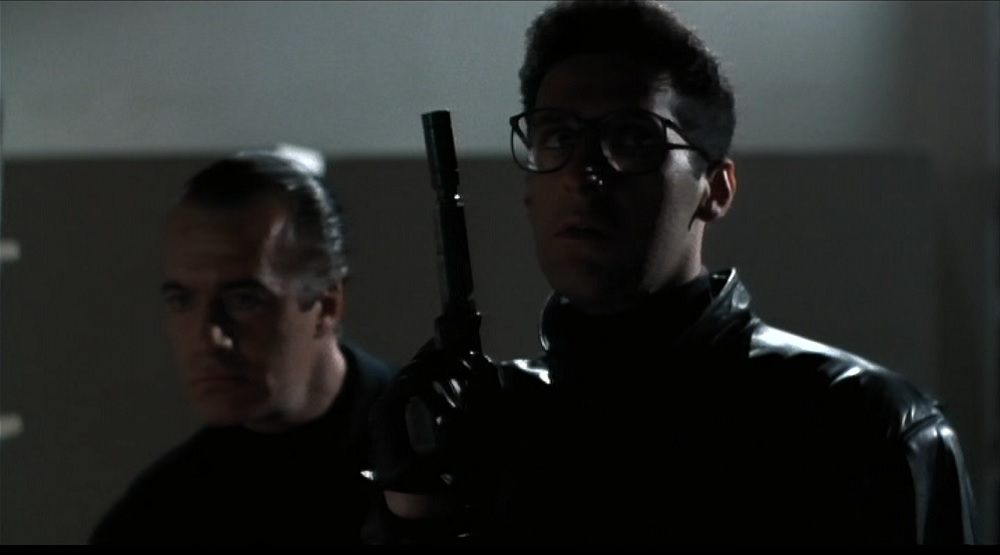
Jodie Foster plays an artist who witnesses a mafia murder. The mob – led by the explosive Leo Carelli (Joe Pesci, in the same year he gave his ultimate mobster performance in GoodFellas) – hires hitman Milo (Dennis Hopper) to silence her.
What makes it puzzling is the sheer amount of talent involved: Jodie Foster, Joe Pesci (uncredited, despite a substantial role), Dean Stockwell, John Turturro, and others. The film also features familiar faces like Charlie Sheen, Bob Dylan (!), and Tony Sirico (Paulie Walnuts from The Sopranos). Yet, despite this very impressive cast, no one is given particularly strong dialogue – not even the two leads.
The bigger problem is that the film never decides what it wants to be. Is it a tense thriller? An arthouse experiment? A romantic gangster film in the vein of Bonnie and Clyde? Or an action movie given that out of nowhere, there’s a helicopter chase? The tone shifts constantly, leaving the viewer wondering: what exactly am I watching? That question is never answered.
It’s also unclear what motivates Hopper’s character, Milo, a saxophone-playing hitman. He suddenly falls in love with his target, but why? And why does she start to reciprocate? Their relationship feels entirely unconvincing.
Originally, Hopper’s cut ran 180 minutes. It’s difficult to imagine what his true vision for the film might have been. The studio, Vestron Pictures, disliked his version and re-edited it without his consent. Hopper was furious and sued, but by then the company had already gone bankrupt.
In short, Backtrack is a curious film for many reasons, but unfortunately the final product simply doesn’t work. It’s a shame, given the remarkable cast, but the movie is proof that without a strong screenplay, even great talent can’t save the day.
Rating:
![]()
Quote:
MILO: “There’s something going on here that I really don’t understand. But I like it.”
Trivia:
The movie includes three Oscar winners: Jodie Foster, Joe Pesci and Bob Dylan; and three Oscar nominees: Dennis Hopper, Catherine Keener and Dean Stockwell.
TV Dungeon: Kung Fu
(1972 – 1975, USA)
Creators: Ed Spielman, Herman Miller
Cast: David Carradine (Kwai Chang Caine), Radames Pera (Young Caine), Keye Luke (Master Po), Philip Ahn (Master Kan)
3 Seasons (63 Episodes)
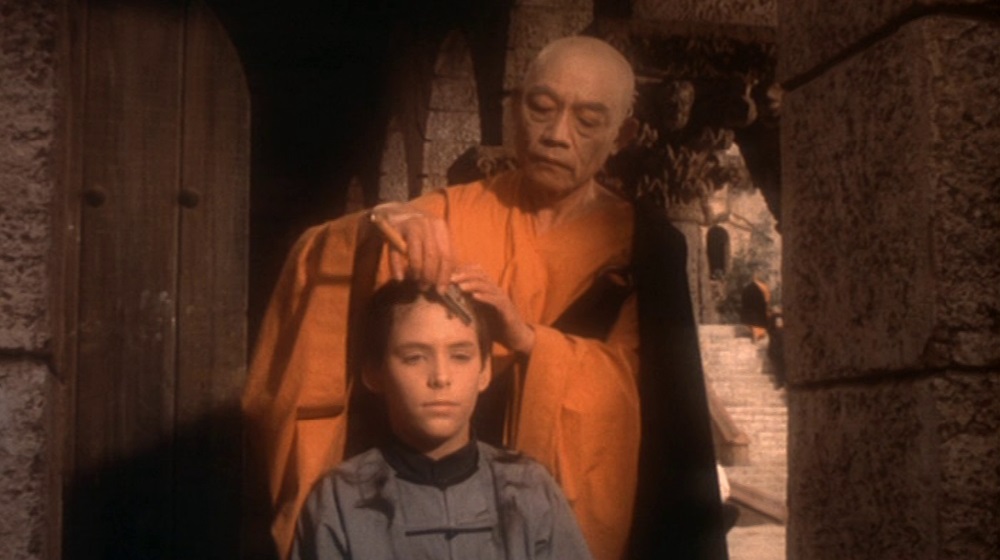
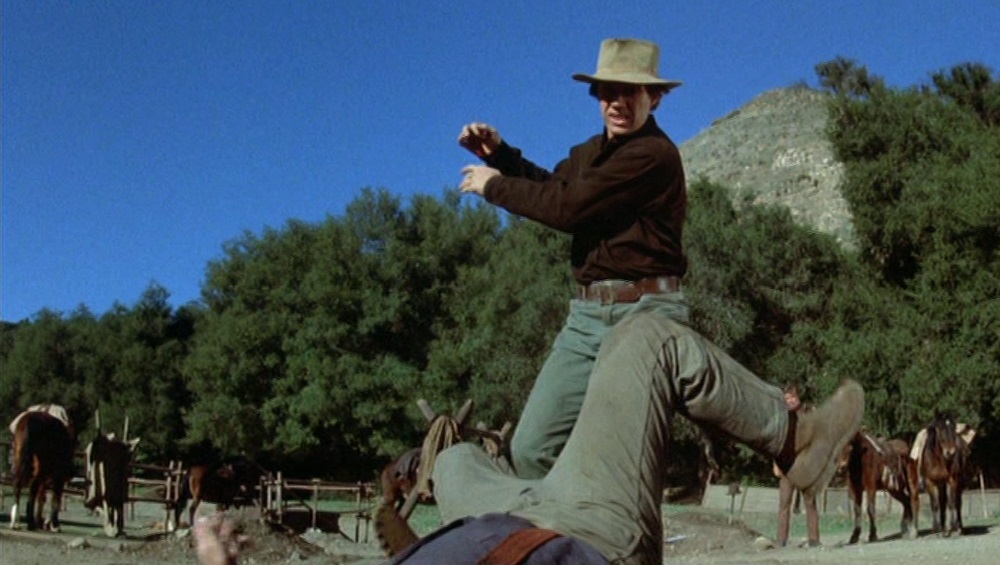
Kwai Chang Caine, a soft-spoken Shaolin priest exiled from China, wanders the savage American West of the mid-19th century. In each episode, he faces conflicts and hardships – whether injustice, violence, or intolerance – and relies on the teachings of his Shaolin monastery to navigate them. Through meditation, wisdom, and only when necessary, martial arts, Caine brings a sense of peace to a world ruled by chaos.
The show’s brilliance lies in its concept: placing a man trained in Taoist philosophy and Shaolin kung fu in the lawless, brutal Old West. The contrast is striking – while the West is filled with bandits, bigotry, and corruption, Caine embodies patience, serenity, and justice. His presence suggests that even a land steeped in violence can be redeemed through wisdom. The Taoist teachings interwoven throughout the show are its greatest strength, offering insights into paradoxes, balance, and a way of seeing the world differently. This depth of philosophy is what makes Kung Fu one of my all-time favorite series.
Yet, there is even more to appreciate. The sweeping American landscapes provide a breathtaking backdrop, immersing viewers in the setting. David Carradine, though regrettably not of Chinese descent (a disappointing yet unsurprising casting decision for the time), delivers a performance that is both mesmerizing and quietly powerful. His portrayal of Caine is nuanced, capturing both his gentleness and his underlying strength.
The series also boasts an impressive lineup of guest stars, many of whom later became household names, such as Jodie Foster, Harrison Ford, Barbara Hershey, Don Johnson, Carl Weathers, and many others. Their early appearances add to the show’s charm, making each episode a delight to revisit.
In today’s turbulent and uncertain world, Kung Fu remains a source of comfort and inspiration. While we may not be able to solve all of the world’s problems, Caine’s approach teaches us how to handle our own struggles with patience and wisdom. He fights only when absolutely necessary and never to kill, making this series a rare example of an action show that is fundamentally about non-violence.
Watching Kung Fu is an enlightening experience – it calms the mind, expands the spirit, and offers a guiding philosophy for life. It’s a show that doesn’t just entertain; it makes you wiser. I’m forever grateful for the lessons it has taught me, and I remain a lifelong student of Taoist philosophy because of it.
Read also: The Tao of Kwai Chang Caine