Did You Notice This ‘GoodFellas’ Reference in ‘Killers of the Flower Moon’?

The latest Scorsese is out! Let’s not hope it is his final film, but if it is, it’s a great one and it contains all the elements of a typical Scorsese movie: criminal conspiracies, the founding myths of America, sin and morally corrupt men… they are all there.

If you know Scorsese’s oeuvre, you might have thought about his other movies during the viewing of ‘Flower Moon’. I certainly did. There was one reference in particular that caught my eye. Logically, since I have seen GoodFellas probably more than 30 times, so I couldn’t miss this reference.

At the end of GoodFellas, protagonist Henry Hill (Ray Liotta) decides to join the witness protection programme and testify against his former superiors James Conway (Robert De Niro) and Paul Cicero (Paul Sorvino). In the scene before the final scene, Hill is in court and he is asked by the prosecutor to point out Conway and Cicero for the jury. Hill does and the prosecutor says:

“Your honor, please let the record reflect that Mr. Hill has identified the defendant James Conway.”

In Killers of the Flower Moon, De Niro’s role is similar to James Conway, since his character – William Hale – is like Conway, leader of a major criminal conspiracy.

Towards the ending of ‘Flower Moon’, Leonardo DiCaprio’s character Ernest Burkhart is testifying against Hale in the Osage murder trial. And when I saw De Niro sitting there in the courtroom, I knew it was coming. And yes, Burkhart is asked to point out Hale and surely the prosecutor says:

“Your honor, please let the record reflect that Mr. Burkhart has identified the defendant William Hale.”

Nice one, Marty!

Cannibalism Now!

In Cannibal Holocaust from 1980, a four-headed film crew heads into the Amazon jungle to shoot a documentary about cannibalism. They never return. When their cans of film are found later on, the gruesome truth about their faiths is uncovered. The film has been extremely controversial since its release and is still banned in several countries. Cannibal Holocaust remains a very unpleasant viewing today due its nauseatingly realistic scenes of violence and mutilation. Still, the shocking subject matter seems to have a certain appeal on many people. What is it with cannibalism that fascinates people so much and how is this fascination translated into cinema?

In Western civilization, cannibalism is considered as something perverted, disgusting, extremely primitive, sick and demented. In most countries there is not even a law against cannibalism. Whenever an occasional case of cannibalism does come to light, the perpetrator is mostly convicted of another act such as murder or necrophilia. The eating of individuals from the same species does still occur, but it happens very marginally. The fact that it still happens means that it is definitely human. We can only admit to this repressed fascination by engaging in fantasy. Through books, music and – off course – movies we can come to terms with the cannibal inside of us.

Cannibals in cinema go back a long time. As far as I can tell, the first movie that features cannibalism is the short Queenie and the Cannibal from 1912. It is the beginning of a very long list. Last century alone, 90 movies premiered with the notion ‘cannibalism’ in the title. Movies that feature the theme cannibalism encompass several genres and subgenres. Very often they are horrors, adventures or crossovers. Mostly, they are also exploitation and sexploitation flicks (or straight out porn). Many can also be classified as racist – as natives are portrayed as savage flesh eaters. Some examples of these types of cannibal movies include; Emanuelle and the Last Cannibals (1977), The Mountain of the Cannibal God (1978), Cannibal Ferox (1981), The Flesh (1991) and Diary of a Cannibal (2007). Human’s fascination with the subject is also translated into the zombie film. After all, despite the fact that they are dead, zombies are still humans that eat other human’s flesh.

Exploitation films that deal with cannibalism are often horrors, but there are quite a lot of comedies as well. Ivan Reitman’s second feature film is the Canadian comedy-horror Cannibal Girls about three beautiful young women who lure men with their seductive charm to their home in order to kill and eat them. By drinking their blood and eating their flesh the women maintain their youthfulness and immortality. Eating Raoul is a 1982 black comedy in which cannibalism is used for the central gag. Another black comedy and horror is Motel Hell (1980) about a farmer / hotel owner who makes meat products with special ingredients. Auntie Lee’s Meat Pies (1992) already tells you all you need to know with its title and Trey Parker from South Park made Cannibal! The Musical (1993) in his college days. This blend of comedy, biography and musical is loosely based on the history of Alfred ‘Alferd’ Packer who was convicted for cannibalism in 1874.

While Italians can often be credited for nasty exploitation cannibal films, the French are largely responsible for putting cannibals in the Art House. A Taste For Woman (1964) is a black comedy by French director Jean Leon from an adapted screenplay by Roman Polanski. This is about a vegetarian restaurant that acts as cover for a sect that eats women as part of a full moon ceremony. Jean-Luc Godards Week End (1967) shows the savage journey of a bourgeois couple through France. They eventually fall prey to hippy cannibals. In Delicatessen (1991) by Marc Caro and Jean-Pierre Jeunet a butcher / landlord sells human flesh to his odd tenants in a post-apocalyptic world. Finally Les amants criminels (1999, François Ozon) is a thriller that retells the Hansel and Gretel legend, only with the wicked witch replaced by a woodsman with cannibalistic tendencies.

While the Art House and Grindhouse cinemas have had their taste of cannibalism, mainstream Hollywood has also exploited the theme for big time box-office return. The Silence of the Lambs was a sleeper hit in 1991, and its main star Hannibal ‘The Cannibal’ Lecter, portrayed by Anthony Hopkins, returned in Hannibal (2001) and Red Dragon (2002). Especially the first sequel has scenes of explicit cannibalism in it, just look at the scene in which Lecter feeds on Ray Liotta’s brains. In Sin City (2005), the mute serial killer Kevin (Elijah Wood) kills prostitutes, mounts their heads on a wall like hunting trophies and cannibalizes their remains, feeding the leftovers to his pet wolf.

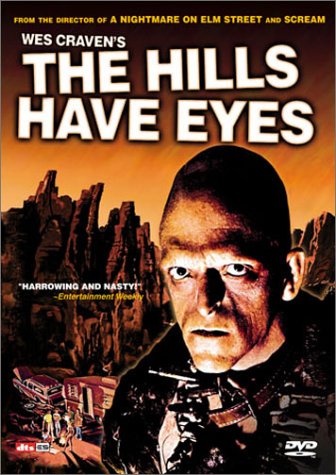
Not a Hollywood film, but immensely popular was The Texas Chain Saw Massacre in 1974. In it, a group of friends stumble upon a family of cannibals in rural Texas. The film was made independently by director Tobe Hooper for just around 140.000 dollars. Due to its graphic content, the film was banned in several countries, but did make 30.8 million dollars at the U.S. box office alone. It got five sequels and a remake in 2003. A quite similar film is The Hills Have Eyes, which is a cult classic directed by Wes Craven in 1977. The story revolves around a family of mutant cannibals that prey on a family who have been stranded in the Nevada desert. In 1991, Craven also made The People Under the Stairs about a psychotic and cannibalistic couple played by Everett McGill and Wendy Robie who also played a couple in Twin Peaks. They ‘keep’ people between the walls of their house and eat the occasional liver.

While Cannibal Holocaust and The Texas Chainsaw Massacre only pretend to be based on reality, there are also real real-life stories about cannibalism that have been turned into movies. Think about Grimm Love aka Rohtenburg. This movie is based on the true story of self-confessed cannibal Armin Meiwes and the ‘internet cannibal movement’. In March 2001 Meiwes killed and partially ate a man he had met on the internet. The eating was based on a mutual agreement. The movie was banned in Germany after Meiwes filed a complaint against it. True cannibalism is also found in Alive (1993). This film tells the story of the Uruguayan national rugby teams’ plane that crashed in the middle of the Andes Mountains in 1972. The survivors have to take desperate measures to stay alive, including eating their deceived friends and family members.

Except for voluntary cannibalism there are also quite a few examples of people who force or trick people into eating other humans. Look no further than The Cook, the Thief, His Wife & Her Lover (1989) and Titus (1999) based on a play by William Shakespeare. There is also Jennifer’s Body (2009), starring Megan Fox and Amanda Seyfried and written by Oscar winning screenplay writer Diablo Cody. In it, Megan Fox plays a high school beauty queen who eats her boyfriends.

Judging from this overview, movies that feature cannibalism come in many forms and vary strongly in quality. Compared to food, they range from the cheapest junk to the highest culinary achievement. Either way, the theme has successfully manifested itself into cinema and still fascinates people to this day and will undoubtedly continue to do so in the future.

The Many Saints of Newark (2021, Review)

Directed by:
Alan Taylor

Written by:
David Chase
Lawrence Konner

Cast:
Alessandro Nivola (Dickie Moltisanti), Leslie Odom Jr. (Harold McBrayer), Jon Bernthal (Johnny Soprano), Vera Farmiga (Livia Soprano), Corey Stoll (Junior Soprano), Ray Liotta (‘Hollywood Dick’ Moltisanti), Michela De Rossi (Giuseppina Moltisanti), Michael Gandolfini (Teenage Tony Soprano), Billy Magnussen (Paulie Walnuts), John Magaro (Silvio Dante)

“My uncle Tony…” It is certainly great to hear Christopher’s voice again. He narrates the story in this long awaited Sopranos prequel from the grave. Chrissy forms the link between the spirit world – where the beloved show now resides – and the world of The Many Saints of Newark, which is now coming to life on cinema screens worldwide and on streaming service HBO Max.

This world, which is set in the 1960’s in New Jersey, is inhabited by many familiar characters in their younger years: Tony Soprano, ages 9 and 17, his parents Johnny Boy and Livia, his uncle Junior, Silvio Dante, Paulie Walnuts, Big Pussy Bonpensiero, and a couple of others. The main character is Christopher’s father Dickie Moltisanti (Alessandro Nivola), who was referred to as a legend in the series, but never seen. Logical, since he was already dead when the show started.

We meet Dickie at the Jersey station, where his father Hollywood Dick, played by Ray Liotta, brings home a new Italian wife from the home country. She is into the handsome and charming Dickie immediately, which complicates the already difficult relationship between him and his mobbed-up father. And soon it leads to a dramatic moment early in the film, which is also none of the highlights of the movie. Both Nivola and Liotta are terrific in their roles. For Liotta, a double role that is; he also plays Dick’s twin brother Sally who’s in jail for life for whacking a made member.

Dickie is a troubled man obviously. He resembles his future son Christopher in many ways: he’s a compulsive law breaker, has an explosive temper and is a murderer. He is also searching. Dickie has the deep desire to do something good, something special to elevate his existence out of the mundane. But he doesn’t know how. Dickie is involved in the numbers rackets in Jersey together with a bunch of black criminals. In the first part of the movie, the 1967 Newark riots take place in which the black riotters, who are structurally discriminated against, face off against the police. In the second part of the film, Dickie’s black business partners get ambitions of their own which leads to a violent conflict in the Jersey underworld.

Besides having his own activities, Moltisanti is also deeply involved with the DiMeo crime family in Jersey whose members love him. But as we know from the show, in this volatile milieu inhabited by envious sociopaths, danger is always lurking. It is this world that young Tony Soprano (Michael Gandolfini) is inevitably drawn to. Dickie becomes his mentor, but on advice of Sally, whom he goes to visit in jail, he turns his back on him. Although the film was marketed as the story of how Tony becomes a gangster, there is not one defining moment through which this happens. This is really at the early beginning of his transformation. Dickie is certainly an inspiration for him with all his influence, his money and his women. But above all, Tony is just talented, and the invitation for him to join the Family is there.

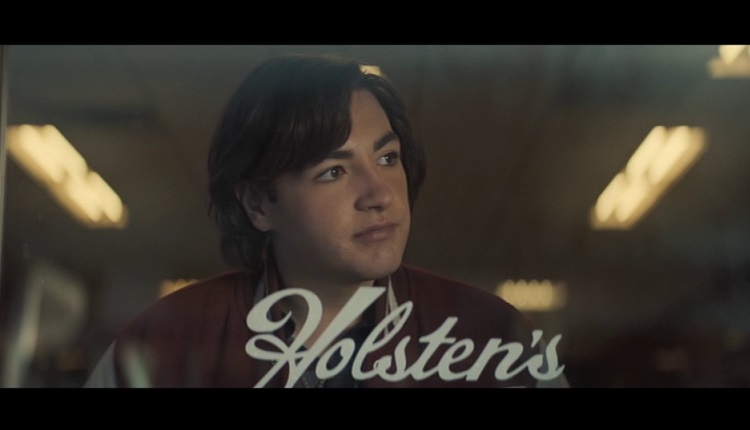
The casting of Michael Gandolfini – son of the deceased James Gandolfini who became a legend by portraying Tony Soprano – works wonderfully well. He is obviously a gifted actor like his father, but the way he resembles his dad as Tony is uncanny at times. Especially during the scene in which he and his friends hijack an icecream truck and start handing out free ice creams. Another standout performance is given by Vera Farmiga as Tony’s batshit crazy mother Livia. The dynamic between her and Gandolfini is great, and the scene between her and Tony’s school counselor is genuinely touching.

Other positive points of Many Saints are the terrific sixties soundtrack, the dark humour and the many clever references to the show that fans will love. A point of critique is that although it feels cinematic, which The Sopranos also did by the way, the screenplay is written more like a long television episode. Storywise, a few cogs are missing and the ending comes too suddenly.

David Chase has expressed interest in doing another period piece about young Tony Soprano together with Terence Winter, who wrote some of the best Sopranos-episodes. Winter responded positively, so there might be another return to this universe Chase has created. But if it doesn’t, that’s okay by me. The Many Saints is a very enjoyable return to the show that still ranks as one of the best ever. The Many Saints can now be added as a great cinematic companion piece.

Dungeon Classics #5: Escape from Absolom

FilmDungeon’s Chief Editor JK sorts through the Dungeon’s DVD-collection to look for old cult favorites….

Escape from Absolom (1994, USA)

Director: Martin Campbell
Cast: Ray Liotta, Lance Henriksen, Stuart Wilson
Running Time: 114 mins.

Actually, this movie – also known as No Escape – is not that good. But it’s childhood nostalgia and has a few things going for it. Ray Liotta is a great actor for starters. And the costumes, that remind of Mad Max, are awesome. In the year 2022 (close now) all US prisons are run by private enterprises (sounds realistic enough). Liotta’s character is a marine who has shot and killed his commanding officer. He is shipped off to a desolated island where there are no guards and no walls; convicts run the show. There are two camps: the barbaric outsiders and the more civilized insiders. Liotta joins the later. He has escape on the brain constantly… but first, there is some fighting that needs to be done. From the producers of Aliens and The Terminator, the tagline promises. No, it’s not that good, but like I said: sweet memories.