Vacation Reading: Three Philip K. Dicks

A Scanner Darkly (1977)
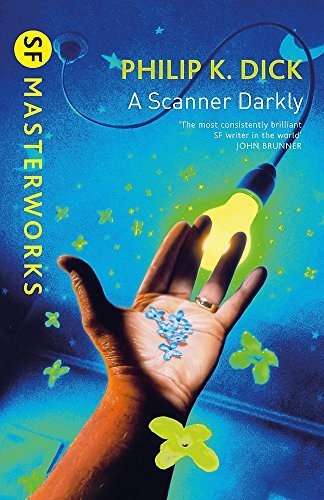
Semi-autobiographical novel about Dick’s experiences of living with a group of dope users. The main character is Bob Archtor, an undercover agent who gets addicted to a futuristic drug (the novel is set in 1994 in Orange County) called ‘Substance D’, a drug that soon leads to serious brain malfunction, and Archtor starts to lose his identity. Dick wrote it after a period in which he wasn’t able to produce any fiction due to drug consumption, so this novel functioned as a turbocharger of sorts. It contains flashes of brilliance, especially when it commentates on the lifestyle of heavy drug users, but as a whole it is quite a dull read, especially for a terrific writer as Dick. Turned into a 2006 movie by Richard Linklater, starring Keanu Reeves, Woody Harrelson, Winona Rider and Robert Downey Jr. The book ends with a list of all the dopers Dick hung out with who had died since then. It is quite a long list.

The Man in the High Castle (1962)

Who is the Man in the High Castle? It is the author Hawthorne Abendsen who wrote a subversive novel in which the allies won the Second World War. You see, this classic novel by science fiction legend Philip K. Dick is set in an alternative America which is governed by the Nazi’s and Japanese who have won WWII. In this world, American culture is quickly vanishing from existence, and an artificial America is rising. The novel follows various American, Japanese and European characters who try to make their way in this reality, thereby using the Taoist book ‘I Ching or Book of Changes’ as their guidance. The fascinating thing about ‘The Man in the High Castle’ is how believable Dick has crafted this alternate world. It makes the reader realize that we live in such a world ourselves, the result of countless choices and actions. We take it for granted, but everything could easily be very different. Turned into a television series by Amazon in 2015.

VALIS (1981)

‘VALIS’ follows the adventures of Horselover Fat (great name for a character!), an alter ego of the writer. This later, partly autobiographical book, is about Dick’s religious experiences. VALIS stands for Vast Active Living Intelligence System and represents the writer’s vision of God, which is that God is actually one huge macro-mind that connects everything. Unfortunately, the book – that was published one year before his death – contains not much more than endless philosophizing about the divine, madness and alien intelligence. Yes, Dick certainly had some fascinating thoughts and ideas, but they lack clarity here. And a plot is also sorely missing in ‘VALIS’. I’m afraid I am more a fan of Dick’s earlier works, like the phenomenal ‘Ubik’. ‘VALIS’ is part of a trilogy that also included ‘The Divine Invasion’ and ‘The Transmigration of Timothy Archer’, his final novel.

Sci-fi meesterwerk: Ubik (1969, Philip K. Dick)

‘The anti-psi factor is a natural restoration of ecological balance. One insect learns to fly, so another learns to build a web to trap him. Is that the same as no flight? Clams developed hard shells to protect them; therefore, birds learn to fly the clam high in the air and drop him on a rock. In a sense, you’re a life form preying on the Psis, and the Psis are life forms that prey on the Norms. That makes you a friend of the Norm class. Balance, the full circle, predator and prey. It appears to be an eternal system; and, frankly, I can’t see how it could be improved.’
Joe Chip in ‘Ubik’

Van de zeer productieve en invloedrijke Amerikaanse science fiction auteur Philip K. Dick (1928-1982) zijn inmiddels de nodige boeken verfilmd: Total Recall (adaptatie van ‘We Can Remember It for You Wholesale’), Blade Runner (adaptatie van ‘Do Androids Dream of Electric Sheep?’), Minority Report (adaptatie van ‘The Minority Report’), The Adjustment Bureau (adaptatie van ‘Adjustment Team’), A Scanner Darkly en de Amazon-serie The Man in the High Castle.

Maar van wat over het algemeen als een van zijn beste, zo niet zijn beste, werk wordt beschouwd – ‘Ubik’ – is nog geen verfilming. Terwijl het zich er wel erg goed voor leent. Het is dan ook onmiskenbaar gebruikt als inspiratie voor films als Scanners, The Matrix, Inception en recentelijk Tenet.

Zoals wel vaker in de verhalen van Dick, is er in ‘Ubik’ iets grondig mis met de realiteit waarin de personages leven. De hoofdpersoon is de altijd blutte psi-tester Joe Chip die werkt voor het anti-psi bureau van Glen Runciter. De diensten van het bureau zijn gericht op het voorkomen van de diefstal van (bedrijfs)geheimen) door telepaten. Daarvoor maakt Runciter gebruik van zogeheten inertials, mensen met vermogens om het telepathische veld te blokkeren.

Tijdens een missie op de in de toekomst gekoloniseerde maan wordt Runciter opgeblazen, vermoedelijk door een zakelijk rivaal. De rest van het psi-team begint kort daarna regressie in hun realiteit te ervaren. Technologische innovaties worden vervangen door steeds eerdere versies, en ook hun lichamen beginnen in verval te raken. Het enige wat hier tegen helpt is het mysterieuze goedje Ubik, dat ze krijgen van Runciter die ze naast Ubik ook mysterieuze boodschappen stuurt vanuit de dood.

SPOILER: Wat er uiteindelijk aan de hand blijkt te zijn heeft te maken met het fenomeen halfleven. Wanneer je sterft in de toekomst (1992) die het boek ons voorschotelt, wordt je in een vorm van cryonische suspensie gebracht, waardoor het bewustzijn nog beperkt toegankelijk is voor enige tijd. Het lijkt erop dat niet Runciter, maar juist zijn teamleden zijn opgekomen in de explosie. Hun nieuwe realiteit wordt verstoord door een jongen – Jory – die ook in halfleven verkeert en wiens lichaam zich fysiek in hun buurt bevindt. Met zijn zeer krachtige geest is hij in staat hen in een door hem geschapen, mentale realiteit gevangen te houden (zoals ook Wanda doet in de Marvel-serie WandaVision). De regressie ontstaat doordat zijn geest niet in staat is de illusionaire werkelijkheid volledig in stand te houden. De in halfleven verkerende vrouw van Runciter werkt intussen tegen Jory, die ze niet kan uitstaan, door de teamleden van Runciter te voorzien van Ubik.

Philip K. Dick blinkt uit in originele ideeën en zijn boeken zijn niet alleen briljant, maar ook grappig. Helaas overleed de schrijver in 1982 op slechte 53-jarige leeftijd en heeft hij de vele geweldige (en ook mindere) verfilmingen van zijn werk niet meegemaakt. Maar de maestro zal zonder twijfel van grote invloed blijven op sci-fi schrijvers en filmmakers. Terry Gilliam zegt het mooi op de cover van mijn editie van ‘Ubik’: ‘Remember, Philip K. Dick got there first.’