
‘I think the Beatles are crackin’, I said. You can’t beat ‘em, I said, they’re all out on their own. They’ve got a style of their own. And they… Well, it’s my opinion, I think they look — they’re a lovely crowd. They’ve got good, good quality, they sing well, and, well what else shall I say but they’re real good people.’
– Man on the street during the rooftop concert.
In 2022, Peter Jackson told the full story of the ‘Get Back’ sessions by the Beatles in 1969 and the eight hour film was met with positive critical appraisal. The original documentary ‘Let It Be’ by Michael Lindsay-Hogg was released at an unfortunate time in May 1970 when the Beatles had just broken up. Therefore the reception was pretty negative at the time.
It is time for a re-appraisal. For the first time in 50 years, the documentary can be seen again at Disney Plus. It is preceded by a conversation between Peter Jackson and Michael Lindsay-Hogg about this amazing project. Jackson notes that although the ‘Get Back’ sessions came to be known as the end of the Beatles, it was probably their most productive period. Not only did they write and compose all these terrific ‘Let It Be’ tracks, but also many of the songs that would end up on ‘Abbey Road’ later that year.
This was originally supposed to be a concert film with some of the studio stuff being more like a sort of introduction. But when the idea of a concert was dropped, Lindsay-Hogg didn’t quite know what to do with the footage. What he eventually did with it, is actually great. ‘Let It Be’ consists for the most part of the Beatles just jamming and trying to find the right approach for all these new songs they’re cooking up.
In the first part in the Twickenham Studio’s, there is some palpable tension within the group with Paul taking charge and correcting the others at times. There is also that famous exchange between Paul in George in which George tells him he’ll play whatever he wants him to play. The bit where George leaves the band is left out. When they move to the studio of Apple Corps and old friend Billy Preston joins the sessions, the atmosphere noticeably improves.
So while the ingredients of the eventual split are there, there is quite a bit of laughing and fooling around. That was how their creative process worked. Jackson’s ‘Get Back’ gives us more context and dialogue while ‘Let It Be’ is all about the music. And watching these guys playing passionately together is a real joy. It is great to see the songs we know so well emerging here.
When this was filmed, the boys hadn’t performed live in years, and they were noticeably unsure about how to pick it up again. They’re adrift as a band. But then the famous rooftop concert happens and they clearly find some footing again. They start out with the fantastic song Get Back, and then you realize that their original plan actually worked. At that point, the Beatles really were back!

THE OTHER FOUR BEATLES MOVIES
A Hard Day’s Night (1964)

The first Beatles movie is a documentary of sorts, shot in razor sharp black and white images, that follows the band in slightly fictionalized form as they travel by train to a studio to do a television performance. Sixty years after its release, it is still a delight to see. There is hardly any story, but it doesn’t matter because we get to spend time with the boys who are funny, charming and extremely musically gifted. The Lennon dominated soundtrack is absolutely fantastic. The film’s extensive use of handheld cameras and sped-up footage gives it a very energetic feel. It’s as if the camera crew had trouble keeping up with the boys, which is in fact the way it was. Director Richard Lester later admitted to using amphetamine during the shoot to get him through it. The mostly improvised shoot really captures the madness of the Beatlemania days and cemented the band members status as rock and roll legends.
Help! (1965)

The higher budgeted follow-up to A Hard Day’s Night revolves around an Eastern cult group who are looking for a sacrificial ring that is worn by none other than Ringo! (he got his stage name originally because of his love for rings). After several attempts to steal it back in London fail, Ringo becomes a target to be sacrificed to their god Kaili, so the boys flee to the Austrian Alps and later The Bahama’s. The comedy act by the Beatles was inspired by Duck Soup by The Marx brothers and the BBC Radio Comedy Programme ‘The Goon Show’ that they listened to in their teen years. The boys appear to be more distanced than in the preceding feature though. According to John that is because they were constantly stoned at the time of filming. Help! didn’t receive the same favorable reviews as their first film, but it is now credited with pioneering the music video.
Magical Mystery Tour (1967)

It has the reputation of being their worst film. Magical Mystery Tour is not really a film though, but a 55 minute television special. And it’s not that different from their preceding two screen efforts: It features the Beatles doing comedy (some jokes corny and some pretty funny) and performing songs from a terrific original soundtrack. Storywise, there isn’t much there. It’s about a busload of weird characters taking a journey through the English countryside. What’s most enjoyable about it are the psychedelic clips for great songs, including Magical Mystery Tour (obviously), The Fool on the Hill (a beauty), Flying (their only instrumental track), I Am the Walrus ( a highlight), Blue Jay Way (George’s misty thing) and Your Mother Should Know (Paul’s lovely granny music). It’s a bit of an unscripted mess with lots of silliness, but the same can be said of the Richard Lester films. And it does feature John serving a woman spaghetti with a shovel, so that is worth the price of admission.
Yellow Submarine (1968)

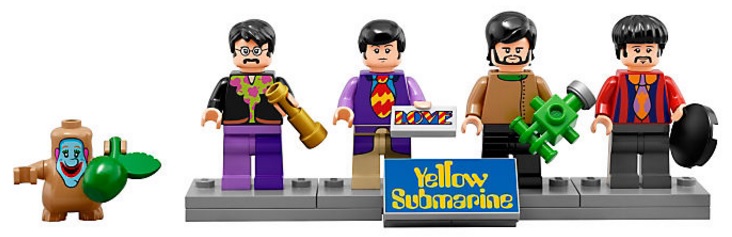
80.000 leagues beneath the sea is a happy place called Pepperland. Then the music-hating Blue Meanies arrive and freeze everybody and hide all instruments. Only Fred escapes in a yellow submarine which he takes straight to Liverpool to retrieve the four heroes known as the Beatles. This is the start of a series of psychedelic adventures as the crew pass through the Sea of Time, the Sea of Monsters, the Sea of Holes, Nowhere Land and eventually Pepperland. The Beatles did this film to complete the three picture deal they signed with United Artists. The voices are provided by actors and the Beatles only appear in a cameo appearance at the end. Like everything they touched, it became a pioneering work of pop art. Before Yellow Submarine, animation was considered a children’s medium, and this feature led to the art form being taken more seriously. Visually, it’s a stunning piece of work, and as opposed to their preceding films, it is well written with a truckload of references to Beatles lyrics. John Lennon said he thought this was the best Beatles film. I think he was right.





 FRAGMENTEN UIT HET SCHEMERLAND