Since the 17th century, the march of science has swept all before it. The route mapped out by Copernicus, Newton, Darwin and Einstein is dotted with numerous significant milestones along the way giving hope that, in time, even the remotest regions of the universe and the innermost secrets of the atom will be exposed by science…
Or will they? There is at least one mystery that has so far resisted the best efforts of scientists and philosophers alike: the human mind. This mind/body problem is arguably the thorniest of all philosophical issues.
We are all immediately conscious of our consciousness. We have thoughts, feelings, desires that are subjective and private to us. In stark contrast, science is triumphantly objective. So how can something as strange as consciousness conceivably exist in the physical world that is being exposed by science?
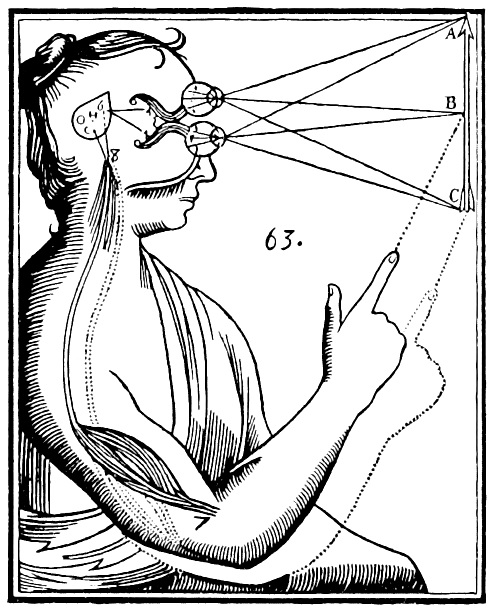
As in epistemology, the philosophy of knowledge, so in the philosophy of mind, the Frenchmen René Descartes made an impact in the 17th century that has reverberated through Western philosophy till this present day. Descartes’ refuge in the certainty of his own self naturally lead him to give an exalted status to mind in relation to everything in the world outside it. In metaphysical terms he conceived mind as an entirely distinct entity as mental substance whose essential nature is thinking. Everything else is matter or material substance whose defining characteristic is spatial extension a.i. filling physical space. Thus he envisioned two distinct realms; one of immaterial minds with mental properties such as thinking and feeling. Another of material bodies with physical properties such as mass and shape.
Problems for dualism
A desire to drink causes my arm to lift the glass. A drawing pin in my foot causes me pain. Mind and body interact. Mental effects bring about physical ones and vice versa. But the need for such interaction immediately casts doubt on the Cartesian picture. It is a basic scientific principle that a physical effect requires a physical cause. But by making mind and matter essentially different, Descartes appears to have made interaction impossible. Descartes himself recognized the problem, and realized it would take God’s intervention to enable the necessary causal relationship. But he did little else to resolve the issue.
Descartes younger contemporary and follower, Nicolas Malebranche, accepted the duality and took it upon himself to tackle the problem. His surprising resolution was to claim that interaction did not in fact occur at all. Instead, on every occasion when a conjunction of mental and physical interaction was required, God acted to make it happen. So creating the appearance of cause and effect. The awkwardness of this doctrine, known as occasionalism, got little support and serves mostly to highlight the seriousness of the problem it was intended to fix.
Idealism & physicalism
The obvious response to the difficulties facing the substance-dualism of Descartes, is to adopt a monistic approach to claim that there is only one kind of stuff in the world, either mental or physical. A few – most notably George Berkeley – have taken the idealist path claiming that reality consists of nothing but minds and their ideas. But the great majority – certainly amongst modern day philosophers have opted for some form of physicalist explanation. Driven on by the undeniable successes by science in other areas, the physicalist insists that the mind too must be brought within the purview of science and since the subject matter of science is exclusively physical, the mind must also be physical. The task then becomes to explain how mind – subjective and private – fits into a purely physical account of the world; objective and publically accessible.
Physicalism has taken a number of different forms. What they have in common is that they are all reductive. They claim to show that mental phenomena can be analyzed, fully and exhaustively, in purely physical terms. Advances in neuroscience have left little doubt that mental states are intimately related to states of the brain. The simplest cause for the physicalist is thus to claim that mental phenomena are actually identical to physical events and phenomena in the brain. The most radical versions of such identity theories are eliminative. They propose that – as out scientific knowledge advances – folk psychology, our ordinary ways of thinking and expressing our mental life in terms of believes, desires, intensions and so on, will disappear. They will be replaced by accurate descriptions and concepts drawn principally from neuroscience.
Physicalist solutions to the mind-body problem brush aside many of the difficulties of dualism at a stroke. Predictably, critics of physicalism complain that its proposers have brushed aside too much. That its successes have been achieved at the heaviest cost: a failing to capture the essence of conscious experience, its subjective nature.
Source: 50 philosophy ideas you really need to know, Ben Dupré
(Resolved)
Fast forward to present day 2017. Quite a few scientists have become frustrated with the failure of science to give an explanation for mind though the general public is not aware of this failure. Also, there is a growing body of evidence for consciousness existing separate from the physical brain and being continually present in the cosmos. This correlates precisely with cutting-edge physics, which posits that things in our time and space are not intrinsically real, but are manifestations of a hidden dimension where they exist in the forms of superstrings, information fields, and energy matrices.
I am personally convinced that the mind-body problem has already been resolved, and the exception amongst Western philosophers – George Berkeley – got it right. It will take a long time before the general paradigm is shifted though. This is a ‘the world is not flat’ type of turnaround that takes time for the science community and general population to digest.
See also: Free-Consciousness.com