The Good, the Bad and the Ugly

Director: Sergio Leone
Written by: Agenore Incrocci, Furio Scarpelli, Luciano Vincenzoni, Sergio Leone
Cast: Clint Eastwood, Lee Van Cleef, Eli Wallach

Year / Country: 1966, Italy, Spain, West Germany
Running Time: 171 mins.

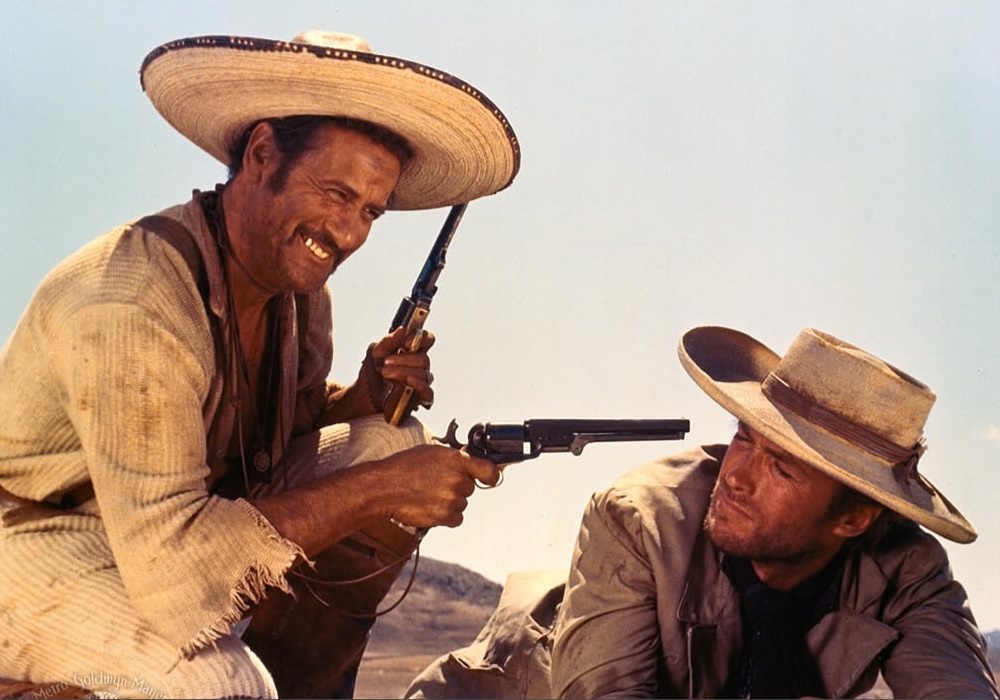
The final installment of Sergio Leone’s ‘Dollars Trilogy’ is a critically acclaimed masterpiece. Set against the backdrop of the American Civil War, three men are on a relentless quest for a fortune in hidden gold. While soldiers fight to determine the fate of a nation, these men pursue only their own interests. They are the Good, the Bad, and the Ugly. While the last two labels are fitting, the first is somewhat misleading – Eastwood’s character, Blondie, may be more principled than the others, but he doesn’t hesitate to kill when it serves his purpose.

Blondie and Tuco (the Ugly, played by Eli Wallach) form a crooked partnership built on mutual betrayal. After one double-cross nearly costs Blondie his life, they’re forced into a reluctant alliance when each comes into possession of a crucial piece of information that could lead them to the buried treasure. Meanwhile, Angel Eyes (the Bad, portrayed by Lee Van Cleef) is hot on their trail, determined to claim the gold for himself. The three men converge on a remote graveyard, where their fates – and the money – await.

Compared to the earlier two films in the trilogy, The Good, the Bad and the Ugly offers a surprisingly human touch. Eastwood’s Blondie reveals a gentler side, cradling a kitten in his hat and comforting a dying soldier with a cigar. Tuco, though undeniably a scoundrel, becomes unexpectedly poignant during a visit to the monastery where he confronts his estranged brother. This and other scenes flesh out Tuco into the trilogy’s most fully realized character, brought to life in a brilliant performance by Wallach. Despite the emotional depth, Leone doesn’t abandon his signature blend of dark humor and biting cynicism.

Visually, the film is a triumph. Leone’s mastery shines in the rhythmic interplay between intimate close-ups and sweeping, war-torn landscapes that seem to take on a character of their own – harsh and unforgiving, especially evident in the desert sequence where Blondie’s face is scorched by the sun. From the bold, stylized opening credits to the iconic, ritualistic cemetery shootout, the cinematography and editing are innovative and arresting. Add to that Ennio Morricone’s legendary score, and you have one of the most influential films of all time.

The Good, the Bad and the Ugly has been released in various versions, but nothing less than the full three-hour cut does it justice. Only in its complete form does this epic ‘horse opera’ truly come into its own. This is cinema as it was meant to be.

Rating:

Biography: Sergio Leone (1929, Rome – 1989, Rome) made his debut in the cinema working as a voluntary assistant and extra, among other things, in The Bicycle Thieves by Vittorio de Sica. Later, he became assistant director to Mario Bonnard. In 1959, when Bonnard was ill, he took over from him on the set of The Last Days of Pompeii. In 1961 he directed his first full-length film: The Colossus of Rhodes. But the film that was to bring him to the general attention came out in 1964: A Fistful of Dollars. His next films, For a Few Dollars More and The Good, The Bad and the Ugly complete what came to be known as the Dollars Trilogy and were a great box-office success. He would only make three more films before tragically passing away in 1989. He was taken from us by a heart attack in his house in Rome, while working on an ambitious project for a film on the Siege of Leningrad.

Filmography: The Colossus of Rhodes (1961), A Fistful of Dollars (1964), For a Few Dollars More (1965), The Good, The Bad and the Ugly (1966), Once Upon a Time in the West (1968), A Fistful of Dynamite (1971), Once Upon a Time in America (1984)


Miller’s Crossing (1990)


‘Up is down, black is white, and nothing is what it seems’

Directed by:
Joel Coen

Written by:
Joel Coen
Ethan Coen

Cast:
Gabriel Byrne (Tom Reagan), Marcia Gay Harden (Verna), John Turturro (Bernie Bernbaum), Jon Polito (Johnny Caspar), J.E. Freeman (Eddie Dane), Albert Finney (Leo), Mike Starr (Frankie), Al Mancini (Tic-Tac), Steve Buscemi (Mink), Richard Woods (Mayor Dale Levander)

‘I’m talkin’ about friendship. I’m talkin’ about character. I’m talkin’ about—hell, Leo, I ain’t embarrassed to use the word—I’m talkin’ about ethics.’ That’s how Italian crime boss Johnny Caspar (Jon Polito) begins his speech to Irish kingpin Leo O’Bannion (Albert Finney) in the opening of Miller’s Crossing. It immediately recalls the first scene of The Godfather, where undertaker Bonasera appeals in much the same way to Don Vito Corleone.

The favor Caspar asks of O’Bannion is permission to whack two-timing bookie Bernie Bernbaum (John Turturro). Leo refuses, since Bernie is the brother of Verna (Marcia Gay Harden), the woman he’s fallen in love with. Of course, Caspar wasn’t really asking permission—he was informing Leo as a courtesy, as he angrily makes clear after being turned down. Gangsters with ethics toward one another: that’s the foundation of Miller’s Crossing. When Leo breaks this unspoken code among the city’s corrupt rulers, the result is all-out war.

The theme of crooks with ethics is embodied in Leo’s right-hand man Tom Reagan (Gabriel Byrne), the film’s central character. He follows a personal code that only he fully understands. Though secretly having an affair with Verna, Tom – unlike Leo – believes Bernie should be handed over to the Italians. He knows that breaking the underworld code is bad for business. But Leo is stubborn, and their disagreement grows until Tom finally confesses the affair. Leo cuts ties, and Tom immediately shifts allegiance to Caspar. His motive, however, is not self-interest. Though finished with Leo, Tom’s loyalty to his old friend remains.

The web of deceit that quickly unfolds in Miller’s Crossing is complex enough to merit a second viewing. Adding to the intricacy are numerous characters referenced but rarely seen. Still, the story – drawn from Dashiell Hammett novels like ‘The Glass Key’ and ‘Red Harvest’, and infused with classic gangster and neo-noir elements – is masterfully told. The Coens integrate these influences into a killer script, ironically born from a period of writer’s block. Their trademark humor and eccentric characters are on full display, while the dialogue carries a poetic cadence that might even make Shakespeare jealous.

The plotlines themselves may not be original, but the Coens conjure a dreamlike world where, as the tagline promises, nothing is what it seems. The mood is unmistakably Irish – you can almost smell the whiskey. Carter Burwell’s haunting score, the gorgeous cinematography, and evocative settings all heighten the effect. The tone shifts effortlessly from cartoonish to brutally violent, without warning or transition.

The cast is uniformly excellent. Gabriel Byrne makes Tom a sympathetic bastard it’s hard not to root for; if I had to trade places with a Prohibition-era gangster, I’d pick him without hesitation. The supporting roles are just as strong, with John Turturro delivering a powerhouse turn as Bernie, a spineless schemer whose lack of ethics drives the story. Miller’s Crossing also reinvents the use of hats and overcoats. Not that there’s any hidden meaning – there’s nothing’s more foolish than looking for meaning in a hat.

Features a terrific cameo from the Coen’s friend Sam Raimi as a trigger happy cop.

Rating:

Quote:
Tom Reagan: Nobody knows anybody. Not that well.

Trivia:
The Coen Brothers suffered writer’s block while working on the script for Miller’s Crossing. They took a three-week break and wrote the script for their next movie Barton Fink during that time, about a writer with writer’s block. There are two references to Barton Fink in this film. The first one is the name of Tom Reagan’s residence called ‘The Barton Arms’. The second is a newspaper article that reads ‘Seven Dead in Hotel Fire’.

This Thing of Ours (2002)


‘21st Century Criminals, 21st Century Payoff…’

Directed by:
Danny Provenzano

Written by:
Ted A. Bohus
Danny Provenzano

Cast:
Frank Vincent (Danny Santini), Vincent Pastore (Skippy), Danny Provenzano (Nicholas Santini), Edward Lynch (Johnny Irish), Louis Vanaria (Austin Palermo), Christian Maelen (Robert Biaggio), Chuck Zito (Chuck), Michael DelGaizo (Patsy deGrazio), Pat Cooper (John Bruno), James Caan (Jimmy ‘the Con’)

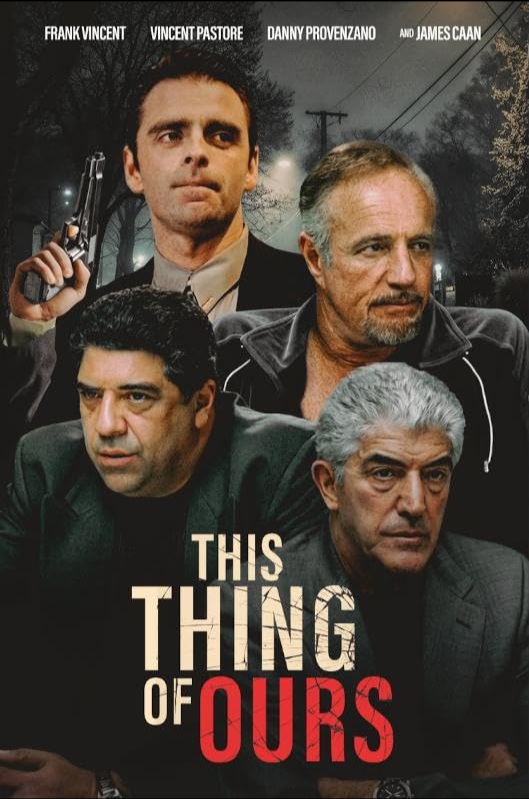
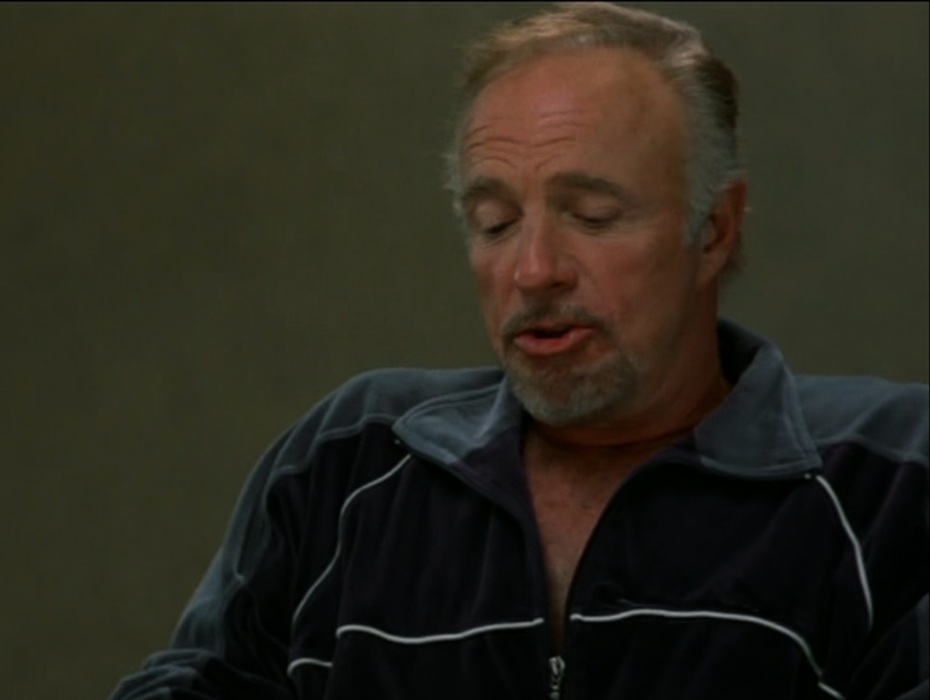
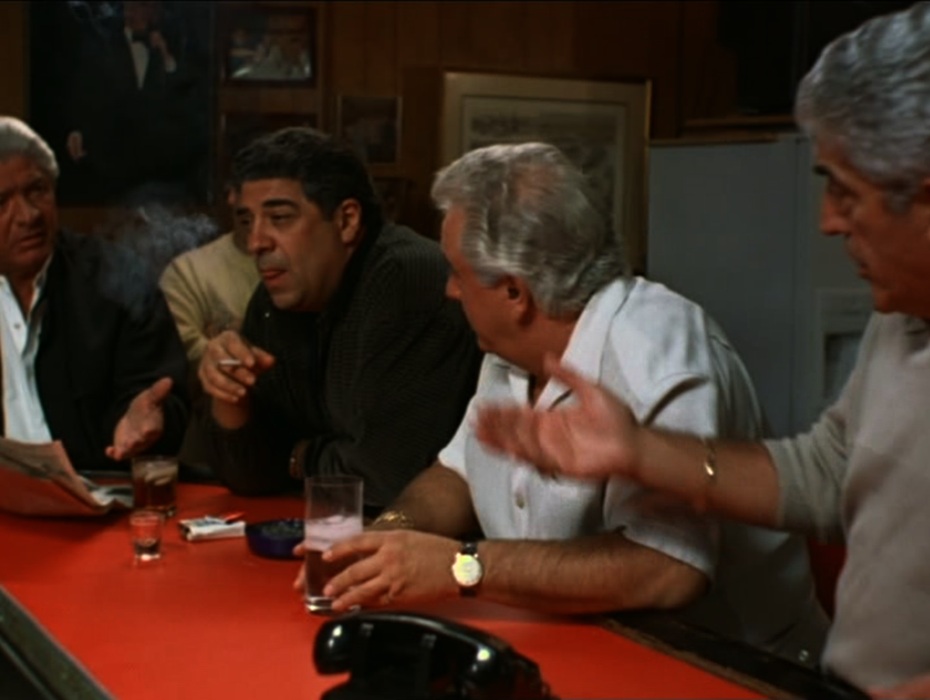
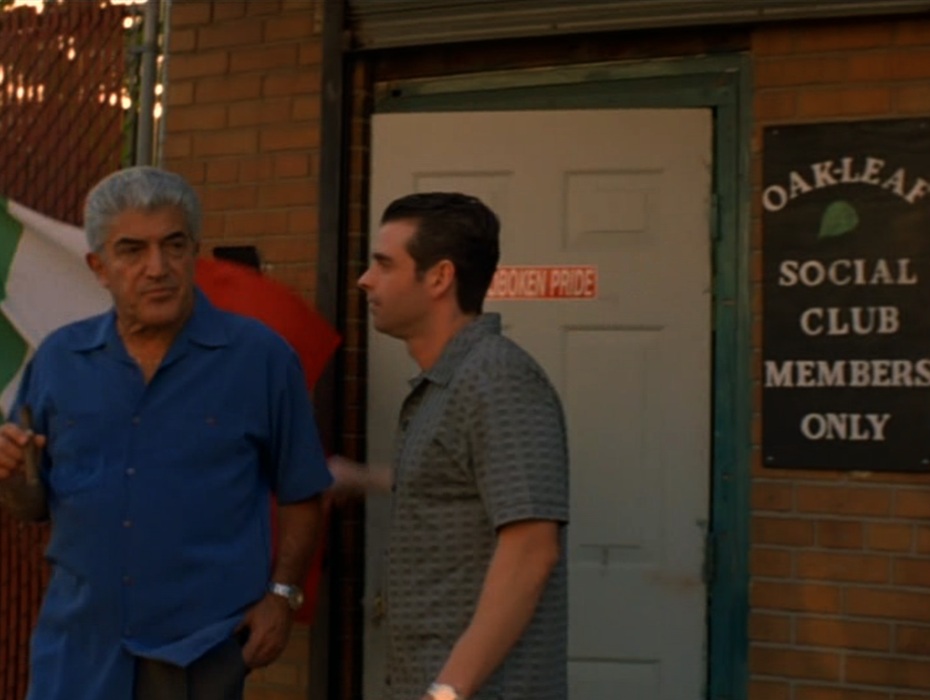
During the height of the phenomenon that was The Sopranos, this low budget independent mob movie was released starring many familiar mob actors, some of whom that were featured in the show, like Vincent Pastore (Big Pussy Ponpensiero), but also Frank Vincent – who would be introduced in The Sopranos two years later, and also James Caan (!), although he is just in one scene, yet featured on the cover in a clever marketing move.

But the film’s most intriguing element isn’t on-screen, it’s the backstory. Writer, director, and star Danny Provenzano was reportedly connected. His script was obviously strong enough to attract these mob-film veterans, yet he barely got to enjoy the release. Weeks before its nationwide theatrical debut, Provenzano pleaded guilty to racketeering and began serving a 10-year prison sentence.

Can wiseguys thrive in the 21st century? That’s the central question of the movie. Provenzano plays Nicky, a mobster with an ambitious plan: using a special microchip to transfer over a billion dollars to a secret Cuban bank account. His uncle Danny (Frank Vincent) must approve and finance the scheme. Success would bring not just massive profits but also a rise through the rigid ranks of their crime family. The problem is that both the FBI and rivals within their own family are making plans as well, leaving the multi-million-dollar heist balanced on a knife’s edge.

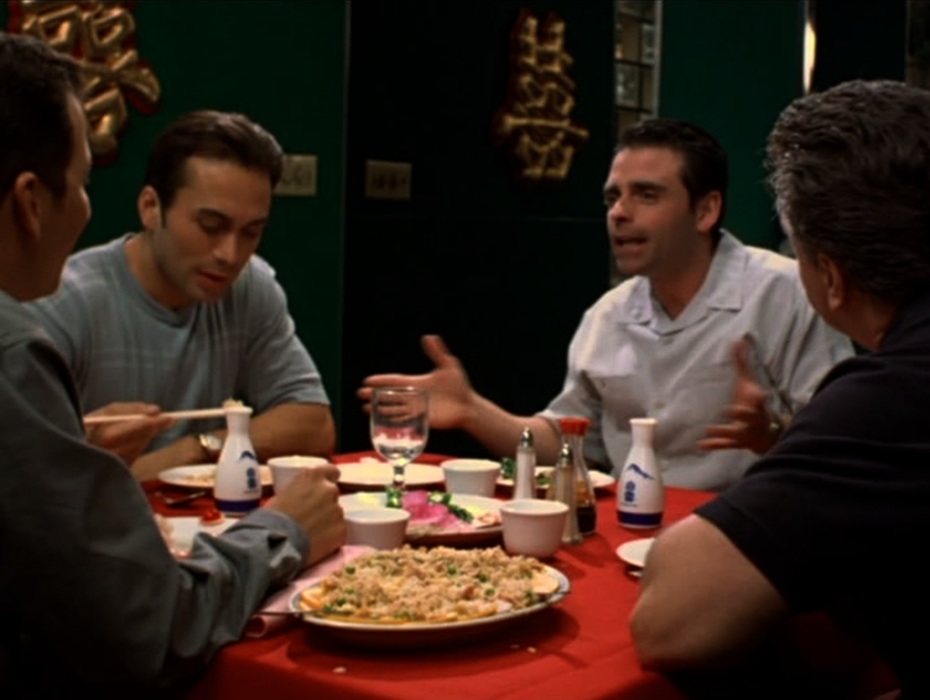
The concept is solid, but the execution stumbles. Only one scene truly delivers on the promise of 21st-century mobsters. This happens when Nicky and his crew pitch their digital heist to their greasy old bosses. The rest of the film offers the usual wiseguy dialogue and violence, none of it fresh. It adds nothing new to the overexploited genre, and Provenzano’s intended statement about the Cosa Nostra – whether they can adapt or if the life itself is a curse – never comes into focus.

Rating:

Quote:
ROBERT BIAGGIO: “It’s about time we brought that thing of ours into the 21st century, huh?”

Trivia:
Apart from mob veterans Frank Vincent, James Caan and Vincent Pastore, it also stars other mob regulars Joseph Rigano (Casino, Analyze This), Vinny Vella (Casino, The Sopranos), and Daniel P. Conte (GoodFellas, The Sopranos).

Faster, Pussycat! Kill! Kill!


SUPERWOMEN! Belted, buckled and BOOTED!

Director: Russ Meyer
Written by: Russ Meyer, Jack Moran
Cast: Tura Satana, Haji, Lori Williams, Sue Bernard

Year / Country: 1965, USA
Running Time: 83 mins.

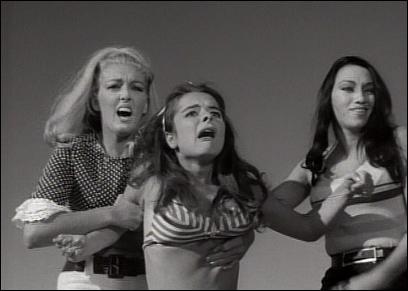
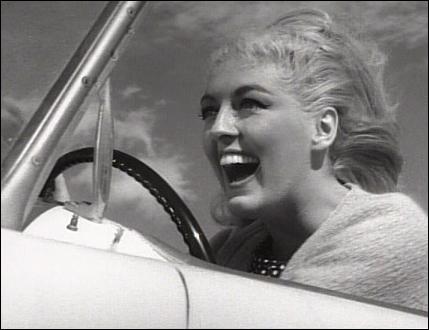
Three thrill-seeking superwomen, working as dancers in a go-go bar, set out on a violent odyssey through the desert, killing men along their way. They have a car each that they use to race against – or drive over their victims.

The women drug and kidnap a young girl after they have wasted her boyfriend. After that, they hatch the plan to rob a crippled father and his sons. These patronizing men deserve a lesson, but it soon becomes clear that this is a journey from which there is no return. Varla, the leader, deliberately goes down the path of her own self-destruction, dragging her two buxotic cohorts along with her.

In a time when men were still considered superior, these three women level the score. It is therefore a feminist film, despite the fact that these women are portrayed as sex objects. This female empowerment is typical for its director, Russ Meyer, the undisputed master of large breasted women, campy humour and sly satire.

Faster, Pussycat! Kill! Kill! stands as Meyer’s masterpiece, a cult movie pur sang. Funny, sexy, exploitative and provocative: a FilmDungeon favourite! They don’t make them like this anymore. Well Tarantino surely tries. But the originality and cult appeal of Faster, Pussycat! Kill! Kill! is rarely matched and never bettered. Watch these pussycats roar and love it!

Rating:

Biography: Russ Meyer (1922, California – 2004, California) is known primarily for making a large number of sexploitation flicks, such as Faster, Pussycat! Kill! Kill! and Vixen! He did almost everything – directing, writing, editing – himself. He even did the distribution of his own movies. In the cult / exploitation circuit his films did very well and made him more than enough money to continue his film career. In the late seventies, Meyer retired as a wealthy man. Many of his films are nowadays considered as cult classics.

Filmography: The French Peep Show (1950, short doc), The Immortal Mr. Teas (1959), The Naked Cinema (1961, short), Eve and the Handyman (1961), Erotica (1961), Wild Gals of the Naked West (1962), Skyscrapers and Brassieres (1963, short), Europe in the Raw (1963, doc), Heavenly Bodies (1963), Lorna (1964), Fanny Hill (1964), Mudhoney (1965), Faster, Pussycat! Kill! Kill! (1965), Motor Psycho (1965), Mondo Topless (1966), Common Law Cabin (1967), Good Morning… and Goodbye! (1967), Finders Keepers, Lovers Weepers! (1968), Vixen! (1968), Cherry, Harry & Raquel! (1970), Beyond the Valley of the Dolls (1970), The Seven Minutes (1971), Black Snake (1973), Supervixens (1975), Up! (1976), Beneath the Valley of the Ultra-Vixens (1979), Pandora Peaks (2001, short)