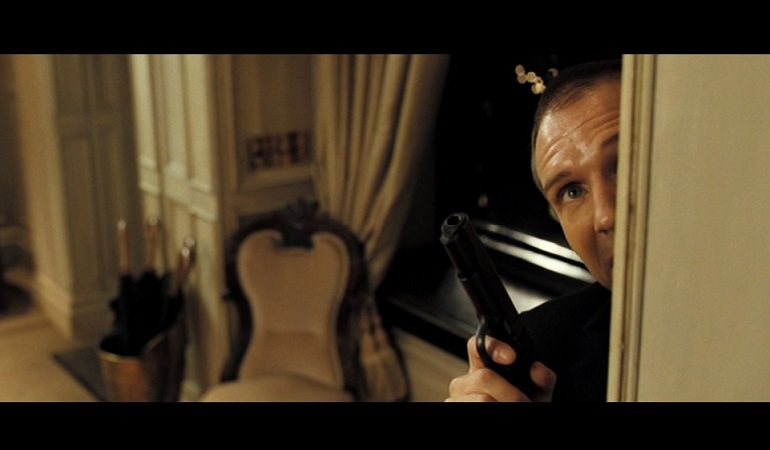
After Jackie Brown, Tarantino took a long break (six years), but when he returned, he did so with a vengeance. If you’re going to compare a Tarantino movie, you compare it to every other movie ever made that wasn’t made by Quintin Tarantino. By that standard, the two-part Kill Bill saga stands among the finest pieces of cinematic art of the century so far. Here, Tarantino does what he does best – lifting fragments from forgotten genre and exploitation cinema and fusing them into something wholly original – better than ever before. It’s a double-edged sword in many ways: a bold blend of Eastern and Western influences, effortlessly shifting between comic-book ultraviolence and moments of genuine emotional weight. This tonal balance works largely thanks to Uma Thurman’s superb central performance as The Bride, which anchors the madness with real feeling. The story itself is simple, yet utterly captivating. The characters are fascinating and endlessly quotable. The style is unmistakable and unmatched. Volume 1 plays like the ultimate samurai/yakuza/action movie of your childhood – the one you could watch endlessly – only somehow even better. Volume 2, by contrast, leans into the rhythms of a spaghetti western, offering more of Tarantino’s signature dialogue and a terrific performance by David Carradine, who reimagines his Kung Fu character Kwai Chang Caine as a pop culture loving and psychopathic mentor. Structured in ten chapters and told out of chronological order, Kill Bill unfolds as a true epic, packed with all of Tarantino’s hallmarks: razor-sharp humor, wax-museum characters, stylized violence, brilliant music choices, and a Pussy Wagon–load of pop culture references. The only Double Bill I actually experienced in theaters – back when Volume 2 was released in 2004 – and one I’ll never forget. Whenever The Whole Bloody Affair finally arrives in European theaters, I will be there for sure.
Categorie archief: Films
Double Bill #16: The Punisher & Showdown in Little Tokyo
Okay, these are not the best movies I’ve ever reviewed for this section. Still, they’re classic actioners from my favorite movie era: the glorious nineties. What they have in common is Dolph Lundgren taking on the Yakuza. Both films also feature a torture scene, and in both cases Lundgren escapes in much the same way, before giving his torturer a taste of his own medicine. In The Punisher (1989, Mark Goldblatt), based on the Marvel comic, the presumed-dead cop Frank Castle hunts down members of the Franco crime family for the murder of his own family (he’s already killed 125). The Francos, led by Giovanni Franco (Jeroen Krabbé), are under pressure as well from a ruthless Yakuza clan eager to take over their territory. In Showdown in Little Tokyo, Lundgren’s cop is likewise driven by revenge for the murder of his parents. This time he teams up with L.A. cop Brandon Lee of the Asian Task Force, and together they take on a Yakuza faction known as Tetsu No Tsume, or the Iron Claw. Frankly, Lundgren and Lee were B-choice action stars of this period, and these films are unmistakably B-style entertainment. That said, the villains are very well done. Lady Kanaka (Kim Miyori) in The Punisher especially leaves a strong impression. Furthermore, the non-stop action and violence are delivered in generous doses. In the end, this Double Bill may not be prestige cinema, but it’s a solid blast of grimy, old-school ’90s action that knows exactly what it is and never pretends otherwise.
Nice Dreams

Director: Tommy Chong
Written by: Tommy Chong, Cheech Marin
Cast: Cheech Marin, Tommy Chong, Stacy Keach The Sarge Stedanko
Year / Country: 1981, USA
Running Time: 88 mins.
In their third feature, once again directed by Tommy Chong himself, the duo is dealing marijuana cones from an ice-cream truck. Police Sgt. Stedanko (Stacy Keach), whom we first met in Up in Smoke, the original Cheech and Chong movie, is addicted to dope and convinced that getting high is the best way to nail his suspected drug peddlers. Meanwhile, lizards are crawling all over the plants of the duo’s suppliers, and Stedanko begins to develop distinctly lizard-like features of his own.
As comedians, Cheech and Chong are known for heavy improvisation. Some of it works better than the rest, and not every joke or line of dialogue lands. Still, the movie is worth the price of admission for the sequence in which they attempt to have a threesome with a Latina woman, only for her animal-hating Mexican husband to come home unexpectedly. It’s a terrific stretch of pure slapstick chaos.
The film is also packed with wonderfully oddball characters, including Paul Reubens as the uniquely weird Howie Hamburger Dude and Dr. Timothy Leary playing himself, sending the guys on one hell of an acid trip inside an insane asylum. Nice Dreams is a cultural time capsule, a groovy museum piece of curious eighties pop culture. These dudes really knew how to conjure comedy magic.
Rating:
![]()
Biography: Tommy Chong (1938, Edmonton, Canada) is a comedian, actor, writer, and activist best known as one half of the legendary stoner duo Cheech & Chong. Raised partly in Canada and later the United States, Chong first made his mark in music and improvisational comedy before teaming up with Cheech Marin in the late 1960s. Together, they became countercultural icons with hit comedy albums and films like Up in Smoke, shaping weed humor for generations to come. Beyond comedy, Chong has appeared in films and TV shows, including a memorable role on That ’70s Show, and has been a vocal advocate for cannabis legalization, even serving a brief prison sentence in the early 2000s that further cemented his status as a counterculture symbol.
Filmography: Cheech and Chong’s Next Movie (1980), Nice Dreams (1981), Still Smokin (1983), Cheech & Chong’s The Corsican Brothers (1984), Toto: Without Your Love (1986, Music Video), Far Out Man (1990)
Cheech and Chong’s Next Movie

Director: Tommy Chong
Written by: Tommy Chong, Cheech Marin
Cast: Cheech Marin, Tommy Chong, Evelyn Guerrero, Betty Kennedy
Year / Country: 1980, USA
Running Time: 99 mins.
After the extreme success of Up in Smoke, there just had to be a Next Movie for stoner duo Cheech & Chong. And from the opening moments – where the word “man” appears four times in the first three lines – you immediately know exactly what kind of movie you’re in for.
Once again, story takes a back seat. Cheech lands a date with the hot chiquita from the welfare office, while Chong hangs out with his Texan cousin Red (played by Cheech Marin), who arrives in L.A. carrying a massive bag of weed. From there, the film unfolds as a loose string of comedy sketches, nearly all of them revolving around drugs and general idiocy, set against the now familiar L.A. backdrop.
Highlights include a lowrider showdown, the systematic torment of their neighbors, and – because why not – an alien abduction in a marijuana field. As with most sketch-based comedies, some bits land better than others, but the tone is consistent throughout: unapologetically dumb, rude, hazy, and laid-back.
Critics were not impressed. Roger Ebert famously wrote, “This movie is embarrassing. There’s no invention in it, no imagination, no new comic vision, no ideas about what might be really funny.” He’s not wrong. And yet, the chemistry between Cheech and Chong remains endlessly watchable. In the end, the biggest joke may be the meta one: that these two lovable burnouts found an audience large enough – and devoted enough – to support an entire franchise built almost entirely on being this relaxed about effort.
Rating:
![]()
Biography: Tommy Chong (1938, Edmonton, Canada) is a comedian, actor, writer, and activist best known as one half of the legendary stoner duo Cheech & Chong. Raised partly in Canada and later the United States, Chong first made his mark in music and improvisational comedy before teaming up with Cheech Marin in the late 1960s. Together, they became countercultural icons with hit comedy albums and films like Up in Smoke, shaping weed humor for generations to come. Beyond comedy, Chong has appeared in films and TV shows, including a memorable role on That ’70s Show, and has been a vocal advocate for cannabis legalization, even serving a brief prison sentence in the early 2000s that further cemented his status as a counterculture symbol.
Filmography: Cheech and Chong’s Next Movie (1980), Nice Dreams (1981), Still Smokin (1983), Cheech & Chong’s The Corsican Brothers (1984), Toto: Without Your Love (1986, Music Video), Far Out Man (1990)