Apple TV Special: Mr. Scorsese

Mr. Scorsese is a five episode film portrait about one of the greatest film directors of all time now playing on Apple TV. It’s the most extensive documentary ever shot about the Italian American cinematic master, featuring interviews with a.o. Leonardo DiCaprio, Robert De Niro and Daniel Day Lewis. Reason enough for me to subscribe to Apple TV. An additional benefit of the subscription is that Marty’s latest film – Killers of the Flower Moon – is also available on the channel.

Scorsese is a very sympathetic guy; I have seen many interviews with him before, logical since he’s my favorite filmmaker, but in this series, you really get to know the man. He grew up in Little Italy and later Manhattan. He was very asthmatic as a child and he couldn’t play outside. There is this shot in GoodFellas where a young Henry Hill is staring out of the window observing the wiseguys outside. That’s Marty right there.

Movie theaters had air conditioning, so that’s where young Martin wanted to be as much as possible. He could breath there, and the movies formed his mind. At home he watched old Italian films with his family. He started making extensive storyboards which his father thought wasn’t very manly. Marty learned of the mobsters who controlled much of the economic activity in his neighbourhood. His father had a good job in the garment industry, which was worked out by the mob. He told young Marty: “Don’t ever let them do you a favor. They’re nothing but bloodsuckers.”

The young Scorsese initially wanted to become a priest, but that path wasn’t for him. Neither were the streets. Literature wasn’t part of his culture either, but a priest encouraged him and his friends to look beyond what they knew; to go to college, to read, learn, and explore. He attended a talk about film school and heard a professor speak passionately about cinema. That was the moment he knew what he wanted to do.

At New York film school he met Thelma Schoonmaker, his future editor. She recalls seeing his student work and knowing immediately that “he had it.” His student film It’s Not Just You, Murray! (1964) won the award for Best Student Film. In 1967 he made his first feature, Who’s That Knocking at My Door, starring Harvey Keitel.

Scorsese married young, but his first marriage collapsed quickly because his mind went more and more to making movies. He went to Hollywood to further his career and met an amazing assortment of talent there: Coppola, Schrader, Spielberg, Lucas and De Palma, known collectively as the ‘Movie Brats’. They were given this name because they were the first generation of formally trained filmmakers to unite film knowledge with artistic ambition.

In the early seventies, King of the B-movies Roger Corman gave Scorsese the chance to direct a movie. This became Boxcar Bertha (1972), a Bonnie and Clyde-style crime movie. His artistic friends hated it. Marty thought it was a good practice in shooting on budget and shooting on time, but his friends thought he had betrayed himself as an artist.

John Cassavetes had seen his feature Who’s That Knocking at My Door and advised him to make more personal movies like that. About Boxcar Bertha he said: “You just spent a year of your life making a piece of shit. Don’t do that again.” Scorsese showed him his Mean Streets screenplay and Cassavetes told him to go find a lead actor to star in it. Then he met De Niro who was from the same neighbourhood.

Mean Streets was based on people and experiences from his neighborhood and people fell in love with it, because it felt completely authentic. That makes sense, because it was real. Now, Marty got more opportunities. With his next film Alice Doesn’t Live Here Anymore (1974), he showed he could also direct women. Ellen Burstyn won the Academy Award for Best Actress for her lead role.

Although Scorsese gained recognition, this period also marked the start of heavy drug use. Film remained his way of working through deep inner turmoil. Drawn to darker characters, he was captivated by Paul Schrader’s script for Taxi Driver. He and De Niro set out to portray a loner like Travis Bickle without turning him into a caricature. Travis is isolated in almost every frame. Taxi Driver (1976) was a huge critical success and won the Palme d’Or.

Everybody praised it. It hit a nerve and showed a true understanding of the American unconscious. A lone man who commits atrocities, like the snipers who killed politicians at that time. Travis has a saviour complex: he wants to save the girls and kill the bad guys. The final scene was too violent for the sensors, so Scorsese changed the colour of the blood to dark, rusty brown or brownish-pink rather than bright red. Daniel Day Lewis was hypnotized by the film and went to see it five or six times. It was the first time he saw Bob (De Niro) act, which was a big thing for him.

After the success of Taxi Driver, he made the costly musical failure New York, New York (1977). His second marriage also fell apart and what started then was a period of self destructive behavior. He started doing lots of drugs and tried to find his cinematic muse again. He almost died – and part of him wanted to because he didn’t know how to create anymore. De Niro had a big part in getting him back on his feet. They went to Sint Maarten where they worked on the script for their next masterpiece: Raging Bull (1980).

Thelma Schoonmaker explains the film’s shooting and editing, and the documentary allows you to rediscover the beauty of its black-and-white imagery. It’s a true work of art. Scorsese had found his muse again, and also his third wife: the daughter of Ingrid Bergman and Roberto Rossellini.

After Raging Bull he wanted to do Gangs of New York and The Last Temptation of Christ. The scripts were there, but the movies were too expensive to make at that time. He did another project with De Niro, The King of Comedy (1982), which flopped. Scorsese’s career was now once again in a bad state. “He was done for in Hollywood”, they told him.

He made a comeback with After Hours (1985), an odd ball comedy shot on a low budget. Key to the film, Scorsese explains, was the collaboration with Director of Photography Michael Ballhaus, who would later shoot GoodFellas. In 1985, he married for the fourth time, this time with Barbara De Fina, who would produce a number of his movies, including Casino.
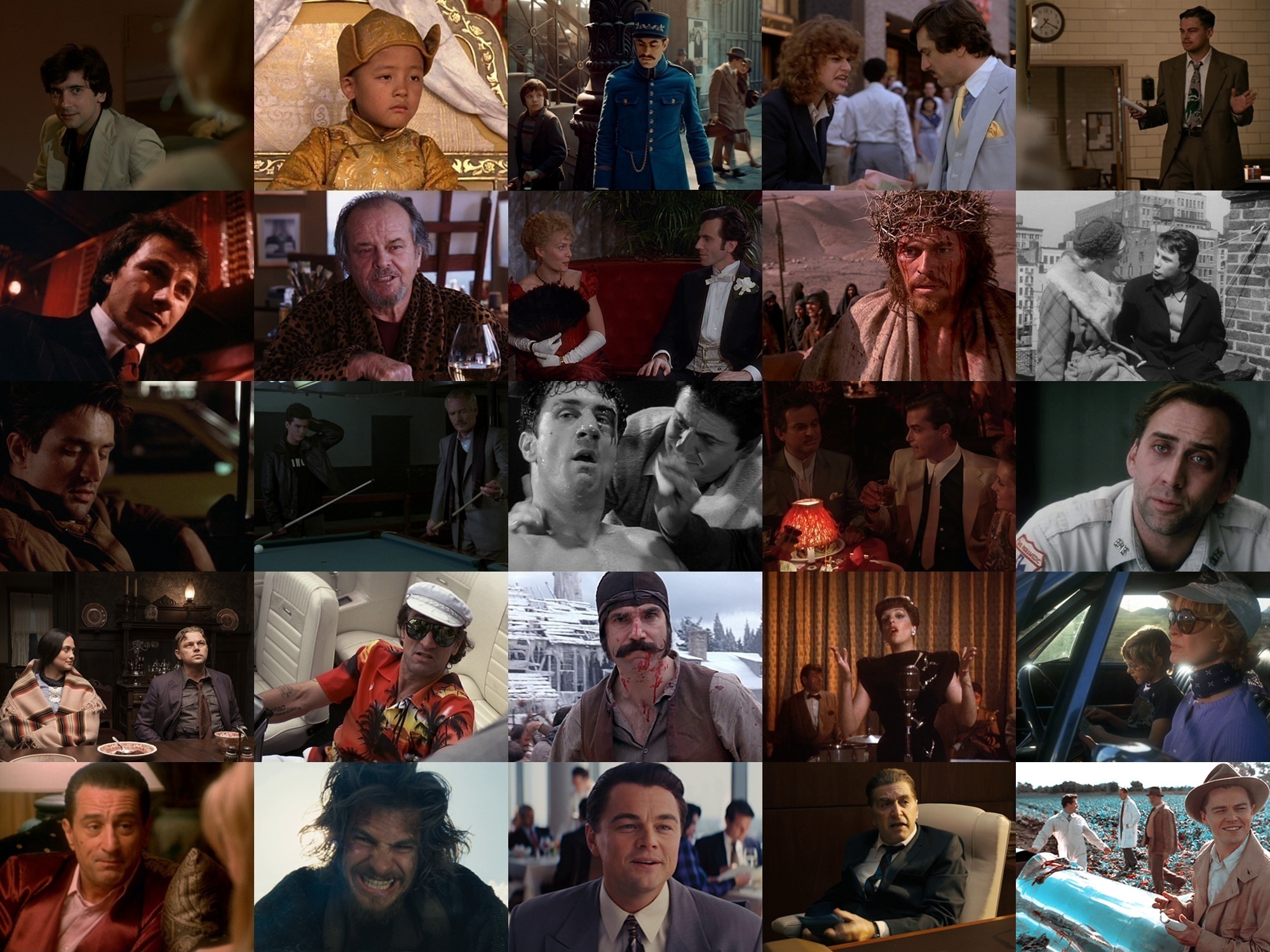
The re-established Scorsese followed up After Hours with The Color of Money (1986), a pool hall movie starring Paul Newman and Tom Cruise, and a sequel to The Hustler (1961). The movie did well, so now Scorsese could finally make his beloved project The Last Temptation of Christ (1988). He made the film to “get to know Christ better”, he explains.

The budget was tight, so he could only do two takes of every shot during the difficult shoot in Morocco. It was very tough, he says. Even tougher was the reception of the film: people were very upset. It was banned in Rome, Israel, and India – and someone set off a bomb during a screening in Paris. Blockbuster didn’t carry the film. Marty needed FBI protection for the second time (he had gotten threats after Taxi Driver and had needed protection then as well).

While working on The Color of Money, Scorsese read Wiseguy by Nicholas Pileggi, the true story of mobster Henry Hill and his life within the Lucchese crime family. Pileggi and Scorsese had both grown up in the same neighborhood and collaborated on the screenplay for GoodFellas. Scorsese had the film fully mapped out in his head – frame by frame, song by song. The result is pure montage, weightless and electric. Scorsese created a new cinematic language for this movie. “It has this crazy energy”, says Spielberg. “Like a runaway train.”

Previews strangely enough saw a lot of walk-outs. Executives wanted him to cut out the last twenty minutes, which is the whole cocaine sequence. Marty stood up to them and saved the movie. God bless him.

After GoodFellas, Scorsese worked with De Niro again in Cape Fear (1991), a successful remake of the 1962 thriller – and in 1995 they made another mob masterpiece with Casino. It’s about mob guys who were given paradise with Las Vegas – but they got kicked out of paradise because they are so evil. The movie has a unique structure like GoodFellas, but it takes it one step further.

In between, he explored another closed society with The Age of Innocence (1993), his first collaboration with Daniel Day-Lewis. It’s about a man imprisoned by the culture he belongs to, and a great love doomed to remain unconsummated.

In 1997, he returned to another genre he loved to do: the spiritual film. Kundun (1997) is about the Dalai Lama in Tibet. There were no actors in that country, so he had to get all these performances out of non-actors. The film was panned-down as dull. Then came Bringing Out the Dead, a loose follow-up to Taxi Driver, but it was still born at the box office.

Scorsese was dead again, but then who came knocking? Leonardo DiCaprio was now Hollywood’s new golden boy, a guaranteed name for box office success – and a movie star with resources to invest in the projects he chose to star in. Now, Scorsese finally got the opportunity to make his long awaited dream: Gangs of New York (2002).

The film reconstructs 1860s New York in massive sets built in Rome. This was the Five Points neighbourhood, which was dominated by gangs. Scorsese calls it science fiction in reverse. George Lucas came to visit the sets and said that “this is the last time sets like this will ever be built”.

The film has an uncanny reverence to today’s political violence, with the natives who can be seen as the proud boys of that time. People who claim to be the only true Americans and are prepared to use savage violence on immigrants.

Fortunately, the very expensive film – that was produced by Harvey Weinstein – did well at the box office.

He continued to work with DiCaprio, first on The Aviator (2004), a biopic about Howard Hughes, a man obsessed with filmmaking and aviation. The film received 11 Oscar nominations, and then it dawned on the film community that Scorsese never won an Oscar. But, even though The Aviator won in nearly every category, it lost the director award to Clint Eastwood for Million Dollar Baby.

But two years later, they made it up by giving him the Oscar for The Departed (2006), another gangster film. It was awarded to him by his old friends George Lucas, Steven Spielberg and Francis Ford Coppola – a bittersweet moment. In 2010, he made another film with DiCaprio, Shutter Island. And to complete the streak with Leo, he made The Wolf of Wall Street (2013), a commentary on how excessive and moralless capitalism has overtaken our society.

Marty once again portrays the dark side of human nature in all its forms, including terrible domestic violence. Scorsese has often been accused of glorifying bad behavior, but another way to see his work is that he refuses to sanitize human nature. The Wolf of Wall Street was a massive success, tapping directly into post-financial-crisis anger.

The documentary concludes with The Irishman (2019) and early footage from Killers of the Flower Moon (2023). We also see Scorsese at home, caring for his fifth and final wife, Helen Schermerhorn Morris, who suffers from Parkinson’s disease. It’s deeply moving to see the great filmmaker in this intimate setting.

Steven Spielberg provides the perfect closing tribute for this must-see documentary about the legendary director: “There is only one Marty Scorsese. He is a cornerstone of this art form. There is nobody like him and there will never be anybody like him again.”

Indeed.
The 20 Greatest Ultra Villains in Movies

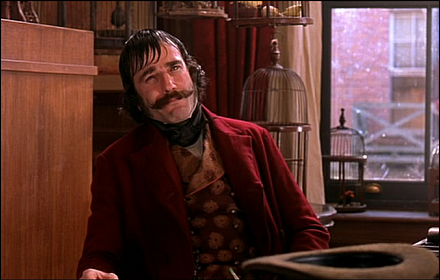
20. Bill the Butcher

Played by: Daniel Day-Lewis
Film(s): Gangs of New York (2002)
Line: ‘Ears and noses will be the trophies of the day. But no hand shall touch him.’

Nothing goes too far for William ‘Bill the Butcher’ Cutting in his personal mission to oppress the new immigrants whom Bill sees as mere cockroaches. His name is very appropriate: whenever he joins the street fights, he slaughters enemies by the dozens using his vast set of knives and stabbing weapons. He shows a softer side around Amsterdam, who he sees as the son he never had, but in the end, Bill is a bad man. Played to perfection by Daniel Day Lewis.

19. Mr. Joshua

Played by: Gary Busey
Film(s): Lethal Weapon (1987)
Line: ‘See, Martin, we have a problem. Since we have Murtaugh, we don’t really need you. But I believe in being thorough.’

The ultra blond Mr. Joshua is pretty much a badass. He shows his macho behavior in his intro-scene by letting his employer hold a lighter under his arm for a pretty long time. Riggs and Murtaugh have a lot of trouble with this ex-commando. In his mission to smuggle heroin into the United States, he lets nothing or nobody get in his way. He scores extra points for his pretty good fighting skills.

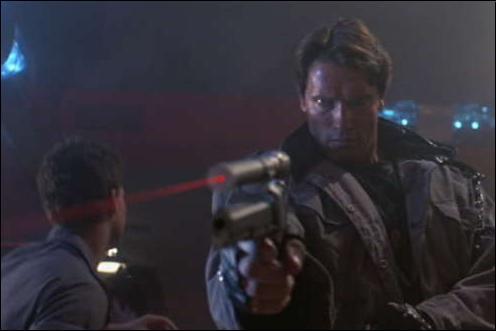
18. The Terminator

Played by: Arnold Schwarzenegger
Film(s): The Terminator (1984)
Line: ‘Your clothes – give them to me, now.’

Schwarzenegger is perfectly cast as a killing machine. The Terminator is one scary motherfucker. ‘Sarah Connor? Yes. Boom!!!’ He is efficient and unstoppable. The perfect invention really. James Cameron (director) and Stan Winston (special effects) have really outdone themselves. The highlight? There are many, but Schwarzenegger barging in the police station killing everybody is pretty damn exciting.

17. Amon Goeth

Played by: Ralph Fiennes
Film(s): Schindler’s List (1993)
Line: ‘Ah, an educated Jew… like Karl Marx himself. Unterscharfuehrer! Shoot her.’

Can a psycho Nazi killer still be charismatic? Leave it to Ralph Fiennes to pull it off. Even though Goeth commits horrible acts and certainly deserves to die for it, he can be touching in a strange and remote way. A truly remarkable bad guy, right up until his ‘Heil Hitler’ sent off.

16. Judge Doom

Played by: Christopher Lloyd
Film(s): Who Framed Roger Rabbit (1988)
Line: ‘Soon, where Toon Town once stood will be a string of gas stations, inexpensive motels, restaurants that serve rapidly prepared food.’

Christopher Lloyd who nailed the ultimately sympathetic ‘Doc’ in Back to the Future, plays a really scary dude here. Judge Doom is one malicious bastard and the type of villain we could use more of: wacky, evil-lookin’ and carrying a dark secret. Brilliant character in a brilliant movie.

15. Anton Chigurh

Played by: Javier Bardem
Film(s): No Country for Old Men (2007)
Line: ‘What’s the most you have ever lost in a coin toss?’

Chigurh is one weird psycho killer for sure. Armed with an oxygen tank and a shotgun he makes life very difficult for the people in the wasteland of the Texas-Nevada borderlands His entrance in No Country for Old Men alone is enough to earn him this position. Add to that his terrible haircut, his deep voice and his seemingly random killing spree and you got an A-grade villain that’s just hard to forget.

14. Freddy Krueger

Played by: Robert Englund
Film(s): A Nightmare on Elm Street series (1984-2003)
Line: ‘I’m your boyfriend now, Nancy.’

The child murdering Freddy literally gives his victims nightmares. Both his burned face and his evil mind tricks can make everybody crap their pants. Freddy is without a doubt the greatest supernatural killer to ever appear on the white screen.

13. Annie Wilkes

Played by: Kathy Bates
Film(s): Misery (1990)
Line: ‘You! You dirty bird! How could you?’

Pour Paul Sheldon. Being captured by his greatest fan is a nightmare beyond imagination. He is constantly walking on eggshells as the slightest provocation will set off Annie Wilkes big time. It’s hard to say what kind of disorder she actually ‘suffers’ from, but there is no doubt that she is completely batshit.

12. Skeletor

Played by: Frank Langella
Film(s): Masters of the Universe (1987)
Line: ‘I am Skeletor.’

Masters of the Universe is no masterpiece, but Frank Langella really elevates the movie with his highly enjoyable appearance. His portrayal of Skeletor, who was already a favorite villain in cartoons, became a most memorable bad guy. His looks are spot on, and he rules his underlings with an iron fist. It’s a total shame that He-Man kicks him into a dark, deep shaft at the end of the movie.

11. Saruman

Played by: Christopher Lee
Film(s): The Lord of the Rings Trilogy (2001 / 2002 / 2003)
Line: ‘Hunt them down! Do not stop until they are found. You do not know pain, you do not know fear. You’ll taste men-flesh!’

While Sauron may be the real bad guy in The Lord of the Rings, Saruman makes a far greater impression. His voice is perhaps his greatest asset. The way he utters spells and commands is just the ultimate in evil cool. Christopher Lee, almost 80 when he played this, is remarkable in the role that he was born to play. When it comes to evil old wizards surrounded by Orcs, Saruman is the man.

10. Agent Smith

Played by: Hugo Weaving
Film(s): The Matrix (1999) / The Matrix Reloaded (2003) / The Matrix Revolutions (2003)
Line: ‘I will enjoy watching you die…Mr. Anderson.’

Who ever thought a software application could be this menacing? Smith may be funny with his monotone voice and robotic locomotion, but he can be vicious as well. It’s really hard to relax with this guy around, and he is always around. When you think he’s finally gone, he returns with clone abilities. Smith is an unstoppable force of destruction and can ultimately be only stopped by himself. Now that’s pretty bad.

9. Clarence Boddicker

Played by: Kurtwood Smith
Film(s): RoboCop (1987)
Line: ‘Can you fly Bobby?’

It’s not exactly his looks that make Clarence Boddicker ultra villain material. It is his ruthless and merciless attitude. He first shows his vileness, when he kicks one of his wounded cronies out of a moving truck. Soon after, he displays a real sadistic streak when he brutally murders Murphy. Although he’s a street level boss, he meets personally with Dick Jones, Vice President at OCP (Omni Consumer Products) showing he is also an intelligent and competent gang leader.

8. T-1000

Played by: Robert Patrick
Film(s): Terminator 2: Judgment Day (1991)
Line: ‘Thank you for your cooperation.’

Robert Patrick as the liquid metal T-1000 is an example of perfect casting. This unstoppable and constantly morphing killing machine is pretty scary at times. The fact that he is wearing a police uniform makes this even worse. Rather than ‘protect and serve’, he fanatically chases John Connor around while killing everybody that gets in his way. Glad to have Schwarzenegger around, the only one with a remote chance to stop it. Now that’s pretty telling.

7. Bill

Played by: David Carradine
Film(s): Kill Bill: Vol. 1 (2003) / Kill Bill: Vol. 2 (2004)
Line: ‘Do you find me sadistic?’

Bill is a murderous bastard, but he can be honorable as well. When the Bride arrives to take revenge on Bill for shooting her in the head, he grants her one night with her daughter, who she had presumed to be dead. Make no mistake though, in the duel that follows he would have killed her without mercy if it hadn’t been for her special skills. A classic villain who gets extra points for his great knowledge of martial arts and pop culture.

6. Major Arnold Toht

Played by: Ronald Lacey
Film(s): Raiders of the Lost Ark (1981)
Line: ‘You Americans, you’re all the same. Always overdressing for the wrong occasions.’

The boring communists in The Kingdom of the Crystal Skull showed again what great villains Nazi’s can be. Major Toht is an absolute favorite. A very unpleasant appearance and an equally disturbing voice can make someone cringe. It’s a true relief when his face starts melting towards the end of Raiders of the Lost Ark.

5. Emperor Palpatine

Played by: Ian McDiarmid
Film(s): Star Wars: Episode VI – Return of the Jedi (1983)
Line: ‘Welcome young Skywalker. I’m looking forward to completing your training. In time, you will call me…master!’

While the Ewoks made Return of the Jedi just a little too child friendly, Ian McDiarmid restored the balance with his dark portrayal of the Emperor. Allegedly, serial killer Jeffrey Damner was a huge fan of Palpatine. This figures, because Palpatine is a true incarnation of evil. Every line he utters comes out as pure poison. He is often underestimated because of his fragile old appearance, but make no mistake! When Palpatine starts using his dark side force techniques there is nobody who can stop him. Well there’s always one.

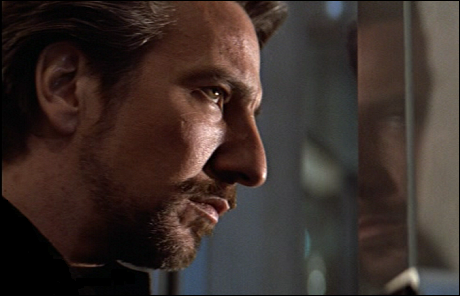
4. Hans Gruber

Played by: Alan Rickman
Film(s): Die Hard (1988)
Line: ‘Nice suit. John Phillips, London. I have two myself. Rumor has it Arafat buys his there.’

Another German villain to make the list. It is just hard to ignore their bad guy potential. Hans Gruber is the perfect baddie against Bruce Willis’ hero John McClane. He is both ruthless and smart, but certainly not without a sense of humor and style. You gotta hand it to this guy. Up till now, the Die Hard creators haven’t yet found a suitable replacement for him as the villains in the four sequels all made far less of an impression.

3. Frank

Played by: Henry Fonda
Film(s): Once Upon a Time in the West (1968)
Line: ‘I could crush you like a wormy apple.’

Not a businessman but ‘just a man’. If that is true, humanity is truly fucked. Look at Frank’s sins: killing a young boy in his first appearance, raping Jill McBain and off course the thing he did to royally piss off Harmonica. Nobody figured the sympathetic Henry Fonda could play a bad guy this well. He proved them dead wrong. Frank is one of the most accomplished villains ever, and Fonda should have won an Oscar for the part.

2. Dr. Hannibal Lecter

Played by: Anthony Hopkins
Film(s): The Silence of the Lambs (1991)
Line: ‘I’m having an old friend for dinner.’

Anthony Hopkins delivers a wicked and Oscar-winning performance as Dr. Hannibal Lecter. Charming, extremely intelligent, psychically strong: Lecter has it all. One of the few baddies in this list who actually survives the films he is in, Lecter stands above the regular laws of good and evil. He just does what he does. His character has been exploited a little too much in modern cinema and literature, but his turn in The Silence of the Lambs remains one of the most chilling and spellbinding performances ever in cinema history.

1. Darth Vader

Played by: David Prowse, James Earl Jones (voice)
Film(s): Star Wars Trilogy (1977 / 1980 / 1883)
Line: ‘If you only knew the power of the dark side.’

Its villains have always been the best thing about Star Wars, but Darth Vader is the baddest motherfucker of them all. It is hard to say which is cooler; his voice (and breathing), his name or his appearance. His introduction in A New Hope alone makes him the best movie villain ever. But he also has a fair share in fighting skills, force power and strategy. Just a fantastic character altogether.

De enige acteur die drie Oscars won

Daniel Day Lewis (1957) groeide op in het Londen van de jaren 60’. Zijn vader was een bekend dichter. Hij kreeg een voorname opvoeding met veel aandacht voor welbespraaktheid, maar nauwelijks of geen affectie. Zijn opa was de oprichter van de bekende Britse Ealing Studios, een ouderwetse, intimiderende man die het maar niks vond dat zijn dochter actrice werd. Met een opa als studiobaas, vader als literaire hoogvlieger en moeder als actrice, werd de filmkunst al jong ingeprent bij Daniel.

Maar hij begon zoals vele Britse acteurs in het theater. Hij studeerde aan de toneelschool in Bristol waar ook zijn moeder had gestudeerd. Daarna trad hij toe tot de elite van de Britse toneelwereld; de Royal Shakespeare Company. Hij beschrijft deze elite als een ‘bespottelijke cultuur’ en ging er gebukt onder dat hij er deel van uitmaakte.

Hij kreeg zijn eerste filmrol in Sunday Bloody Sunday en speelde vervolgens in veel BBC kostuumdrama’s. Op de planken speelde hij Hamlet, de vuurproef die alle beroemde Britse acteurs moesten doorstaan. Dit riep veel bij hem op vanwege het vader-element (zijn eigen vader overleed voordat hij bekend werd als acteur). Zeven maanden lang speelde Daniel avond aan avond de Deense prins en dat drukte zwaar op hem. Op een avond bezweek hij tijdens de voorstelling en dat was de laatste keer dat hij Hamlet speelde.

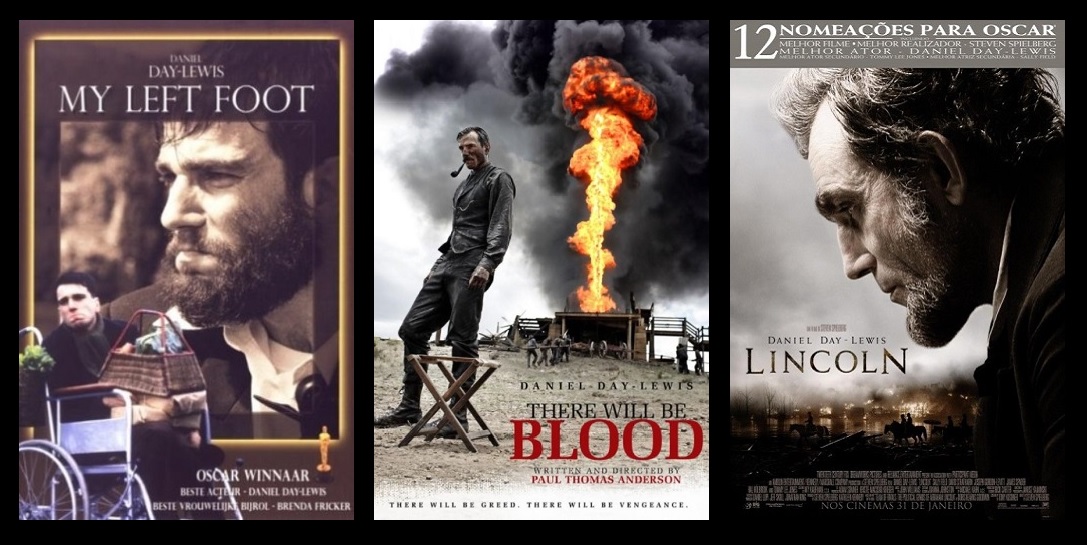
Zijn volgende fase was een serieuze carrière als filmacteur. In My Left Foot gaf hij alles om een verlamde schilder gestalte te geven in een waargebeurd verhaal. Hij viel als een blok voor dit personage en leefde maanden als invalide om het optreden zo realistisch mogelijk te maken. Hij at uitsluitend nog met een theelepeltje. Het leverde hem zijn eerste beeldje op.

De aanpak van Day Lewis om in de huid van een personage te kruipen zette hij voort in zijn volgende rollen. Bijvoorbeeld in Gangs of New York als bendeleider Bill the Butcher. Hij leerde alles over messen en het bewerken van vlees en zijn medespelers vonden hem griezelig in het contact. Of in zijn rol in The Boxer waarvoor hij zoveel trainde dat hij het volgens professionals wel tot de top 10 in de klasse middengewicht had kunnen schoppen. Daniel Day Lewis dompelt zich als acteur helemaal onder in een personage en in een wereld. Zo ontstaat leven dat via hem tot uitdrukking komt.

De voorbereiding van een rol en het optreden putten hem wel steeds helemaal uit, dus nam hij vaak lange pauzes tussen de films die hij koos. In die tijd verdween hij van de radar en ging hij werken als timmerman of schoenmaker in Italië. Hierdoor ontstond een legendarische status rond de acteur. In There Will Be Blood – de tweede rol waarvoor hij een Oscar ontving – kon hij zijn woede, die nog in hem zat door zijn jeugd, een uitlaatklep geven. Dat is een voordeel van het beroep; hij kan zijn verborgen kanten ontdekken, zei de acteur. Maar er is ook een keerzijde; zijn optreden in My Left Foot leverde hem bijvoorbeeld een chronisch pijnprobleem op.

De legendarische regisseur Steven Spielberg wilde niemand anders dan Daniel Day Lewis voor de rol van president Lincoln en hij moest negen jaar op hem wachten. Toen was Daniel klaar voor de rol van zijn leven die wederom goed was voor een Oscar voor Beste Mannelijke Hoofdrol. Daarmee liet hij zijn leermeesters, inclusief zijn favoriete acteur Marlon Brando, achter zich.

Zijn laatste film was Phantom Thread uit 2017 van Paul Thomas Anderson waarin hij de complexe kleermaker Reynolds Woodcock portretteerde. Daarna heeft hij zich met zijn vrouw teruggetrokken in het rustige Ierland. Hij heeft nooit van drukte gehouden of om beroemdheid gegeven. Zijn acteren gebruikte hij als therapie om momenten uit zijn jeugd terug te halen. Maar het lijkt erop dat hij genoeg therapie heeft gehad. Daniel is met pensioen en het is maar zeer de vraag of we de acteur ooit nog terug gaan zien op het witte doek. Zijn nalatenschap geeft in ieder geval genoeg stof om nog lang van te genieten en voor andere acteurs om te benijden.

Acteur Daniel Day-Lewis – De erfgenaam
Avro Tros | Close Up | 26 jan 2022
Zie: https://www.avrotros.nl/close-up/gemist/detail/acteur-daniel-day-lewis-de-erfgenaam/

Academy Award voor beste vrouwelijke hoofdrol
Het record voor het vaakst winnen van de Oscar voor beste vrouwelijke hoofdrol staat op vier. Katharine Hepburn mocht maar liefst vier keer met het beeldje naar huis gaan. Frances McDormand won net als Daniel Day Lewis drie Oscars voor beste vrouwelijke hoofdrol. Er zijn in totaal dertien actrices die er twee wonnen. Meryl Streep is de recordhoudster voor de meeste nominaties (zeventien).

1932/1933: Katharine Hepburn (Morning Glory)
1967: Katharine Hepburn (Guess Who’s Coming to Dinner)
1968: Katharine Hepburn (The Lion in Winter)
1981: Katharine Hepburn (On Golden Pond)

1996: Frances McDormand (Fargo)
2017: Frances McDormand (Three Billboards Outside Ebbing, Missouri)
2020: Frances McDormand (Nomadland)

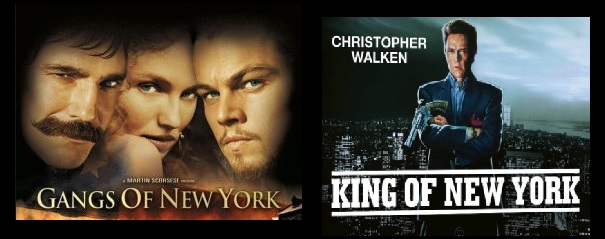
Gangs of New York Vs. King of New York

Gangs of New York
Historisch epos van Martin Scorsese over kolonisatie in New York gedurende halverwege de 18de eeuw. Destijds waren de verwachtingen erg hoog en als gevolg viel de film wat tegen, maar een herevaluatie is op zijn plaats. Amerika is echt gebouwd op bloed en dat zie je hier in al zijn glorie. Briljant zijn de kostuums, de sets, het camerawerk en de legendarische vertolking van Bill the Butcher door Daniel Day Lewis.

King of New York
Een gangster film geschoten als vampierfilm. De psychopathische drugsbaas Frank White – briljante vertolking van Christopher Walken – neemt de macht over in New York. Een groep agenten die er niet voor terugdeinzen zelf te moorden zit achter hem aan. Donkere visie op de misdaad van filmmaker en kunstenaar Abel Ferrara met een uitstekend script en ditto cast.

Als je er maar één mag kijken, welke wordt het dan?
Beide zijn het net geen perfecte films, en hebben ze een paar dingen die niet goed werken. In ‘Gangs’ o.a. het optreden van Cameron Diaz en in ‘King’ is het einde niet optimaal. Toch zijn beide wel behoorlijk essentieel. Met het pistool op het hoofd dan maar ‘Gangs’ vanwege de geschiedenisles die je bij blijft.