Double Bill #11: The Truman Show & The Matrix

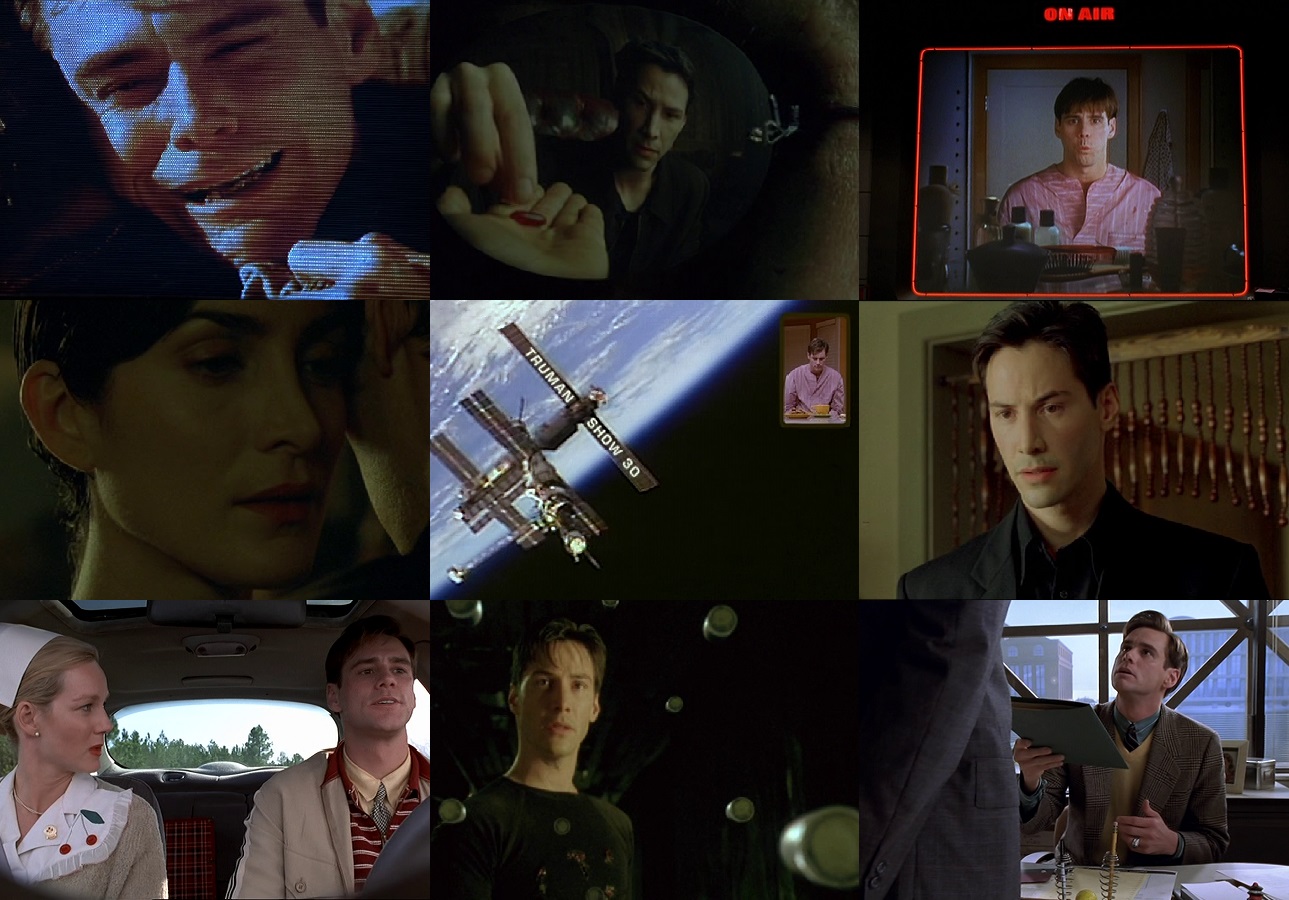
Two masterpieces from the late ’90s, The Truman Show (1998) and The Matrix (1999), both revolve around protagonists who discover they’ve been living in an artificial reality. In The Truman Show, Truman Burbank (Jim Carrey) realizes that his entire life has been a carefully orchestrated television show, where everyone around him – his wife, parents, and best friend – is merely an actor. Similarly, in The Matrix, Neo (Keanu Reeves) learns that humanity is trapped in a simulated reality controlled by artificial intelligence, with people’s minds imprisoned while their bodies serve as mere power sources. In Truman’s case, the man behind his imprisonment is Christof (brilliantly portrayed by Ed Harris), a visionary television producer who will stop at nothing to maintain control over Truman’s life, ensuring the continued success of his wildly successful show. Neo, on the other hand, faces a more intangible and insidious enemy, namely rogue artificial intelligence. In the first film, this AI is represented through sinister agents, with Hugo Weaving delivering an unforgettable performance as Agent Smith. Both films captivate as they depict the journey of discovery – watching Truman and Neo slowly unravel the truth about their worlds is nothing short of enthralling. The moment of revelation in each film remains awe-inspiring, evoking goosebumps even after repeated viewings. Truman’s world, we learn, is enclosed in an enormous dome, a massive set visible from space, while Neo’s reality reveals him as a human battery in a sprawling field of organic towers, where infants are cultivated as power sources for the AI’s machinery. Interestingly, both films imbue the protagonists’ names with deeper significance. Truman is the only ‘true man’ in his artificial world, while Neo is an anagram of ‘ONE’, symbolizing his status as the singular anomaly within the Matrix, with the potential to bend its rules. Neo’s discovery of his unique abilities leads to some of the most iconic moments in cinematic history. In the end, both The Truman Show and The Matrix conclude with their heroes breaking free from their respective confinements, delivering an exhilarating sense of liberation. It’s a triumphant and cathartic experience for the audience, as well – leaving us with the best feeling in the world.

Read also: The Matrix And The Awakening To True Reality

Double Bill #10: Dune: Part Two & Furiosa: A Mad Max Saga

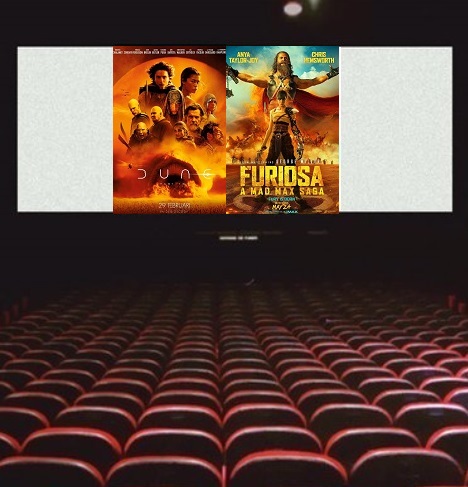
The two major blockbusters of 2024 have a lot in common: They are both sequels/prequels, are epic in scope, have huge ideas, and take place (almost) completely in deserts. Storywise, they are about the hero’s journey. In Dune: Part Two, we witness how the chosen one Paul Atreides (Timothée Chalamet) develops his powers and fulfills his destiny as savior of the Fremen on Arrakis, while in Furiosa: A Mad Max Saga we see how Furiosa (Anya Taylor-Joy) became the legendary, one-armed warrior she is in Mad Max: Fury Road (2015). Furthermore, both sci-fi epics are directed by visionary directors that don’t appear to have had any studio interference. They made the films they wanted to make and both are – well there’s that word again – epic. Both movies also have fantastic villains for the heroes to stand up against. Dune: Part Two has the Harkonnens, with the psychopathic Feyd-Rautha (Austin Butler) as their latest addition. Furiosa sees the return of the cult leader Immortan Joe with his memorable skull mask and breathing tubes, but also introduces a new bad boy: Dementus (played by a hard to recognize Chris Hemsworth), who’s a depraved sort of father figure for the fiery Furiosa. The henchmen are similar as well: the Harkonnen’s soldiers and the War Boys are both white, bald and loyal without questioning. The production design is in both cases absolutely stunning and must be seen on cinema screens. Highlights: I thought the first showdown between Dementus and Immortan Joe at the Citadel and the attack on the war rig are Furiosa’s most mind-blowing sequences. In Dune: Part Two, Paul’s sandworm ride, Feyd-Rautha’s memorable introduction on the Harkonnen planet of Giedi Prime, and his ritualistic knife fight with Paul are my favorite moments. And there’s good news for the fans: Both movies clearly leave a door open for another sequel. In Furiosa’s case, this would be The Wasteland, another origin story about what happened to Max before we meet him at the beginning of Mad Max: Fury Road. Director George Miller is now 79, but he might still be up for it. It is already confirmed that Denis Villeneuve will return to wrap up his Dune trilogy by adapting Frank Herbert’s book sequel ‘Dune Messiah’. In both cases I say: Bring them on!

Double Bill #09: Apocalypto & Mad Max: Fury Road

Apocalypto (2006) opens with a little quiet before the storm; a tribe of Indians hunting a tapir, capturing it and having a pleasant night around the campfire. Then an evil tribe attacks and their harmonious lives soon descend into violent madness. Mad Max: Fury Road (2015) immediately throws you into the action and doesn’t give you a breather for at least 45 minutes. Both movies explore culture gone bad. The Indian tribes are working on destroying their culture from within, but their environment is still beautiful and rich with life. In Fury Road, civilization has already collapsed and all that is left is a desolate wasteland (it was filmed in the Namibian desert). They are both great settings for some of the most spectacular chase scenes ever committed to celluloid. In Apocalypto, it is a grueling foot chase through the deadly jungle (filmed in Mexico’s Catemaco rain forest) and a fight to the death. Mad Max throws in spectacular war machines and a stunningly visualized ride to mayhem. Both feature outrageous custom design, kinetic editing and ‘die hard’ violence along the way. Thematically, the films are very similar. In both stories, the men are the insane ones, and the (pregnant) women carry the greatest hope for humanity in these desperate times. But in both stories, at least one man is sane enough to take on the crazies and help the women, and their offspring, towards a better future. A connection between the two classics you may have missed at this point, is that Apocalypto is directed by none other than Mel Gibson, the original road warrior, who was too old to play Max in 2015. I must admit I enjoyed Apocalypto more than Mad Max: Fury Road. The latter features shots that are just mind boggling, but I didn’t feel much for the characters. In Apocalypto, I did. As a Double Bill, this works fantastically.

Double Bill #08: Die Hard & Die Hard 2

The greatest Christmas Double Bill in history! Bruce Willis stars in the role that made him a super star: John McClane is an old style hero: smoking cigarettes, cracking jokes and killing bad guys. The first Die Hard (1988) is considered the greatest action film of all time. Why is that so? I tried to analyze it and came up with this. First of all; it is really, really tense. John McClane (Willis) is locked up in a building with a bunch of heavily armed and completely ruthless German terrorists. What are the odds of survival? Minimal. This is survival action optimally done. It is fun to watch a guy – who is not really scared of death, but definitely no narcissistic psychopath either – face impossible odds. Secondly, the screenplay is intelligent and the casting is terrifically done. Part 2 is off course (this is the sequel after all) BIGGER! It takes place at an airport, which is taken over by terrorists who want to free a South American dictator (Franco Nero) who is landing soon. Groovy! In a magazine article on an airplane read by one of the characters, a picture is shown of Roger Murtaugh (Danny Glover) and Martin Riggs (Mel Gibson) in Lethal Weapon 2. This is a sequel that was indeed even better than the original. Die Hard 2 is not, although you could argue for it. Film critic Roger Ebert thought so and wrote a terrific review about the sequel (he curiously gave the first movie only two stars out of four). I understand his point of view about the sequel, although the story is even more unbelievable than the first, Finish director Renny Harlin, who took over from John McTiernan from the first, did a great job. It misses the claustrophobia of the first one, taking place at an airport rather than a high-rise office building. However, this creates new tense situations as the terrorists can take down airplanes and do so. The horror of a plane crash is captured perfectly in the second one as the terrorists purposefully let a passenger airplane crash. Thereby, they make the main baddie – William Sadler – even worse than Hans Gruber (Alan Rickman) in the first one. Still, Die Hard 2 loses momentum a little bit during the second half (especially after the clever plot twist) and therefore I still think the first movie is superior. The endings of both movies give you this very warm Christmas feeling indeed. In part 1, John meets his pal Al for the first time, and then Al kills Karl and proves he is ready again for joining the force (he got a desk job after accidentally shooting a thirteen-year old kid with a fake gun). In the second movie, John blows up the plane with terrorists and thereby creates landing lights for all the other planes that were close to crashing, including the one that carries his wife. Then he tells her he loves her so much and they carry off in a modern sledge accompanied by Frank Sinatra’s ‘Let It Snow’. It makes me all warm inside and the same goes for the fantastic first part ending.Therefore, Die Hard is just the greatest Christmas movie ever. Die Hard 2 adds to the fun.