What these two movies have in common is quite a lot actually. Most importantly, they have the world’s heavyweight champions in acting – Robert De Niro and Al Pacino – playing Satan, The Dark Prince, Beelzebub, or in the case of Angel Heart Louis Cyphre (as in ‘Lucifer’). Both movies are based on novels (by William Hjortsberg and Andrew Neiderman respectively) and both involve a handsome lead (Mickey Rourke and Keanu Reeves) and equally handsome female co-star (Lisa Bonet and Charlize Theron). And in both cases, the couple falls prey to the evil machinations of the Dark One, because the man sold his soul to the devil. Both movies also involve seductive, violent and frightening sex scenes. So far what they have in common, because the movies are very different beasts. Angel Heart is a slow, dark and moody film, a psychological horror that takes place in the voodoo and jazz scene of New Orleans, and has a few shocking moments of bloody death in store. The Devil’s Advocate, which was made ten years later in 1997, is big time Hollywood entertainment with terrific production design and the corporate world of New York as its main setting. The way Satan is portrayed is quite different as well. De Niro plays him small; he’s only in a few scenes, working on collecting a debt (singer Johnny Favorite sold his soul to him to become famous and then he disappeared). Pacino, as always, is the definite lead of the film, and goes all the way in his fierce and memorable performance. Final coincidental connection; the movie’s directors – Alan Parker and Taylor Hackford – made a few iconic hits in the eighties and nineties, but both disappeared from mainstream Hollywood cinema in the zeroes. Both Angel Heart and The Devil’s Advocate are definitely amongst the finest films they made.
Tagarchief: Double Bill
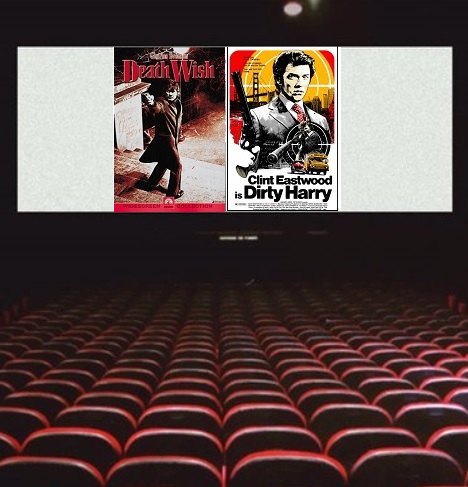
Double Bill #05: Dirty Harry & Death Wish
Dirty Harry (1971) and Death Wish (1974) are two movies that deal with the urban crime wave of the 1970’s when gang violence, murders, subway crime, robberies and muggings skyrocketed. Both films present a distinctive one man army, a new type of hero, to deal with that. Both lead actors of the films, Clint Eastwood and Charles Bronson, had starred in Sergio Leone’s legendary Westerns in the 1960’s and both had made the move to action pictures during the following decade. The films have similarities like strong violence, an ineffective and outnumbered police force and a ‘hero’ who takes matters in his own hands. But the characters are quite distinct. Bronson’s Paul Kersey is an architect and a liberal who only has a change of heart after the violent murder of his wife and the rape of his daughter. Eastwood’s Harry Callahan is an ultra tough, ultra-macho cop from the beginning who illustratively takes out a gang of robbers while eating a hot dog. Like Kersey, he is a vigilante; he breaks the rules if that enables him to stop the criminals on the loose. Both Death Wish and Dirty Harry were controversial at the time as they could be viewed as being in support of vigilantism. And both successful movies led to a series of five films total that all starred the original leads Bronson and Eastwood. And finally; none of the sequels were as good as the original movies. What Dirty Harry introduced was the disturbed psycho as villain. Andrew Robinson is terrific as serial killer Scorpio (loosely based on the San Francisco Zodiac killer). Clearly, this formed inspiration for the serial killer genre that emerged a decade later. Death Wish also features scary criminals, most notably the original gang (that includes a young Jeff Goldblum) that invade the house of the Kersey family. This is still a disturbing scene when viewed today. Death Wish got a remake in 2018 starring Bruce Willis, but Dirty Harry didn’t yet get one. This makes sense as finding a new Clint Eastwood will not be an easy feat. Imagine any other actor delivering iconic lines like “Do I feel lucky?’ Well, do ya, punk?” with so much venom like Eastwood does.
Double Bill #04: Jackie Brown & Out of Sight
Both based on novels by the famous crime author Elmore Leonard and made roughly around the same time (Jackie Brown by Quentin Tarantino in 1997 and Out of Sight by Steven Soderbergh in 1998), the movies have a lot in common. They are both light hearted crime stories with not so much violence, especially compared to Tarantino’s other movies. They also both feature a romantic story about a love that doesn’t entirely come to fruition. Stewardess Jackie Brown (Pam Grier) tries to bond with bond bailsman Max Cherry (Robert Forster), but despite him being in awe of her, he doesn’t go for it for somewhat mysterious reasons. US Marshal Karen Sisco (Jennifer Lopez) and convicted bank robber Jack Foley (George Clooney) fall in love after he holds her hostage in the trunk of a car after a jailbreak, but because of their chosen professions, they cannot be together. Both movies also revolve around a big score (a half a million in cash and five million worth of uncut diamonds) that several parties try to get their hands on. And in both cases, the relative ‘good guys’ prevail and the badder (and stupider) ones meet their demise. As can be expected from the fantastic writer Leonard, the characters are top notch and the dialogues are both smart and funny. One character crosses over from one story to the next; Ray Nicolette, and Tarantino and Soderbergh cleverly casted the same actor for the role: Michael Keaton. Out of Sight also features quite a few actors from Pulp Fiction, which was one of the defining movies of the era: Ving Rhames, Paul Calderon and – in a surprise appearance at the end: Samuel L. Jackson. The better movie of the two? Jackie Brown for the brilliant screen adaptation by Tarantino and the unforgettable performances of Samuel L. Jackson and Robert De Niro as stupid criminal duo Ordell Robie and Louis Gara. Not to forget a superb Grier and Forster! But both movies are great and together form an ideal double feature.
Double Bill #03: The Terminator & Terminator 2: Judgment Day
Forget all the sequels for a minute, and consider the first two The Terminator movies as a diptych. As a diptych, they work perfectly. The first one is a hyper tense thriller, the second one a sensational action movie. The major downside of The Terminator movies, I always thought, is that you have to accept an extremely unlikely plot point. We’re supposed to buy that in the future, the resistance somehow found out about the machines’ new time travel capabilities, and destroyed their one and only time machine after they used it for the very first time. Not only that, the resistance also managed to send through one of their own soldiers before they blew it up. Since the humans are shown to be pretty much cannon fodder in their own environment, how would they be able to penetrate the machines’ base of operations? Anyway, this plot device was necessary to get a futuristic killer robot into the present to stalk the Conners (Sarah in the first, John in the second). Once you accept this unlikely scenario, the execution of both movies is pretty much perfect. In the first Terminator, Schwarz is truly scary as the ultimate hunter-killer. A great move by writer-director James Cameron is that Arnie’s T-800 joins the good team in part 2, but it is now technologically outdated. The new and improved terminator – the T-1000 – is perhaps the coolest non-human character ever created for a film. These movies have inspired countless others with their stories and special effects. The Matrix would never have happened if it wasn’t for these terminators. With more than a whiff of philosophy (“it is in your nature to destroy yourselves”), the two The Terminator movies also deliver deeper, underlying messages apart from just giving us the spectacle. Although there is more than enough from that. In T2, it even goes on pretty much non-stop. You could consider that another downside or just as a realistic screenplay measure following the unlikely time travel plot. After all, once you have a killer like the T-1000 on your tail, a non-stop rollercoaster is what you would get.