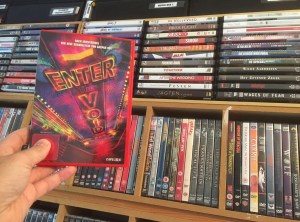
Director: Gaspar Noé
Written by: Gaspar Noé, Lucile Hadzihalilovic
Cast: Nathaniel Brown, Paz de la Huerta, Cyril Roy, Olly Alexander
Year / Country: 2009, France / Germany / Italy / Canada / Japan
Running Time: 161 mins.
Death is the greatest drug!
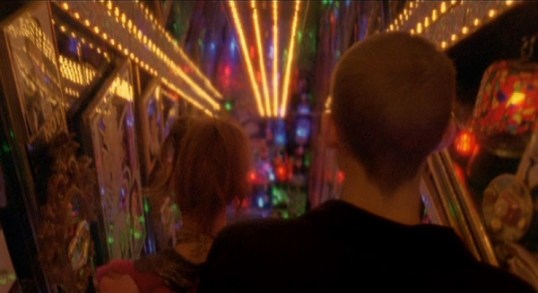
Gaspar Noé’s Enter the Void is hypnotic from the trippy credits onwards. The entire film is shot from the perspective of the heavy drug user and dealer Oscar who dies fifteen minutes into the movie. He gets shot during a police raid in a Tokyo bar called ‘the Void’ when he locked himself in the toilet trying to flush his stash of gear.
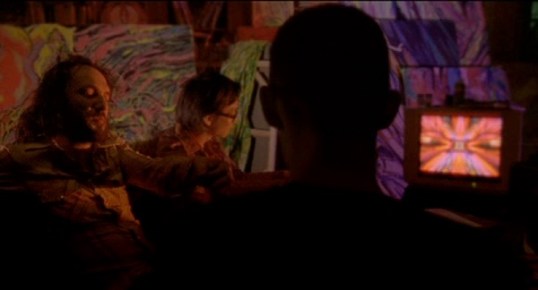
Oscar, who was just reading ‘The Tibetan Book of the Dead’ which he borrowed from his friend Alex, sees his own dead body on the restroom floor and it feels like a genuine death experience. The rest of the film follows Oscar’s consciousness point-of-view that keeps hovering above people he used to be close to, seeing psychedelic images, or just strangers and old friends having sex. He also re-experiences scenes from his own life from an outside perspective. Oscar is no longer burdened by the restraints of a physical body or the flow of time. Philosophically, the laws of cause and effect are one of the main themes of the film.
His main memory is the car crash that killed his parents and left him and his sister traumatized orphans. They ended up in Tokyo where she became a stripper and he became a dealer and user. Oscar observes the aftermath of his death which includes police interrogations, dramatic arguments between his old friends, and lives going seriously off the rails. Watching the human tragedy play out from an eagle eye perspective is playful and refreshing. (Spoiler: It ends with Oscar’s soul reincarnating as a baby).
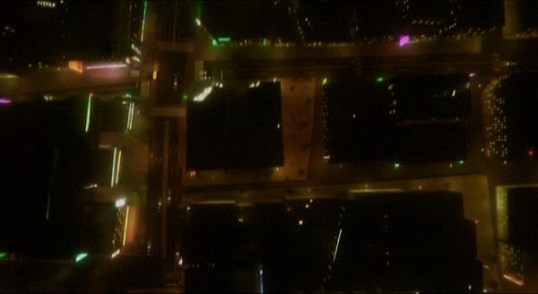
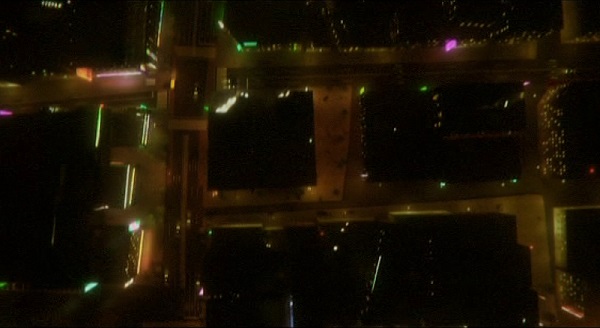
Noé’s dream project is a successful experimental film with a number of powerful scenes and some stunning visuals. The film’s main problem is that it is more than two and a half hours long! For an experimental movie that is a major sin. But Noé is all about trying new things. Unfortunately, the film became a major flop (not even a million gross worldwide versus a sixteen million dollar budget according to IMDb). Still these beautiful crane shots of neon-lit Tokyo were worth every buck. With some proper editing, this could have been a masterpiece.
Another downside is that Enter the Void is mostly a visual experience. The electronic pop helps to create the unique atmosphere, but there are no thoughts by Oscar after he is killed or other sensations. Therefore, I hope that monsieur Noé will one day create a virtual reality project of his vision. About his elaborate view on death two notions stick. One, dying ain’t so bad. And two, voiced by Oscar in a discussion with Alex about the ‘The Book of the Dead’ on their way to the club is; are we really gonna be stuck forever on this shit hole of a planet?
Rating:

Biography: Gaspar Noé (1963, Buenos Aires) is an Argentine-born French film director. Noé spent his childhood in Buenos Aires and New York before moving to France with his parents at the age of 12. He studied philosophy and film studies at the École Louis-Lumière in Paris. After this he initially started working as First Assistant Director before becoming a director himself. In 1992 he made his breakthrough as a director with his short film Carne. Noé mainly focuses on short films. Stanley Kubrick’s films in particular serve as inspiration for him. Well known feature length films he directed are the controversial Irreversible and Enter the Void. Noé is married to filmmaker Lucile Hadzihalilovic. She is credited as co-writer for his movie Enter the Void from 2009.
Filmography (a selection): Carne (1991, short) / I Stand Alone (1998) / Sodomites (1998, short), Irréversible (2002), Intoxication (2002, short), Eva (2005, short), Destricted (2006, segment: We Fuck Alone), SIDA (2006, short), Enter the Void (2009), 42 One Dream Rush (2010, short), Love (2015), Climax (2018), Lvx Æterna (2019), Vortex (2021)





 FRAGMENTEN UIT HET SCHEMERLAND